Why You Should Not Place Objects Around an AC Outdoor Unit and Safety Guidelines
Blocking an AC outdoor unit's intake or discharge vents with objects can hinder heat dissipation, reduce cooling capacity, and increase the risk of protective shutdowns or malfunctions. This guide covers ventilation for outdoor-unit rooms, model-specific clearances, items that must not be stored nearby, and precautions for washing with water and providing shade.
- Obstacles around an outdoor unit can cause hot exhaust air to be drawn back in, reducing cooling performance.
- Poor ventilation may cause the air conditioner to run longer, but if protective controls activate, cooling capacity may decrease before instantaneous power consumption does, or operation may stop.
- Keep the louvered window in the outdoor-unit room sufficiently open during operation, and follow the installation manual for the specific model rather than using an arbitrary standard clearance.
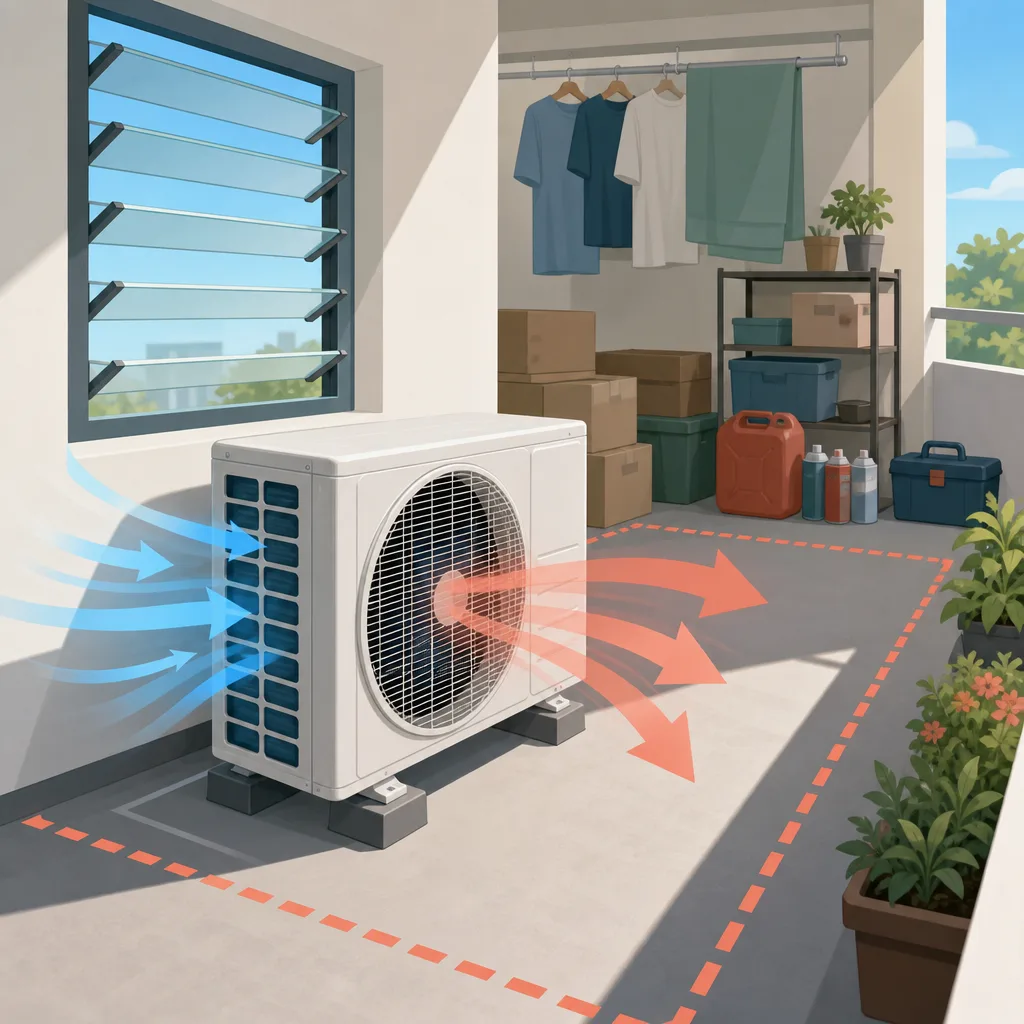
- For safety, do not place cardboard boxes, laundry, spray cans, fuel, plant pots, or other objects on or around the outdoor unit that could increase the risk of obstructed airflow, fire, corrosion, or falling objects.
- If you notice a burning smell, smoke, unusually loud noise, repeated circuit breaker trips, or frequent shutdowns at short intervals, stop operation and have the unit inspected.
An air conditioner outdoor unit releases heat absorbed indoors into the outside air. Placing objects on top of the outdoor unit or surrounding it with boxes and laundry does more than create an unsightly obstruction. It can restrict airflow, affecting cooling capacity, operating time, noise, component life, and safety.
Why Outdoor Unit Ventilation Is Important for Cooling
During cooling operation, the indoor unit transfers indoor heat to the refrigerant, while the outdoor unit uses a condenser and fan to release that heat outside. To do this, the outdoor unit needs an air intake where air enters and an air outlet where heated air exits.
If the intake or outlet is blocked, the following may occur.
- Hot air discharged from the outdoor unit cannot escape smoothly.
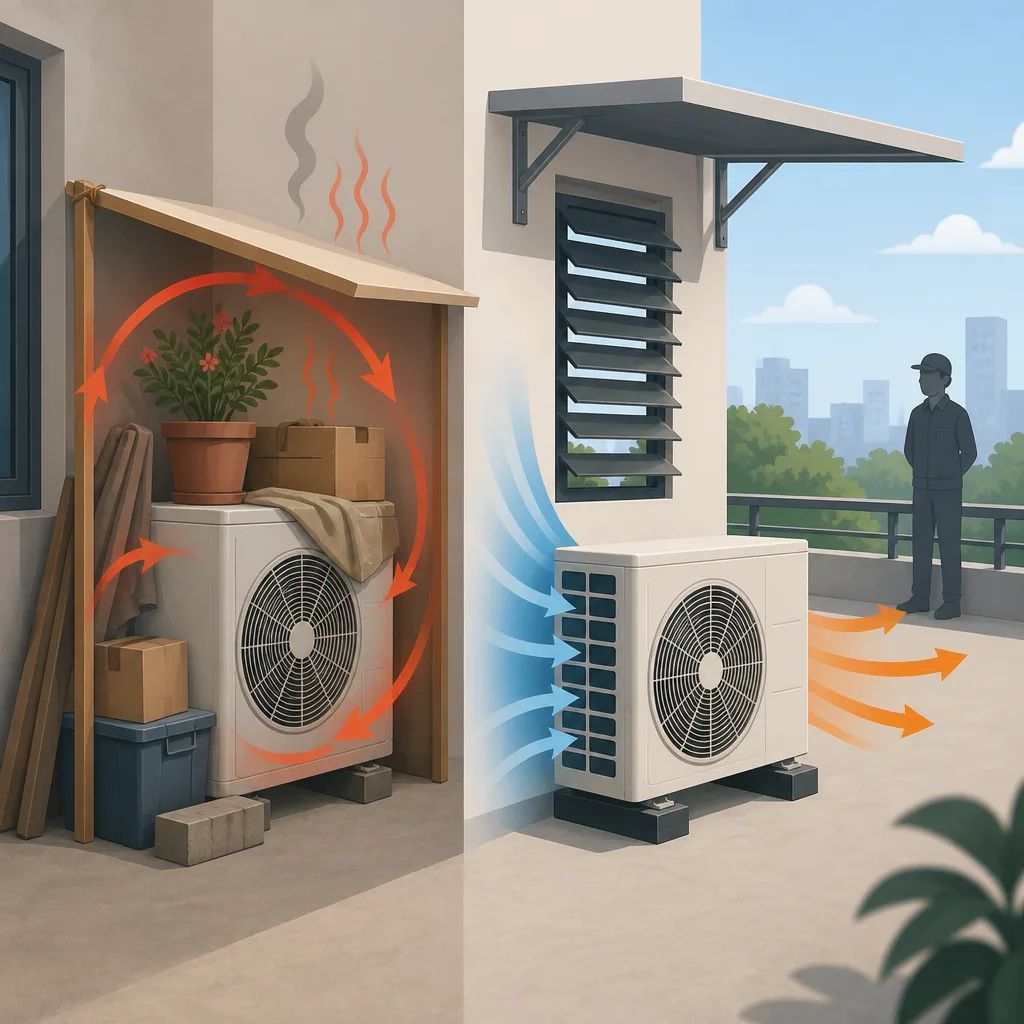
- Heat recirculation occurs as discharged air reenters the intake.
- The condensing temperature and pressure in the refrigerant system may rise.
- The compressor may run longer or under a higher load to achieve the same indoor temperature.
- The unit may reduce its output or temporarily stop to protect its components.
Therefore, it cannot be assumed that obstructed ventilation will always increase instantaneous power consumption by a fixed percentage. When inverter controls and protective devices activate, cooling capacity may decrease or operation may repeatedly stop. However, if it takes longer to achieve the required cooling, total electricity consumption may increase.
| Condition | Expected Impact | Required Action |
|---|---|---|
| Boxes or laundry in front of the intake | Reduced airflow and heat exchange performance | Remove the objects and leave the intake side open |
| Wall or objects blocking the outlet | Hot-air buildup and recirculation | Maintain the front clearance specified in the installation manual |
| Outdoor unit room louvered window closed | Higher room temperature and possible protective shutdown | Open it fully before starting cooling operation |
| Multiple outdoor units facing one another | One unit draws in heat discharged by another | Ask the manufacturer or an installation professional to inspect the arrangement |
| Excessive dust on insect screens, louvers, or fins | Reduced airflow and increased noise | Turn off the power, then clean within the permitted scope or request service |
How to Check Louvered Windows and Clearances in Outdoor Unit Rooms
A louvered window or louvers in an apartment’s outdoor unit room provide a passage for hot discharge air to escape outside. When operating the air conditioner, the window or louvers must be opened fully. If they are only partially open, the available ventilation area may be insufficient or may not align with the discharge direction, causing the temperature inside the outdoor unit room to rise quickly.
There is no single minimum clearance that applies to every air conditioner. The required spacing varies according to the outdoor unit’s fan direction, capacity, installation type, and the structure of the walls and ceiling. The following process provides the most accurate way to check.
- Check the model name on the outdoor unit.
- In the installation manual for that model, find the diagram showing clearances for the intake side, outlet side, left and right sides, and top.
- If the manufacturer’s manual is unavailable, check the official customer support site for model-specific documents or request an installation inspection.
- Inspect the actual airflow path, including structures in the outdoor unit room, insect screens, railings, and other outdoor units.
- If the interior becomes extremely hot or the unit repeatedly stops even with the window open, have a professional inspect the installation.
Do not assume there is enough space merely because you can fit your hand between the outdoor unit and the wall. Even if the area directly in front of the outlet looks spacious, a side intake may be blocked, or heat may become trapped in a narrow space above the unit.
Items That Must Not Be Placed on or Around the Outdoor Unit
An outdoor unit is not a shelf or drying rack. Its top panel cannot be assumed to be designed to withstand the continuous weight of stored objects, and vibration and wind may cause items to move or fall.
The following items in particular should be removed.
- Cardboard boxes, plastic, fallen leaves, and trash: These may stick to the intake and increase the amount of combustible material nearby.
- Laundry, bedding, and curtains: Wind may blow them over the intake or outlet without warning.
- Aerosol sprays, butane canisters, fuels, and solvents: These are flammable or pressurized items that should not be stored near heat sources and electrical equipment.
- Flowerpots and water containers: Their weight may deform the casing, and soil or water may enter electrical components and metal parts.
- Tools and metal objects: Vibration may cause them to fall, damage the casing, or interfere with maintenance.
- Shelves, panels, and improvised covers: These may reduce intake and outlet space and cause hot air to recirculate.
Even if objects do not directly cover the outdoor unit’s openings, stacking them nearby and narrowing the passage may cause heat to build up. Space must also be maintained for inspection and fire response.
Precautions When Spraying Water or Cleaning
A product designed for outdoor installation is not necessarily a fully waterproof device capable of withstanding powerful water jets or cleaning agents from every direction. High-pressure water may force moisture into the electrical box, wiring connections, motor, sensors, or service valves. Water containing high levels of salt or minerals may leave deposits after drying, interfering with heat exchange or accelerating corrosion.
The basic safety principles are as follows.
- Do not spray water on an outdoor unit while it is operating.
- Before cleaning, do not merely turn it off with the remote control; follow the manufacturer’s instructions to determine whether the power must be disconnected.
- With the power disconnected, carefully remove fallen leaves or loose dust from the exterior.
- Heat exchanger fins are thin, sharp, and easily bent, so do not press them with your hands or a stiff brush.
- Do not use pressure washers, steam, or acidic or alkaline cleaners unless permitted by the manufacturer.
- Do not remove panels or clean inside electrical components; use professional service instead.
Even when spraying water on the ground to cool the area around the outdoor unit, prevent water from splashing onto or pooling around outlets, wiring, and connections. If there is already current leakage, damaged insulation, or a grounding problem, water may increase the danger, so arrange an inspection first if you suspect an issue.
Is It Safe to Install a Sunshade?
Reducing direct sunlight may help lower the surface temperature of the casing, but unobstructed ventilation is generally more important to outdoor unit performance. Attaching a panel directly above the outdoor unit or in front of the outlet to provide shade may instead trap heat.
If considering a shade structure, all of the following conditions must be reviewed.
- It must not narrow the airflow path below the manufacturer’s required top, front, and side clearances.
- Screws must not be driven into the outdoor unit casing, and no weight should be placed on it.
- It must be securely attached to the building so that it cannot be blown away or fall in strong winds.
- Rainwater or condensate must not collect near electrical connections.
- Apartment building management rules, evacuation routes, appearance standards, and requirements concerning falling objects must be checked.
If it is difficult to assess the installation conditions, an inspection by the manufacturer or a qualified installer is safer than installing an improvised sunshade.
Warning Signs Requiring Immediate Shutdown and Inspection
If any of the following occurs, do not simply attribute it to extreme heat; stop the air conditioner.
- A burning smell, smoke, flames, or abnormal discoloration of the casing
- Unusually loud metallic noises, grinding sounds, or severe vibration
- The outdoor unit repeatedly turning on and off at short intervals
- The circuit breaker repeatedly tripping, or wires or plugs becoming abnormally hot
- The compressor can be heard, but the outdoor unit fan is not spinning
- Damaged wiring, pooled water, oily traces, or severe icing on refrigerant piping
- No cooling even after opening the louvered window and removing obstructions
Only use the remote control to stop operation and disconnect the power when it is safe to approach. If there is smoke or flame, or if electrical equipment appears wet, do not attempt to touch the outdoor unit or circuit breaker. Move away from the area and contact an emergency agency such as 119. Do not disassemble the refrigerant circuit, electrical box, or fan yourself.
Outdoor Unit Checklist Before Extreme Heat
- All objects have been removed from on top of and around the outdoor unit.
- There is no laundry, boxes, or contamination on insect screens in front of the intake or outlet.
- The outdoor unit room’s louvered window or louvers are fully open before operation.
- The clearances specified in the model-specific installation manual have been checked.
- It has been confirmed that discharged hot air is not being drawn back into the unit.
- There is no damaged wiring, pooled water, severe corrosion, or abnormal vibration.
- The service contact information is ready for immediate use if an unusual smell or repeated shutdown occurs.
The key principles are simple. Keep all of the outdoor unit’s airflow paths open, place nothing on top of it, exercise caution with water and improvised structures, and stop operation if warning signs appear. Always prioritize the installation and user manuals for the specific model when determining clearances and cleaning methods.
FAQ
Can placing even one lightweight object on top of the outdoor unit cause a problem?
It cannot be concluded that the object will cause an immediate malfunction, but doing so is not recommended. Even a lightweight object can move due to vibration or wind, block the air intake or outlet, or fall, and covering the top panel also makes maintenance and checking for abnormalities more difficult.
Will the electricity bill increase even if the space in front of the outdoor unit is only slightly obstructed?
The result varies depending on the degree of obstruction, outdoor temperature, installation configuration, and control method, so a fixed rate of increase cannot be stated. Poor ventilation can reduce cooling capacity and lengthen operating time, and protective controls may reduce output or stop operation.
Must the louvered window in an apartment's outdoor unit room be opened when the air conditioner is running?
If it is a louvered window or louver designed to vent heat from the outdoor unit to the outside, it should generally be opened sufficiently during cooling operation. Leaving it closed can raise the temperature in the outdoor unit room, resulting in reduced performance or a protective shutdown.
How many centimeters of clearance should there be between the outdoor unit and the wall?
There is no single measurement that applies to all products. Check the installation manual for the specific model to confirm the minimum clearances for the intake side, outlet side, left and right sides, and top.
Does spraying water on the outdoor unit on a hot day improve cooling?
Although it may temporarily lower the temperature of the surrounding area or heat exchanger, it is not recommended for users to spray water on the unit at their discretion while it is operating. Water may enter electrical components, or deposits and corrosion may develop, so follow methods approved by the manufacturer and professional cleaning procedures.
Can installing a sunshade over the outdoor unit reduce electricity bills?
The effectiveness of shading varies depending on the installation environment, and the amount of savings cannot be generalized. If the sunshade obstructs airflow, the loss of performance may outweigh the benefits, so first check the model-specific clearance requirements, mounting safety, drainage, and apartment complex regulations.
Can I clean leaves or dust around the outdoor unit myself?
After safely disconnecting the power, you can carefully remove easily removable debris, such as loose leaves on the outside. Do not put your hands near the sharp heat exchanger fins, electrical box, or inside the fan, and it is safer to leave heavy contamination or cleaning that requires disassembly to a professional service provider.
If the outdoor unit frequently stops during extreme heat, is removing nearby objects enough?
You can first open the louvered window and remove obstacles from the air intake and outlet, but if it continues to stop repeatedly, discontinue use and have it inspected. There may be other causes, such as issues with the refrigerant system, fan, sensors, power supply, or installation.
If there is a burning smell but the air conditioner is still cooling, can I continue using it?
Do not continue using it. Stop operation, disconnect the power only if it is safe to do so, and request an inspection. If you see smoke or flames, do not approach the unit; evacuate and call 119.
Sources
Images