Hometown Love Donation Tax Credit: Proposed Regional Incentives for 2027
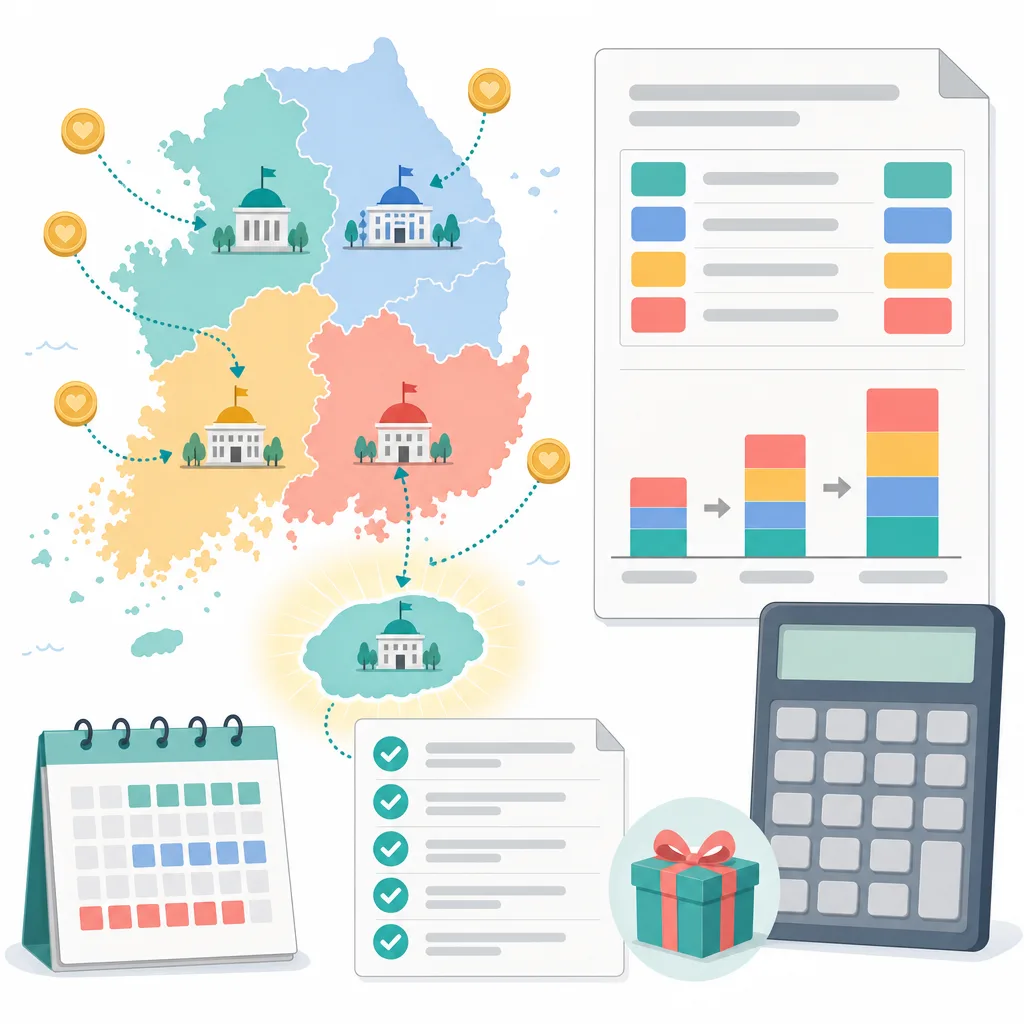
A plan to vary Hometown Love Donation tax credits based on regional conditions is being pursued with implementation targeted for 2027. This article separately explains the current credit brackets, the proposed changes, the calculation structure for a maximum credit of KRW 5.6 million, and what to check before donating.
- The Hometown Love Donation Program allows individuals to donate a combined total of up to KRW 20 million per year to local governments outside their registered place of residence.
- Under the proposed 2027 plan, donations exceeding KRW 100,000 would receive higher tax credit rates in non-capital and preferential regions.
- For other non-capital and preferential regions, a proposal has been made to raise the credit rate from 44% to 55% for the bracket exceeding KRW 100,000 and at most KRW 200,000.
- For amounts exceeding KRW 200,000 in other preferential non-capital regions, the credit rate would rise from 16.5% to 27.5%, resulting in a maximum credit of KRW 5.6 million.
- Because the implementation date, regional classifications, or tax rates may change during the legislative amendment and subordinate regulation process, donors should check the latest criteria before donating.
A reform proposal that would apply different Hometown Love Donation Program tax credits depending on local conditions is being pursued with the goal of implementation in 2027. However, as of August 30, 2026, this remains a proposal under consideration and should be distinguished from the current system, which has already been finalized.
What Is the Hometown Love Donation Program?
The Hometown Love Donation Program allows individuals to donate to a local government outside their current place of residence and receive tax credits and thank-you gifts. Although the program’s name includes “hometown,” donations are not limited to a person’s birthplace or former place of residence.
The main conditions are as follows.
- Eligible donors: Individuals may participate, but donations made in the name of a corporation are not permitted.
- Ineligible destinations: Donors may not donate to a local government that includes their registered address. Eligibility must be checked for both metropolitan-level and municipal-level local governments.
- Annual donation limit: The combined limit for donations to all local governments is KRW 20 million.
- Tax benefits: Income tax and local income tax liabilities are reduced according to the tax credit rate for each bracket.
- Thank-you gifts: Local governments may provide designated thank-you gifts. Specific provision criteria must be checked on Hometown Love e-um. The types and provision rates of thank-you gifts vary by region.
Tax credits and thank-you gifts are separate benefits. Receiving a thank-you gift does not cause its value to be deducted from the tax credit amount.
How Are Current Tax Credits Calculated?
Under the current structure, the applicable credit rate is determined by the donation amount bracket rather than the region receiving the donation. Based on the general combined tax credit effect, the structure is as follows.
| Donation bracket | Current credit rate | How the bracket applies |
|---|---|---|
| KRW 100,000 or less | Equivalent to 100% | An amount equivalent to the full donation within this bracket |
| More than KRW 100,000 and at most KRW 200,000 | 44.0% | Applied to the portion exceeding KRW 100,000 |
| More than KRW 200,000 | 16.5% | Applied to the portion exceeding KRW 200,000 |
The rate for each bracket is not applied to the entire donation. For example, a donation of KRW 300,000 is calculated separately for each bracket.
- First KRW 100,000: KRW 100,000
- Portion over KRW 100,000 and at most KRW 200,000: KRW 100,000 × 44% = KRW 44,000
- Portion over KRW 200,000: KRW 100,000 × 16.5% = KRW 16,500
- Total tax credit effect: KRW 160,500
Under the current rules, the maximum calculated credit for donating the annual limit of KRW 20 million is KRW 3,411,000.
- KRW 100,000 + KRW 44,000 + KRW 19.8 million × 16.5%
- Total: KRW 3,411,000
This amount is not guaranteed to be refunded in cash to every donor. The actual tax savings may vary depending on whether the donor has sufficient income tax and local income tax liabilities to offset and how many other tax credits apply.
What Will Change Under the Proposed Regional Preferential Rates for 2027?
The key feature of the proposal is to apply different regional credit rates to donations exceeding KRW 100,000. The structure is intended to encourage donations by offering higher credit rates to regions facing relatively difficult fiscal and demographic conditions.
The following four regional categories are under review.
- Capital region
- Non-capital metropolitan cities and similar areas
- Other non-capital areas
- Other preferential non-capital areas
The main bracket changes identified in materials provided by the operator are as follows.
| Donation bracket | Applicable region | Current credit rate | Proposed 2027 credit rate |
|---|---|---|---|
| More than KRW 100,000 and at most KRW 200,000 | Other non-capital areas | 44.0% | 55.0% |
| More than KRW 100,000 and at most KRW 200,000 | Other preferential non-capital areas | 44.0% | 55.0% |
| More than KRW 200,000 | Other preferential non-capital areas | 16.5% | 27.5% |
The detailed credit rates applicable to the capital region, non-capital metropolitan cities, and similar areas, as well as the designation criteria and list of preferential regions, must be checked in the final legislation and subordinate regulations. A region should not be assumed to qualify for preferential treatment based only on its general image or population size.
How Is the Maximum of KRW 5.6 Million Calculated?
Under the proposal, if a donor contributes the annual limit of KRW 20 million to another preferential non-capital area and qualifies for all of the highest preferential rates, the maximum credit is calculated as KRW 5.6 million.
| Calculation bracket | Formula | Credit amount |
|---|---|---|
| KRW 100,000 or less | KRW 100,000 × 100% | KRW 100,000 |
| More than KRW 100,000 and at most KRW 200,000 | KRW 100,000 × 55% | KRW 55,000 |
| More than KRW 200,000 and at most KRW 20 million | KRW 19.8 million × 27.5% | KRW 5,445,000 |
| Total | KRW 100,000 + KRW 55,000 + KRW 5,445,000 | KRW 5.6 million |
Compared with the current maximum of KRW 3,411,000, this represents a calculated increase of KRW 2,189,000. However, KRW 5.6 million is an upper-limit calculation based on donating the full KRW 20 million to a region eligible for the highest preferential treatment and having sufficient related tax liabilities.
How Much Could the Same Donation Vary by Region?
The difference can be seen easily by comparing the current method with the proposed preferential rates for a donation of KRW 300,000.
Under the Current Credit Rates
- KRW 100,000 or less: KRW 100,000
- Next KRW 100,000: KRW 44,000
- Remaining KRW 100,000: KRW 16,500
- Total: KRW 160,500
Under the Proposed Rates for Other Preferential Non-Capital Areas
- KRW 100,000 or less: KRW 100,000
- Next KRW 100,000: KRW 55,000
- Remaining KRW 100,000: KRW 27,500
- Total: KRW 182,500
The difference between the two calculations is KRW 22,000. Any thank-you gift offered by the local government may be received separately, but its actual value and delivery conditions must be checked for each region.
Points That Are Easy to Miss When Donating Based Only on the Credit Rate
Explanations of regional preferential rates tend to emphasize the credit rates themselves, but the following conditions are also important when making an actual decision.
A Tax Credit Is Not an Unconditionally Paid Refund
A tax credit reduces the amount of tax payable. If the final tax liability available to offset is insufficient, the donor may not receive the full benefit of the stated maximum amount. The final result also varies if the donor has substantial tax credits for other donations, insurance premiums, medical expenses, or education expenses.
Thank-You Gifts Do Not Mean a 30% Cash Payment
Because the criteria for providing thank-you gifts differ by local government, they must be checked on Hometown Love e-um. Donors should verify the items, required points, inventory, and eligible delivery areas.
Splitting Donations Among Regions May Change the Calculation
Even when donations are divided among multiple regions, they are combined when applying the annual donation limit. If differentiated credits take effect in 2027, how each region’s category and donation bracket are applied may become important, so the finalized rules must be checked for the actual calculation method.
Donations Made Before a Policy Change Are Subject to the Rules for That Year
Donation tax credits are generally determined under the laws applicable in the year the donation was made. It should not be assumed that rates scheduled to take effect in 2027 will apply retroactively to donations made in 2026.
Checklist Before Donating
- Confirm that the recipient is not a local government that includes your registered address.
- Confirm the official regional category into which the area is classified.
- Check the tax credit rate in effect on the donation date.
- Review whether your expected final tax liability is sufficient to use the credit amount.
- Check the thank-you gift’s points, items, inventory, and delivery conditions.
- After completing the donation, confirm the receipt and whether it is reflected in National Tax Service year-end tax settlement records.
- Employees should verify that it is reflected in their year-end tax settlement, while those required to file due to comprehensive income should verify it during the comprehensive income tax filing process.
Online donations and thank-you gift selections can be handled through Hometown Love e-um, the official integrated platform. However, before making payment, it is safest to reconfirm that the eligible donation regions, credit information, and thank-you gift conditions displayed on the screen are current.
Items That Must Be Rechecked Before Implementation
The differentiated regional credits planned for 2027 are part of a tax reform being pursued by the government. The actual application criteria will be finalized only after the National Assembly passes the relevant tax law amendments and subordinate regulations are established.
In particular, the following items may change in the final system.
- Effective date and first eligible donation date
- Legal definitions of the four regional categories
- Designation criteria and validity periods for preferential regions
- Detailed credit rates applicable to the capital region, non-capital metropolitan cities, and similar areas
- Applicable rules when a region’s category changes during the donation process
- How information is displayed in year-end tax settlement and comprehensive income tax filing records
Accordingly, when planning donations for 2027, donors should check the applicable laws and official regional lists through Hometown Love e-um, the Ministry of the Interior and Safety, the Ministry of Economy and Finance, and the Korean Law Information Center.
FAQ
Can donations under the Hometown Love Donation Program only be made to one's actual hometown?
No. Regardless of one's birthplace or previous place of residence, donations may be made to any local government other than the one in which one's registered address is located.
How much can I donate annually under the Hometown Love Donation Program?
Each individual may donate up to KRW 20 million per year in total across all local governments. This is a combined annual limit, not a limit for each region.
Will the tax credit rates definitely vary by region starting in 2027?
As of August 30, 2026, differentiated tax credits by region are a proposal under consideration. Because relevant tax laws must be amended and subordinate regulations established, the implementation date, tax credit rates, and list of preferential regions must be confirmed in the final legislation.
Can everyone receive a refund of up to KRW 5.6 million?
No. KRW 5.6 million is the calculated maximum based on donating the annual maximum of KRW 20 million to a region receiving the highest preferential rate and applying the stated tax credit rate. The actual benefit may be reduced depending on the final tax liability against which the credit can be applied and the results of applying other tax credits.
Can I receive both a tax credit and a thank-you gift?
If the requirements are met, you may receive both a tax credit and a thank-you gift. The available gifts and the criteria for providing them vary by region, so they must be checked on Hometown Love e-um.
Does a 30% thank-you gift mean that 30% of the donation is returned in cash?
No. The maximum cost of thank-you gifts must be checked in the latest guidance from Hometown Love e-um and the relevant local government. In practice, donors select designated items such as regional specialty products or vouchers, and they are not provided in cash.
If I donate in 2026, can I receive the preferential tax credit rate for 2027?
Generally, the tax law in effect in the year of the donation applies. Unless a separate provision for retroactive application is finalized, the rates scheduled for 2027 cannot be considered applicable to donations made in 2026.
How can I check which regions receive preferential treatment?
Preferential regions must be confirmed through the final legislation and the government's official designation list. Do not make assumptions solely because a region has a small population or is outside the Seoul metropolitan area; check the latest notices from Hometown Love e-um and the relevant government ministries.
Sources
Images