Where Does the Resilience of Koreans Come From? A Look at Cultural Traits Through the Geography and Climate of the Korean Peninsula
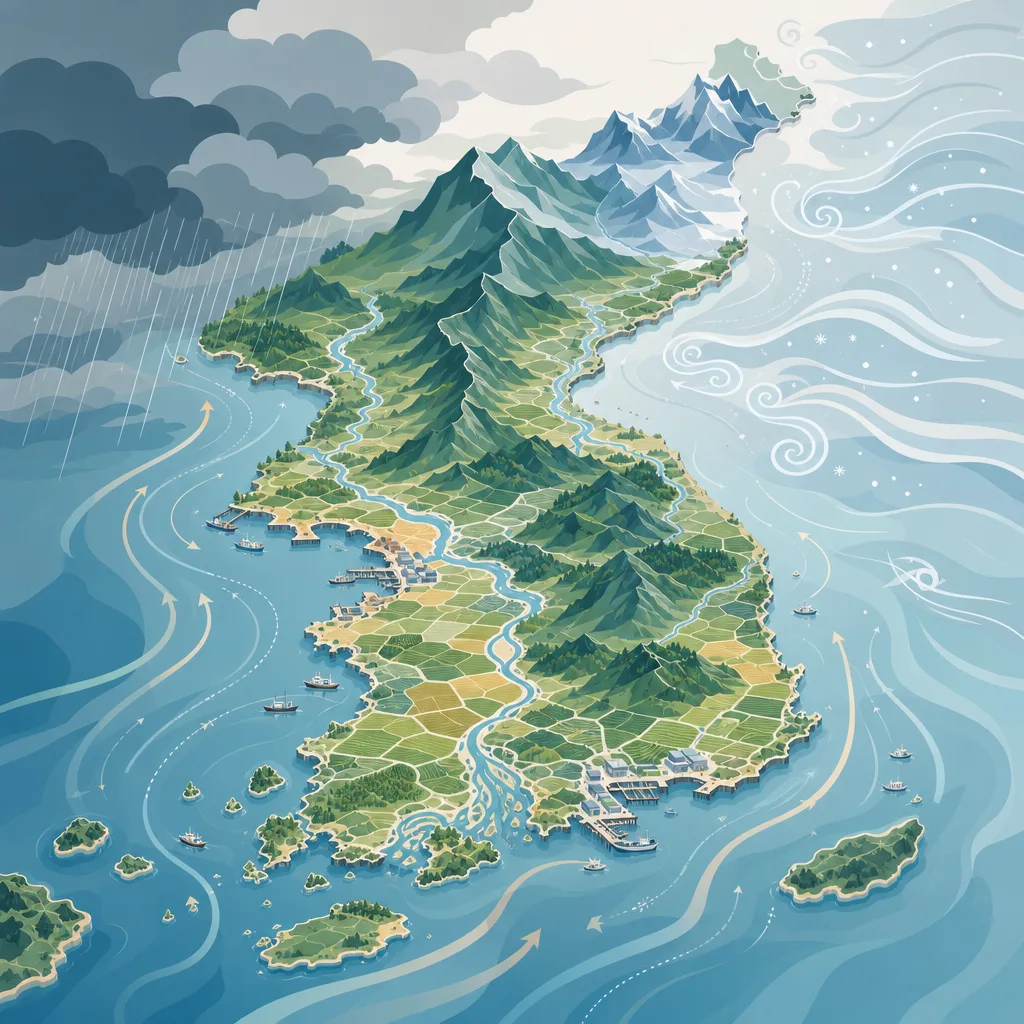
The mountainous terrain of the Korean Peninsula, its monsoon climate, limited arable land, and its peninsular location have served as important contextual factors shaping the Korean way of life and historical choices. However, rather than viewing geography as the sole determinant of national character, it should be understood as the result of the combined influence of the environment, history, institutions, and the economy.
- The Korean Peninsula’s mountainous terrain and limited plains have created ongoing constraints and challenges requiring adaptation in agriculture, mobility, and regional exchanges.
- A monsoon climate, characterized by distinct summer rainy seasons, typhoons, and winter cold snaps, has influenced the development of daily life—including food, clothing, and shelter—as well as agricultural schedules and crisis response strategies.
- As a peninsula, the region served as a meeting point between continental and maritime civilizations and a conduit for external pressures, while simultaneously providing the foundation for development driven by exchange and exports.
- While it would be an overstatement to attribute Koreans’ diligence, sense of urgency, practicality, and strong commitment to education solely to geography, ecological conditions can be viewed as one of the factors that have reinforced these behavioral patterns.
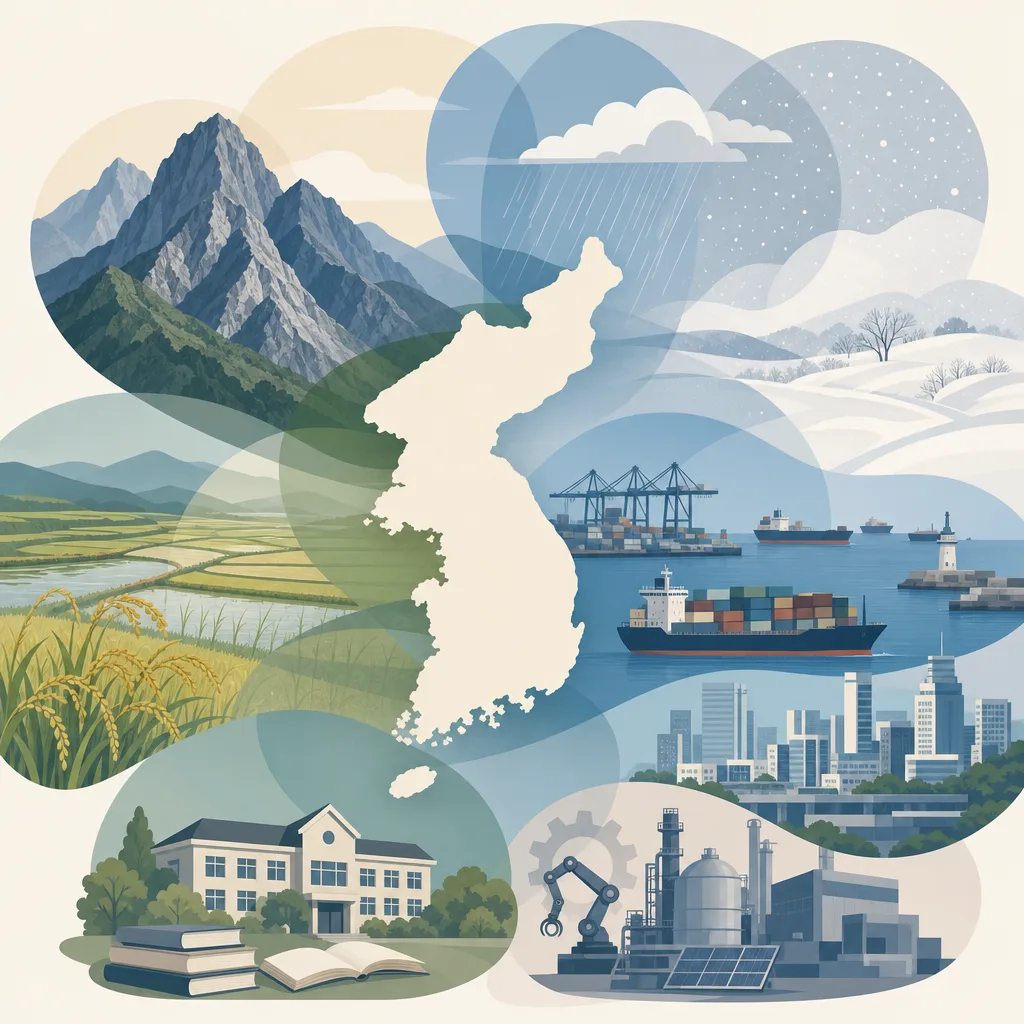
- The modern dynamism of Korean society was shaped not only by geographical conditions but also by a combination of postwar reconstruction, industrialization, the expansion of education, government policies, and integration into the global market.
Key Question: Do Koreans’ Energy and Adaptability Stem from Geography?
Korea is often described as a nation that, despite its relatively small territory, high population density, scarcity of natural resources, and division, has achieved rapid industrialization, a high level of education, strong export competitiveness, and global cultural influence. In light of these phenomena, many people ask, “Where does the resilience of Koreans come from?”
Attempts to find the answer to this question in geography and climate are both interesting and useful. The Korean Peninsula is mountainous, experiences significant seasonal variations, and is situated at the junction of continental and maritime environments. This environment has influenced agriculture, housing, transportation, defense, community formation, and the ways in which external civilizations have been assimilated.
However, there is an important caveat: geography does not mechanically determine a person’s character or national character. Essentialism—the notion that “Koreans are just like that”—is academically dangerous and offers little explanatory power regarding reality. A more accurate explanation is as follows.
The natural environment of the Korean Peninsula explains the types of problems Korean society has repeatedly faced, and the behavioral patterns of Koreans were shaped by the interplay of that environment with history, institutions, war, education, industrialization, and the global economy.
1. Basic Conditions of the Korean Peninsula: A Land of Many Mountains and Limited Plains
A frequently cited characteristic when describing the topography of the Korean Peninsula—and South Korea in particular—is its abundance of mountains. A significant portion of South Korea’s land area is mountainous, and its topography consists of a complex interweaving of mountain ranges, basins, river basins, and coastal plains rather than vast plains.
These conditions have had various impacts on people’s lives throughout history.
| Geographical Conditions | Impact on Daily Life | Aspects That Can Be Interpreted as Cultural and Social Outcomes |
|---|---|---|
| Abundance of Mountains | Increased costs of transportation and logistics; constraints on interregional exchange | Strengthened cohesion within local communities; reinforcement of hometown and regional identity |
| Limited plains | Increased value of arable land; need for intensive agriculture | Emphasis on diligence and efficient land use |
| Well-developed river basins and valleys | Villages and cities grew centered around specific living spheres | Maintenance of regional living spheres and differences in dialects and customs |
| Surrounded by the sea on three sides | Opportunities for fishing and maritime exchange; need for coastal defense | Coexistence of external exchange and the risk of invasion |
How should the term “barren land” be understood?
It is inaccurate to describe the Korean Peninsula simply as barren land. The Korean Peninsula possessed fertile river basins and plains, abundant marine resources, and diverse forest resources. However, when compared to regions like the Yellow River and Yangtze River basins in China—which feature vast, contiguous plains and large-scale inland waterway networks—the Korean Peninsula had many conditions that were relatively unfavorable for large-scale agricultural production and long-distance logistics.
Therefore, a more accurate description is not “uninhabitable land” but “land requiring considerable effort and adaptation.” This distinction is important. If the environment had been completely inhospitable, it would have been difficult for a sustainable state and culture to develop; however, the Korean Peninsula offered sufficient potential while also demanding constant adaptation.
2. Limited Arable Land and Intensive Agriculture: The Background of Resilience and Practicality
In a mountainous terrain, efficient use of arable land is crucial. In traditional societies, land was a key resource for survival, and farming schedules, water management, and the mobilization of labor were directly linked to the community’s survival.
These conditions likely reinforced the following ways of life:
- Diligence: Increasing yields on limited land required labor input and meticulous management.
- Pragmatism: Solving immediate problems—such as farming, food, heating, and water management—inevitably took priority over philosophical concepts.
- Cooperation at the Family and Village Levels: Collective labor was necessary for rice transplanting, harvesting, and maintaining irrigation facilities.
- Desire for education and social mobility: In an agrarian society, land and government office—and later, academic credentials and professional careers—became symbols of stability.
In modern Korea, the tendency to prioritize practical majors, stable professional careers, and quick results cannot be explained solely by geography. These trends are deeply intertwined with the colonial experience, the Korean War, industrialization, rapid economic growth, the structure of the labor market, real estate asset accumulation, and the education system. However, it is also difficult to view the “social sensibility sensitive to survival stability” as entirely unrelated to the long-standing agrarian environment.
3. Monsoon Climate: An Environment That Demanded Prediction and Adaptation
Korea’s climate is characterized by distinct four seasons and the influence of monsoons. Summers bring hot and humid weather, the monsoon season, and typhoons, while winters are marked by intense continental cold snaps and dry conditions. Spring and fall are relatively pleasant, but there is also volatility, such as yellow dust in spring and typhoons in fall.
This climate did not merely cause discomfort; it also spurred the development of practical skills and adaptation strategies.
Representative Adaptation Methods Shaped by the Climate
| Climate Issue | Traditional Response | Significance |
|---|---|---|
| Winter Cold Snaps | Ondol, thick clothing, kimchi preparation | Development of heating and storage technologies |
| Hot and Humid Summers | Wooden floors, ventilated structures, thin clothing | Architectural wisdom from the pre-air-conditioning era |
| Monsoon and Typhoons | Adjusting farming schedules, managing irrigation facilities | The need for community-based water management |
| Seasonal Fluctuations in Food Supply | Fermented sauces, fermentation, drying, and preserved foods | The development of a food preservation culture |
The coexistence of ondol and maru in hanok is a prime example. Ondol is a heating system designed to withstand the winter cold, while the wooden floor (maru) is a space that alleviates summer humidity and heat. In essence, mechanisms for coping with different seasons coexist within a single residential style.
4. A Frequently Changing Environment and Agility: An Interpretation of the “Hurry, Hurry” Culture
The “hurry, hurry” culture is a phrase that frequently comes up when describing Korean society. It is sometimes viewed as an advantage and sometimes as a disadvantage.
- Advantages: Rapid execution, crisis response, adoption of technology, service improvement, speed of infrastructure development
- Disadvantages: Overwork, disregard for safety procedures, lack of long-term deliberation, competitive pressure
This sense of urgency cannot be explained by climate alone. The modern “hurry-hurry” mentality is the result of a combination of post-war reconstruction, state-led development during the industrialization era, educational competition, urbanization, information and communications infrastructure, and pressure from global markets.
However, historical experiences in a rapidly changing natural environment—where timing and swift responses were critical—may have laid the cultural groundwork for a culture that values speed and agility. In farming, missing the sowing or harvest season could jeopardize a family’s livelihood for the entire year, and failing to prepare for the monsoon season or cold snaps led to severe damage. “A sense of timing” was a crucial skill in agrarian societies.
5. Mountainous terrain created isolation but also provided a line of defense
Mountainous terrain makes travel between regions difficult. In the past, when roads and bridges were insufficient, crossing even a single mountain range was a costly endeavor. These conditions led to distinct local spheres of life, dialects, cuisines, marriage networks, and market areas.
However, mountainous terrain was not merely an obstacle. In the event of an external invasion, it provided favorable conditions for defense. Even highly mobile armies from the plains would face difficulties with supply and movement in mountains, gorges, and narrow passes.
This point holds significant meaning in the history of the Korean Peninsula.
- Regions were partially segmented by mountainous terrain.
- At the same time, the mountains served as a defensive factor that made it difficult for external forces to enter and maintain long-term occupation.
- Mountain fortresses and mountain strongholds were an important part of the traditional defense system.
- As a result, the Korean Peninsula was able to maintain linguistic and cultural continuity despite being heavily influenced by external forces.
6. The Peninsula’s Location: Geopolitics That Created Both Pressure and Opportunity
The Korean Peninsula is situated between the continent and the ocean. This location has been both a blessing and a burden in Korean history.
The Dual Nature of the Peninsula’s Location
| Aspect | Disadvantages | Advantages |
|---|---|---|
| Connection to the Continent | Pressure from continental powers and risk of war | A conduit for adopting advanced culture, institutions, and technology |
| Border with the Sea | Maritime invasions and the burden of coastal defense | Opportunities for trade, fishing, and maritime expansion |
| Crossroads of Northeast Asia | Within the sphere of influence of great power rivalry | Foundation for growth centered on transit, exchange, and exports |
Historically, the Korean Peninsula has been influenced by the civilizations of the Chinese mainland, northern nomadic powers, the Japanese archipelago, and modern maritime powers. While this has sometimes been a source of war and pressure, it has also served as a backdrop for developing the ability to absorb and reinterpret diverse cultural elements.
Modern South Korea’s export-oriented industrialization is also closely tied to its geography. Being surrounded by the sea on three sides has enhanced the potential for utilizing ports and maritime logistics. Of course, South Korea’s rise as an export powerhouse was not achieved by geography alone; it was the result of a combination of industrial policy, investment in education, corporate strategy, international division of labor, the Cold War security order, and integration into the global market.
7. A Broader Framework for Explaining the “Resilience” of the Korean People
Geography and climate are important contextual factors, but they are not sufficient conditions. It is more accurate to view the phenomenon referred to as the “resilience” of the Korean people as the result of the following factors acting in concert.
| Explanatory Factor | Key Points | Examples |
|---|---|---|
| Natural Environment | Mountainous terrain, monsoons, limited plains, peninsular location | Intensive agriculture, adaptation to seasonal changes, regional living spheres |
| Historical Experience | War, foreign invasions, colonial rule, division, reconstruction | Survival instinct, sensitivity to national security |
| Educational System | Exams, educational attainment, preference for professional careers | Strong commitment to education and a competitive structure |
| Industrialization | Export-led growth, manufacturing, urbanization | Speed, organizational mobilization, labor intensity |
| Global Market | Technological competition, cultural industries, digital platforms | Semiconductors, automobiles, K-pop, content exports |
| Social Psychology | Family responsibilities, saving face, pressure to achieve | Pursuit of rapid results and the problem of overwork |
Applying this framework allows us to interpret the striking expression “Koreans are tenacious” more concretely. Rather than an innate trait, this may be the result of historical pressures to achieve results under limited conditions and collective learning.
8. Limitations of Geographical Explanations: Three Points to Watch Out For
1) Geography Is Not Destiny
Even among mountainous countries, some follow different political and economic paths. Even within the same monsoon region, development patterns vary depending on social institutions and international relations. Geography provides starting conditions and constraints, but it does not automatically determine outcomes.
2) “All Koreans” Cannot Be Grouped Under a Single Personality Type
Within Korean society itself, there is a wide variety of values and behaviors depending on generation, region, social class, gender, occupation, and migration experiences. Descriptions that reduce Koreans to a single character trait obscure this actual diversity.
3) Emphasizing Only Success Stories Overshadows the Costs
Diligence, speed, and pragmatism have contributed to Korea’s growth, but they have also given rise to problems such as overwork, competitive stress, regionalism, and a lack of long-term deliberation. To understand Korea’s underlying strength, one must consider both its strengths and its costs.
9. Summary: The Korean Peninsula Has Been an Environment That Continually Challenges People
The Korean Peninsula was neither a land of excessive abundance that spared people the need to work hard, nor was it a land so harsh that it prevented the formation of civilization. It was a complex environment where mountainous regions and plains, cold and heat, monsoons and droughts, and the pressures of the continent and the sea coexisted.
These conditions compelled Korean society to repeatedly answer the following questions:
- How can we produce more on limited land?
- How can we prepare for sudden seasonal changes?
- How can we preserve our identity amid external pressures?
- How can we embrace and utilize the cultural achievements of both the continent and the sea?
- How can we recover quickly after a crisis?
The resilience of the Korean people can be seen as the accumulation of long-standing responses to these questions. Geography was the stage that demanded those responses, and history was the record of the choices made upon it.
FAQ
Can the resilience of the Korean people be explained solely by geography and climate?
No. While the mountainous terrain of the Korean Peninsula, its monsoon climate, and its peninsular location are important contextual factors, the Korean way of life and social dynamics are the result of the combined influence of history, war, education, industrialization, institutions, and the global economy.
How has the abundance of mountainous terrain on the Korean Peninsula influenced Korean culture?
When there were many mountainous areas, past transportation and logistics were difficult, which strengthened local communities and increased the pressure to use arable land efficiently. At the same time, the mountainous terrain also served as a defensive line against external invasions.
How has Korea’s monsoon climate shaped people’s way of life?
The hot, humid weather and the rainy season in summer, as well as the cold snaps in winter, have had a significant impact on housing and food culture. Ondol, wooden floors, kimchi-making, fermented foods, and seasonal farming schedules are prime examples of how people have adapted to this climate.
Is South Korea’s “hurry-hurry” culture also related to geography?
While it can be interpreted as a partial contributing factor, it cannot be definitively identified as the direct cause. The agricultural and climatic environment, which demands rapid responses, may be one of the underlying factors, and the modern “hurry-up” culture has been reinforced by a combination of postwar reconstruction, industrialization, urbanization, educational competition, and digital infrastructure.
Was Korea's location on a peninsula a disadvantage or an advantage?
It was both. While the peninsula’s location was a geopolitical burden that subjected it to pressure from both continental and maritime powers, it also offered opportunities for the adoption of foreign cultures, maritime exchanges, and export-oriented growth.
How does the geographical explanation differ from the claim that “Koreans are just like that”?
A geographical explanation involves analyzing the environmental conditions and adaptation challenges that people have repeatedly faced. In contrast, the claim that “Koreans are just like that” runs the risk of erasing the differences among various individuals and groups and viewing national character as a fixed essence.
Is the environment of the Korean Peninsula related to the creativity of Koreans?
An environment undergoing significant change requires problem-solving and adaptation, which can foster creative responses. However, when considering technological and cultural creativity in modern Korea, it is essential to examine the combined influences of education, businesses, urban infrastructure, global markets, and digital platforms.
Is South Korea's economic growth due to its geography?
While geography provided opportunities such as ports and maritime trade, it did not automatically lead to economic growth. South Korea’s growth was the result of a combination of investment in education, industrial policy, corporate capabilities, the workforce, the international trade environment, and technological accumulation.
Sources
Images