How the Government’s ‘AI for Everyone’ Differs from Existing Free Chatbots: Domestic Models, Privacy, and Launch Schedule
The government’s ‘AI for Everyone’ initiative aims to provide a free, unlimited general-purpose chatbot and public AI agents to all citizens. The share of domestic models, B200 GPU support, long-term operating costs, and standards for handling prompt data will determine its actual differentiation and reliability.
- ‘AI for Everyone’ is a public AI service initiative targeting a beta launch by the end of September 2026 and an official launch within the year.
- The project requirements specify that domestic AI models must account for at least 70% of usage and that a proprietary foundation model must be included.
- The 512 NVIDIA B200 GPUs provided by the government will support the initial inference infrastructure, but they do not automatically guarantee service quality or sustainability.
- The phrase ‘free and unlimited’ refers to pricing policy, while actual operations may require restrictions to prevent security risks, overload, and abuse through automation.
- If user prompts are to be used for monetization, the service must clearly disclose data minimization practices, purposes of use, retention periods, and whether data is shared with third parties.
The government’s “AI for All” initiative is not simply a project to create yet another free generative AI chatbot. The core of the publicly announced plan is to build a general-purpose chatbot that anyone can use without concerns about cost or usage limits, an operating structure centered on domestically developed AI models, and AI agents connected to public services.
However, as of August 3, 2026, the operator bidding process is still underway, and the actual operator, terms of use, privacy policy, and performance have not been finalized. Therefore, what can currently be compared is not a finished product, but the project requirements and goals presented by the government.
AI for All Project Overview and Schedule
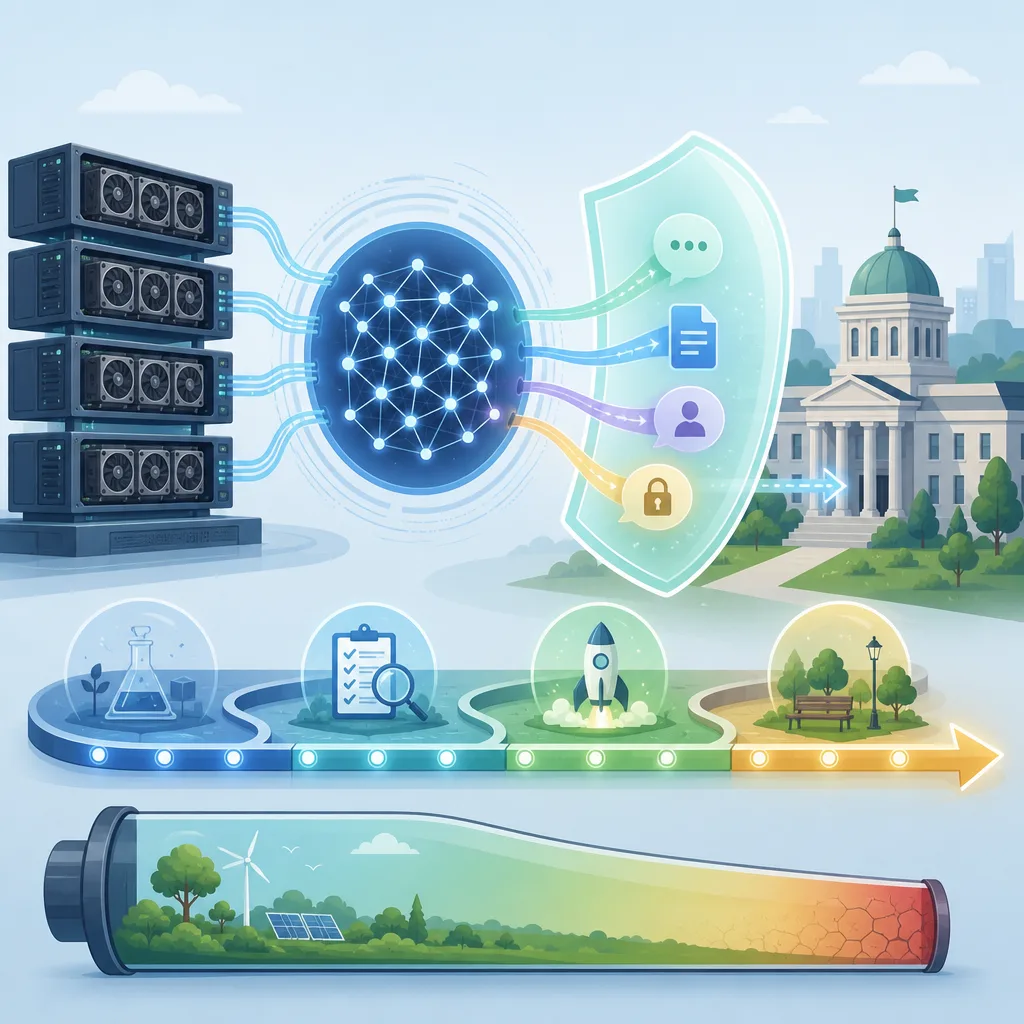
The Ministry of Science and ICT is accepting bids for the “AI for All Project” from July 13 to August 11, 2026. The publicly announced implementation schedule is as follows.
| Stage | Scheduled time | Items to check |
|---|---|---|
| Operator bidding | July 13–August 11, 2026 | Participation requirements, technical and operational proposals, privacy protection measures |
| Operator selection | August 2026 | Final operator and consortium structure, models to be used |
| Beta service | Late September 2026 | Actual usage limits, response quality, incident response, scope of data collection |
| Official service | Within 2026 | Scope of public-service integration, long-term operating policy, official terms |
This schedule represents the project’s implementation targets. It may change depending on the results of the bidding and development processes, security verification, or integration with public institutions.
Under the plan, the scope of the service is broadly divided into two areas.
- General-purpose AI chatbot: A public service providing common generative AI functions such as answering questions, drafting documents, summarization, and translation
- Public AI agent: A function that finds public information, provides guidance on administrative procedures, and, in the future, assists with the use of public services within permitted limits
Whether public AI agents will actually take the place of administrative dispositions or eligibility determinations is a separate issue. Providing information, assisting with applications, querying institutional systems, and making automated decisions with legal effect involve different levels of authority and responsibility, so they must be distinguished in the official service.
What Does the 70% Domestic AI Model Requirement Mean?
The publicly disclosed project requirements state that domestically developed AI models must account for at least 70% of all models used and must include an independent foundation model. This can be interpreted not as a requirement to exclude foreign models entirely, but as a standard designed to ensure that domestic models form the primary foundation of the service.
An independent foundation model means an internally developed base model that has been pre-trained on large-scale data and can be used for multiple tasks, rather than a service that simply resells another company’s model or changes only its interface. However, this may not mean that the training data, open-source components, and even synthetic data generated using external models must all be domestic technologies.
To evaluate the 70% requirement, the method used to calculate the ratio must be disclosed.
- Is it calculated based on the number of user queries?
- Is it based on the number of tokens processed or GPU usage?
- Are calls for individual functions such as search, translation, and image generation calculated separately?
- How are cases reflected when a domestic model fails and the request is switched to a foreign model?
- In an agent system combining multiple models, which stage is used as the basis?
If these standards are unclear, the nominal share of domestic models may differ from their actual share of usage. For the official service, regularly disclosing the list of models used, routing principles by purpose, and the results of ratio calculations would help with verification.
The Role of 512 B200 GPUs
The 512 NVIDIA B200 GPUs provided by the government are core computing resources for running large-scale AI models and responding to user requests. For a free service accessed by many users simultaneously, sustained inference-processing capacity and stable resource allocation are especially important, even more so than model training.
The expected benefits of GPU support include:
- Reducing the burden of initial infrastructure investment
- Securing inference capacity to accommodate increases in concurrent users
- Supporting performance testing and routing across multiple domestic models
- Measuring demand and costs during the beta-service period
However, actual user capacity or response speed cannot be calculated from the number of GPUs alone. Throughput varies significantly depending on model size, input and output length, precision, quantization, batch processing, caching, search systems, and reserve capacity for incident response. GPU support is a resource for service quality, not an indicator that guarantees quality itself.
Supported resources must also be distinguished from long-term operating expenses. After the GPU support period ends, the operator must continue to cover server rental fees, electricity costs, network expenses, security, and customer-support personnel. To keep the service free after 2027, a clear structure is needed to specify whether costs will be covered through government budgets, contracts with public institutions, enterprise services, APIs, or other sources of revenue.
Does Free and Unlimited Literally Mean No Restrictions?
The free and unlimited service described in the plan means that it aims to offer a service in which users do not pay subscription fees or face ordinary limits on the number of questions. It is difficult to interpret this as meaning that there will be no technical restrictions whatsoever.
Large-scale public AI services generally require the following types of operational controls.
- Preventing bulk requests made through automated programs
- Blocking attacks, spam, illegal content generation, and service disruptions
- Preventing a single user from consuming excessive resources
- Applying temporary speed limits or queues during service incidents
- Allocating resources differently between high-cost functions and ordinary text functions
The official terms should therefore clearly specify the scope of “unlimited” use, the fair-use policy, conditions for speed limits, and whether high-volume commercial use is permitted. The fact that the service is free also does not mean that the government guarantees the accuracy of every answer or the results of using the service.
User Prompts and Privacy Issues
AI chatbot prompts may contain not only names and contact information, but also sensitive information such as health, income, family relationships, civil complaint details, contracts, and company secrets. In particular, AI connected to public services may process data with a higher likelihood of identifying individuals than an ordinary chatbot.
If the use of processed user prompts for service improvements or revenue models is being considered, the following details must be disclosed first.
| Item to check | Explanation required |
|---|---|
| Scope of collection | What is stored among prompts, attachments, answers, and access logs? |
| Purpose of use | Is it used for service delivery, safety reviews, model training, statistics, or commercial analysis? |
| Legal basis and choice | How are mandatory processing and optional training or analysis distinguished? |
| Retention period | When are the original and processed data deleted, respectively? |
| Provision to third parties | What data is transferred to participating companies or public institutions? |
| De-identification measures | How is the risk of re-identification assessed and reduced? |
| Exclusion from model training | Can users exclude their conversations from training? |
| Deletion and access | How can users review and delete stored conversations? |
| Transfer to external models | Are any requests sent to foreign models or overseas servers? |
Removing a name or replacing it with a pseudonym does not automatically make all information anonymous. This is because an individual may be re-identified when a rare civil complaint case is combined with location, occupation, and family relationships.
Data minimization needs to be incorporated into the basic design of public AI. Merely warning users not to enter sensitive information such as resident registration numbers, financial information, or medical information is not sufficient; automated detection and masking, short retention periods, access controls, encryption, and audit logs are also required.
It cannot be concluded that monetization of prompt data has been finalized. However, if long-term operating expenses are to be covered through a data-based business, it must be made clear whether citizens who do not consent to data use can still access core public AI functions and how their data will be handled after consent is withdrawn.
Comparison with ChatGPT, Gemini, and Claude
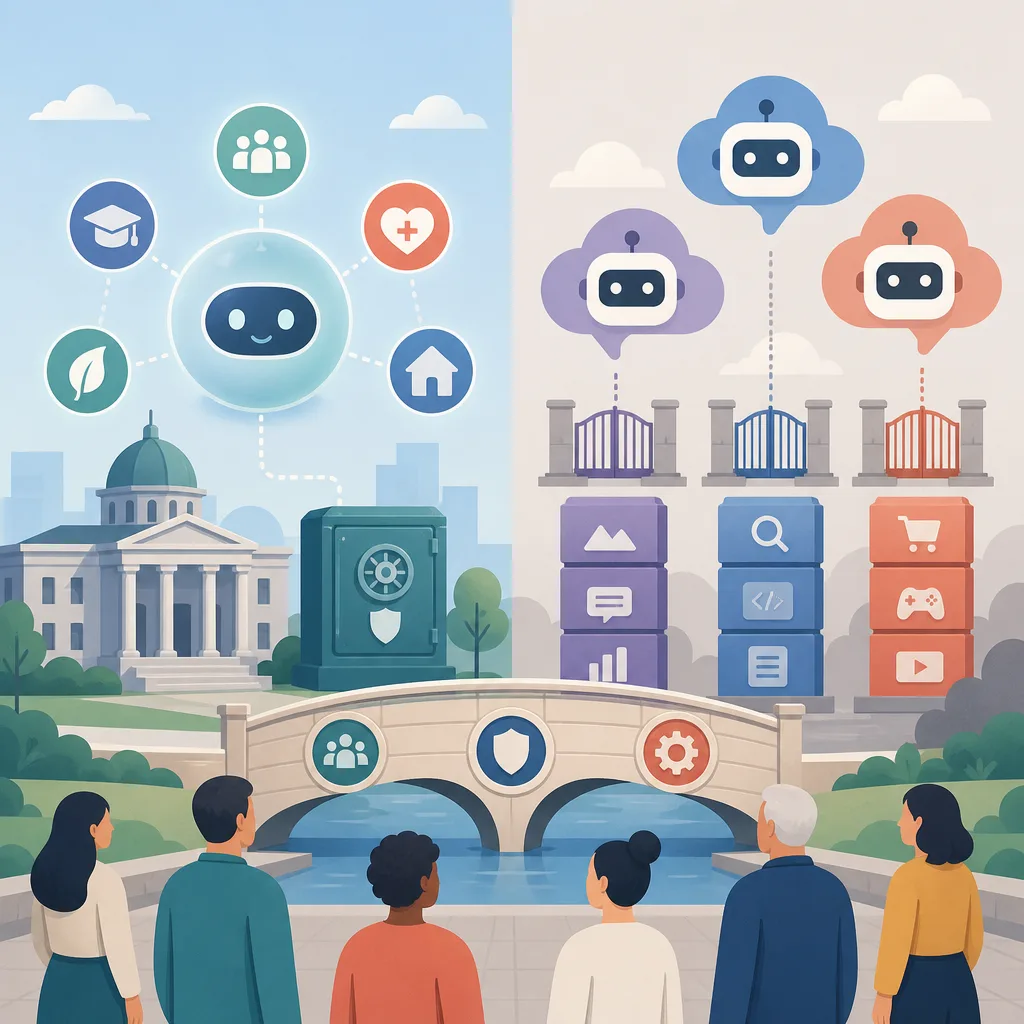
The biggest difference between AI for All and existing global chatbots lies not in current performance, but in policy goals and operating structure. ChatGPT, Gemini, and Claude are commercial services that are already available, whereas AI for All is still at the planning stage, ahead of operator selection and beta testing.
| Comparison item | AI for All | Free ChatGPT, Gemini, and Claude services |
|---|---|---|
| Current status | Operator bidding and implementation planning stage | Already available to general users |
| Pricing policy | Presented with the goal of being free and unlimited for all citizens | Free tiers are available, but model, feature, and usage limits vary by service |
| Main models | Requirement for at least 70% domestic models, including an independent foundation model | Centered on models developed and operated respectively by OpenAI, Google, and Anthropic |
| Public-service integration | One of the core goals | Focused on general conversation and productivity functions, with limited integration into domestic administrative services |
| Infrastructure | Plan to use 512 government-supported B200 GPUs | Uses each company’s global cloud and AI infrastructure |
| Privacy rules | Official policy must be reviewed after the operator is selected | Vary according to each company’s terms, region, account, and plan |
| Performance verification | Actual measurements possible after the beta launch | Available through public services, but performance differs by model and plan |
| Responsibility structure | Roles of the government, operator, and connected public institutions must be distinguished | Governed by the service company’s terms and applicable laws |
The existence of a free tier does not mean that service conditions are the same. Global chatbots may impose separate limits on specific high-performance models, file processing, image generation, or deep-research functions. Conversely, AI for All may also apply fair-use standards to maintain stability and prevent abuse.
How Should Performance and Responsibility Be Verified?
The share of domestic models and the number of GPUs are input requirements, while the results experienced by users require separate evaluation. Once the beta service begins, it should be possible to review at least the following indicators.
Performance Indicators
- Accuracy of Korean-language factual queries and long-document comprehension
- Source citations and up-to-dateness of legal and policy information
- Rate of hallucinations that generate content without supporting evidence
- Average response time and success rate during peak periods
- Downtime, recovery speed, and whether data was lost
- Accessibility for people with disabilities and usability on mobile devices and low-speed networks
Public-Service Safety Indicators
- Clear distinction between informational guidance and decisions with legal effect
- Procedures for reporting and correcting incorrect answers
- A function for transferring users to the responsible institution or a human counselor
- Change history when models or data are modified
- Checks for discriminatory errors based on gender, age, region, disability, and other factors
Responsibility Structure
Errors in general conversational answers, errors in public-institution data, and errors in actions performed by agents may have different causes. The official terms and operating rules must specify who, among the government, operating company, model developer, and data-providing institution, will investigate and correct such errors and respond to user harm.
Key Questions to Check Before and After Launch
For AI for All to become public infrastructure that is meaningfully different from existing free chatbots, it must be able to answer the following questions.
- In what units is the 70% domestic-model share calculated, and who verifies it?
- Under what conditions are questions sent to foreign models, and are they transferred overseas?
- What fair-use standards apply to free and unlimited use?
- Where and for how long are original prompts stored?
- Can users opt out of model training or commercial analysis?
- What funding sources will cover GPUs and operating expenses after 2027?
- What can and cannot public AI agents do?
- Who is responsible when incorrect administrative guidance or a personal-data breach occurs?
Ultimately, what distinguishes AI for All will not be determined solely by the label “a free chatbot created by the government.” Meaningful comparison with existing services will only be possible when the actual use of domestic models, the accuracy of public information, a design that prioritizes privacy over profit, long-term funding, and the responsibility framework are disclosed.
FAQ
Is AI for All available for immediate use now?
No. As of August 3, 2026, it is at the stage of soliciting operators. The publicly announced target schedule is to select an operator in August, launch a beta service at the end of September, and officially launch by the end of 2026, though the actual schedule may change.
Does AI for All really have no usage limits whatsoever?
Free and unlimited access is a policy goal intended to eliminate the burden of costs and limits on the number of questions for general users. However, fair-use restrictions or temporary rate limits may be necessary to prevent automated bulk requests, attacks, spam, and excessive resource consumption, and the specific criteria should be checked in the official terms of service.
Does AI for All use only domestic models?
The publicly announced requirements are that domestic AI models account for at least 70% of usage and that a proprietary foundation model be included. This does not mean that no foreign models will be used, and further clarification is needed on which unit, such as the number of questions or tokens, will be used to calculate the 70%.
How many people can use the service simultaneously with 512 B200 GPUs?
The number of concurrent users cannot be determined from the number of GPUs alone. Actual throughput varies significantly depending on the model size, response length, quantization, batch processing, cache, image features, and reserve capacity, so measurement results from the beta service are needed.
Does AI for All perform better than ChatGPT, Gemini, and Claude?
It is too early to tell. Since AI for All is still in the pre-development stage, it must be compared under the same conditions during the beta service using the same set of questions, accuracy of up-to-date information, Korean-language processing, response speed, and hallucination rate.
Will conversations entered into AI for All be used to train models?
This cannot be stated with certainty until the operator and official privacy policy are finalized. At launch, users should check the scope of prompt storage, purposes of training and analysis, retention period, provision to third parties, and methods for opting out of training and requesting deletion.
Are responses from the public AI agent official government decisions?
General guidance provided by AI does not automatically constitute an official decision by an administrative agency. Legally effective dispositions or eligibility determinations require separate authority and procedures, so the service must clearly distinguish between guidance, application assistance, and actual administrative processing.
Can it continue to operate for free after 2027?
Whether it can remain free over the long term depends on its funding structure after GPU support ends. The methods used to cover costs, such as government funding, contracts with public institutions, enterprise services, or APIs, as well as whether prompt data will be used commercially, must be disclosed transparently.
Sources
Images