AI Productivity and Business Leverage: Why You Must Find the Bottleneck First
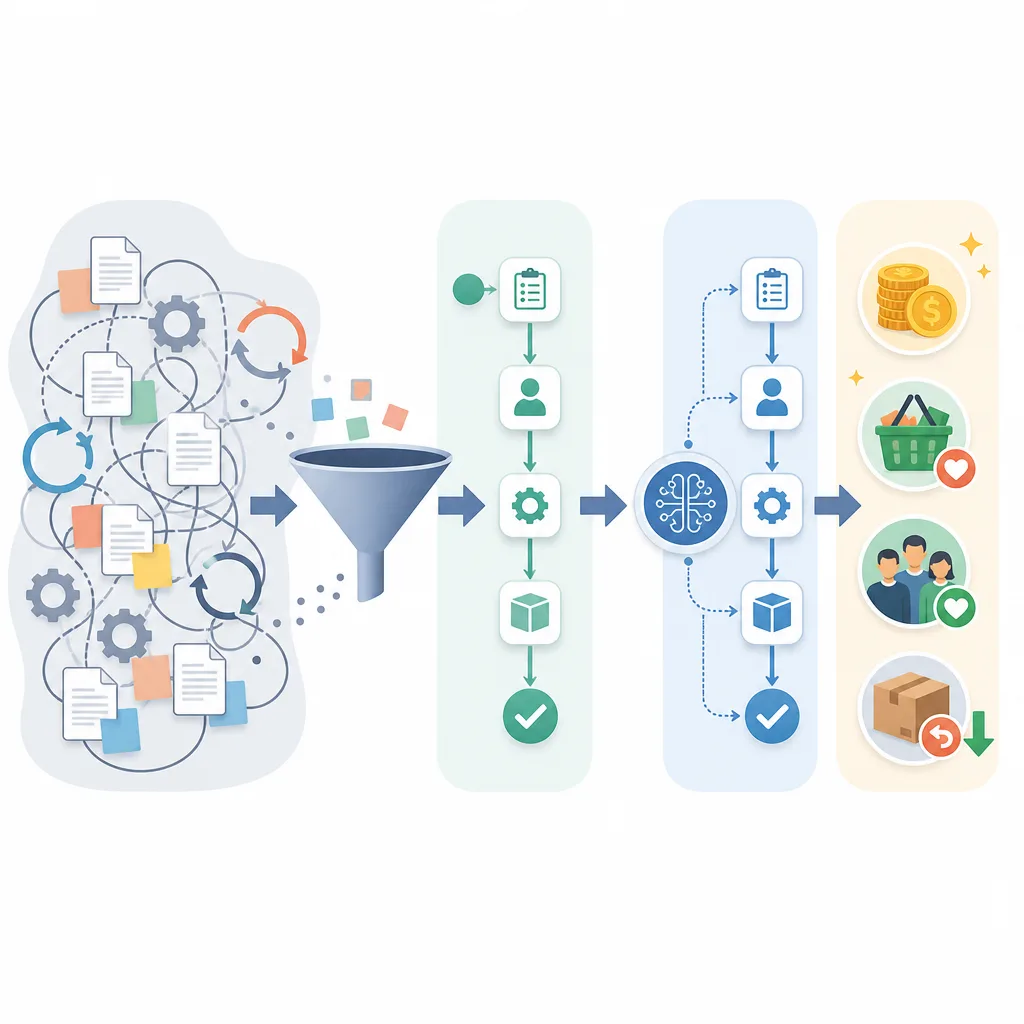
AI handles specific tasks quickly, but that alone does not guarantee revenue or profit. To improve business performance, identify the current critical bottleneck and focus resources on eliminating, redesigning, and then automating it.
- Task processing speed and business performance are not the same metric, so you must separately verify whether productivity gains lead to higher profits.
- AI has a greater impact when combined with capital, talent, data, distribution channels, brand, customer trust, and operational systems.
- Before automating, eliminate unnecessary tasks and simplify the processes and responsibilities for the remaining work.
- Identify the business's critical bottleneck by comparing metrics across demand generation, purchase conversion, and service delivery.
- Evaluate AI investments using outcome metrics such as revenue, contribution margin, conversion rate, retention rate, and refund rate rather than throughput.
AI can reduce the time required for specific tasks such as writing, summarization, analysis, coding, and customer support. However, producing more documents and content faster and increasing a business’s revenue, profit, and customer value are separate outcomes.
Empirical studies have also observed that generative AI can improve the speed or quality of some knowledge work and customer support tasks. However, the measured effects varied depending on the type of work, the user’s experience, the input data, and the review method. Productivity gains confirmed in specific tasks should not be generalized into increased profits across all industries and companies.
The Meaning of Leverage and the Role of AI
In business, leverage means a structure that repeatedly produces greater results with the same or fewer resources. Here, resources include not only time but also capital, personnel, data, brand, software, distribution channels, and customer trust.
For example, instead of spending an hour explaining something to one customer, a business can provide training in which multiple customers participate together, or standardize recurring explanations in documents and videos so that the same knowledge reaches a wider audience. This is structural leverage that is possible even without AI.
AI can strengthen existing leverage in the following ways.
- It reduces the time spent on repetitive tasks such as drafting, classification, search, and summarization.
- It creates content in multiple formats and personalized responses at a relatively low marginal cost.
- It helps employees review more cases or respond to customers more quickly.
- It lowers barriers to entry for coding, data analysis, and knowledge retrieval.
However, AI is not an independent formula for success. Without channels for reaching customers, reliable data, people to verify quality, an organization capable of execution, and affordable costs, only the speed of production may increase. AI can suggest alternatives and support judgment, but it does not automatically replace the role of deciding which goals to prioritize and taking responsibility for the results.
Why Productivity and Profitability Must Be Distinguished
Productivity generally means output relative to input. Profitability, by contrast, concerns the result of subtracting the costs required to provide products and operate the organization from the revenue customers actually pay.
The two metrics can be connected, but they do not automatically move together.
| Change | Directly measurable metric | Condition required to translate into business performance |
|---|---|---|
| Reduced report-writing time | Work time per document | Reports must be used to make better decisions or reduce costs |
| Increased content production | Number of weekly posts | Inflow and purchase conversion among suitable customers must increase |
| Faster customer responses | First response time | Response accuracy and resolution rate must be maintained |
| Faster code generation | Development time per feature | Defects, security risks, and maintenance costs must be controlled |
| Increased consultation volume | Cases handled per hour | Customer satisfaction, repurchase rate, and employee burden must not worsen |
Therefore, when comparing performance before and after AI adoption, throughput metrics and outcome metrics must be considered together. Even if work time decreases, if revenue, contribution margin, customer retention, or quality does not change, it is also necessary to verify whether the saved time has been reallocated to other valuable activities.
The Productivity Trap: Doing Unnecessary Work Faster
When the cost of tools falls, organizations may produce more reports, features, meeting materials, and content that they would not have created before. Each task may appear inexpensive, but when the costs of review, approval, revision, storage, distribution, and maintenance are added, the burden on the organization as a whole can increase.
Common signs include the following.
- The number of reports that no one reads or uses for decision-making increases.
- Features are continuously added without customer requests or validation.
- The number of posts increases, but inquiries and purchases from suitable customers do not.
- Reviewing and revising AI outputs takes longer than expected.
- Different teams duplicate similar automation tools and databases.
- The workload increases, but the person responsible for each task and the completion criteria remain unclear.
The core of this problem is not AI performance but task selection. Lowering the unit cost of unimportant work can cause more of that work to occur, so before deciding whether to automate a task, it is necessary to determine whether the task is needed at all.
Structural Leverage That Can Be Applied Before AI
Converting One-to-One Services into a One-to-Many Structure
Consulting, training, or onboarding that involves repeated explanations can be converted into group sessions, workshops, recorded training, and standardized materials. However, not every service is suitable for a one-to-many model. Work involving sensitive personal information, complex diagnoses, or individual negotiations may require separate consultations.
Converting Synchronous Work into Asynchronous Work
Instead of handling every question in real-time meetings, questions can be submitted through a standardized form and answered within a set period. This can reduce scheduling costs and frequent context switching. Urgency classifications, expected response times, assigned personnel, and exception-handling criteria must be defined together to prevent delays and avoidance of responsibility.
Disclosing Recurring Sales Information in Advance
Providing price ranges, delivery procedures, target customers, limitations, frequently asked questions, and actual cases in advance can reduce unsuitable inquiries. Rather than repeatedly providing basic explanations, sales representatives can address the specific problems of customers who are more likely to buy.
Standardizing Services and Decision-Making
Defining checklists, approval criteria, templates, and scopes of responsibility helps retain experienced employees’ knowledge within the organization. Once these standards are in place, AI can be used more reliably to generate drafts or perform classification.
Elimination and Selection as the Highest Forms of Leverage
Automating a task can reduce the time it takes. However, if the task was unnecessary in the first place, the greatest savings come not from automation but from elimination.
The following sequence can be applied when reviewing work.
- Eliminate: Determine which customers or outcomes would actually be harmed if the task were discontinued.
- Reduce: Reduce the frequency, scope, participants, and volume of outputs.
- Standardize: Clarify inputs, procedures, quality standards, and the person responsible.
- Delegate: Separate the parts that must be handled by highly skilled personnel from those that do not.
- Automate: Apply AI or software after reviewing repeatability, data quality, and the cost of errors.
Applying this sequence in reverse automates complex, low-value procedures as they are. As a result, existing errors may be replicated faster and more broadly.
Questions for Eliminating Work
- What customer outcome or management decision does this task support?
- Who actually uses the output?
- What specific loss would occur if it were suspended for one month?
- Is it required for legal, safety, contractual, or audit reasons?
- Can it be replaced by a shorter document, lower frequency, or sample inspection?
- Can the saved time and budget be reallocated to the current bottleneck?
Finding the Real Bottleneck in the Revenue Flow
A simplified business flow can be viewed as three stages: demand generation, purchase conversion, and service delivery. Actual businesses may face additional constraints such as supply chains, cash flow, hiring, and regulation, but this is a useful framework for the initial diagnosis of customer and revenue flows.
| Stage | Signs of a suspected bottleneck | Metrics to check first | First action | Example of misguided AI investment |
|---|---|---|---|---|
| Demand generation | Insufficient visits or inquiries from suitable customers | Qualified traffic, number of inquiries, acquisition cost by channel | Validate target customers, channels, and messaging | Automating only internal report generation |
| Purchase conversion | Plenty of inquiries but few purchases | Inquiry-to-purchase conversion rate, reasons for churn, win rate by proposal | Improve pricing, product configuration, evidence, and sales procedures | Mass-producing only advertising content |
| Service delivery | Many refunds, delays, errors, and complaints | Refund rate, defect rate, resolution time, retention rate | Improve capacity, quality standards, training, and delivery procedures | Expanding acquisition without improving quality |
When Demand Generation Is the Bottleneck
If there are not enough suitable customers who know about the product, reach channels and messaging must be validated. Rather than measuring simple impressions, it is important to measure qualified demand such as visitors with a realistic likelihood of purchasing, consultation requests, and trial requests.
When Purchase Conversion Is the Bottleneck
If there are many inquiries but few purchases, review customer interviews, sales records, and reasons for churn. The cause may be not only price but also a mismatch with target customers, insufficient explanation of value, complex contracts, lack of trust, or a lengthy purchasing process.
When Service Delivery Is the Bottleneck
If sales volume is sufficient but delivery delays, refunds, and complaints are increasing, delivery capacity and quality should be improved before advertising is expanded. Increasing demand without resolving the bottleneck can increase both wait times and errors.
Once the current bottleneck is improved, another stage may become the new bottleneck. Bottleneck management is therefore not a one-time diagnosis but a recurring measurement process.
Bottleneck-Centered AI Adoption Process
Step 1: Define One Business Outcome
Set the desired outcome for this improvement cycle as a measurable metric such as revenue, contribution margin, customer retention, refund rate, or on-time delivery rate. Trying to optimize multiple metrics simultaneously can blur priorities, so designate a core metric along with quality and risk metrics that must not deteriorate.
Step 2: Record the Current Baseline
Measure work time, costs, throughput, error rates, and outcome metrics over a set period before adoption. Without a baseline, it is difficult to determine whether changes after AI adoption were caused by the tool, seasonality, pricing changes, or staffing changes.
Step 3: Identify the Strongest Constraint in the Flow
Compare data from the demand, conversion, and delivery stages and gather feedback from frontline personnel and customers. Do not look only at averages; examine differences by customer type, product, channel, and person responsible.
Step 4: Eliminate and Redesign First
Remove unused outputs and simplify approval stages, input forms, and scopes of responsibility. Automating unstable procedures makes exceptions and errors difficult to manage.
Step 5: Test AI Within a Limited Scope
Do not deploy it immediately across the entire organization. Begin by testing highly repetitive tasks in which errors can be detected. Review personal information, confidential information, copyright, security, the potential for discrimination, and regulatory obligations together, and retain human approval where necessary.
Step 6: Compare Outcomes and Side Effects Together
Where possible, compare similar teams or periods, or introduce AI in stages. Measure not only processing time but also revenue, conversion rates, quality, refunds, rework, customer satisfaction, and total costs.
Step 7: Decide Whether to Expand, Modify, or Discontinue
Expand only when improved outcomes have been confirmed and errors and risks are within acceptable limits. If there is no effect, before continuing to revise prompts, first reassess whether the wrong bottleneck was selected and whether the data and procedures were ready.
AI Investment Decision Table
Evaluating each candidate task according to the following criteria can reduce investments driven by simple trends or demonstration effects.
| Evaluation criterion | Key question |
|---|---|
| Bottleneck relevance | Will improving this task actually increase the processing capacity of the current constraint? |
| Impact on outcomes | Through what path will it affect revenue, costs, quality, or customer retention? |
| Repeatability and scale | Does it occur often enough to recover implementation and review costs? |
| Data readiness | Is there accurate input data with clear usage rights? |
| Cost of errors | How much harm could an incorrect output cause to customers, safety, legal compliance, or reputation? |
| Verifiability | Can a person verify correctness and quality at a realistic cost? |
| Total cost | Does it include not only model fees but also integration, training, review, security, and maintenance costs? |
| Comparison with alternatives | Would elimination, standardization, pricing changes, training, or conventional software be simpler? |
Decisions should not be automated merely by adding up scores. In particular, risks that have a low probability of occurring but could cause severe harm, such as regulatory violations or safety incidents, must be reviewed separately.
How to Measure the Results of AI Adoption
Performance evaluation becomes clearer when divided into three layers.
- Activity metrics: Number of documents generated, number of automation runs, number of employees using AI
- Operational metrics: Work time, throughput, first response time, rework rate, error rate
- Business metrics: Revenue, contribution margin, conversion rate, retention rate, refund rate, customer lifetime value
Activity metrics show only that the tool is being used. Operational metrics show that the work has changed, while business metrics show whether that change has translated into economic value.
A simple evaluation formula can be structured as follows.
Net effect of AI adoption = Additional revenue + actual cost savings − adoption, operation, review, and error costs
Time saved does not automatically become cash savings. If labor costs remain unchanged, additional value may arise only when that time is reallocated to improving the bottleneck, serving customers, or enhancing product quality.
Conclusion
AI is a powerful work tool, but it is not an agent that automatically creates wealth or business success. Even when the same AI is used, outcomes differ depending on how customer demand, data, brand, capital, teams, distribution channels, and operating systems are combined.
The key question is not “How much AI is being used?” but “Has the business’s most important current constraint been improved?” Productivity gains are more likely to translate into actual business performance when unnecessary work is eliminated, the structure through which customer value flows is simplified, and AI is then applied in areas where results can be verified.
FAQ
Does adopting AI necessarily increase productivity?
No. Its effectiveness varies depending on the nature of the work, data quality, user proficiency, review procedures, and the level of tool integration. It can help with highly repetitive and verifiable tasks such as drafting, but for tasks involving complex judgment or high costs of errors, the review burden may offset the benefits.
How do AI productivity and business profitability differ?
AI productivity relates to the ability to handle more work in the same amount of time or reduce working time. Business profitability is the result after subtracting implementation costs, review costs, error costs, and other expenses from the additional revenue and actual cost savings generated by those changes, so it must be measured separately.
How can you identify a business bottleneck?
First, divide the customer journey into demand generation, purchase conversion, and service delivery, then compare qualified inquiries, purchase rates, refund rates, processing times, and retention rates. Treat the stage that causes the greatest loss or delay and limits overall performance as the current bottleneck candidate, then validate it through on-site observation and customer feedback.
Why should eliminating tasks come before automation?
Because automating unnecessary tasks may only increase the number of times they are performed and the volume of their outputs. It is more efficient to determine whether a task contributes to customer value, legal obligations, or important decision-making, then eliminate, reduce, or standardize it before automating the remaining repetitive tasks.
Which metrics should be used to measure the impact of AI adoption?
In addition to operational metrics such as working time and throughput, revenue, contribution margin, conversion rates, retention rates, refund rates, and quality metrics should also be measured. Model usage fees, system integration, training, human review, security, and error-handling costs should also be included in the total cost.
Does employee time saved directly translate into cost savings?
Not always. If salaries and working hours remain unchanged, cash expenditures do not immediately decrease from an accounting perspective. The saved time should be reallocated to revenue-generating activities, resolving bottlenecks, customer support, or quality improvement, and the actual outcomes should be assessed to see whether they have changed.
Can business leverage be increased without AI?
Yes. Methods include converting one-on-one services to a group format, shifting real-time work to an asynchronous model, providing recurring sales information in advance, and creating checklists and standard procedures. Establishing these structures first also makes it easier to measure and manage the impact when AI is applied later.
Is there always only one bottleneck?
Multiple problems may exist at the same time, but at any given point, there is often a constraint that most strongly limits the overall flow. Improving that constraint may cause another stage to become the new bottleneck, so the data must be continuously reviewed.
Sources
Images