Gyeongsin Famine 1670~1671: Relief and Recovery
The Gyeongsin Famine was a disaster marked by crop failures and epidemics across Joseon in 1670~1671. The court responded by distributing food, easing burdens, and providing seeds, but records of good harvests alone do not establish that livelihoods had recovered.
- The Gyeongsin Famine was a disaster in 1670~1671 during Hyeonjong's reign, when crop failures and epidemics struck together.
- In 1671, the court ordered land tax revenues from six provinces to be used for local famine relief.
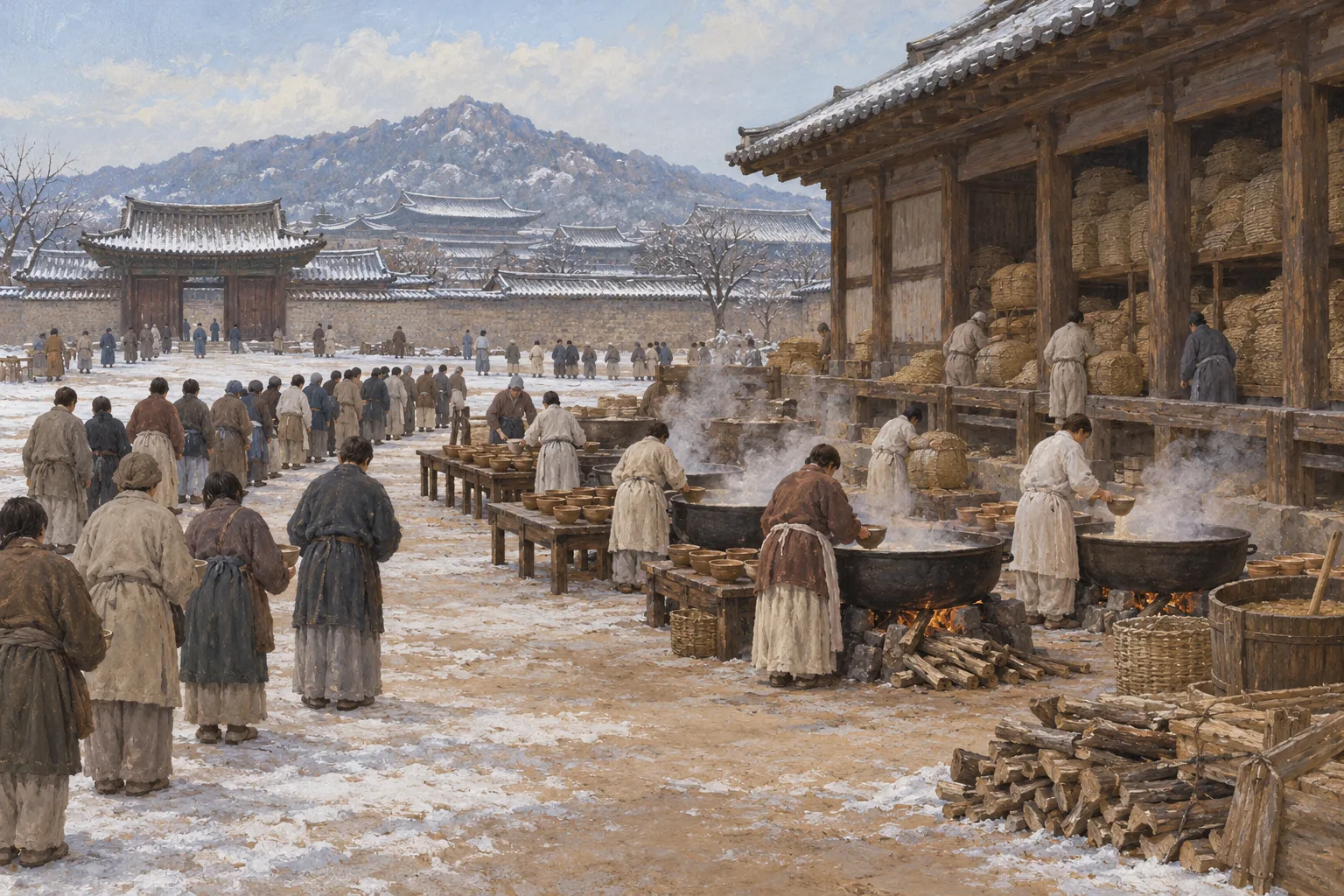
- Porridge distribution, dry ration distribution, and grain sales differed in how relief was provided and the conditions for receiving it.
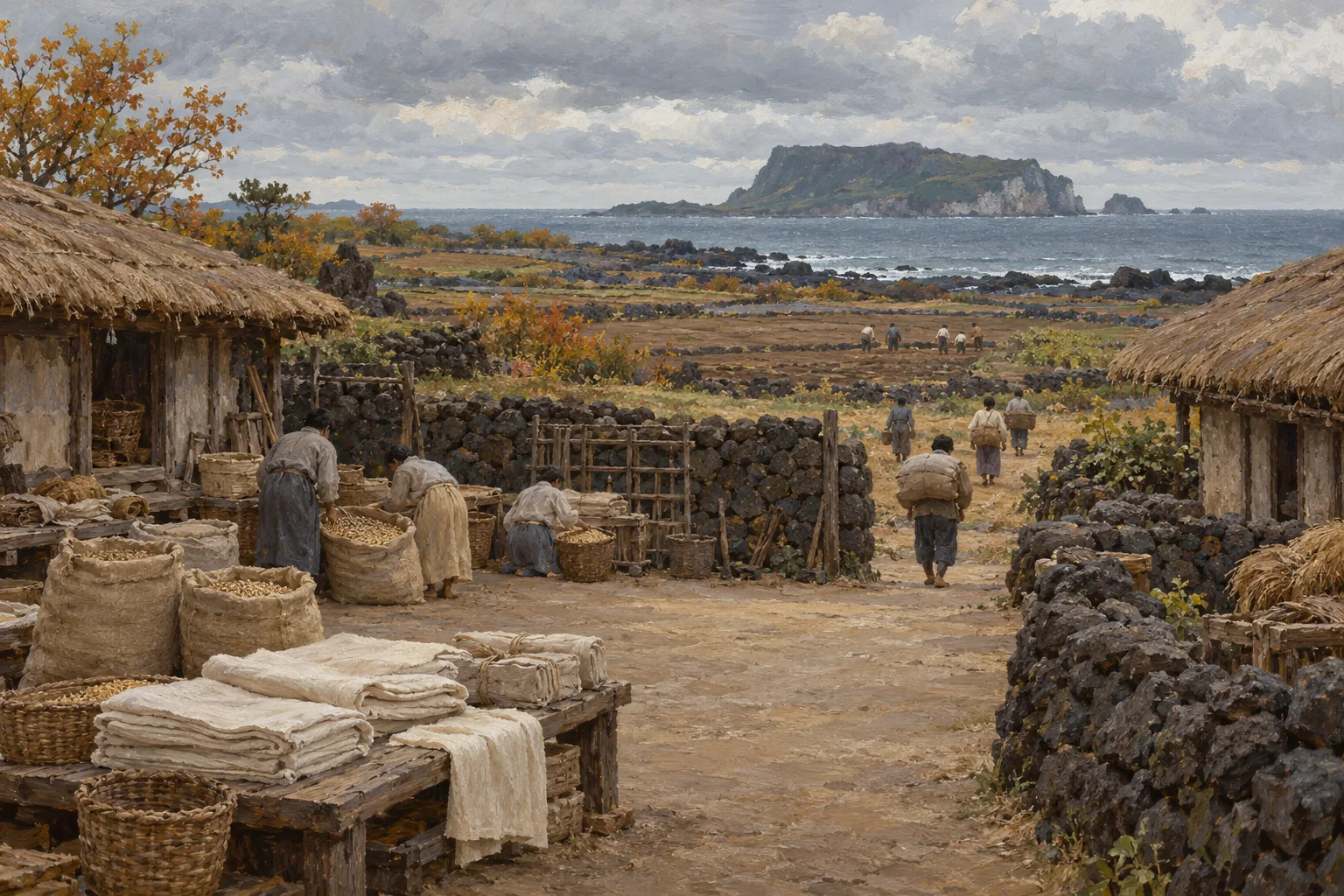
- Aid to Jeju in the form of cotton cloth and barley seeds aimed both to sustain livelihoods and to restart farming for the next season.
- Famine relief continued in 1672, and the decline in the population recorded in household registers must be distinguished from the death toll.
The Great Gyeongsin Famine was a disaster in which crop failures and epidemics struck Joseon in 1670~1671. During Hyeonjong’s reign, the court responded with relief and reduced burdens. Seed support helped farming resume. The event is remembered as a case showing the achievements and limits of relief rather than a complete recovery.
The National Institute of Korean History’s annals and 『New History of Korea』 were consulted in October 2026.
Name and Timing
The name Gyeongsin takes one syllable each from the Gyeongsul and Sinhae years. The Gyeongsul year was 1670, the 11th year of Hyeonjong’s reign. The Sinhae year corresponds to 1671, the 12th year of Hyeonjong’s reign. The name therefore does not mean that the famine occurred in a single Gyeongsin year.
A poor harvest means that crop yields fall below normal levels. A famine is a shortage of food that threatens people’s survival. In this event, poor harvests coincided with epidemics. The biographical account in the 『Annals of Hyeonjong』 describes the affected area as all eight provinces.
Causes of the Great Gyeongsin Famine and the Collapse of Livelihoods
The causes lie in the combination of agricultural disasters and disease. The biographical account in the 『Annals of Hyeonjong』 records a drought in the summer of 1670. Frost occurred in the 5th and 7th lunar months of the same year. In 1671, a poor barley harvest prolonged the food shortage.
『New History of Korea』 interprets these disasters in connection with the Little Ice Age. The Little Ice Age refers to a long-term trend of climatic cooling. Droughts, floods, and unusually low temperatures formed the background of the agricultural threats at the time. It does not, however, identify a particular volcano or solar activity as a confirmed direct cause.
The damage extended beyond reduced yields. Song Si-yeol’s memorial points out that poor farming households had stopped cultivating their land. His explanation was that even when the weather improved, people lacked the strength to farm. Food shortages thus created a vicious cycle that made the next crop harder to grow.
Timeline of Responses, 1670~1672
Relief began as the famine worsened and continued into the following year. The months and days in the table below follow the lunar calendar used in the annals. The measures taken in 1672 must also be included to understand how long support continued.
| Period | Events and Measures | Record |
|---|---|---|
| Summer 1670 | Drought and frost damaged agriculture | Biographical account in the 『Annals of Hyeonjong』 |
| 8th lunar month of 1670 | Rice from Ganghwa was moved to Seoul for sale | Biographical account in the 『Annals of Hyeonjong』 |
| 10th lunar month of 1670 | The Ministry of Taxation, Relief Office, and Hanseong Prefecture were ordered to distribute grain and winter clothing | Biographical account in the 『Annals of Hyeonjong』 |
| 1st lunar month of 1671 | Instructions were issued to use the land tax from six provinces for local relief | Biographical account in the 『Annals of Hyeonjong』 |
| 1671 | Relief was provided in Seoul and the provinces | Biographical account in the 『Annals of Hyeonjong』 |
| 12th day of the 9th lunar month of 1671 | Jeong Chi-hwa reported on reduced burdens for Jeju and support in cotton cloth and barley seed | 『Revised Annals of Hyeonjong』, volume 24, entry 3 |
| 30th day of the 11th lunar month of 1671 | Song Si-yeol pointed out farming households’ hardships and corruption in relief | 『Revised Annals of Hyeonjong』, volume 25, entry 2 |
| 1st lunar month of 1672 | Discussions continued on reducing the daedong rice tax burden and on relief methods | Biographical account in the 『Annals of Hyeonjong』 |
A Turning Point: Keeping the Land Tax in the Provinces
A turning point in the response was the decision to redirect tax grain intended for the central government to local relief. The land tax was a tax imposed on land. Transporting taxes collected in grain also burdened the people. The court redirected the use of that grain to disaster-stricken areas.
The measure in the 1st lunar month of 1671 applied to the land tax from six provinces. Samnam refers to Chungcheong, Jeolla, and Gyeongsang. These were joined by what was then Wonyang Province, along with Hwanghae and Gyeonggi. The biographical account states that the grain was to be used to relieve people suffering from hunger in the spring.
Using the land tax locally must be distinguished from a full tax exemption. It changed how the collected grain was used. Tax reductions and payment deferrals were implemented separately. Securing relief funds and reducing burdens were different policy tools.
Differences in Relief Methods During the Great Gyeongsin Famine
Famine relief means measures to help people suffering from hunger. At the time, porridge distribution, dry ration distribution, and grain sales were used together. Dry rations were food supplies not cooked into porridge. The functional distinctions in the following table explain the distribution methods recorded in the sources.
| Method | Form Recorded in the Sources | Function and Distinguishing Features |
|---|---|---|
| Porridge distribution | Porridge was cooked and served at relief sites | Provided food ready to eat |
| Dry ration distribution | Dry food supplies were handed out | Recipients received food supplies to consume separately |
| Grain sales | Grain secured by government offices was supplied to the market | Required purchase, unlike free distribution |
| Clothing distribution | Winter clothing or cotton cloth was provided | Supported basic needs other than food |
| Burden reduction | Taxes, tribute, and labor service were reduced, waived, or deferred | Reduced the resources households had to give up and their labor obligations |
The biographical account distinguishes between porridge distribution in Seoul and the receipt of dry rations by scholar-officials. Distribution methods therefore also differed according to social status. Discussions in 1672 focused on relief for people who wandered and begged. Dry ration distribution alone could not address every situation.
Support for Jeju and the Resumption of Farming
Support for Jeju combined immediate subsistence aid with help for sowing. Jeong Chi-hwa’s report survives in the entry for the 12th day of the 9th lunar month of 1671. The report mentions reductions in tribute and labor service, along with support in cotton cloth and barley seed. This response went beyond food distribution.
Cotton cloth was a material used to provide clothing. Barley seed was the starting point for the next crop. Burden reduction lowered the amount of goods or labor that households had to provide. Each supported a different aspect of subsistence and the resumption of production.
However, a decision to provide support is not the same as a recovery in harvests. This entry does not provide statistics showing the extent of recovery across Jeju. Nor does it show how much seed reached all farming households. Its significance should be understood within the limits of its role in supporting the recovery of production.
Why Relief Continued After a Good Harvest
A record of a good harvest does not by itself mean that every household recovered. The biographical account describes 1671 as a year of good harvests in all eight provinces. Song Si-yeol, however, pointed out that poor farming households had stopped cultivating their land that year. The two records shed different light on harvest conditions and individual households’ lives.
The memorial dated the 30th day of the 11th lunar month of 1671 identified a shortage of labor as the cause. Households unable to farm had difficulty benefiting from the harvest. Song Si-yeol argued that these households continued to need relief. This shows that good harvests and hunger could coexist.
The biographical account includes discussions of relief even in the 1st lunar month of 1672. It also records measures to reduce the daedong rice tax burden that same month. The period covered by the event’s name therefore differs from the point when relief ended. It is difficult to conclude that 1671 was a year of complete recovery from the damage.
The Difference Between Approving Support and Delivering It
The existence of a relief order alone does not establish that aid was properly delivered. Song Si-yeol criticized the inflation of recipient numbers at some relief sites. According to him, officials kept the surplus rice for themselves. Delayed decisions by the central government were also identified as a cause of delays in relief.
This memorial calls for the different stages of administration to be examined separately. Court approval and local distribution were separate processes. Improvements in recipients’ lives were outcomes that needed to be verified afterward. The distinctions below are an interpretation based on the memorial.
| Stage to Verify | What the Records Show | What Requires Separate Verification |
|---|---|---|
| Policy decisions | Relief was ordered or supplies were allocated | When implementation actually occurred |
| Local distribution | Recipient numbers and distribution conditions were reported | The accuracy of reports and any missing supplies |
| Recovery of livelihoods | Assessments of cultivation and food conditions remain | Differences in recovery by region and household |
The term “distribution” also does not always mean free support. The biographical account mentions exemptions from repayment for some dry rations received. These applied when recipients had died and had no land. Distribution methods and repayment conditions therefore need to be checked separately.
Records and Interpretation
This event should be read with a distinction between accounts in the annals and later research. A biographical account is a text that summarizes a king’s life and achievements. A memorial is a document in which an official raises problems and proposes policies. The purposes for which both types of record were written need to be considered.
Responses and Criticism in the Records
The biographical account emphasizes Hyeonjong’s relief measures and achievements. Song Si-yeol’s memorial raises concerns about corruption and delays in relief. The memorial’s criticisms cannot be extended to conditions at every relief site nationwide. Conversely, the biographical account’s positive assessment alone should not be taken as proof of recovery from the damage.
Social Effects Explained in Research
『New History of Korea』 connects the disaster to issues of population and military service obligations. Military service obligations refer to military service or the burdens imposed to support it. The great famine created conditions that made it difficult to maintain the existing scale of these obligations. The interpretation is that this gave momentum to discussions about restructuring those burdens.
The study also explains that administrative purposes influenced household register figures. This was because the intensity of investigations to identify people liable for military service varied. The population listed in household registers must therefore be distinguished from the actual total population. This study’s interpretation cannot be treated as a consensus across all population estimates.
How Far Can the Death Toll Be Verified?
A decline in the population recorded in household registers cannot be directly counted as deaths. The population change table in 『Guksagwan Nonchong』 presents figures from different records side by side. Even for the same year, registered population figures differ by source. The figures below are those drawn from the 『Annals of the Joseon Dynasty』.
| Category | Registered Population | Meaning of the Figure |
|---|---|---|
| 1669 | 5,164,524 people | Population in household registers at the start of the comparison |
| 1672 | 4,695,611 people | Population in household registers at the end of the comparison |
| Decline in 1669~1672 | 468,913 people | Difference in registered population, not a confirmed death toll |
Besides deaths, migration and the conditions of surveys and registration may have contributed to this difference. This table alone does not establish the exact number of deaths nationwide. The timing of the actual population’s recovery also needs to be examined in light of the research methods used. When citing figures, both the source and the years being compared should be stated.
Significance for the History of Disaster Response Today
This case calls for food supply and the recovery of production to be analyzed separately. Some households could not resume farming even when grain was available. Even after relief was approved, omissions and delays occurred during delivery. These are distinct problems documented in the records of the time.
Seed support for Jeju was a measure aimed at the next crop. Using the land tax locally was a way to secure relief resources. Song Si-yeol’s criticism reveals the need to verify implementation. These are points that can be compared without declaring them the direct origins of modern systems.
Frequently Asked Questions
When did the Great Gyeongsin Famine occur?
It occurred in 1670~1671, the 11th~12th years of Hyeonjong’s reign. Its name comes from the Gyeongsul and Sinhae years. Relief continued into 1672.
Was the damage limited to certain regions?
The biographical account in the 『Annals of Hyeonjong』 records famine in all eight provinces. It describes relief in both Seoul and the provinces. Jeju also received separate material support.
Did Hyeonjong handle relief alone?
Various institutions and local officials carried out the king’s orders. The records mention the Ministry of Taxation, Relief Office, and Hanseong Prefecture, among others. Actual results also depended on how relief was managed locally.
Were porridge distribution and grain sales the same form of relief?
Both were used to address food shortages, but their methods of supply differed. Porridge distribution provided cooked food. Grain sales required people to make purchases.
Why was barley seed distributed?
Barley seed was supplied to help with sowing. Its function differed from immediate food aid. A decision to distribute it does not by itself confirm that harvests actually recovered.
Did the good harvest in 1671 mean the famine was over?
A record of a good harvest does not establish that livelihoods had recovered. Song Si-yeol pointed out the difficulties of poor people who had been unable to farm. Relief and burden reductions continued into the following year.
How did it differ from the Great Eulbyeong Famine?
The Great Eulbyeong Famine was a separate disaster during Sukjong’s reign. 『Guksagwan Nonchong』 treats 1695~1699 as the period of related damage. Population decline figures for the two events must not be mixed.
Does this mean that 468,913 people died?
That figure is the decline in the registered population in 1669~1672. It is not a count of deaths alone. It should not be cited as the exact death toll.
FAQ
When did the Gyeongsin Great Famine occur?
It occurred in 1670~1671, the 11th and 12th years of Hyeonjong's reign. It was named after the Gyeongsul and Sinhae years. Relief efforts continued into 1672.
Was the damage limited to specific regions?
The biographical account in the Annals of King Hyeonjong records that famine struck all eight provinces. It mentions relief efforts in both Seoul and the provinces. Separate supplies were also sent to Jeju.
Did Hyeonjong handle relief efforts alone?
Various agencies and local officials carried out the king's orders. The records mention Hojo, Jinhyulcheong, and Hanseongbu, among others. Actual results also depended on how relief was managed on the ground.
Were porridge distribution and grain sales the same form of famine relief?
Both were used to address food shortages, but their methods of distribution differed. Porridge distribution provided cooked food. Grain sales required a purchase.
Why were barley seeds distributed?
Barley seeds were supplies intended to help with sowing. They served a different purpose from immediate food aid. A decision to distribute them alone does not confirm that harvests actually recovered.
Did a good harvest in 1671 mean the famine was over?
A record of a good harvest alone does not establish that people's livelihoods had recovered. Song Si-yeol pointed out the hardships faced by poor people who had been unable to farm. Famine relief and measures to ease burdens continued the following year.
How did it differ from the Eulbyeong Great Famine?
The Eulbyeong Great Famine was a separate disaster during Sukjong's reign. Guksagwan Nonchong discusses 1695~1699 as the period affected by this disaster. Figures for population decline in the two events must not be mixed.
Does that mean 468,913 people died?
That figure is the decrease in the registered population during 1669~1672. It is not a count of deaths alone. It must not be cited as an exact death toll.
Sources
- National Institute of Korean History, Annals of the Joseon Dynasty, Annals of King Hyeonjong, appendix, “Biographical Account of King Hyeonjong the Great”
- Revised Annals of King Hyeonjong, volume 24, year 12 of King Hyeonjong’s reign, lunar month 9, day 12, article 3, discussion of aid to Jeju
- Revised Annals of King Hyeonjong, volume 25, year 12 of King Hyeonjong’s reign, lunar month 11, day 30, article 2, memorial submitted by Song Si-yeol
- National Institute of Korean History, New History of Korea, volume 30, “Natural Disasters and Population Trends during the Little Ice Age”
- Guksagwan Nonchong, issue 96, “A Study of the History of Disease in the Late Joseon Period,” “The Effects of Epidemic Outbreaks,” and a table of population changes in the late 17th century
Images