Seoul Metropolitan Area Jeonse Shortage: Move or Buy?
Rising jeonse prices alone are not enough to justify buying. The comparison should include checking the reference dates of the statistics and whether the lease can be renewed, then comparing housing costs, the deposit return schedule, and the apartment's condition.
- Weekly price indexes and actual transaction data are compiled differently, so the same time lag cannot be applied to both.
- The share of Gyeonggi home purchases made by Seoul residents alone cannot prove relocation caused by the jeonse shortage.
- To compare staying in a jeonse lease, moving, and buying, calculate costs over the same period of residence separately from the cash needed each month.
- To judge an apartment's orientation, check both its actual sunlight exposure and your daily routine.
- For a top-floor apartment, do not judge insulation by the year it was built alone. Check equipment noise and any history of leaks or condensation.
To respond to a shortage of jeonse housing, first check whether you can renew your lease and what housing costs you can afford. Rising jeonse prices alone are not a reason to buy. For a home you might buy, check how much sunlight it actually gets, not just its orientation. Top-floor units need separate checks for insulation, noise, and leaks.
Check the reference date for market figures in the original Korea Real Estate Board 「Weekly Apartment Price Trends」 report. (Verified figure: Among the official press releases reviewed, the latest Weekly Apartment Price Trends report has a survey reference date of September 28, 2026, and a publication date of October 1, 2026. · Source: reb.or.kr · Checked 2026-09-28)
What indicators show a shortage of jeonse housing?
A shortage of jeonse housing means it is hard to find a jeonse home within your budget in the area you want. It is not an official classification determined by a single rate of increase. Check prices, listings, and actual lease terms together.
| What to check | What it tells you | Limits to interpretation |
|---|---|---|
| Change in the jeonse price index | Price trends for surveyed homes | Differs from the deposit increase for an individual home |
| Number of jeonse listings | Number of listings on a particular service | Affected by duplicate listings and the scope of the count |
| Actual jeonse transaction amounts | Deposits in reported contracts | Vary by floor area, floor, and contract date |
| Jeonse supply and demand trends | Supply and demand conditions identified by the survey | A different measure from the number of actual contracts |
| Nearby move-in schedule | The number of homes due to be occupied and when | Not all new homes will be offered as jeonse rentals |
Compare the rates of increase in sale prices and jeonse prices for the same area and period. Even if jeonse prices rise faster, that does not guarantee an increase in sale prices. Loan terms and your ability to afford a purchase also affect the decision to buy.
An increase with no reference date is hard to use as a description of the current market. A claim of the “worst jeonse shortage in 5 years” also needs a comparison period and criteria. For a claim that “listings have halved,” check whether it compares the same coverage on the same service.
Are all real estate statistics slow to reflect changes?
Distinguish the time lag in weekly price indexes from the lag in actual transaction data. The Korea Real Estate Board’s price trends survey refers to actual transaction cases, among other sources. Listing information and real estate agents’ views are also used to set sample prices. You can check the method in the explanation of the National Housing Price Trends Survey.
For actual transaction data, there is a gap between the contract date and the reporting date. Recent contracts may therefore be added later. That does not mean all statistics lag by 1 to 2 months. The Ministry of Land, Infrastructure and Transport’s Actual Transaction Price Disclosure System FAQ explains the difference between the two dates.
Does rising jeonse demand in Seoul lead to home purchases in Gyeonggi?
The cost of jeonse housing in Seoul can affect housing demand in neighboring areas. But not every Gyeonggi home purchase by a Seoul resident is for relocation. A buyer’s previous place of residence alone does not reveal why they bought.
Even if the share of purchases by Seoul residents rises, the number of transactions may fall. That happens when total transactions fall by more. Check the actual number of purchases as well as the share.
If you are considering neighboring areas such as Guri or Hanam, compare their local conditions. Differences in commuting routes and move-in schedules can mean differences in demand. Do not buy solely on a prediction that prices in nearby areas will rise in sequence.
- Buyer residence statistics: the number of purchases by Seoul residents and their share of all transactions
- Reported lease transactions: terms of new and renewed contracts for homes of the same size
- Housing supply: scheduled move-in dates and actual move-in progress in areas you are considering
- Living conditions: commuting time, transport costs, and the facilities you need
“Rotational buying” is a metaphor for price movements across areas. It is not a rule that prices in every area will rise in turn. Check transaction data separately to see whether the cost of jeonse housing is leading to purchases.
What can measures to address the jeonse shortage change?
Policies affect financing costs, housing stability, and supply in different ways. Expanding loans and protecting tenants are not the only options. Programs that use existing homes as rental housing are also in operation.
| Policy measure | What it may do | Limits to consider |
|---|---|---|
| Financial support for jeonse deposits | Help fund the money needed to move in | Interest costs and a lack of supply are separate issues |
| Tenant protection, including lease renewal | Help existing tenants remain in their homes | Must be distinguished from helping new tenants find a home |
| Purchase of existing homes for rental | Use acquired homes as rental housing | Limited by which homes can be bought and eligibility conditions |
| New housing supply | Increase the stock of homes available for occupancy | Projects and move-ins take time |
LH provides information on its program to buy existing homes and rent them out. Responses therefore need not be limited to building new apartments. Check eligibility and how homes are supplied in the LH Cheongyak Plus guide to rental housing purchased from existing stock.
The effect of expanded lending on prices depends on supply conditions. The effects of tenant protection also need to be examined separately for existing and new contracts. Concluding that a particular policy caused the jeonse shortage requires a separate analysis.
The government’s future choices are not confirmed terms until they are announced. Do not calculate what you can borrow now based on policy forecasts. It is best to check the amount you can actually borrow with a financial institution before signing a contract.
Comparing staying in a jeonse home, moving, and buying
Whether you can renew your lease and how long you plan to stay determine which options to compare first. You do not need to narrow your choices based only on the amount you can afford to buy. Calculate how much you will have left for living expenses after taking out a loan.
| Current situation | First option to consider | What to check |
|---|---|---|
| You want to stay in your current home | Whether you can renew the lease | Whether and when you have exercised your right to request renewal |
| A deposit increase would be difficult to afford | Compare other jeonse homes with monthly rentals requiring a deposit | Interest, monthly rent, guarantee fees, and moving costs |
| You can move to another area | Rent in a neighboring area | Additional transport costs and commuting time |
| You plan to stay for a long time | Compare the costs of buying and renting | Loan principal and interest payments and repair costs |
| Your job or family plans may change | Consider how easily you could move | Brokerage fees and the time needed to sell |
How do you check whether you can renew your lease?
First, check whether you have used your right to request lease renewal. An automatic renewal must be distinguished from exercising that right. It helps to review previous contracts and the notices exchanged at the time of renewal.
A lease may be renewed by agreement between the parties or under the provisions of the 「Housing Lease Protection Act」.
Source: Easy-to-Find Practical Legal Information, 「Renewal of a Lease Contract」
In principle, you may exercise the right to request renewal once. The lease renewed under that right lasts 2 years. There are also statutory grounds for refusal, including the landlord’s intention to live in the home.
The following period applies to contracts signed or renewed on or after December 10, 2020. You must request renewal from 6 months to 2 months before the lease expires. Check which conditions apply to your contract in the guide to lease contract renewal.
Comparing housing costs and the deposit return schedule
Compare jeonse and buying over the same period of residence. Also distinguish between monthly cash outflows and the costs you ultimately bear. Repaying loan principal is a cash outflow, but it reduces your debt.
| What to compare | Jeonse or monthly rent with a deposit | Buying |
|---|---|---|
| Cash needed upfront | Your own funds for the deposit, plus contract and moving costs | Your own funds for the purchase price, plus acquisition and contract costs |
| Cash needed each month | Loan payments, monthly rent, management fees, and other costs | Loan principal and interest, management fees, and other costs |
| Separate costs | Guarantee fees and moving-related costs | Property taxes, repair costs, and future selling costs |
| Your own funds tied up | Your own funds used for the deposit | Your own funds used to buy the home |
| Factors affecting a move | When the deposit is returned | When the home sells and its actual sale price |
There is also a cost to being unable to use your own funds for something else. This is called opportunity cost. Calculate it yourself by comparing it with deposits or other options actually available to you. It is best to exclude expected price gains from income you count on receiving.
In particular, you need to align the date your existing deposit is returned with the final payment date for your new home. Even with sufficient total assets, you could be short of cash on the final payment date. Write out your funding schedule in this order.
- Note when your current contract ends and when you expect your deposit to be returned.
- Check the dates for the new home’s initial deposit, interim payment, and final payment.
- Compare the loan disbursement date and the cash available on each payment date.
- Check how you could raise funds if the deposit is returned late.
- Coordinate the contract schedule once you have worked out the necessary steps.
A jeonse deposit return guarantee is a product that protects against the risk of a deposit not being returned. Check eligibility and the conditions for a guarantee payout separately. Having a guarantee does not, by itself, ensure you will have cash on the final payment date for your new home. See the Korea Housing & Urban Guarantee Corporation’s guide to jeonse deposit return guarantees for the conditions.
How should you compare apartment orientations?
Consider both actual sunlight and the times you use your home. Even a south-facing home may get limited sunlight if a building in front blocks it. Whether southwest-facing or southeast-facing is better also depends on your lifestyle.
| Orientation | General sunlight characteristics to consider | What to check on site |
|---|---|---|
| South-facing | Daytime sunlight through south-facing windows | Shadows from the building in front and winter sunlight |
| Southeast-facing | Morning sunlight | Morning brightness and afternoon natural light |
| Southwest-facing | Afternoon sunlight | Afternoon glare and shade in summer |
Sun exposure means direct sunlight entering the home. Natural lighting refers to daylight brightening the interior. A view is the scenery visible outside the window. These are related, but they are not the same feature.
- Check which window is used to describe the listing’s orientation.
- Check the brightness of the rooms you use most and the living room separately.
- Compare morning and afternoon conditions if possible.
- Check the position of buildings in front and nearby development plans.
- Account for the difference in sunlight between the season you visit and winter.
A clear view when you visit may not remain clear. Check nearby development potential separately. A good view does not guarantee a future sale price either.
What should you check in a top-floor unit?
A top-floor unit has the advantage of no unit above it. But noise from other units or shared equipment can still be heard. Do not judge insulation or waterproofing solely by the year the building was completed.
The claim that “top-floor insulation is not a problem if the building was completed in 2014 or later” is not a reliable rule. The Energy-Saving Design Standards include transitional provisions based on factors such as the permit date. The completion year and the design standards applied may not match. You can check the relevant provisions in the addenda to the Energy-Saving Design Standards for Buildings.
| What to inspect | Where or what to check | Points to keep in mind |
|---|---|---|
| Equipment noise | Inside the unit while the elevator operates; location of rooftop equipment | Elevator structures and equipment layouts vary by complex |
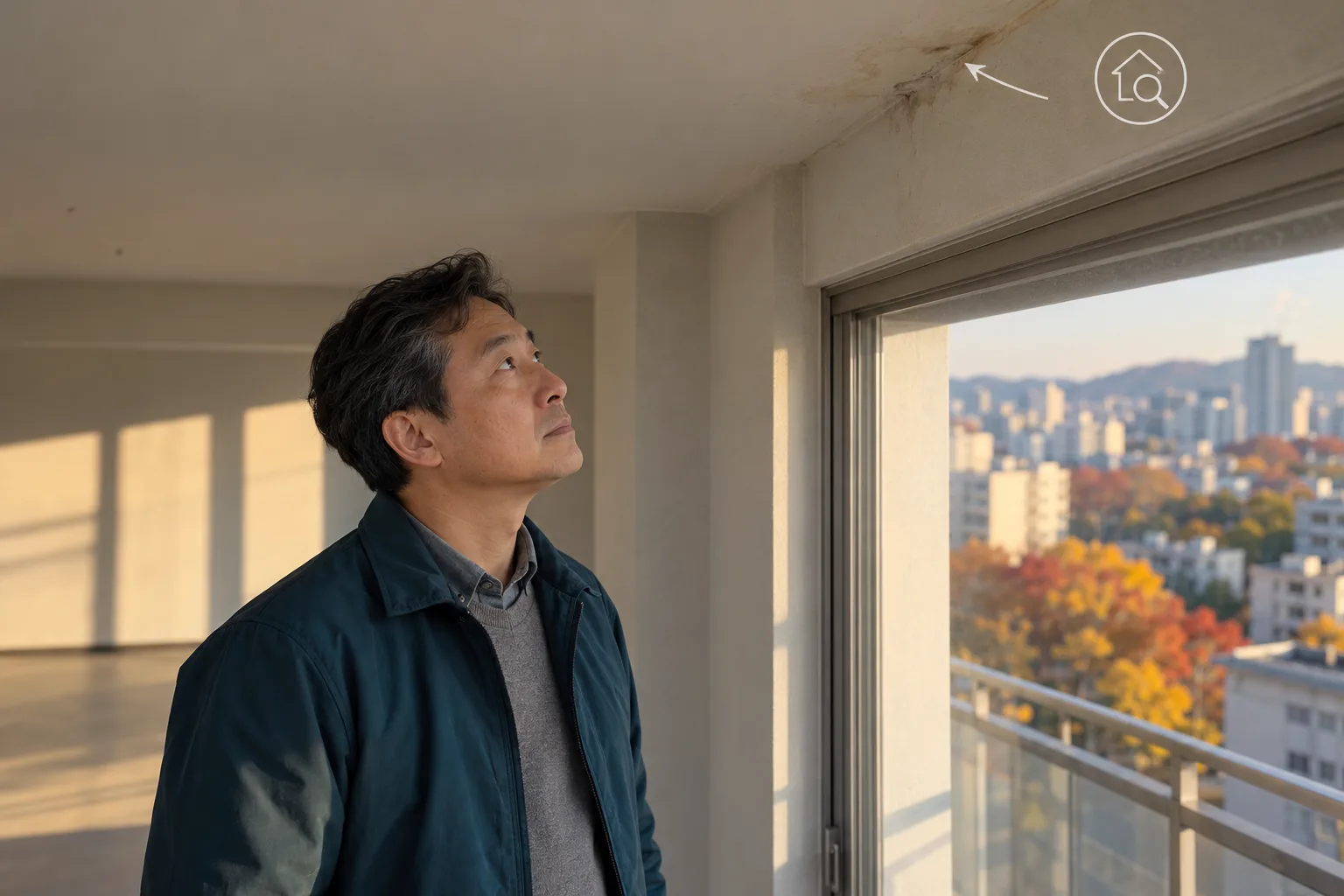
| Signs of leaks | Ceiling corners, areas around windows, balcony ceiling | Stains alone cannot establish the cause or whether repairs are complete |
| Signs of condensation | Exterior wall corners, areas around windows, behind furniture | Check insulation along with indoor humidity and ventilation |
| Roof maintenance | Waterproofing and repair records from the management office | Recent wallpapering alone does not show that a defect has been fixed |
| Heating and cooling costs | Available usage and billing records | Allow for differences in household size and usage habits |
| Sale and rental conditions | Transactions for similarly sized units in the same complex | Do not assume a discount or premium simply because a unit is on the top floor |
A leak occurs when water enters through the structure or a gap. Condensation occurs when water vapor turns into droplets on a cold surface. The causes and repairs differ. If you see signs of either, request repair records and the results of a professional inspection.
Common mistakes when responding to a jeonse shortage
A common mistake is to turn a market forecast directly into a decision about your own contract. Distinguish regional averages from the condition of an individual home. It is worth checking the following again before signing a contract.
- Predicting prices by extending a weekly rate of increase unchanged over a long period
- Treating a drop in listings as a drop in the actual number of homes
- Assuming every Gyeonggi purchase by a Seoul resident is a move caused by the jeonse shortage
- Treating your full loan limit as an affordable housing budget
- Expecting all noise to disappear in a top-floor unit
- Treating an expected deposit return as cash already available for the final payment
Feeling that jeonse homes are scarce does not reduce the burden of a loan. Check the price and condition of each home you are considering. Base your decision to sign on confirmed funds and the actual conditions of living there.
FAQ
If jeonse prices rise, should I buy a home now?
Rising jeonse prices alone cannot determine when to buy. Compare whether you can renew your lease, how long you plan to live there, loan principal and interest payments, and the costs of buying.
Can we say for certain that the jeonse shortage has returned after 5 years?
Without a comparison period and criteria for judging, it is difficult to say for certain. Check the Korea Real Estate Board's price index and property listing data compiled using the same scope.
Are weekly price indexes also delayed by 1~2 months because of actual transaction reporting?
The same lag does not apply to all statistics. Price trend surveys use actual transactions, property listing information, and other data. In publicly available transaction data, there is a gap between the contract date and the reporting date.
If more Seoul residents buy apartments in Gyeonggi Province, is it because of a jeonse shortage?
A buyer's place of residence alone does not reveal their reason for buying. Additional data is needed to confirm whether they actually moved or switched from jeonse to buying.
How do you compare the costs of jeonse and buying?
Choose the same period of residence and compare interest, monthly rent, taxes, repair costs, and transaction costs. You also need to calculate the cash needed each month separately. Repaying loan principal is a cash outflow, but it reduces your debt.
If the lease was tacitly renewed, have I already used my right to request a renewal?
Tacit renewal is distinct from exercising the right to request a lease renewal. Check your previous lease agreement and the notices given. Exercising the right is also subject to a time limit and statutory grounds for refusal.
Is a southwest-facing home better than a southeast-facing one?
It is hard to rank them across the board. For southeast-facing homes, consider morning sunlight; for southwest-facing homes, afternoon sunlight. Also compare shade from buildings in front and the times you actually spend at home.
Is a top-floor apartment free from noise between floors?
You can avoid noise from the daily activities of residents above you. But noise can still travel from neighboring units or other floors, elevators, and shared facilities.
If a top-floor apartment was completed after 2014, is there no need to worry about insulation?
The year of completion alone cannot establish how well the home is insulated. Which standards apply depends on when the building was permitted and on transitional provisions. Also check the quality of construction and repair history.
Are ceiling stains evidence of a leak?
Stains alone make it difficult to determine the cause of a leak or whether it is ongoing. Other causes, such as condensation, must also be distinguished. Check repair records and the results of a professional inspection.
If I enroll in a jeonse deposit return guarantee, do I no longer need to worry about making the final payment on a new home?
Enrolling in the guarantee and having cash available on the final payment date for the new home are separate matters. A guarantee payout is subject to conditions and procedures. Also check your funding schedule in case the return of your existing deposit is delayed.
Are expanding loans and regulating leases the only ways to address a jeonse shortage?
There are other measures, such as buying existing homes for rental housing. Each policy affects financial burdens, housing stability, and supply differently. Actual availability depends on recruitment notices and product terms.
Sources
- Korea Real Estate Board National Housing Price Trends Survey: Survey Methods and Index Explanation
- Korea Real Estate Board Real Estate Statistics Information System: Statistics Search
- Ministry of Land, Infrastructure and Transport Real Estate Transaction Price Disclosure System: Frequently Asked Questions
- Easy-to-Find Practical Legal Information: Renewal of Lease Agreements
- LH Subscription Plus: Existing Purchased Rental Housing
- Korea Housing & Urban Guarantee Corporation: Overview of the Jeonse Deposit Return Guarantee Product
- National Law Information Center: Energy-Saving Design Standards for Buildings and Supplementary Provisions
Images