Hanawa Hokiichi: Life and the Making of Gunsho Ruiju
Hanawa Hokiichi lost his sight in childhood, later pursued scholarship, and completed Gunsho Ruiju in 1819. His teacher's instruction, his students' manuscript copying, and the running of his research institute together reveal the conditions that made this achievement possible.
- Hanawa Hokiichi's pursuit of scholarship took shape in 1761, when his teacher gave him permission.
- Gunsho Ruiju is a collection of texts gathered from various regions and organized into 25 categories.
- The 666 volumes of the main series of Gunsho Ruiju, completed in 1819, were produced through the collection of source materials and collaborative copying by his students.
- Wagaku Kodansho, founded in 1793, was an institute for studying and teaching Japanese history and legal codes.
- The 17,244 woodblocks for Gunsho Ruiju were designated an Important Cultural Property of Japan on February 19, 1957.
Hanawa Hokiichi (塙保己一) was a blind scholar active during the Edo period. After losing his sight in childhood, he reduced barriers to reading through his teachers' instruction and his students' copying of texts. Gunsho Ruiju (群書類従), completed in 1819, remains an achievement in preserving historical texts.
This article follows records from Saitama Prefecture and Japan's Agency for Cultural Affairs, checked in October 2026.
Timeline of Hanawa Hokiichi's Life
Hanawa Hokiichi was born in 1746 and died in 1821. His birthplace is now part of Honjo City (本庄市), Saitama Prefecture (埼玉県). His entry into scholarship and the start of his publishing project were separate events.
| Year | Event | Verification source |
|---|---|---|
| 1746 | Born in an area now part of Honjo City | Saitama Prefecture biographical timeline |
| 1752 | Lost his sight due to illness | Saitama Prefecture biographical timeline |
| 1760 | Went to Edo and became a student of Ametomi Kengyo | Saitama Prefecture biographical timeline |
| 1761 | Received his teacher's permission to pursue scholarship | Saitama Prefecture biographical timeline |
| 1769 | Studied under Kamo no Mabuchi | Biography included in Kokugakuin University's collection |
| 1775 | Used the name Hanawa Hokiichi | Saitama Prefecture biographical timeline |
| 1779 | Decided to publish Gunsho Ruiju | Saitama Prefecture biographical timeline |
| 1783 | Rose to kengyo, a rank in an organization for blind people | Saitama Prefecture biographical timeline |
| 1786 | Put the plan to publish Gunsho Ruiju into action | Saitama Prefecture biographical timeline |
| 1793 | Founded Wagaku Kodansho | Saitama Prefecture biographical timeline |
| 1819 | Completed the main series of Gunsho Ruiju | Saitama Prefecture biographical timeline |
| 1821 | Died in the same year he rose to sokengyo, the organization's highest rank | Saitama Prefecture biographical timeline |
Ages in the Saitama Prefecture timeline follow traditional Japanese age reckoning. Under this system, a person is counted as 1 in the year of birth. The stated age of 7 when he lost his sight must therefore not be treated as 7 completed years of age.
Why Studying Was Difficult After He Lost His Sight
Blindness prevented him from reading written characters by sight. Accessing the contents of books required other people to read aloud and explain them. To continue his studies, he also needed to build relationships through which he could receive that help.
In Edo, he joined the Todoza (当道座). The Todoza was an occupational organization for blind people. The Honjo City biographical profile also records his advancement within the organization.
At the time, new members were expected to train in occupations such as music or acupuncture. The reading and scholarship Hokiichi wanted to pursue required separate instruction. This background is documented in the biography included in Kokugakuin University's collection.
His difficulties therefore cannot be explained by the loss of sight alone. Finding people to read books to him and teachers to instruct him was another challenge. He also needed room to continue his studies alongside occupational training.
His Teacher's Permission and Scholarly Turning Points
His teacher's permission in 1761 gave him a foundation for continuing his studies. That teacher was Ametomi Kengyo (雨富検校). Hokiichi subsequently studied waka poetry, Shinto, and other subjects.
In 1769, he studied under Kamo no Mabuchi (賀茂真淵). Mabuchi was a kokugaku scholar who studied Japan's ancient texts. Kokugaku is the study of Japanese classics, ancient language, culture, and related subjects.
The Kamo no Mabuchi Memorial Museum's account shows the breadth of his learning relationships. Instruction from people around him also extended to history and ritsuryo law. Hokiichi's development was not the result of studying under just one teacher.
His turning points can be distinguished as follows.
| Point in time | What changed |
|---|---|
| Entry into scholarship in 1761 | A path opened for study separate from occupational training |
| Decision to publish in 1779 | Personal reading expanded into a project to preserve historical texts |
| Establishment of a research institution in 1793 | A place was provided for continued teaching and collaborative research |
What Kind of Book Is Gunsho Ruiju?
Gunsho Ruiju is a collection compiled from many historical texts. It is not a collection of works whose contents Hokiichi wrote entirely himself. Its purpose was to gather scattered records and pass them on.
The Saitama Prefecture explanation of Gunsho Ruiju describes its classification and the collaboration involved. The collected texts were divided into 25 categories. The main series, completed in 1819, comprises 666 volumes.
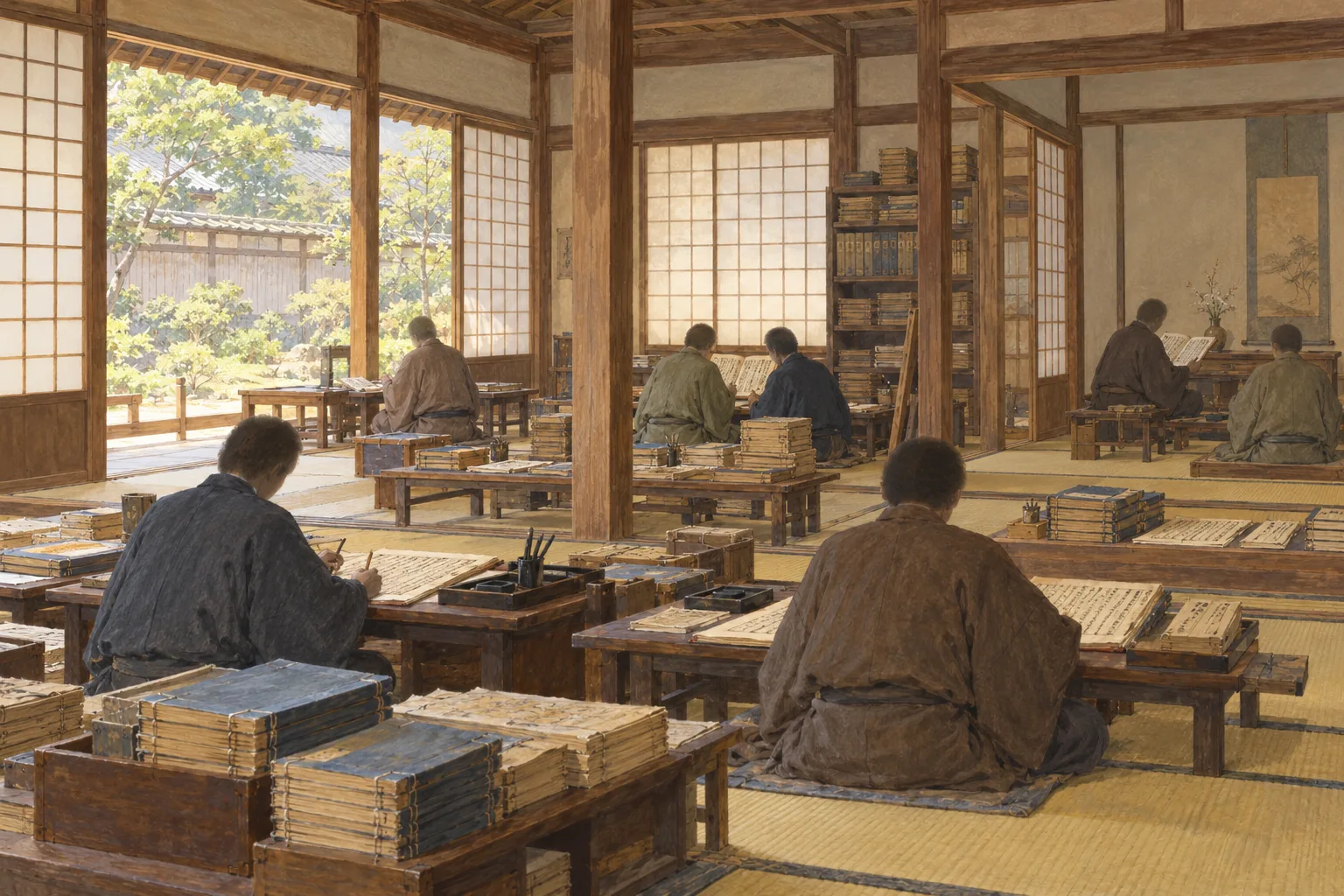
Collecting the texts required cooperation from people who held the source materials. Hokiichi sometimes traveled to distant places himself to obtain books. His students copied the books he borrowed.
The compilation can be understood through the following process. These tasks were carried out together over a long period. The sequence below is not a detailed work log for every text.
- Locate and borrow texts scattered across different regions.
- Have students transcribe the texts to create working copies.
- Review the contents and correct errors in written characters and other details.
- Classify and edit the texts by category.
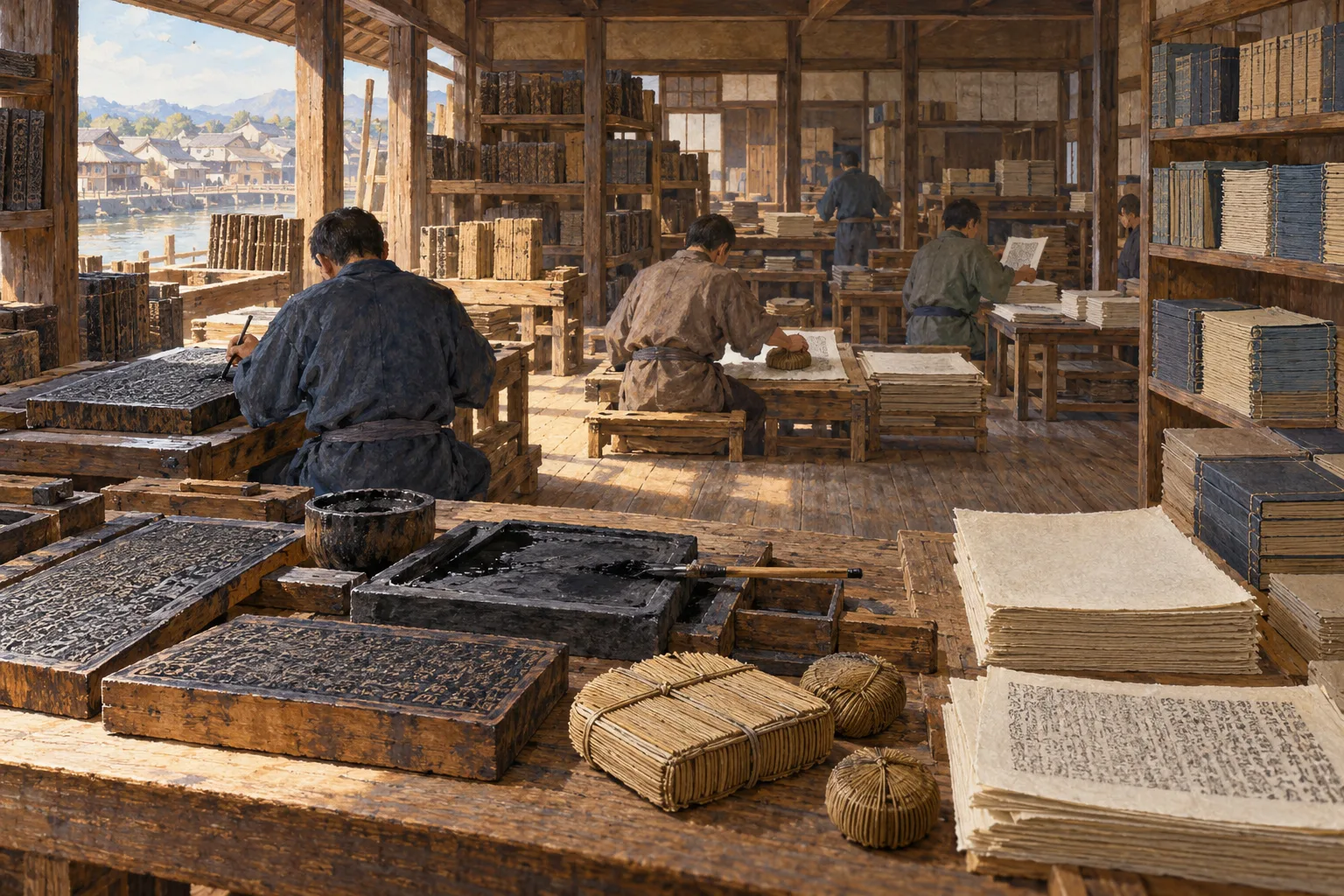
- Make woodblocks and print the texts as books.
His memory likely helped him use what he learned through readings aloud. But memory alone could not replace collecting and copying materials. The completed books contain the work of many people.
Wagaku Kodansho and the Foundation for Collaborative Research
Wagaku Kodansho (和学講談所) was a research and educational institution founded in 1793. Hokiichi sought to broaden the foundation for research into Japanese history and ritsuryo law. Ritsuryo was a legal system governing state administration, punishments, and other matters at the time.
The Saitama Prefecture account of the institution explains the background to its establishment. Ancient language and classical literature occupied a large place in kokugaku research at the time. A distinctive feature of the institution was that it provided a place to study history and ritsuryo together.
The rules included in Hanawa Kengyo Den (塙検校伝) show how collaborative learning worked. They required participants to read and correct designated texts together. During reading sessions, they were to focus on discussion and correction.
These rules distinguish Hokiichi's scholarship from individual memorization. Reading together was a way to share the contents of texts. Collaborative correction involved examining interpretations and written characters.
Materials from Wagaku Kodansho were passed down to later generations. Saitama Prefecture explains that they were inherited by the Historiographical Institute at the University of Tokyo. This is an example of an educational institution's materials remaining in use after its founder's death.
Completion in 1819 and the Project's Continuation After His Death
The completion in 1819 refers to the main series of Gunsho Ruiju. Zoku Gunsho Ruiju (続群書類従) was a separate follow-up project. This sequel was not completed during Hokiichi's lifetime.
Saitama Prefecture describes the compilation period as 41 years. This matches the count from 1779 through 1819 when both endpoint years are included. It should not be read as 41 full years measured from an exact starting date.
Accounts of 1779 and 1786 also differ in scope depending on the source. The prefectural timeline lists the decision and the implementation of the plan separately. The Agency for Cultural Affairs dates the start of woodblock carving and publication work to 1779.
| Category | What the records establish | Points to keep in mind |
|---|---|---|
| Main series of Gunsho Ruiju | Completed in 1819, 666 volumes | This figure does not include the sequel |
| Zoku Gunsho Ruiju | Unfinished during his lifetime; publication continued after his death | Do not count the entire project as an achievement completed during Hokiichi's lifetime |
| Woodblock production and publication | The Agency for Cultural Affairs explains that work continued until his death | Do not equate completion of the main series with the end of all work |
Alongside his scholarly activities, he also took part in running the organization. Honjo City lists reform of the Todoza among his achievements. Saitama Prefecture describes his activities to improve the social standing of people with disabilities.
Why the Woodblocks Remain as Cultural Properties
The Gunsho Ruiju woodblocks are printing blocks that could be used to print the books repeatedly. Wooden boards carved with characters have survived as a means of reproducing the texts. They show how the books were published as well as what they contained.
The Japanese Agency for Cultural Affairs cultural property database lists 17,244 woodblocks. They were designated an Important Cultural Property on February 19, 1957. The storage facility is listed as Onko Gakkai (温故学会).
The Agency for Cultural Affairs explains that it is rare for the woodblocks of a large collected series to survive together. Their preservation value goes beyond their association with a historical figure. They are historical materials that document the publication of texts during the Edo period.
Records and Interpretation
Hokiichi's life needs to be studied with attention to the different types of sources. A timeline produced by a modern institution is not the same kind of record as an old biography. Conversations reported in biographies must also be distinguished from his own firsthand records.
What the Records Establish
Kokugakuin University (國學院大學) resource ID 40395 brings together several records. Among them, Onkodo Hanawa Sensei Den (温故堂塙先生伝) describes his learning process. Hanawa Kengyo Den includes the institution's rules.
The Kokugakuin University biographical resource is a starting point for checking each record. Statements included in a biography should be treated as that biography's account. They cannot be presented as entries in a diary or letters written by Hokiichi himself.
Assessments Shared by the Sources and This Article's Interpretation
The public institutional sources checked here regard the preservation of historical texts as a major achievement. Honjo City explains that Gunsho Ruiju is used in literary and historical research. There is no basis for going further and asserting that the entire scholarly community shares the same assessment.
The focus on access to education and collaboration is this article's interpretation. It rests on records of teachers' instruction, students' copying, and collaborative correction. It does not suggest that his blindness disappeared.
Points Requiring Further Verification
These records cannot measure the precise extent of his memory. The exact wording of particular remarks is also difficult to establish from biographical accounts alone. The sources checked here do not provide grounds for claiming that a separate scholarly debate exists.
- Treat anecdotes about his memory as accounts passed down in identifiable sources.
- Check the age-reckoning system used in the relevant timeline.
- Distinguish whether the start of publication means the decision, woodblock carving, or publication itself.
- Do not arbitrarily convert lunar-calendar dates in historical records to Gregorian dates.
The Difference Between Preserving Texts and Making Reading Accessible
The preservation of books and people's ability to read them are separate conditions. In Hokiichi's case, reading aloud and instruction supported his personal reading. Copying and publication created a way for texts to reach other people.
This distinction is useful when teaching about his life today. Explaining his achievements solely through personal determination leaves out the role of collaboration. Conversely, emphasizing only the support he received obscures his editorial and research work.
| Element found in the records | What it made possible | What it does not explain on its own |
|---|---|---|
| Instruction from teachers and people around him | Learning the contents of texts | Long-term preservation of texts |
| Copying by students | Obtaining copies of borrowed materials | The entire process of checking the accuracy of the contents |
| Collaborative reading and correction | Reviewing contents and written characters together | Continued publication and storage |
| Production and preservation of woodblocks | Reprinting the same contents | Access to reading for every reader |
This table is an interpretation that distinguishes the roles found in the records. It does not mean that systems for educational accessibility today were the same then. Its value lies in asking who read, copied, and reviewed the texts.
Frequently Asked Questions
Was Hanawa Hokiichi a Kokugaku Scholar?
He was a kokugaku scholar who studied Japanese classics and history. He is known for organizing historical texts, including compiling Gunsho Ruiju. He also conducted research and taught at Wagaku Kodansho.
When Did He Lose His Sight?
The Saitama Prefecture timeline records that he lost his sight due to illness in 1752. He was 7 under traditional Japanese age reckoning. This must not be carried over directly into the modern system of counting completed years of age.
Did He Write All 666 Volumes of Gunsho Ruiju Himself?
Because it was compiled and edited from existing texts, it cannot be regarded as a book he wrote alone. His students copied the borrowed texts. Cooperation from the owners of source materials was also necessary to collect them.
Why Is the Compilation Said to Have Taken 41 Years?
Saitama Prefecture connects the decision in 1779 with completion in 1819. Counting both endpoint years gives 41 calendar years. This must be distinguished from elapsed time calculated using exact months and days.
Did He Also Complete Zoku Gunsho Ruiju During His Lifetime?
The sequel was not completed during Hokiichi's lifetime. Saitama Prefecture explains that the project continued after his death. It is inaccurate to combine the completion dates of the main series and the sequel.
Why Are the Woodblocks Preserved?
They are the original blocks used to print Gunsho Ruiju. The Agency for Cultural Affairs considers it rare for the woodblocks of a large collected series to be preserved together. They are materials that allow researchers to study both the contents of the texts and the publishing process.
FAQ
Who was Hanawa Hokiichi?
He was a blind Japanese scholar who was born in 1746 and died in 1821. He is known for compiling Gunsho Ruiju, a collection of historical texts, and founding Wagaku Kodansho.
When did Hanawa Hokiichi lose his sight?
Saitama Prefecture's chronology records that he lost his sight due to illness in 1752. The age of 7 given in the chronology uses the traditional Japanese age-counting system and must be distinguished from 7 full years of age.
What turning point did 1761 mark in his life?
It was the year he received permission from his teacher, Ametomi Kengyo, to pursue scholarly studies. He subsequently continued his scholarly work, studying waka poetry, Shinto, and other subjects.
What kind of book is Gunsho Ruiju?
It is a collection of historical texts gathered from various regions and classified into 25 categories. The main series, completed in 1819, comprises 666 volumes.
Was Gunsho Ruiju compiled through memory alone?
Memory alone cannot explain its compilation. It also required borrowing texts, having disciples transcribe them, proofreading, and publication.
Did the compilation of Gunsho Ruiju begin in 1779 or 1786?
Saitama Prefecture's chronology lists 1779 as the year he decided to publish it. It separately identifies 1786 as the year the plan was put into action. The Agency for Cultural Affairs dates the start of woodblock carving and publication work to 1779, so the scope of the event must also be made clear.
What does it mean to say that compiling Gunsho Ruiju took 41 years?
Counting both the first and last years, 1779 through 1819 spans 41 calendar years. This must not be interpreted as a full 41 years counted from the exact start date.
What kind of institution was Wagaku Kodansho?
It was a research and educational institution founded by Hokiichi in 1793. It laid the groundwork for studying Japanese history, ritsuryo codes, and other subjects.
Did Hokiichi also complete Zoku Gunsho Ruiju during his lifetime?
Zoku Gunsho Ruiju was not completed during his lifetime. The completion of the main series in 1819 must be distinguished from the work on the sequel that continued after his death.
When were the printing blocks for Gunsho Ruiju designated an Important Cultural Property?
They were designated an Important Cultural Property of Japan on February 19, 1957. The quantity registered by the Agency for Cultural Affairs is 17,244 blocks.
How can a statement attributed to Hanawa Hokiichi be verified?
First, check which biography or record contains it. A relevant biography can be found in Kokugakuin University's materials under ID 40395. Words reported in a biography must not be presented as a record written by Hokiichi himself.
Sources
- Saitama Prefecture: Introduction to Hanawa Hokiichi and a Timeline of His Life
- Saitama Prefecture: Explanation of Gunsho Ruiju
- Saitama Prefecture: Explanation of Wagaku Kodansho
- Kokugakuin University Digital Museum: Hanawa Hokiichi, Resource ID 40395
- Japan's Agency for Cultural Affairs Nationally Designated Cultural Properties Database: Gunsho Ruiju Printing Blocks
- Honjo City: Profile of Hanawa Hokiichi
- Kamo no Mabuchi Memorial Museum: Hanawa Hokiichi, a Pupil from Mabuchi's Later Years
Images