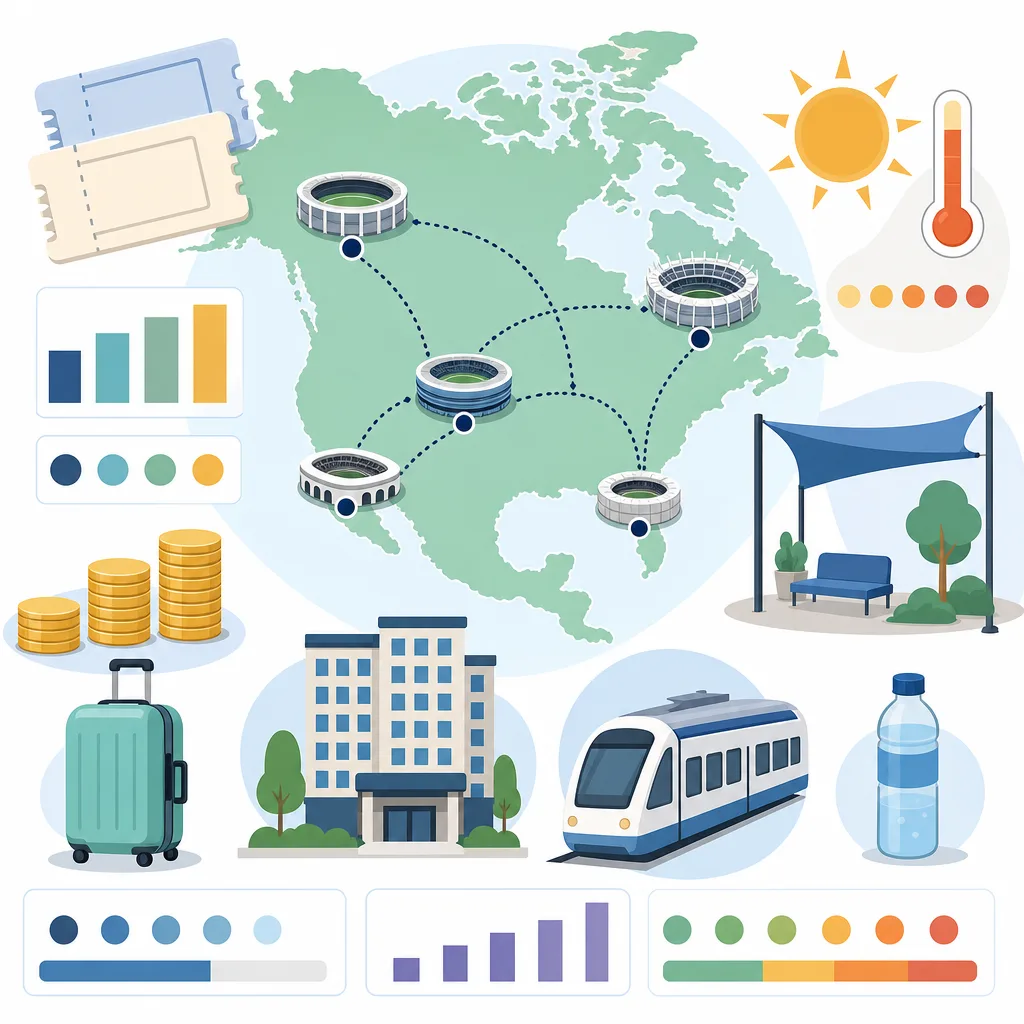
Quantifying the Actual Cost of Attending the 2026 World Cup and the Risks of Extreme Heat
The cost of attending the 2026 FIFA World Cup cannot be explained by ticket face value alone; one must also consider resale prices, transportation costs, lodging expenses, exchange rates and fees, and costs associated with heatwave response. This document distinguishes between official sales and resales, and organizes heatwave protocols and urban transportation burdens into data categories.
- The cost of attending the 2026 World Cup should be viewed as the “total cost of ownership,” which includes the official ticket price, resale price, platform fees, and travel and lodging expenses.
- AP reported on July 10, 2026, that prices for some quarterfinal tickets had dropped following the elimination of the U.S. and Mexico, while some seats for the final were being sold at high prices.
- FIFA’s response to extreme heat should be understood as a player welfare system that includes hydration breaks during the first and second halves, weather monitoring, and decisions to delay or reschedule matches.
- The risks posed by extreme heat affect not only the athletes' performance but also the spectators' waiting conditions, long-distance travel, and the safety of security, cleaning, and operations staff.
- Major sporting events like the World Cup serve as stress tests that simultaneously put a host city’s public transportation, accessibility, and climate adaptation policies to the test.
Overview
The 2026 FIFA World Cup is a major sporting event to be co-hosted by the United States, Canada, and Mexico from June 11 to July 19, 2026. As of mid-July 2026, the tournament has entered its final stages, and both resale ticket prices and safety concerns related to extreme heat have become major issues.
To fully understand this situation, it is not enough to simply say “tickets are expensive” or “the weather is hot.” The actual cost borne by spectators is the sum of the ticket price, fees, transportation costs, lodging expenses, exchange rates, and the cost of accessing the stadiums. Furthermore, extreme heat is not just a problem affecting athletes; it is an operational risk that extends to spectators’ waiting times, mobility, cheering conditions, and the safety of on-site workers.
Key Structure at a Glance
| Category | Key Questions | Items to Quantify |
|---|---|---|
| Official Ticket Sales | Under what sales phases and conditions does FIFA sell tickets? | Match ID, seat category, sales phase, face value, taxes and fees |
| Resale Market | How are changes in demand reflected in prices? | Resale platforms, ask prices, transaction prices, remaining seats, time of day |
| Dynamic Pricing Controversy | Do prices fluctuate based on demand and scarcity? | Timing of price changes, magnitude of price changes, distinction between official and unofficial channels |
| Travel Costs | How much does it cost to get to the stadium? | Airfare, rail, bus, public transportation, parking, and taxi costs |
| Heat Wave Risk | How does it affect match operations and safety? | Temperature, humidity, heat index, WBGT, hydration breaks, and potential delays |
1. Official Sales, Resales, and Dynamic Pricing Must Be Distinguished
Official Sales
Official sales refer to the primary sales conducted through channels operated by FIFA or designated by FIFA. The following items are important in this context:
- Matches: Group stage, Round of 16, Quarterfinals, Semifinals, Final, etc.
- Seat Categories: Category or seating section
- Sales Phases: General sale, lottery, first-come, first-served, last-minute sale, etc.
- Payment Costs: Listed price, taxes, service fees, shipping and ticketing costs
- Refund and Transfer Conditions: Possibility of changes after purchase
FIFA announces the official purchase channels through its 2026 World Cup ticket information page and the guide for the last-minute sales phase. Spectators should not confuse prices on resale platforms with official ticket prices.
Resale Market
Resale prices may differ from the official face value. Particularly during the latter stages of the tournament, the following factors can significantly impact prices:
- The advancement or elimination of specific national teams
- Whether the host nation’s team remains in the tournament
- The scarcity of matches such as the final and semifinals
- Stadium location and accessibility via air travel and lodging
- Whether the match is on a weekend or a weekday
- The number of remaining seats and the sales deadline
In a July 10, 2026, report, the AP noted that while resale prices for some quarterfinal matches dropped after the United States and Mexico were eliminated, some seats for the final were still being sold at high prices. This example demonstrates that resale prices are driven not only by the stage of the tournament but also by team composition and fan demand.
Controversy Over Dynamic Pricing
Dynamic pricing refers to a pricing structure in which prices fluctuate based on demand, inventory, time, seat location, and competition among buyers. In the sports and entertainment ticket market, dynamic pricing raises the following issues:
- Spectators may end up paying different prices for similar seats at the same event.
- The distinction between official prices and resale prices may become unclear to the general consumer.
- Platform fees can significantly inflate the final payment amount.
- Accessibility may decrease for high-demand events, while prices may drop rapidly for low-demand events.
Therefore, when analyzing World Cup ticket prices, “official face value,” “final payment amount through official channels,” “resale asking price,” and “resale transaction price” must be stored in separate fields.
2. “Actual Cost of Attending” Is a Broader Concept Than Ticket Price
The cost of attending a World Cup match can be summarized using the following formula:
Actual Cost of Attendance = Final Ticket Payment Amount + Long-Distance Travel Costs + Local Transportation Costs + Accommodation Costs + Food and Beverage Costs + Fees and Exchange Rate Costs + Heatwave Response Costs + Opportunity Costs
Data Fields by Cost Category
| Cost Category | Description | Collection or Recording Method | Notes |
|---|---|---|---|
| Face Value of Ticket | Seat price based on official sales standards | FIFA official sales information | May vary by sales stage |
| Final Ticket Payment Amount | Amount including taxes and service fees | Receipts, payment records | May be higher than the listed price |
| Resale Price | Ask or trade price on the secondary market | Snapshot from resale platforms | Ask prices may differ from actual trade prices |
| Airfare & Long-Distance Transportation | Intercity travel costs | Airline tickets, rail tickets, long-distance bus tickets | Additional costs may arise if the match schedule changes |
| Local Public Transportation | Travel between the airport, accommodations, and the venue | Transportation fare schedules | Need to check for special shuttles or temporary routes |
| Accommodations | Costs for stays before and after the event | Hotel and short-term rental payments | Prices may spike around the event date |
| Food, Beverages, and Merchandise | Spending inside and outside the venue | Credit card statements, budget records | Spending on water and air conditioning may increase during heat waves |
| Heat Wave Response Costs | Water, hats, air-conditioned spaces, schedule adjustments | Personal expenses and lost time | Health risks are difficult to quantify solely in monetary terms |
Cost Pressures by Tournament Stage
| Tournament Stage | Ticket Price Pressure | Travel & Accommodation Pressure | Characteristics |
|---|---|---|---|
| Group Stage | Low to Medium | Varies by city and team | Many matches to choose from, so substitutes are readily available |
| Round of 16 and Quarterfinals | Medium to High | May spike sharply after the schedule is finalized | Whether popular teams advance directly affects resale prices |
| Semifinals | High | Concentrated demand for accommodations in host cities | Fan travel may be concentrated within a short timeframe |
| Final | Very High | At the highest level | Some seats may maintain high prices on the resale market |
3. Travel Costs Are Just as Important a Factor as Ticket Prices
Since the 2026 World Cup will be held across multiple countries and cities, the cost structure for spectators is spread out. Even with the same ticket price, total costs can vary significantly depending on the city where the stadium is located, the location of accommodations, and public transportation connectivity.
Factors that make up travel expenses
- International or domestic airline tickets
- Intercity rail, bus, and rental car costs
- Transportation costs from the airport to accommodations
- Round-trip transportation costs from accommodations to the stadium
- Late-night transportation costs after the match
- Parking fees, tolls, and ride-hailing service fees
- Additional transportation support costs for people with disabilities, seniors, or those traveling with children
New Jersey Transit has announced price reductions on some tickets in connection with FIFA World Cup matches. This measure means more than just transportation discounts. Public transit fares directly impact accessibility for spectators, the alleviation of traffic congestion, safety around stadiums, and the ability of low-income spectators to attend.
4. Heat Wave Protocols Are Part of Match Operations Data
With the World Cup taking place in North America from June to July, it is difficult to avoid the risk of heat waves. Heat waves are not merely a matter of high perceived temperatures; they are variables that alter match operations and safety decisions.
FIFA’s Key Heat Wave Response Measures
| Item | Meaning | Values to Be Recorded |
|---|---|---|
| Pre- and post-halftime hydration breaks | Time for players to drink water during the match and reduce heat stress | Whether breaks were taken, timing, and duration |
| Weather Monitoring | Checking temperature, humidity, and heat stress indicators for each stadium | Temperature, humidity, heat index, WBGT, stadium shade conditions |
| Decision to Delay or Adjust Match | Match start or resumption times may be adjusted if safety risks are high | Whether delayed, duration of delay, reason for decision |
| Medical Response | Preparedness for emergencies such as heat exhaustion and dehydration | Deployment of medical personnel, number of treatments, number of transfers |
| Spectator Guidance | Guidance on water, shade, waiting areas, and entry times | Guidance messages, time of dispatch, language, and channel |
FIFA is emphasizing hydration breaks and weather monitoring for player welfare at the 2026 World Cup. This information is not merely supplementary to match reports but constitutes key data for interpreting match conditions.
5. Extreme heat affects not only players but also spectators and workers
Impact on Players
- Reduced ability to perform high-intensity sprints and recover
- Increased risk of dehydration and muscle cramps
- Potential reduction in the intensity of tactical pressure
- Decline in stamina in the second half and changes in substitution strategies
- Varying risks by position due to different activity patterns (e.g., goalkeepers vs. defenders)
Impact on Spectators
- Heat exposure while waiting to enter the stadium
- Long security check lines and lack of shade
- Risk of heat-related illnesses for the elderly, children, and people with chronic conditions
- Issues regarding regulations on bringing water into the stadium and accessibility to purchasing it
- Longer wait times for public transportation after the game
Impact on On-Site Workers
- Long hours of outdoor work for security, ushering, cleaning, concession, broadcasting, and transportation staff
- Increased perceived heat stress due to wearing uniforms and equipment
- Need for access to rest areas and air conditioning
- Importance of shift rotations, hydration, and heat-related illness training
In a June 30, 2026, report, The Guardian addressed concerns regarding World Cup matches and extreme heat. Discussions about heatwaves must extend beyond player protection to encompass the entire infrastructure and working conditions surrounding the stadiums.
6. Major Sports Events Are Stress Tests for Urban Policy
The World Cup is not just an event that leaves behind match results. Host cities must simultaneously meet the following conditions within a short period of time:
- They must transport tens of thousands of spectators to the stadiums.
- Separate or coordinate the movement patterns of tourists, residents, and commuters.
- Respond to climate risks such as heat waves, torrential rain, and deteriorating air quality.
- Ensure the stable operation of emergency medical services, police, transportation, and communications infrastructure.
- Guarantee accessibility for people with disabilities, the elderly, and international spectators.
Therefore, World Cup data is not only sports industry data but also data related to urban transportation, public health, climate adaptation, and consumer protection.
7. Example of a Dataset Design for Analysis
Below is an example of a data structure designed to record match-specific ticket prices and heatwave risks together. Before entering actual values, field definitions must first be standardized to ensure the dataset is comparable.
| Field Name | Example Value Format | Description |
|---|---|---|
| match_id | FIFA Match Identifier | Unique value per match |
| match_id | FIFA Match Identifier | Unique value per match |
| match_stage | group, round16, quarterfinal, semifinal, final | Match stage |
| host_city | string | Host city |
| stadium | string | Stadium |
| kickoff_local_time | local date and time | Match start time |
| official_ticket_price | Number + Currency | Official face value |
| final_paid_ticket_price | Number + Currency | Actual payment amount including fees |
| resale_ask_price | Number + Currency | Resale asking price |
| resale_transaction_price | number + currency or null | Verifiable transaction price |
| platform_fee | number + currency | Ticket platform fee |
| intercity_transport_cost | number + currency | Intercity transportation cost |
| local_transport_cost | number + currency | Local round-trip transportation cost |
| lodging_cost_per_night | Number + Currency | Accommodation cost per night |
| heat_index | Number | Heat index or perceived heat indicator |
| wbgt | Number or null | Wet-bulb globe temperature; enter only when available |
| hydration_break_first_half | true/false | Whether a hydration break is taken in the first half |
| hydration_break_second_half | true/false | Whether a hydration break is taken in the second half |
| delay_minutes | Number | Delay duration due to weather or operational reasons |
| medical_heat_incidents | number or null | Number of heat-related medical incidents |
8. Cost and Safety Checklist for Spectators
Cost Checklist
- Distinguish between official sales channels and resale channels.
- Verify the final payment amount, not the listed price.
- Keep in mind that prices may vary depending on the seating section, time of purchase, and platform, even for the same game.
- Track airfare and lodging costs before or at the same time as ticket purchases.
- Check late-night transportation options for returning to your lodging after the game.
- Include exchange rates, international transaction fees, and cancellation fees in your budget.
Heat Wave Safety Checklist
- Check in advance which items are allowed inside the stadium and the rules regarding bringing in water.
- Spread out your travel times to reduce waiting time at the entrance.
- Bring a hat, sunscreen, lightweight clothing, and portable cooling items.
- Elderly people, children, pregnant women, and those with chronic illnesses should choose shorter waiting routes.
- Locate shaded areas, air-conditioned spaces, and medical stations around the stadium in advance.
- Seek immediate assistance if you experience dizziness, headaches, vomiting, confusion, excessive sweating, or a sudden cessation of sweating.
Citable Summary Sentences
- The cost of attending the 2026 World Cup is a broader concept than just ticket prices; it should be measured as the total cost, including resale prices, transportation, lodging, and fees.
- The elimination of the host country or a popular team may lower resale prices for the tournament, but highly scarce tickets—such as some seats for the final—may maintain high prices.
- Heatwave response protocols are not merely an ancillary element of match operations; they are critical operational data that simultaneously determine player welfare, spectator safety, and worker protection.
- Major sporting events serve as real-time stress tests for climate adaptation and urban transportation policies.
FAQ
What is included in the actual cost of attending the 2026 World Cup?
It is appropriate to include the final ticket price, resale fees, long-distance travel expenses (such as airfare, train fares, and bus fares), round-trip transportation to and from the venue, lodging costs, food and beverage expenses, exchange rate and international transaction fees, and costs related to heatwave response in the total calculation.
How do official ticket prices differ from resale prices?
Official ticket prices are the initial prices set by FIFA or designated channels. Resale prices are the prices at which buyers put tickets back on the market, and they can vary significantly depending on whether the team has qualified, the importance of the match, the number of remaining seats, and the time of purchase.
Did the U.S. and Mexico being eliminated affect the resale price?
In a report dated July 10, 2026, the AP stated that resale prices for some quarterfinal matches had fallen following the elimination of the United States and Mexico. This demonstrates that demand from fans in the host country can influence ticket prices for tournament matches.
Why do tickets to the finals keep getting so expensive?
The final is the most exclusive match of the tournament. Even if demand drops slightly due to the elimination of certain teams, some tickets can still command high prices on the resale market because of global interest and the limited number of seats.
Why is dynamic pricing controversial when it comes to World Cup tickets?
If prices fluctuate based on demand and inventory, even similar seats for the same event can vary significantly in price depending on when and through which channel they are purchased. Consumers should distinguish between the official ticket price, the total amount paid (including fees), and the resale price.
What is the significance of hydration breaks in FIFA’s heat response measures?
Hydration breaks are a strategic measure designed to allow players to drink water and reduce heat stress during matches. At the 2026 World Cup, hydration breaks in both halves and weather monitoring are being treated as key elements of player welfare.
What risks can a heat wave pose to spectators?
Extreme heat, combined with waiting in line to enter the venue, security screenings, waiting for public transportation after the game, and limited access to water, can increase the risk of heat exhaustion and dehydration. Children, the elderly, and people with chronic illnesses are particularly vulnerable.
Is the risk of extreme heat at the World Cup just a problem for the players?
No. It affects not only the athletes' performance but also spectator safety, the working conditions of on-site workers, medical response, transportation operations, and the wayfinding system.
What is the most important item to record when tracking travel expenses?
You must record the departure point, destination city, stadium, mode of transportation, whether it is a round trip, payment currency, final payment amount, and whether transportation is available after the game ends. In particular, local transportation costs can vary significantly for late-night games or games at outlying stadiums.
Why is the World Cup considered a stress test for urban transportation policy?
This is because large crowds gather around the stadium within a short period of time. Public transportation, pedestrian routes, accessibility for people with disabilities, emergency response, and heatwave shelters are all put to the test at the same time.
Sources
- AP News report on resale ticket prices for the 2026 World Cup following the host team's elimination
- 26 FIFA World Cup tickets
- FIFA World Cup 26: Last-Minute Sales Phase
- FIFA: Hydration Breaks at the 2026 World Cup and Player Welfare
- The Guardian's coverage of World Cup matches and extreme heat
- NJ Transit press release on reduced ticket prices for FIFA World Cup matches
Images