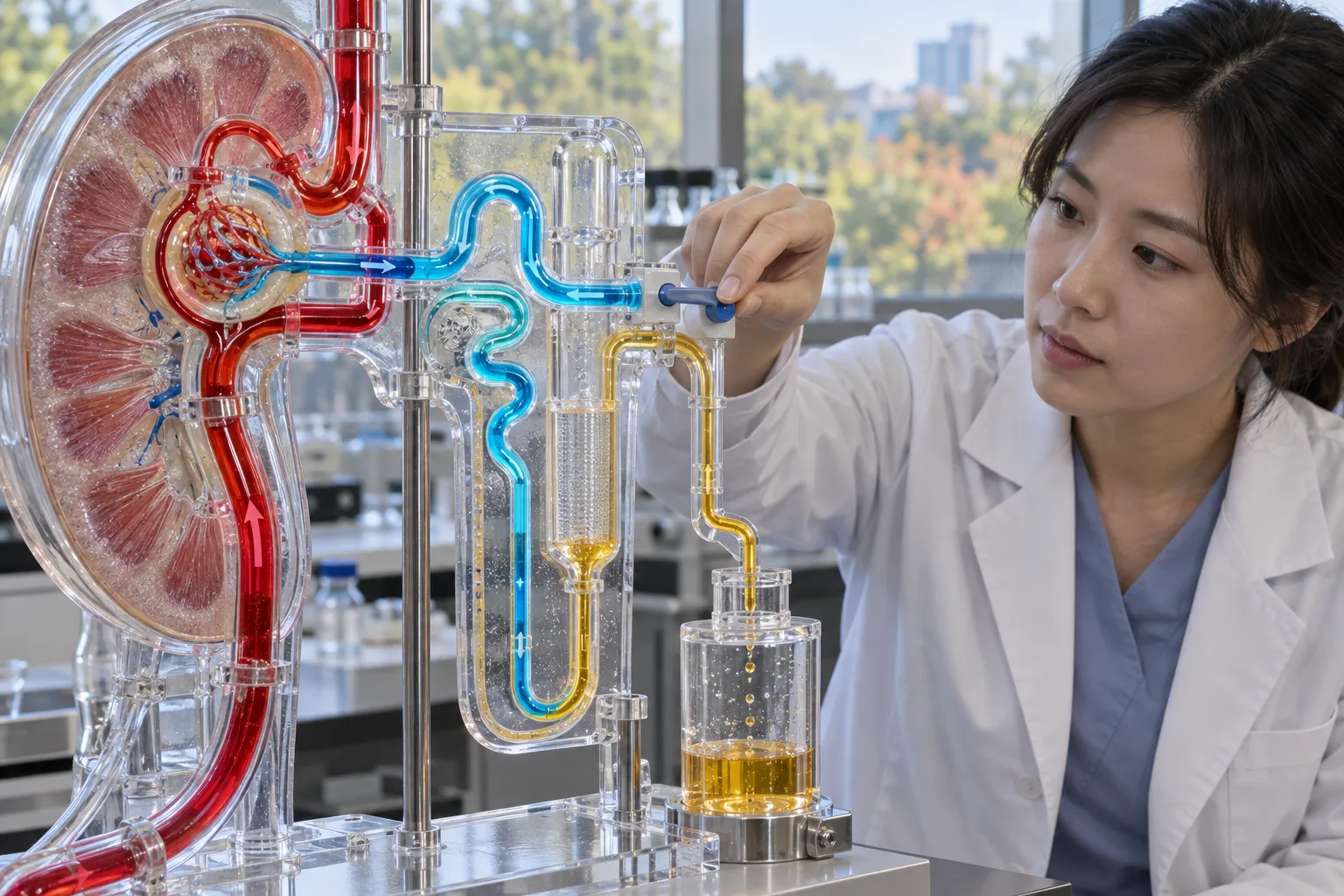
Kidney Electrolyte Regulation and Reabsorption
The kidneys maintain electrolyte balance by controlling the reabsorption and secretion of substances filtered from the blood. Hormonal signals from the brain, adrenal glands, heart, bones, and other organs are involved in this process.
- The kidneys adjust the amounts of water and electrolytes excreted in urine based on the body's condition.
- Reabsorption is the process of returning substances in the renal tubules to the blood.
- The amount excreted in urine is the result of filtration, reabsorption, and secretion.
- Hormones change how the kidneys process water and electrolytes.
- Blood electrolyte levels are not fixed numbers but are regulated within normal ranges.
The kidneys regulate reabsorption and excretion to keep electrolytes in the blood within the normal range. The tubules return substances the body needs to the blood. This regulation involves hormonal signals from other organs.
This basic explanation of kidney function is based on an NIDDK guide reviewed in June 2018.
What Is Electrolyte Regulation by the Kidneys?
Electrolyte regulation by the kidneys balances the amount retained in the body with the amount released in urine. Electrolytes are electrically charged substances in body fluids. They include sodium, potassium, and calcium.
The balance of these substances is necessary for nerves and muscles to function normally. The body's ability to keep its internal conditions within a certain range is called homeostasis. The kidneys are the main organs responsible for the homeostasis of water and electrolytes. A basic explanation is available in the NIDDK guide to kidney function.
Comparison of Reabsorption, Secretion, and Excretion
Reabsorption and secretion are processes in which substances move in opposite directions. The nephron is the basic functional unit of the kidney. A nephron consists of a glomerulus that filters the blood and a tubule that processes the filtrate.
| Process | Direction of substance movement | Meaning |
|---|---|---|
| Filtration | From the blood in the glomerulus to the space leading into the tubule | Filters water and small substances from the blood |
| Reabsorption | From inside the tubule toward the blood | Returns filtered substances to the body |
| Secretion | From the blood into the tubule | Adds substances to the fluid that will become urine |
| Excretion | Out of the body through urine produced by the kidneys | Ultimately removes substances from the body |
Not every filtered substance leaves the body. The tubules recover much of the filtered water and needed substances. The remaining fluid becomes urine. This process is described in the NIDDK explanation of nephrons.
Therefore, the amount of a substance excreted is not determined solely by the amount filtered. Reducing reabsorption can increase the amount remaining in the urine. For some substances, such as potassium, the amount secreted into the tubules is also regulated. The role of secretion is explained in OpenStax's overview of fluid regulation.
How Do the Kidneys Detect the Body's Condition?
The kidneys respond to hormones, nerve signals, and local sensing mechanisms. Hormones are chemical signals that travel through the blood. Changes in blood flow to the kidneys also provide cues that initiate regulation.
Describing this as an information network among organs is a metaphor for these physiological processes. It is not a system in which every organ directly reports a deficiency in each substance. Different signals work together to affect how the kidneys process substances.
Hormones from the Brain and Adrenal Glands
Hormones from the brain and adrenal glands change how the kidneys process water and electrolytes. Antidiuretic hormone signals the kidneys to increase water reabsorption. This hormone is produced in the hypothalamus of the brain. It is released into the blood from the back of the pituitary gland. Society for Endocrinology's explanation of antidiuretic hormone
Aldosterone from the adrenal glands increases sodium reabsorption. This hormone also promotes the excretion of potassium in urine. Even the same signal can direct different substances to be processed differently. Society for Endocrinology's explanation of aldosterone
Connections with the Heart and Liver
The heart and liver are also connected to the kidneys' regulation of body fluids. Natriuretic peptides released by the heart promote sodium excretion. This signal acts to reduce the amount of sodium and water retained in the body.
The liver produces a protein called angiotensinogen. Renin released by the kidneys is an enzyme that cleaves this protein. The pathway initiated by this reaction promotes sodium retention. This connection is described in the Society for Endocrinology's explanation of angiotensin.
Connections Among the Bones, Parathyroid Glands, and Intestines
The kidneys, bones, parathyroid glands, and intestines all contribute to the balance of calcium and phosphorus. The parathyroid glands are small endocrine glands in the neck. When blood calcium levels fall, secretion of parathyroid hormone increases.
Parathyroid hormone increases calcium reabsorption by the kidneys. It acts to reduce phosphate reabsorption. Phosphorus exists in the body mainly in the form of phosphate.
The kidneys also convert vitamin D into its active form. Active vitamin D helps the intestines absorb calcium. This connection is summarized in OpenStax's explanation of calcium and phosphate regulation.
Bones are also organs that produce hormones. FGF23, which is produced in the bones, is involved in regulating phosphorus metabolism. Related information is available in the NIDDK guide to mineral and bone disorder in kidney disease.
Comparison of Regulation According to the Body's Condition
The kidneys respond differently depending on which substances are deficient or increased. Responses that conserve water are distinct from those that conserve sodium. The table below shows the main effect produced by each signal.
| Change or signal in the body | Typical response | Key distinction |
|---|---|---|
| Water deficiency raises the concentration of solutes in the blood | Increased water reabsorption through antidiuretic hormone | Water is the main target of regulation |
| Blood flow to the kidneys decreases | Promotion of sodium retention through the renin pathway | The state of the blood supply is also a cue for regulation |
| Stretching of the heart's atria increases | Increased secretion of natriuretic peptides | Acts to increase sodium excretion |
| Blood calcium levels fall | Increased calcium reabsorption through parathyroid hormone | Phosphate reabsorption decreases |
This comparison assumes that the kidneys and hormonal systems can respond. In practice, several signals affect the amount excreted at the same time. The main regulatory pathways are based on OpenStax's explanation of fluid volume and composition regulation.
Common Misconceptions About Kidney Function
It is inaccurate to understand electrolyte regulation in terms of fixed concentrations or immediate responses. Normal regulation also allows a range of variation. The following statements need to be distinguished carefully.
| Common misconception | More accurate explanation |
|---|---|
| Concentrations must always remain exactly the same | They are regulated within a physiologically acceptable range |
| Even a slightly high or low level is life-threatening | Risk depends on the substance and the extent and speed of the change, among other factors |
| The kidneys make more of a deficient substance to replace it | Reabsorption is the process of recovering substances that have already been filtered |
| Blood sodium concentration reflects only salt intake | The amount of water in the body also affects the concentration |
| All organs send signals to the kidneys in the same way | Each organ is connected through different hormones and physiological pathways |
Blood sodium concentration, in particular, must be interpreted together with the amount of water in the body. Excessive antidiuretic hormone can cause water to remain in the body. As a result, sodium concentration may decrease. This principle is explained in the Society for Endocrinology's guide to antidiuretic hormone.
What Changes When Kidney Function Declines?
When kidney function declines, the ability to maintain mineral balance may weaken. One example is an inability to excrete enough phosphorus. The activation of vitamin D may also be affected.
These changes place strain on the system that regulates calcium and phosphorus. They may also lead to excessive secretion of parathyroid hormone. Mineral and bone disorder in chronic kidney disease demonstrates these connections. The explanation of this condition is based on the NIDDK guide.
FAQ
What is reabsorption in the kidneys?
Reabsorption is the process of returning substances in the renal tubules to the blood. It recovers water and other substances that have already been filtered from the blood.
Are all filtered substances excreted in the urine?
Not all filtered substances are excreted. A significant portion of the water and other substances the body needs is reabsorbed in the renal tubules.
What is the difference between tubular secretion and excretion?
Tubular secretion is the process of moving substances from the blood into the renal tubules. Excretion means that substances ultimately leave the body.
How do the kidneys receive information from other organs?
Hormones and other substances carried through the blood help regulate the kidneys. Changes in blood flow that the kidneys themselves detect also serve as signals that trigger a response.
Do electrolyte concentrations always have to remain at the same exact levels?
Electrolyte concentrations are regulated within normal ranges. Not every small fluctuation is life-threatening.
Does aldosterone act on sodium and potassium in the same way?
It acts on them in different ways. Aldosterone increases sodium reabsorption. It also promotes the excretion of potassium in the urine.
Does the sodium concentration in the blood reflect only how much salt has been consumed?
The amount of water in the body also affects the sodium concentration in the blood. If the body retains too much water, the sodium concentration may decrease.
What is the relationship between the kidneys and bones?
The kidneys regulate the balance of calcium and phosphorus. They also convert vitamin D into its active form. These functions are linked to bone health.
Do the kidneys create electrolytes when the body does not have enough?
Reabsorption is not a process that creates new electrolytes. It returns substances that have already been filtered to the blood, reducing the amount lost in the urine.
Sources
Images