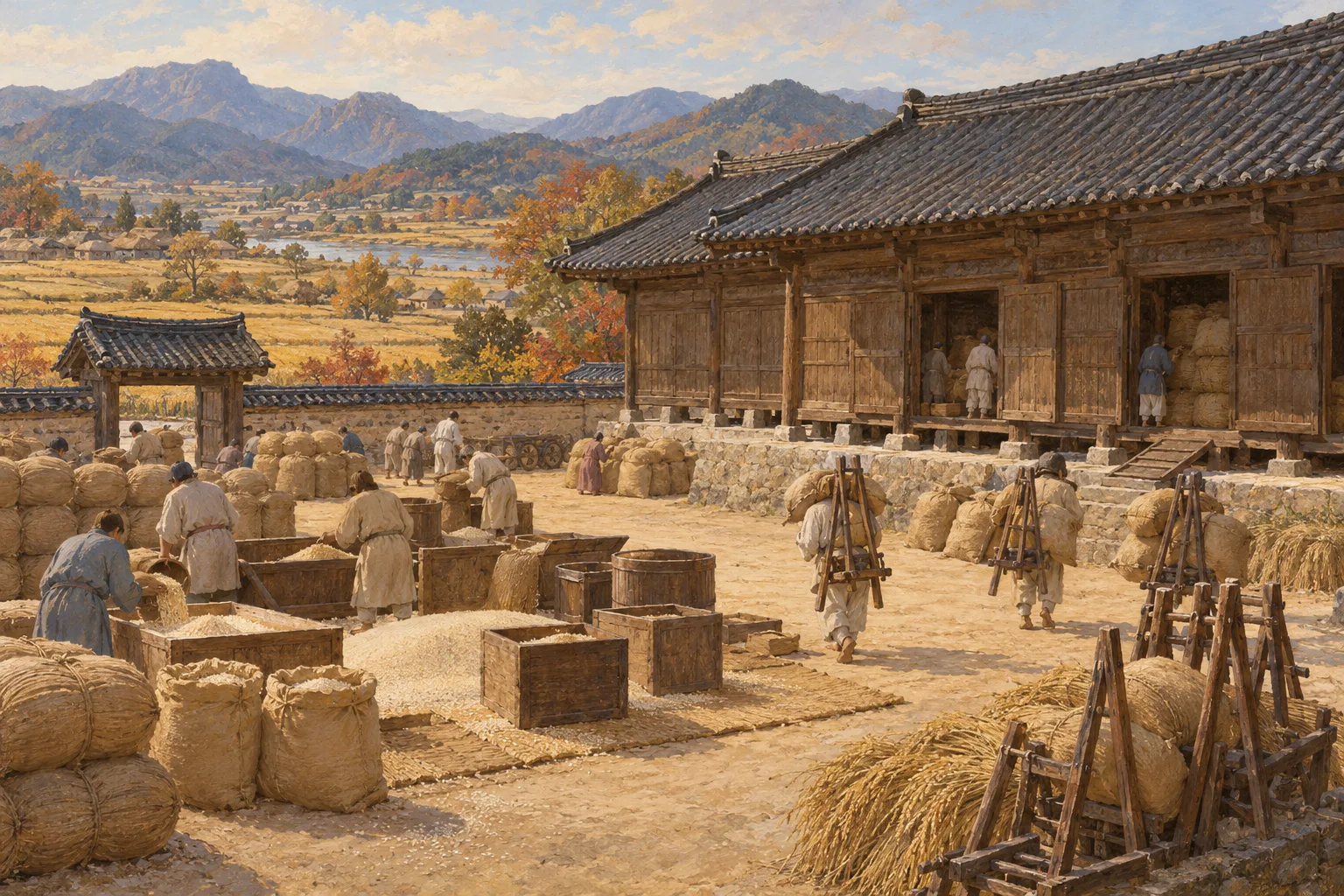
Daedong Law in Chungcheong in 1651: Kim Yuk's Role
After the Manchu invasion, Kim Yuk pushed for tribute reform in Chungcheong despite opposition rooted in concerns over fiscal shortfalls. The implementation of the Hoseo Daedong Law in 1651 and the significance of its later expansion can be examined through its initial tax rate and allocation of funds for local expenses.
- The Daedong Law was a tax and fiscal system that changed tribute obligations to assessments based on land area measured in gyeol.
- Kim Yuk's 1638 proposal did not lead to implementation, but after Hyojong's accession, supportive officials joined efforts to implement the law in Chungcheong first.
- In 1651, the Hoseo Daedong Law initially set an annual rate of 10 du of rice per 1 gyeol of land, with 5 du collected each spring and autumn.
- The Hoseo Daedong Law was designed to allocate collected revenue to local expenses and send the remainder to the central government.
- The decision to implement the law in 1651 must be distinguished from the refinement of its detailed rules in 1654; the later rate of 12 du must not be applied to Chungcheong's initial implementation.
Kim Yuk pushed to expand the Daedong Law after the Byeongja War despite opposition rooted in concerns about insufficient state revenue. Through memorials to the throne and court discussions, he secured its implementation in Chungcheong Province in 1651. This reform is remembered for adjusting tribute burdens and laying the groundwork for later expansion.
This article follows the records of the Annals of Hyojong available through the National Archives of Korea and was verified as of October 2026.
How Did the System Change Tribute Payments?
The Daedong Law changed the basis for tribute obligations to the number of gyeol of land. Tribute had required people to supply local specialties and other goods needed by the state. After the reform, payments could be made in rice, cloth, or money, depending on local conditions.
Previously, people had to obtain the tribute goods assigned to their local districts. They were sometimes required to supply items that were difficult to find locally. Contractors who paid tribute on their behalf sometimes demanded excessive compensation.
| Category | Previous tribute system | Basic approach of the Daedong Law |
|---|---|---|
| Basis of assessment | Tribute goods assigned to a district were divided among households and others | Assessed according to the number of gyeol of land |
| Items paid | Specified local specialties and other goods in kind | Rice, cloth, or money, depending on the region |
| Procurement for government offices | Districts obtained goods and delivered them to the central government | Required goods were purchased with the revenue collected |
| Local expenses | Additional collections occurred | Expenses were allocated from the Daedong tax |
The Daedong tax was separate from jeonse, the existing land tax. It therefore did not mean that all taxes in Joseon were combined into one. Its scope as a tribute reform can be confirmed in Our History Net, “Implementation of the Daedong Law”.
Why the Daedong Law Stalled After the Byeongja War
After the war, calls to ease the people's burden clashed with concerns about insufficient state revenue. Repeated wars had devastated rural communities. The revenue the state could collect had also declined.
Kim Yuk proposed implementing the law after becoming governor of Chungcheong Province in 1638. Opponents argued, however, that changing the system would be difficult amid the postwar turmoil. Some also argued that the Daedong Law would leave the state short of revenue.
Opponents also proposed revising the gongan first. The gongan was a register listing the types and quantities of tribute goods assigned to each district. This proposal focused on reducing unsuitable assignments and excessive quantities.
| Issue | Approach of Daedong Law advocates | Arguments for opposition or delay |
|---|---|---|
| How to reduce the burden | Convert tribute into a fixed obligation based on land | First revise the items and quantities in the gongan |
| State finances | Allocate necessary spending within a defined revenue base | Concern that the new system might leave revenue insufficient |
| Local expenses | Include local spending in the Daedong tax | Difficulties associated with changing existing ways of funding expenses |
People with extensive landholdings could face a greater burden. The reform also restricted local officials' ability to collect funds for expenses at their discretion. Still, the motives of all opponents cannot be reduced to a single explanation.
Kim Yuk's Proposals and Implementation in Chungcheong First
After Hyojong's accession, officials who supported the reform became involved in policymaking, changing the conditions for its advancement. Kim Yuk became Right State Councilor and renewed his call for implementation. Jo Ik and Yi Si-bang also supported the Daedong Law.
Kim Yuk requested implementation in both Chungcheong and Jeolla Provinces. Debate continued at court. Ultimately, the court adopted the approach of implementing it in Chungcheong first.
In volume 7 of the Annals of Hyojong, the third entry for the 24th day of the 8th lunar month in year 2 of Hyojong's reign is the key record of the decision. It reports that Kim Yuk pointed out the uneven burdens in Chungcheong Province. Hyojong discussed the advantages and disadvantages of implementation with his officials. The result was a decision to implement the law in Chungcheong Province first in 1651.
Kim Yuk's role lay in his repeated proposals and efforts to advance a concrete implementation plan. Implementation also required the participation of supportive officials and the king's decision. The people involved and the political conditions are covered together in Our History Net, “Kim Yuk”.
Timeline of the Daedong Law's Expansion
Expansion began in Gyeonggi Province in 1608 and proceeded through regional implementation and revisions. Chungcheong Province had also experienced an earlier implementation that was discontinued. The 1651 decision marked a turning point in renewing the reform.
| Year or date | Event | Source |
|---|---|---|
| 1608 | Gyeonggi Seonhye Law implemented in Gyeonggi Province | National Archives of Korea, “How Was the Daedong Law Implemented?” |
| 1623 | Expansion to Gangwon, Chungcheong, and Jeolla Provinces pursued | Same National Archives of Korea commentary |
| 1625 | Gangwon Province continued implementation after the abolition of the Samdo Daedongcheong | Annals of Injo and commentary available through the National Archives of Korea |
| 1638 | Kim Yuk, governor of Chungcheong Province, proposed implementation | Our History Net, “Kim Yuk” |
| 1649 | Kim Yuk and others pursued expansion after Hyojong's accession | Our History Net, “Kim Yuk” |
| 24th day of the 8th lunar month, 1651 | Decision to implement the law in Chungcheong Province first | Annals of Hyojong, volume 7, third entry |
| 1654 | Detailed implementation rules for Chungcheong Province revised and supplemented | Encyclopedia of Korean Culture, “Daedong Law” |
| 1658 and 1662 | Expansion to coastal areas of Jeolla Province, followed by inland mountainous areas | National Archives of Korea commentary |
| 1666 | Sangjeong Law implemented in Hamgyeong Province | National Archives of Korea commentary |
| 1678 | Daedong Law implemented in Gyeongsang Province | Our History Net, “Implementation of the Daedong Law” |
| 1708 | Sangjeong Law implemented in Hwanghae Province | Our History Net, “Implementation of the Daedong Law” |
The Sangjeong Law set payment amounts according to each district's circumstances. It is therefore inaccurate to interpret nationwide expansion as a uniform tax rate in every region. Regional differences in implementation are explained in Our History Net's commentary on historical sources.
How Much Was Collected in Chungcheong Province in 1651?
The initial rate under the Hoseo Daedong Law was 10 du of rice annually per 1 gyeol of land. It was collected in two installments of 5 du each, in spring and autumn. A du is a unit of grain volume, also called a mal.
| Item | Details in the record of the 1651 implementation decision |
|---|---|
| Annual assessment | 10 du of rice per 1 gyeol of land |
| Spring collection | 5 du of rice per 1 gyeol of land |
| Autumn collection | 5 du of rice per 1 gyeol of land |
| Alternative payment in mountainous districts | 1 pil of cotton cloth instead of 5 du of rice |
| Local expenses | Allocated according to district size and necessary costs |
| Remittance to the central government | Revenue remaining after allocations for local needs was transported to the Seonhyecheong |
These figures follow the entry from the Annals of Hyojong provided by the National Archives of Korea. It would be incorrect to apply the later, widely used rate of 12 du per 1 gyeol to this point in time. The alternative payment rate for mountainous districts must also be understood as a Chungcheong Province regulation of that period.
The gyeol was a taxation unit that accounted for land productivity. The actual area of 1 gyeol varied by land grade. It therefore cannot simply be converted into a fixed number of square meters. The nature of this unit is explained in the Academy of Korean Studies entry “Land Grades”.
Why Local Expenses Were Specified Alongside the Tax
Allocating funds for local expenses was a necessary part of the system for reducing additional collections. Simply replacing tribute goods sent to the central government with rice would leave the problem of district spending unresolved. Collecting those costs from the people again could reduce the reform's effects.
The Hoseo Daedong Law allocated funds for government office expenses according to district size. It also left funds for other local needs. The remainder was sent to the Seonhyecheong to meet the needs of central government offices.
| Use of revenue | Function |
|---|---|
| Share allocated to districts | Cover the operating costs of government offices |
| Revenue retained locally | Meet needs arising within the province |
| Share sent to the Seonhyecheong | Cover the costs of goods and services needed by central government offices |
The records do not provide a single allocation ratio applicable to every district. The central and local shares therefore must not be calculated using an arbitrary ratio. The key to this design was that spending at both levels was included within a fixed revenue total.
What Did the Seonhyecheong and Gongin Do?
The Seonhyecheong was the government office that managed revenue collected under the Daedong Law. The Hoseo Daedongcheong was established when the law was implemented in Chungcheong Province. As regional operations were brought together, the Seonhyecheong's responsibilities also expanded. These institutional changes are outlined in Our History Net, “Seonhyecheong”.
Gongin were merchants who procured goods needed by government offices. They used payments received from the government to purchase or produce goods for delivery. These payments were called gongga.
| Category | Tribute-payment contractors | Gongin |
|---|---|---|
| Main role | Pay tribute on behalf of districts | Procure goods for government offices |
| Basic payment relationship | Demanded payment from people responsible for tribute obligations | Received procurement payments from the government |
| Position within the system | Intermediaries who paid tribute under the previous system | Government-recognized procurement providers |
The reform linked government purchasing to market transactions. This is one way of explaining commercial development. However, the existence of gongin did not eliminate all problems with procurement costs. Budget and supply constraints can also be seen in Our History Net, “Gongga”.
Records and Interpretation
Facts directly stated in the records must be distinguished from later assessments. The implementation decision in the annals shows the system's goals and rules. A single entry cannot establish how actual burdens changed in every region.
What the Records Confirm
The 1651 entry records the decision to implement the law in Chungcheong Province first and the initial collection rates. It also describes allocating funds for local expenses before remitting the remainder to the central government. This provides evidence of the system's design at the time of implementation.
Significance Commonly Explained in Historical Commentaries
Public history commentaries explain both the adjustment of tribute burdens and changes in fiscal management. The National Archives of Korea highlights the practice of retaining funds for local expenses. Our History Net explains the connection between gongin procurement activities and commerce.
The Encyclopedia of Korean Culture emphasizes the additions to the detailed rules in 1654. This means the system continued to be refined after the 1651 implementation decision. The relevant entry also distinguishes the Gyeonggi Seonhye Law from the refined Daedong Law.
Differences in Interpretation and Limits of Verification
Where the reform's starting point is placed depends on the focus of the explanation. Some interpretations distinguish the experimental system of 1608 from the refined system in Chungcheong Province. Treating this as a simple error in dates obscures changes in the system.
The rate at which farmers' burdens decreased cannot be calculated from the records examined in this article alone. That would require comparing previous tribute burdens with the amounts actually collected in additional levies. Presenting a specific figure or a nationwide average effect would require separate regional studies.
Why the Implementation Year and Tax Rate Must Be Recorded Together
When citing historical information, figures must be accompanied by the region and stage of implementation. Rules changed even under the same system name. In this case, it is useful to distinguish the date of the decision from the timing of subsequent revisions.
| Record item | Information to retain in this case | Misunderstanding if omitted |
|---|---|---|
| Region | Chungcheong Province | Mistaken for a nationwide rule |
| Point in time | At the time of the 1651 implementation decision | Confused with later tax rates |
| Unit and period | 10 du of rice annually per 1 gyeol of land | Mistaken for a seasonal collection amount or a household obligation |
| Calendar system | 24th day of the 8th lunar month in year 2 of Hyojong's reign | Mistaken for a solar-calendar date |
| Nature of the event | Implementation decision | Confused with completion of the detailed rules |
This table organizes the preceding records into a form suitable for citation. It does not add new historical figures or conditions. It allows the scope of a statement to be checked even when that sentence is found separately in a search.
The Monument and Reading History Today
The Monument to the Implementation of the Daedong Law in Pyeongtaek shows how the reform was remembered. It was erected in 1659. Its inscription honors Kim Yuk's achievements. The year of construction and information about the inscription can be found on the National Research Institute of Cultural Heritage's National Heritage Knowledge Portal.
The annals and the monument are records that answer different questions. The annals document discussions and implementation rules. The monument reveals contemporary assessments honoring the reform.
Today, this case is valuable for examining tax assessment and spending together. Even with the same tax rate, operations differ depending on how local expenses are funded. Kim Yuk's activities can also be understood within this process of design and adjustment.
Frequently Asked Questions
Was Kim Yuk the First Person to Create the Daedong Law?
The Gyeonggi Seonhye Law was implemented in Gyeonggi Province in 1608, before Kim Yuk's efforts. Kim Yuk contributed to implementation in Chungcheong Province and helped lay the groundwork for later expansion. The system's beginnings must be distinguished from the role of leading its expansion.
Did Chungcheong Province Pay 12 du from the Start?
At the time of the 1651 implementation decision, the annual rate was 10 du of rice per 1 gyeol. Collections were divided into 5 du each in spring and autumn. The later rate of 12 du must not be applied to this point in time.
Did Mountainous Districts with Little Rice Pay in the Same Way?
The early Hoseo Daedong Law allowed payment in cotton cloth instead. Mountainous districts could pay 1 pil of cotton cloth instead of 5 du of rice. This exchange rate cannot be applied to all regions and periods.
Which Year Is Correct, 1651 or 1654?
1651 is the reference year for the decision to implement the law in Chungcheong Province. 1654 is when the detailed rules were supplemented, as emphasized by the Encyclopedia of Korean Culture. The two years refer to different stages in the system's formation.
Did the Daedong Law Abolish All Taxes?
The Daedong Law was a reform centered on tribute. Jeonse, the existing land tax, remained separate. It is therefore inaccurate to say that paying the Daedong tax alone ended all obligations.
FAQ
What kind of system was the Daedong Law?
The Daedong Law was a tax and fiscal system that changed tribute assessments to be based on landholdings measured in gyeol. Depending on local conditions, rice, cloth, or money was collected and used to cover necessary central and local expenditures.
What role did Kim Yuk play in the Daedong Law?
Kim Yuk proposed implementing it in 1638 while serving as governor of Chungcheong Province. He continued to promote it after Hyojong's accession, contributing to its implementation in Chungcheong Province first in 1651.
Why was Kim Yuk's proposal not immediately accepted after the Qing invasion of Joseon?
There were concerns about postwar turmoil and insufficient state finances. There were also objections calling for the items and quantities listed in the tribute register to be revised first, rather than changing the method of tribute collection.
What changed after Hyojong's accession?
Kim Yuk was appointed Right State Councilor, and Jo Ik and Yi Si-bang, officials who supported the law, also joined the effort. Opposition had not disappeared, however, so the decision was made to implement it in Chungcheong Province first.
How much was the Daedong tax in Chungcheong Province in 1651?
The initial rate was 10 du of rice annually for every 1 gyeol of land. Payments of 5 du each were collected in spring and autumn.
What did mountain counties pay instead of rice?
The 1651 regulations for mountain counties under the Hoseo Daedong Law included a provision for paying 1 pil of cotton cloth instead of 5 du of rice. This standard should be understood in the context of Chungcheong Province's regulations at the time.
Was all the rice collected sent to the central government?
Funds were first allocated to cover county operating expenses and local needs. The remainder was sent to Seonhyecheong to meet the needs of central government offices.
What was the difference between Seonhyecheong and gongin?
Seonhyecheong was the government office that managed revenue from the Daedong Law. Gongin were merchants who received payment from the government to procure the necessary goods.
Why are both 1651 and 1654 mentioned?
1651 marks the decision to implement the law in Chungcheong Province. 1654 marks the revision and supplementation of the detailed implementation rules, so the two years refer to different stages.
Was the Daedong Law implemented at the same tax rate nationwide?
The amounts assessed and methods of payment varied by period and region. In places such as Hamgyeong Province and Hwanghae Province, the Sangjeong Law was implemented to reflect local conditions.
Can we calculate how much the Daedong Law reduced the burden on farmers?
The rate of reduction cannot be calculated from the initial tax rate alone. The previous tribute burden must be compared with the actual additional amounts collected in each region.
When was the Monument to the Implementation of the Daedong Law erected?
The Monument to the Implementation of the Daedong Law in Pyeongtaek was erected in 1659. It is a record commemorating Kim Yuk's contributions and should be distinguished from entries in the Annals from the time of implementation.
Sources
- National Archives of Korea, Stories from the Annals in Textbooks: How Was the Daedong Law Implemented?
- National Institute of Korean History, Our History Net, A Chronology of Korean History: Kim Yuk
- National Institute of Korean History, Our History Net, Korean History Through Historical Sources: Implementation of the Daedong Law
- Academy of Korean Studies, Encyclopedia of Korean Culture: Daedong Law
- National Institute of Korean History, Our History Net, A Chronology of Korean History: Seonhyecheong
- National Institute of Korean History, Our History Net, Textbook Glossary: Government-Licensed Merchants
- National Institute of Korean History, Our History Net, Textbook Glossary: Payments for Tribute Goods
- Academy of Korean Studies, Dictionary of the Annals of the Joseon Dynasty: Land Grades
- National Research Institute of Cultural Heritage, National Heritage Knowledge Portal: Monument Commemorating the Implementation of the Daedong Law
Images