China's EAST Artificial Sun: 1.65x Density and Limits
China's EAST reached an electron density 1.3 to 1.65 times the Greenwald limit. This is an achievement in high-density operation research, not proof of commercial power generation or that the United States has lost its technological competitiveness.
- EAST researchers reported a line-averaged electron density 1.3 to 1.65 times the Greenwald limit.
- The Greenwald limit is an empirical benchmark derived from experiments.
- This experiment adjusted the initial gas conditions and electron cyclotron resonance heating.
- Commercial power generation requires verification of net power production and fuel supply, as well as high-density operation.
- Publication metrics by country alone cannot determine the winner in the fusion industry.
China’s EAST reached electron densities 1.3~1.65 times the Greenwald limit. This expands the possibilities for high-density operation. It does not, however, demonstrate commercial power generation or the end of U.S. technological dominance.
The experimental figures are from a Science Advances paper published in January 2026.
What is China’s artificial sun, EAST?
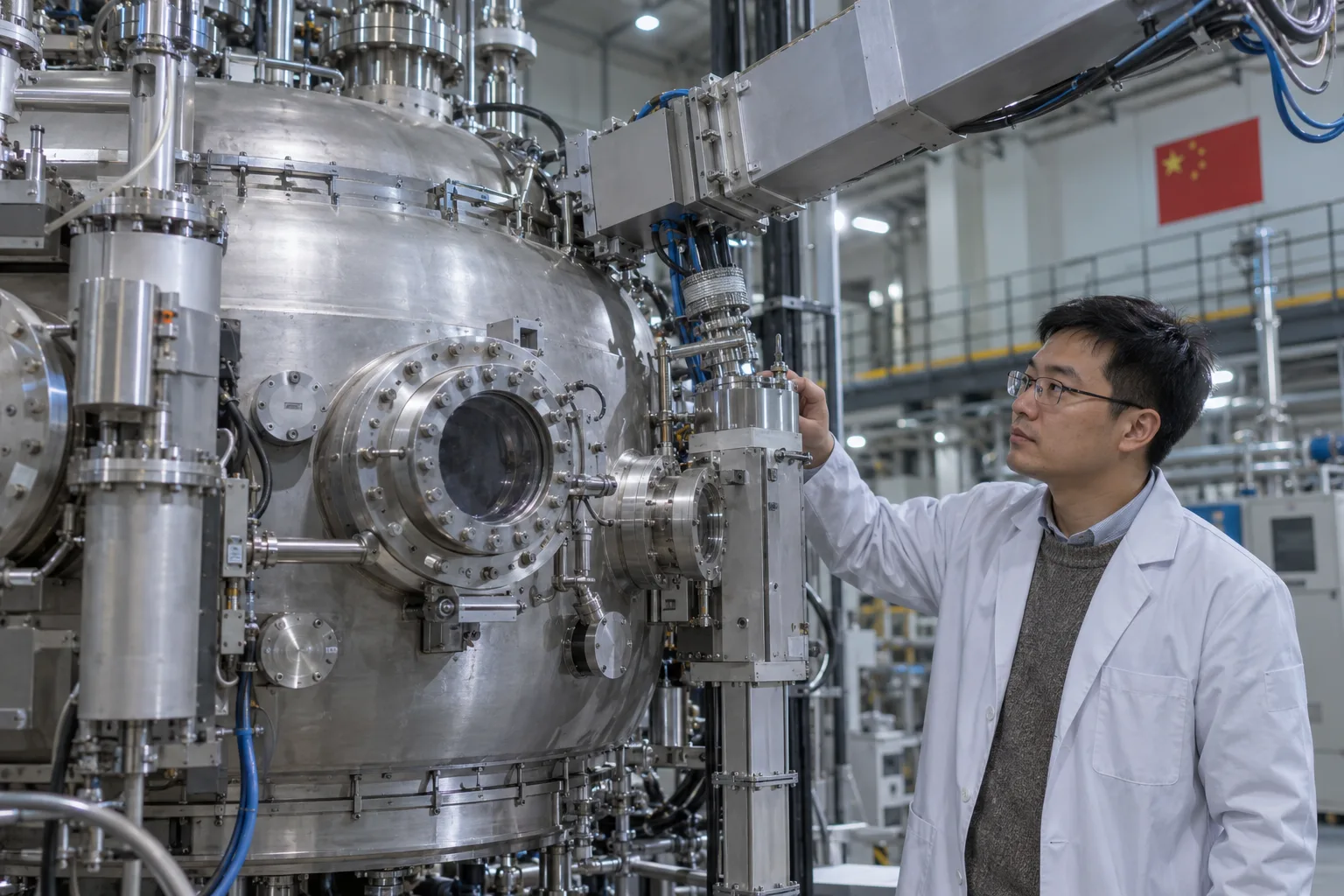
EAST is a superconducting tokamak research device that uses magnetic fields to confine plasma. A tokamak holds plasma in a doughnut-shaped space. “Artificial sun” is an informal name for a nuclear fusion research device.
Nuclear fusion is a reaction in which light atomic nuclei combine and release energy. Plasma is matter in which electrons and ions are separated. To use fusion for power generation, energy must be confined effectively at sufficiently high temperatures and densities.
| Term | Meaning | Distinction to keep in mind for this result |
|---|---|---|
| Plasma density | Number of particles in a given volume | A different measure from temperature or power output |
| Line-averaged electron density | Electron density averaged along a measurement path | Different from density at a single point in the center |
| Energy confinement | The ability to keep the plasma’s energy from escaping | Must be verified separately from increasing density |
| Net power | Power supplied externally after subtracting the power consumed by the plant | A measure for assessing commercial power generation |
The measurement in the EAST study is line-averaged electron density. It should not be read as saying that power output increased by the same multiple. The scope of the experiment is described in the EAST paper abstract.
Is the Greenwald limit an absolute law of nature?
The Greenwald limit is an empirical density benchmark derived from tokamak experiments. Its reference density is calculated using plasma current and cross-sectional size. It is not a law setting the same maximum particle count for every device.
At higher densities, plasma becomes harder to sustain under certain conditions. Cooling at the edge and radiation from impurities can be particularly important. The conditions near the wall must therefore be controlled along with density.
The Greenwald benchmark had been exceeded before EAST. In 2024, the U.S. DIII-D reported achieving high density and strong confinement performance at the same time. It would therefore be inaccurate to describe this result as humanity’s first time exceeding the limit. U.S. Department of Energy research explanation
What conditions did EAST change?
The researchers adjusted both the gas conditions at startup and the electron heating. The main heating method was electron cyclotron resonance heating. It uses microwaves to transfer energy to electrons in the plasma.
| Factor adjusted or analyzed | Observed role | Interpretation to avoid |
|---|---|---|
| Initial fuel gas conditions | Controlled plasma-wall interactions from startup | A special gas absorbed impacts like an airbag |
| Electron cyclotron resonance heating | Affected initial heating conditions and the density reached later | Made particles softer and eliminated collisions |
| Plasma conditions near the wall | Helped suppress tungsten impurities and energy loss | An endlessly self-renewing coating completely blocked impurities |
The Chinese Academy of Sciences describes a reduction in the physical sputtering of tungsten impurities. Sputtering occurs when particles strike a surface and knock atoms loose. Reducing it can lower radiation losses caused by impurities. Chinese Academy of Sciences research announcement
The researchers interpreted the results using the theory of plasma-wall self-organization, abbreviated PWSO. The term “self-organization” does not itself mean an automatic coating technology.
It is reasonable to describe this as an improvement in how an existing device was operated. But calling it a software-only achievement overlooks the experimental conditions. The heating equipment, gas supply, and wall conditions all played a part. Researchers’ publicly available manuscript
Example calculation for 1.65 times the density
A density 1.65 times the Greenwald benchmark is 65% higher than the benchmark. A density 1.3 times the benchmark is 30% higher. Both figures are density ratios from the study published in January 2026.
| Density ratio in the study | Increase relative to the benchmark | Meaning |
|---|---|---|
| 1.3 times | (1.3 - 1) × 100 = 30% | Density 30% higher than the Greenwald benchmark |
| 1.65 times | (1.65 - 1) × 100 = 65% | Density 65% higher than the Greenwald benchmark |
Calling 1.65 times a 165% increase would exaggerate the increase. Nor does this calculation compare the result with EAST’s previous record. The denominator is the Greenwald reference density under the conditions in question.
Comparing the density record with power generation
A density record must be assessed separately from progress toward commercial power generation. Temperature and fuel composition also affect fusion output. A power plant must account for power conversion losses and the electricity consumed by its equipment.
| Measure | What it shows | What it cannot show on its own |
|---|---|---|
| Density ratio | Electron density reached relative to the benchmark | Electricity production |
| Confinement performance | Ability to retain energy in the plasma | The energy balance of the entire power plant |
| Fusion gain Q | Ratio of fusion output to external plasma heating power | Net power after subtracting all equipment power consumption |
| Net power and operating rate | Power supplied externally and actual time available for operation | Long-term generation costs and profitability |
ITER defines Q as the ratio of fusion output to external heating power. That ratio does not fully account for the electricity consumed by the entire power plant. High Q must therefore also be distinguished from net power production. ITER’s explanation of energy gain
The EAST research announcement identified further verification under high-performance conditions as the next task. At the time of the January 2026 announcement, the researchers planned to apply the approach to high-confinement operation. The paper cannot be used to calculate generation costs or a commercialization date. Chinese Academy of Sciences press release
Common misconceptions about fusion fuel and waste
It is inaccurate to describe fusion as waste-free power generation that can run indefinitely on seawater alone. A leading approach to power generation uses deuterium and tritium as fuel. The two fuels have different supply requirements.
- Deuterium is a hydrogen isotope that can be obtained from water.
- Tritium is a radioactive isotope that occurs rarely in nature.
- Researchers are studying how to produce tritium using lithium to make the fuel supply self-sufficient.
- Structural materials exposed to neutrons can become radioactive.
The U.S. Department of Energy identifies tritium production and fuel self-sufficiency as research challenges. Systems to recover and reuse fuel are also needed. The potential abundance of raw materials and a power plant’s ability to supply its own fuel are different issues. U.S. Department of Energy explanation of fusion fuel
Fusion also requires management of activated structural materials. Activation occurs when exposure to particles makes a material radioactive. The characteristics of the waste depend on the materials used and the design. U.S. Department of Energy overview of fusion
Does China’s achievement mean the end of U.S. technological dominance?
EAST’s result alone cannot establish that U.S. technological dominance has ended. There is evidence that China’s capacity to produce research papers has grown. But publication measures do not directly measure the competitiveness of fusion power plants.
In a 2025 announcement, Springer Nature described China’s growing research contribution. The data covered 2024. Nature Index’s Share is a measure of contributions to papers allocated according to authors’ affiliations. Springer Nature’s 2025 announcement
Comparisons between countries must use the same field and period. Nature Index also updates tables for past years when its data changes. Ratios without a source and version are therefore difficult to reproduce. Nature Index tables and methodology
| What is being assessed | Evidence needed |
|---|---|
| Capacity to produce research papers | Research measures for the same field, period, and version |
| Plasma control performance | Experimental results that specify operating conditions and measurement methods |
| Power plant competitiveness | Net power, operating rate, construction costs, and maintenance costs |
| Supply chain competitiveness | Actual contracts, production capacity, quality verification, and delivery times |
Individual cases of insufficient travel funding also make it difficult to assess the research capacity of the U.S. as a whole. Such claims require evidence about the institution, event, and budget. Conversely, there is no reason to downplay EAST’s achievement.
Opportunities for Korean companies in the fusion supply chain
Opportunities for Korean companies should be assessed through their actual ability to deliver and their contracts. There is a verifiable precedent for Korean participation in the fusion supply chain. In 2013, ITER announced that Korea had completed production of niobium-tin superconducting strand. ITER’s record of Korean procurement
Advances in operational control do not eliminate the need for magnets and structures. ITER’s magnets use niobium-tin and niobium-titanium. It would therefore be inaccurate to treat the entire superconducting supply chain as identical to the rare earth supply chain. ITER magnet components
| Field | Role | Evidence for assessing commercial prospects |
|---|---|---|
| Control and diagnostics | Measure plasma conditions and control operation | Use in experimental devices and performance verification |
| Superconducting magnets | Generate magnetic fields that confine plasma | Strand and magnet supply contracts and delivery history |
| Wall materials and thermal management | Provide structures that withstand heat and particle loads | Lifetime testing in operating conditions |
| Fuel cycle | Produce, recover, and reuse tritium | Verification of fuel processing and self-sufficiency |
These distinctions are an analysis based on the functions a power plant needs. They are not a forecast of increased revenue for any particular company. When assessing a company, check its disclosures for contract scope and delivery terms.
Comparing the industrialization of solar power and fusion
There is insufficient basis to apply solar power’s path to market expansion directly to fusion. Fusion still faces equipment challenges beyond plasma operation. The U.S. Department of Energy treats the fuel cycle as a separate technical challenge. Explanation of the fusion fuel cycle
| Comparison | Solar power | Fusion |
|---|---|---|
| Energy conversion | Converts light into electricity | Requires recovery of energy from nuclear reactions and conversion to electricity |
| Operating fuel | No on-site supply of nuclear fuel needed | Deuterium-tritium systems require a fuel cycle |
| Requirements for expansion | Repeated installation of proven modules and systems | Verification of integrated performance at power plant scale |
| Cost assessment | Can be assessed using actual installation and operating records | Commercial generation costs cannot be calculated from individual research results alone |
The possibility that mass production will lower costs and the viability of commercial power generation are separate claims. The EAST paper is not a cost study estimating savings from mass production. It cannot be used as evidence that China will dominate the market.
What to check when comparing fusion records
To compare records, check the experimental conditions as well as the numbers. A density ratio alone makes it difficult to rank devices. Reading results in the following order reduces the chance of confusing different achievements.
- Check whether the measurement is electron density or fuel density.
- Check whether it is an average or a value at the center.
- Distinguish startup from a period of sustained high performance.
- Check how long the conditions were maintained and the confinement performance.
- Distinguish a density record from energy gain and net power.
These points are a checklist for comparing research results. Each value can be checked in the paper’s methods and results. Record both the research institution’s announcement date and the period covered by the data.
FAQ
Did China's artificial sun produce electricity in this experiment?
The focus of this research is high-density plasma operation. The experiment did not demonstrate net electricity generation after subtracting the power plant's total electricity consumption.
What is the 1.65 times figure compared with?
It is compared with the Greenwald reference density under those operating conditions. The study published in January 2026 reported line-averaged electron density.
Does 1.65 times the Greenwald reference mean a 165% increase?
1.65 times the reference value is 65% above it. That is different from a 165% increase.
Was China the first to exceed the Greenwald limit?
Other experiments have exceeded the Greenwald reference before. In 2024, the U.S. DIII-D reported achieving high density and strong confinement performance at the same time.
Does the density-free regime mean density can be increased without limit?
It does not mean that unlimited density has been demonstrated experimentally. The interpretation is that the experiment approached an operating regime predicted by PWSO theory.
Did EAST exceed the limit through software alone?
Software alone cannot easily explain it. Initial gas conditions, electron heating, and interactions between the plasma and the wall all played a role.
Has infinite self-coating technology been confirmed?
The research describes conditions near the wall and the suppression of impurity generation. There is no basis for describing PWSO self-organization as infinite self-coating.
Can nuclear fusion operate with seawater alone?
The fact that deuterium can be obtained from water is not enough. The deuterium-tritium approach also requires technology to supply and recover tritium.
Does nuclear fusion produce no radioactive waste?
Structural materials exposed to neutrons can become radioactive. Tritium must also be managed, so it would be inaccurate to call it waste-free power generation.
Does a high Nature Index mean a country is also ahead in fusion technology?
Nature Index measures contributions to papers in selected journals. It does not directly assess fusion power plant performance or the cost of generating electricity.
How can benefits for Korean companies be verified?
Check company disclosures for actual supply contracts and the scope of deliveries. Announcements of research findings alone cannot establish that an individual company's profits will increase.
Does this achievement tell us when nuclear fusion will be commercialized?
This paper alone cannot establish when commercialization will happen. Net electricity generation at the power plant level, fuel self-sufficiency, and long-term operating performance must be verified.
Sources
- Science Advances: Accessing the density-free regime with ECRH-assisted ohmic start-up on EAST
- Manuscript released by the researchers: Increasing the density limit with ECRH-assisted Ohmic start-up on EAST
- Chinese Academy of Sciences: Announcement of EAST density-free regime experiment, January 6, 2026
- Chinese Academy of Sciences press release: EAST Tokamak experiments exceed plasma density limit, January 1, 2026
- U.S. Department of Energy: DIII-D achieves high density and high confinement simultaneously, July 31, 2024
- ITER: What will ITER do?
- U.S. Department of Energy: DOE Explains...Deuterium-Tritium Fusion Fuel
- U.S. Department of Energy: Fusion Energy
- U.S. Department of Energy: Explanation of fuel cycling and tritium processing in the fusion science and technology roadmap
- Springer Nature: Announcement of Nature Index Research Leaders, June 11, 2025
- Nature Index: 2025 Research Leaders table by country and counting methodology
- ITER: Composition and materials of superconducting magnets
- ITER: Korea completes niobium-tin strand production, December 11, 2013
Images