Wright Brothers' 1903 Flight: Path to Success and Impact
The Wright brothers' successful flight in 1903 began with rechecking lift data and improving glider controls. To understand its significance, the flight records from December 17 must be distinguished from a transmission error in the telegram.
- The 1901 glider's lack of lift prompted a reexamination of existing calculations and wing design.
- Wind tunnel experiments provided a way to obtain measurements suited to the wing's shape.
- The 1902 glider improved control by linking wing warping to a movable rudder.
- The first flight on December 17, 1903, lasted 12 seconds, and the last flight that day lasted 59 seconds.
- The 57-second figure in the telegram about the first flight was a transmission error and should be distinguished from the longest flight record.
The Wright brothers overcame a lack of lift and failures in control through wind tunnel measurements and improvements to their gliders. On December 17, 1903, they achieved powered flight. They are remembered for getting a piloted aircraft into the air under its own power and controlling it.
This article follows flight records from the Library of Congress and explanations from the National Park Service. The sources were checked in October 2026.
Timeline of the Wright brothers' flight research
The success of 1903 resulted from repeated improvements to gliders and measuring devices. Before powered flight, the brothers had to solve the problem of controlling an aircraft in the air. Development continued afterward to make a practical airplane.
| Year or date | What happened | Source |
|---|---|---|
| 1899 | They requested aeronautical literature from Smithsonian and tested principles of control with a kite. | National Park Service, The Road to the First Flight |
| 1900 | They began glider experiments at Kitty Hawk. | National Park Service, The Road to the First Flight |
| 1901 | After encountering insufficient lift and control problems, they tested wings in a wind tunnel. | NASA, Wright 1901 Wind Tunnel Tests |
| 1902 | They linked the glider's wing-warping system to a movable rudder. | National Park Service, The Road to the First Flight |
| December 14, 1903 | Wilbur's attempt at powered flight failed, and they repaired the aircraft. | National Park Service, 1903-The First Flight |
| December 17, 1903 | The brothers took turns making four powered flights. | Library of Congress, First Flight |
| 1905 | They achieved sustained, turning flight with Flyer III. | Smithsonian, 1903 Wright Flyer |
How did reading and the bicycle business provide a foundation?
Reading and experience making machines were starting points for their flight research. Their home had shelves of theological and general books. Their parents created an environment where their children could investigate what interested them.
In 1899, Wilbur requested aeronautical literature from Smithsonian. The brothers read earlier research by Otto Lilienthal and others. They also exchanged research findings with engineer Octave Chanute. This background is recorded in the National Park Service's account of the Wright brothers.
The bicycle business provided funds for their experiments. Repairing and making bicycles also gave them mechanical experience. They used tools and workspace from the bicycle shop to make airplane parts. The National Park Service's account of their research process explains this connection.
Why did they choose Kitty Hawk?
The wind and sandy terrain around Kitty Hawk suited their experiments. The brothers requested wind data from the U.S. weather authorities. The sand dunes offered favorable conditions for gliding experiments and landings.
Kitty Hawk is a place name widely used when describing the first flight. The actual site of the 1903 flights was nearby Kill Devil Hills. Distinguishing the experimental site from the town where they sent a telegram avoids confusion between the names. National Park Service educational material about the historic site explains the two locations.
Why did the 1901 glider fall short of expectations?
The 1901 glider produced less lift than expected. Lift is the component of the force a wing receives from the air that supports the aircraft. The lift measured at the time was about one-third of what their calculations predicted. NASA's account of the wind tunnel experiments explains the difference.
Control posed a separate problem. The aircraft's nose moved up and down unpredictably. When they tilted the wings, the nose sometimes turned opposite to the intended direction.
- Lift problem: The aircraft could not support itself and its pilot as the calculations predicted.
- Pitch problem: The nose rose too high, making flight unstable.
- Directional problem: Tilting the wings did not produce the desired turn.
Simply making the wings larger would not solve these problems. The brothers reexamined the figures they had used in their design. The National Park Service's account describes this as the reason they turned to their own measurements.
The figures corrected by wind tunnel experiments and the conditions for applying them
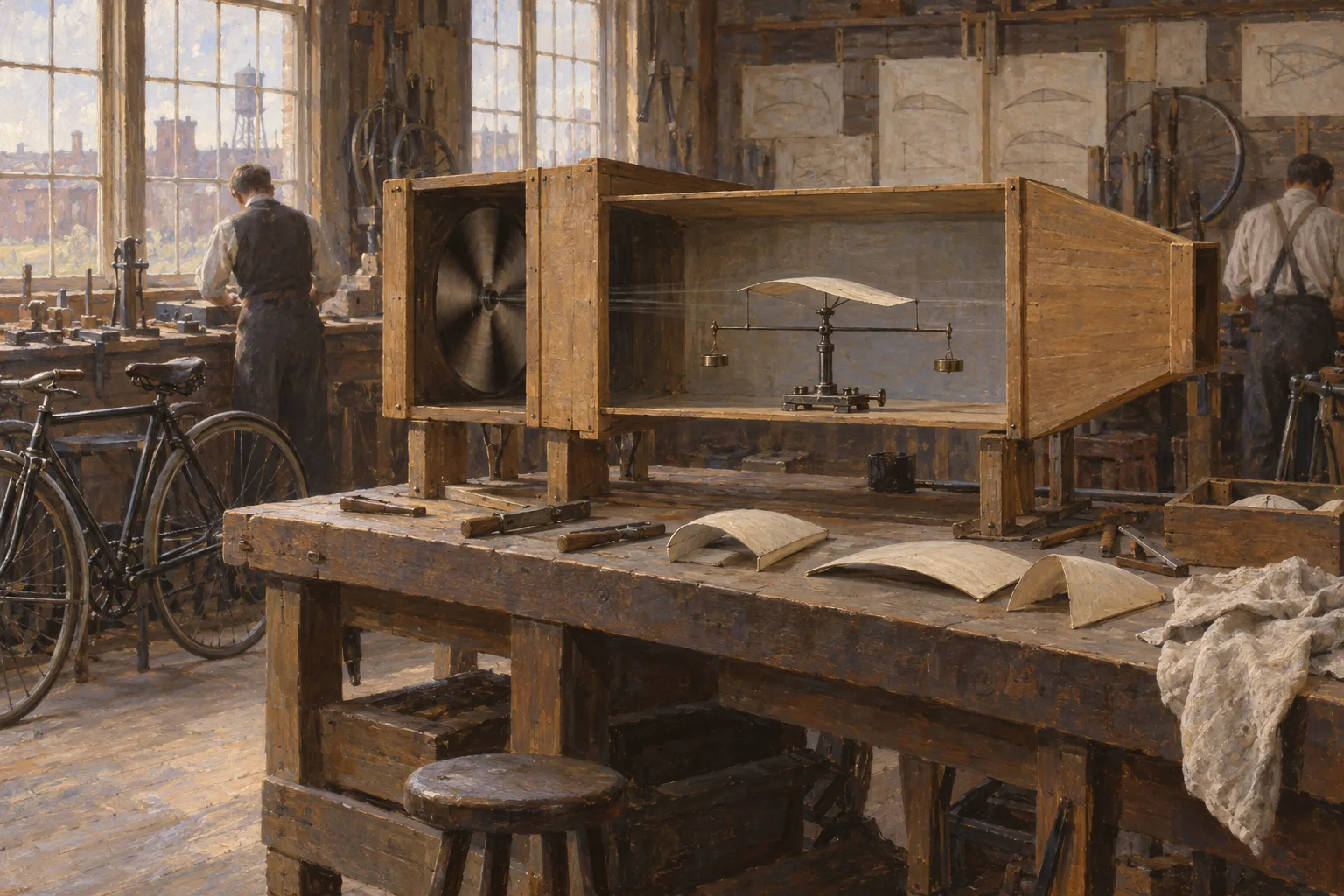
A wind tunnel is a device for testing models in a steady flow of air. The brothers placed small wings inside a box that produced wind. They used a separate measuring device to compare lift and drag.
Drag is the force that resists an object's movement through air. The brothers examined differences in these forces as they changed wing shapes. In their detailed experiments, they changed one design condition at a time. This method is described in NASA's account of the 1901 experiments.
It would be inaccurate to say that all existing data was wrong. The Smeaton coefficient used in their calculations needed revision. At the time, this coefficient was a standard value used to calculate the effects of air pressure.
Lilienthal's measurements involved different conditions of application. The wings he tested had a different shape from the brothers' wings. Applying the same values without adjustment changed the predicted lift. NASA's account of the lift equation used at the time points out this difference.
| Item examined | Nature of the problem | Approach to correction |
|---|---|---|
| Smeaton coefficient | An error in the standard value used to calculate aerodynamic forces | Reexamine the value against flight experiments |
| Lilienthal's wing data | Applying data to wings of a different shape | Measure their own wing models |
| Wing design | Effects of curvature and aspect ratio | Change the design based on measurements |
Control technology in the 1902 glider
The turning point in 1902 was controlling the aircraft's movements together. The brothers applied their wind tunnel results to the wing design. They replaced the fixed rear tail fin with a movable rudder.
They linked the rudder's movement to the wing-warping mechanism. Wing warping varies the lift produced by the left and right wings. The rudder reduced the unwanted change in direction that resulted.
| Movement to control | Meaning | Device used at the time |
|---|---|---|
| Pitch | The nose moves up and down | Front elevator |
| Roll | The left and right wings tilt | Wing-warping mechanism |
| Yaw | The nose turns left and right | Rear rudder |
A system that controls these three movements is called three-axis control. The brothers had established a basis for control before adding an engine. The National Park Service's account of their research process describes the linked controls as a breakthrough.
How did they prepare the engine and propellers?
Powered flight required an engine and propellers suited to the aircraft. The brothers could not obtain a suitable lightweight engine. They built one with the help of mechanic Charlie Taylor.
Their wing research also informed the propeller design. The brothers understood a propeller as a rotating wing that produces force. They arranged for the two propellers to turn in opposite directions. The construction process is covered in the National Park Service's account.
The December 14 failure and the December 17 flights
The December 14 attempt failed during control of the aircraft. Wilbur, who made the first attempt, raised the nose too high after takeoff. The aircraft stalled and fell onto the sand.
A stall is a condition in which the wings do not produce enough lift to sustain flight. The brothers repaired the damaged aircraft. On December 17, Orville took the controls first. The National Park Service's account of the first flight explains this sequence.
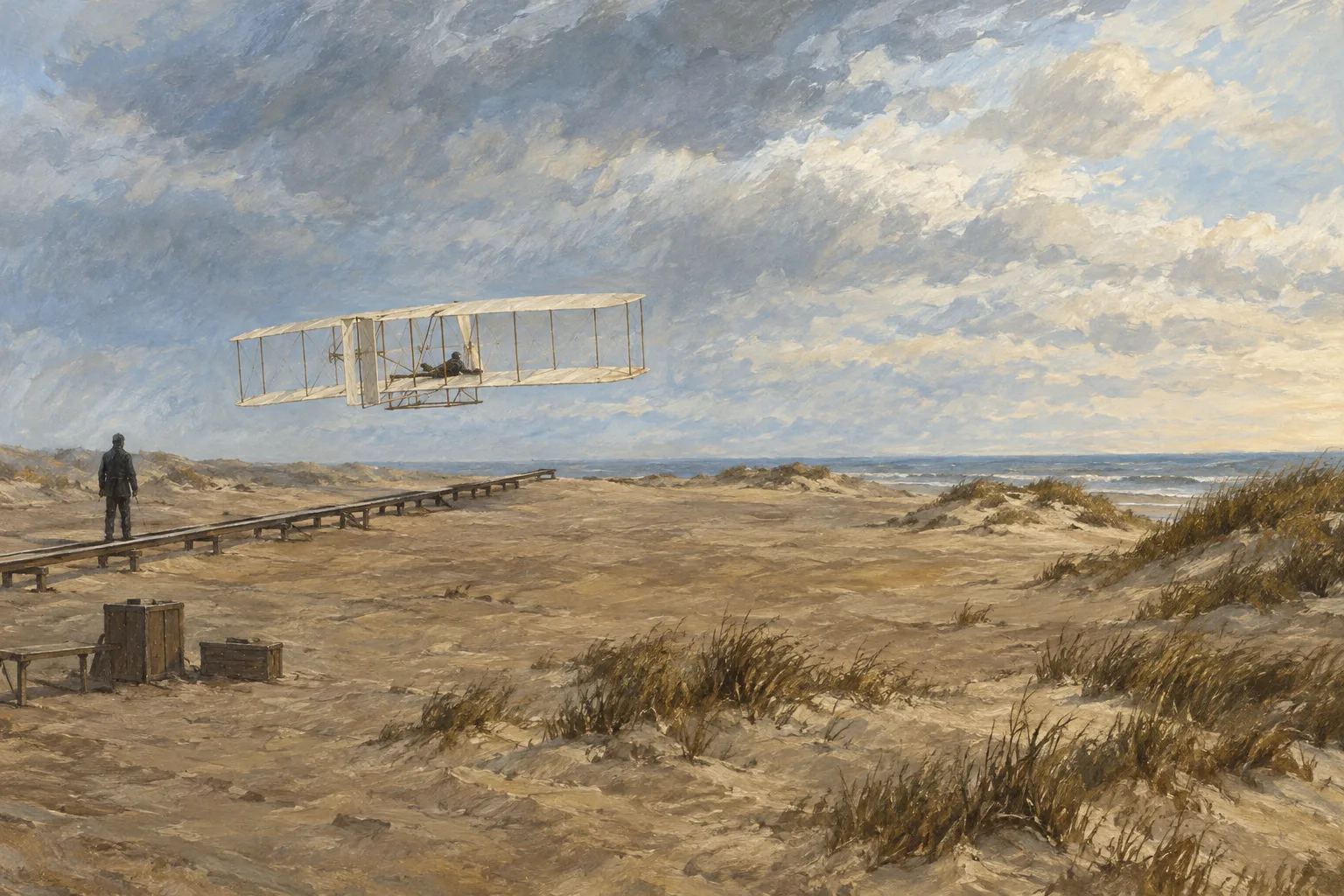
The first flight began at 10:35 a.m. Orville's flight lasted 12 seconds. The brothers then took turns making three more flights.
| Flight on December 17, 1903 | Pilot | Flight time | Distance over the ground |
|---|---|---|---|
| First | Orville | 12 seconds | 120 feet, 36.576 meters |
| Second | Wilbur | About 12 seconds | About 175 feet |
| Third | Orville | About 15 seconds | About 200 feet |
| Fourth | Wilbur | 59 seconds | 852 feet, 259.6896 meters |
The flight figures follow the National Park Service's detailed record. The meter values were calculated using 0.3048 meters per foot. The number of decimal places in the conversions does not indicate the precision of the original measurements.
After the fourth flight, a strong gust flipped the aircraft over. The damage brought their flying for that year to an end. The 1903 Flyer never flew again. This outcome is confirmed in the National Park Service's account of the first flight.
Records and interpretation
The fact of the flights, assessments of their achievement, and claims of earlier flights should be kept separate. Diaries and telegrams are records of events. Comparing those records to explain the achievement is a matter of historical interpretation.
How do the diary and telegram differ?
The longest flight time given in the telegram differs from the actual record. The telegram says 57 seconds. The Library of Congress explains this as a transmission error for 59 seconds.
| Source | What it establishes | What to keep in mind when reading it |
|---|---|---|
| Orville's diary entry for December 17, 1903 | Specific details of the day's four flights | It is a record written by a participant. |
| Telegram to their father | The brothers' report to their family that the flights succeeded | The longest time was incorrectly transmitted as 57 seconds. |
| Library of Congress explanation of the sources | The relationship between the diary and telegram, and the transmission error | The original records should be distinguished from the institution's explanation. |
The telegram's figure should therefore not be copied directly into a table of flight performance. The first flight lasted 12 seconds. The fourth flight lasted 59 seconds. The Library of Congress's First Flight supports this distinction.
What achievement is recognized in aviation history?
Standard accounts of aviation history recognize the Wright brothers' controlled powered flight. The aircraft in question was heavier than air and carried a person. The achievement also includes taking off under its own power and sustaining flight.
This does not mean they were the first people to rise into the air. Balloon flights and glider flights have their own earlier histories. Smithsonian's account of the 1903 Wright Flyer also describes the aircraft's achievement within these bounds.
What remains disputed?
There is still debate about the evidence for claims of earlier flights. Researcher John Brown has argued that Gustave Whitehead flew earlier. A Smithsonian statement describes that claim.
Aviation historian Tom Crouch assessed the evidence as insufficient. He questioned the reliability of reports from the time and later testimony. His position appears in a National Air and Space Museum review.
The difference between success in 1903 and practical flight in 1905
The success of the 1903 flights did not mean that a practical airplane was complete. The Flyer was difficult to control in its up-and-down movement. Development continued to keep it flying longer and to change direction.
| Category | 1903 Flyer | 1905 Flyer III |
|---|---|---|
| Main achievement | Demonstration of controlled powered flight | Sustained, turning flight |
| Stage of development | Short flights proved it was possible | Achieved practical operating capability |
| Historical significance | Establishment of powered flight | Expanded the potential uses of airplanes |
In 1905, Flyer III repeatedly circled the flying field. Smithsonian describes this period as a stage in the development of a practical airplane. The first success and practical operation should be understood as distinct achievements. Smithsonian's account of the aircraft also covers the subsequent development.
What this case means in the history of science today
This case shows the importance of the conditions under which measurements are applied to a design. An error in a figure and a difference in what that figure applies to were separate issues. Wind tunnel experiments gave the brothers a way to distinguish them.
It also matters for how records are read. Even a telegram sent at the time could transmit a number incorrectly. Comparing the diary with the explanation from the institution preserving the records makes it possible to identify the error.
- Experimental design: They controlled conditions to compare the effects of wing shape.
- Technical development: They applied measurement results to the design of the next aircraft.
- Review of historical sources: The figures in original records are distinguished from confirmed flight records.
This significance is an interpretation drawn from NASA's account of the experiments. The basis for reviewing the records is the Library of Congress's explanation of the telegram. Explaining the achievement solely through personal perseverance leaves out this process of verification.
Frequently asked questions
Who piloted the first flight?
Orville piloted the first flight on December 17, 1903. Wilbur made the failed attempt on December 14. On December 17, the brothers took turns making four flights.
Did the first flight last 12 seconds or 59 seconds?
The first flight lasted 12 seconds. The 59-second flight was the fourth flight that day, piloted by Wilbur. The 57 seconds in the telegram was a transmission error.
Did the wind tunnel solve every problem?
The wind tunnel provided measurements needed for wing design. Control problems also had to be checked in glider flights. The movable rudder introduced in 1902 was part of the improvement.
Did the Wright brothers only invent an engine?
Their achievement cannot be explained by the engine alone. They first improved the wings and controls. They then incorporated the engine and propellers into the aircraft.
Are Kitty Hawk and Kill Devil Hills the same place?
They are distinct places. The first powered flight took place at Kill Devil Hills. The brothers went to Kitty Hawk to send their father a telegram.
FAQ
When did the Wright brothers achieve powered flight?
They achieved controlled powered flight on December 17, 1903. It took place at Kill Devil Hills, North Carolina, in the United States.
Who piloted the first flight, and what were its recorded figures?
Orville Wright piloted the first flight. It lasted 12 seconds and covered 120 feet over the ground.
How long was the longest flight on December 17, 1903?
The fourth flight, piloted by Wilbur, was the longest. It lasted 59 seconds and covered 852 feet over the ground.
Why did the telegram announcing the first flight say 57 seconds?
The Library of Congress explains that 59 seconds was mistakenly transmitted as 57 seconds. The wording of the telegram should be distinguished from the verified flight record.
What problems emerged with the 1901 glider?
It produced less lift than expected. There were also problems controlling the aircraft's pitch and direction.
Was all of Lilienthal's lift data wrong?
That cannot be stated definitively. NASA explains that the problem was applying Lilienthal's data to wings of a different shape. Separately, the Smeaton coefficient also needed to be corrected.
What was the key improvement to the 1902 glider?
The wing-warping mechanism was linked to a movable rudder. This helped reduce unwanted changes in direction when the aircraft banked.
Why did the attempt on December 14, 1903, fail?
Wilbur raised the nose too high after takeoff, causing the aircraft to stall. The brothers repaired the damage and tried again on December 17.
Why was Kitty Hawk chosen as the testing site?
The wind conditions and sandy terrain were suitable for glider experiments. Before choosing the site, the brothers reviewed data from U.S. weather authorities.
How did the bicycle business help with airplane development?
It provided a way to fund their experiments. Their repair and manufacturing experience, along with their tools, also helped them develop the airplane.
Did the Wright brothers begin their aviation research on their own?
They began by reading earlier research by Lilienthal and others. They obtained publications from the Smithsonian and exchanged research findings with Chanute.
Was the 1903 Flyer already a practical airplane?
The 1903 aircraft demonstrated controlled powered flight. The development of a practical aircraft capable of sustained turns continued with the 1905 Flyer III.
Sources
- U.S. National Park Service, The Road to the First Flight
- U.S. National Park Service, 1903-The First Flight
- U.S. National Park Service, Wright Brothers
- U.S. National Park Service, Wright Brothers National Memorial: Site of the First Controlled Powered Flight
- NASA Glenn Research Center, Wright 1901 Wind Tunnel Tests
- NASA Glenn Research Center, Lift Equation of the 1900's
- Library of Congress, First Flight: Commentary on Orville's diary and the first-flight telegram
- Library of Congress, Orville's December 17, 1903 telegram to Milton Wright and commentary
- Smithsonian Institution, 1903 Wright Flyer
- Smithsonian Institution, Did Gustave Whitehead Beat the Wright Brothers?
- Smithsonian National Air and Space Museum, Tom Crouch's review of the claim that Whitehead flew first
Images