Dunkirk Evacuation 1940: Events and Significance
The Dunkirk evacuation was an operation to rescue Allied troops surrounded by German forces by sea in 1940. The navy's coordination of transport and the Allies' defense saved troops, but equipment was lost and the campaign in France ended in defeat.
- Operation Dynamo evacuated 338,226 Allied troops from May 26 to June 4, 1940.
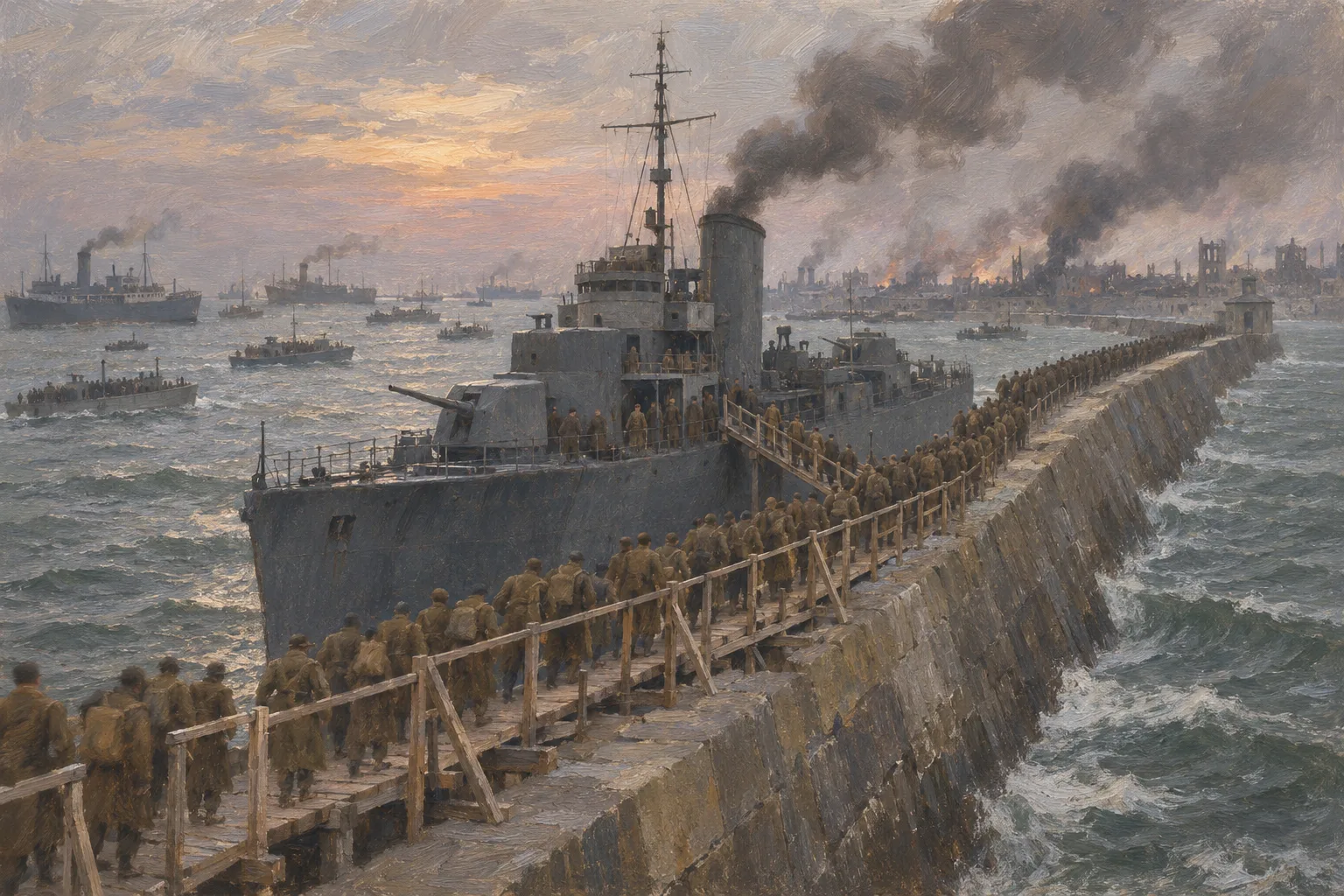
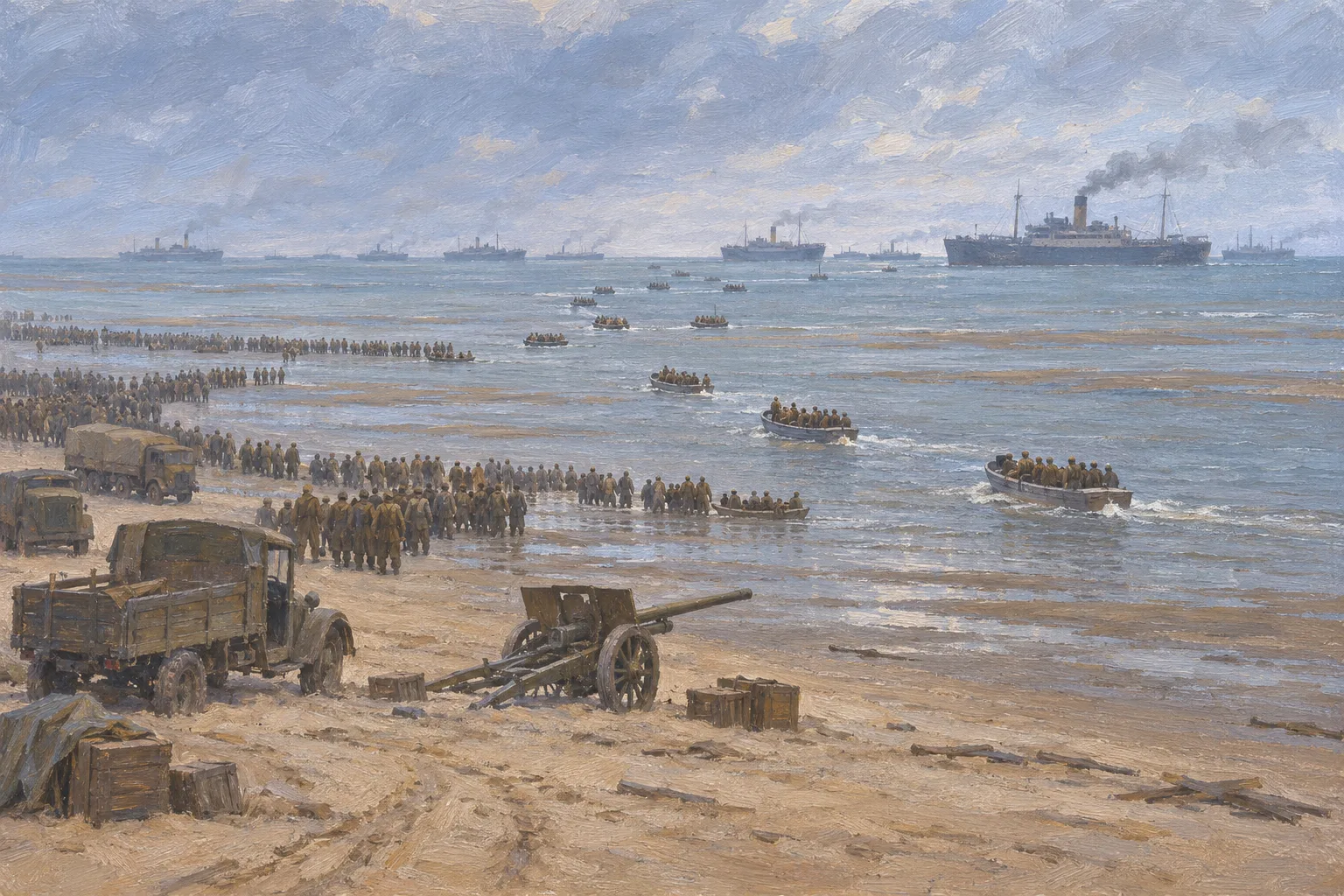
- Boarding at the east mole and transfers from the beaches by small boats were separate evacuation routes.
- French troops were among those evacuated and also held the defensive line in the later stages of the operation.
- The successful evacuation preserved experienced troops, but it did not reverse the military defeat in the campaign in France.
- Troop figures in reports and speeches from the time must be distinguished from later tallies.
The Dunkirk evacuation lasted from May 26 to June 4, 1940. 338,226 Allied troops surrounded by German forces escaped through a transport network led by the navy. It is remembered as an operation that preserved troops amid defeat.
This account follows the records of Hansard and English Heritage and was checked in November 2026.
Background to the Dunkirk Evacuation
Allied forces became isolated in northern France as German forces advanced toward the Channel. The main British and French forces had moved into Belgium to stop the Germans. However, the main German attack came farther south, through the Ardennes.
After breaking through French defenses at Sedan, German forces advanced west. The Allied forces in the north were cut off from the main French forces to the south. Supply routes, as well as routes for moving troops, were threatened.
Gort, commander of the British Expeditionary Force, was left with evacuation by sea as his remaining option. Counterattacks intended to reopen a route to the south had failed. On May 26, orders were issued to evacuate through Dunkirk. The National Army Museum's account of the campaign explains this sequence of events.
Timeline of the Encirclement and Evacuation in 1940
The evacuation took place while the German advance and Allied defensive operations continued. All dates in the timeline below are in 1940.
| Date | Event | Source |
|---|---|---|
| May 10 | German offensive in Western Europe begins | National Army Museum |
| May 13 | German forces cross the Meuse at Sedan and break through | National Army Museum |
| May 20 | German forces reach the coast near Abbeville | U.S. National Archives and Records Administration account |
| May 24 | A halt in the German armored advance gives the Allies time | National Army Museum |
| May 26 | Order issued to carry out Operation Dynamo | English Heritage |
| May 28 | Belgian surrender worsens the defensive situation | U.S. National Archives and Records Administration account |
| June 2 | French forces take over and continue the defense of the operational area | U.S. National Archives and Records Administration account |
| June 4 | Evacuation ends and German forces enter Dunkirk | U.S. National Archives and Records Administration account |
The date on which German forces reached the coast follows the U.S. National Archives and Records Administration's account. Dates referring to different locations and events have not been combined into one.
The Mole and Small Boats That Opened an Escape Route
The turning point in the evacuation was securing usable embarkation points. The main docks had been put out of action by German attacks. Large ships could not easily approach the gently sloping beaches.
Operation Dynamo was the code name for the rescue operation organized by the Royal Navy. Vice Admiral Bertram Ramsay directed transport from Dover Castle. The east mole and the beaches were used in different ways.
| Location or vessel | How troops boarded | Role in the operation |
|---|---|---|
| East mole | Boarded ships that came alongside the mole | A route for large numbers of troops to board directly |
| Beaches | Boarded small boats and transferred to larger ships farther offshore | Connected the shallow-water areas to larger ships |
| Large ships | Took troops aboard from the mole or small boats | Carried troops on return trips to Britain |
English Heritage gives the number evacuated via the mole as 239,465. The number evacuated via the beaches was 98,761. Both figures cover the full duration of Operation Dynamo in 1940. They come from English Heritage's account of the operation.
These categories count troops by embarkation location. They cannot be read as the numbers transported by civilian vessels and warships respectively. Some troops used small boats and then larger ships after leaving the beaches.
The Roles of Civilian Vessels and Allied Forces
Small civilian vessels extended the reach of the naval transport network. Fishing boats, pleasure boats, and other vessels entered places that large ships could not easily reach. Some carried troops directly to Britain.
Not all privately owned vessels were operated by their owners. Historic England explains that many vessels were requisitioned. It also states that the small boats were crewed mainly by naval personnel. Historic England's account of the evacuation distinguishes ownership from operation.
The defense on land bought the time needed for transport. The Royal Air Force tried to stop German air attacks. French forces also took part in both the defense and the evacuation.
The U.S. National Archives and Records Administration describes the French defense during the later stages of the operation. Its account also records the evacuation of non-British troops. Some French troops who remained until the end were taken prisoner. Describing the operation as an escape by British troops alone therefore understates its scope. This is documented in the historical account covering the French perspective.
Troops Preserved and Losses Left Behind
The evacuation's achievement was preserving the personnel needed to rebuild the army later. Troops with training and combat experience returned to Britain. However, the return of troops and the restoration of fighting strength were separate matters.
| Area assessed | Situation after the operation |
|---|---|
| Personnel | The personnel needed to rebuild the army were preserved |
| Equipment | Heavy losses of vehicles, artillery equipment, and other equipment |
| Campaign in France | The German offensive continued |
| Defense of Britain | Preparations were needed against the threat of an invasion |
The National Army Museum emphasizes the preservation of the Expeditionary Force's core personnel. It also describes the loss of most of its equipment. Evacuations from other French ports continued after Dunkirk. The Dunkirk total is therefore different from the total number evacuated from France. This distinction is based on the National Army Museum's account of the outcome.
Records and Interpretations
Statements made at the time, later totals, and interpretations of causes must be distinguished. Even when records concern the same event, their purposes and dates of creation differ. A single speech or memoir is not enough to establish the full picture.
What the Parliamentary Record from the Time Says
Churchill distinguished the success of the evacuation from victory in the war. The following sentence appears in Hansard's “WAR SITUATION” of June 4, 1940.
Wars are not won by evacuations.
Winston Churchill, Hansard, “WAR SITUATION,” June 4, 1940
This means that evacuation alone cannot win a war. The same speech gives the number evacuated as at least 335,000. This was the account presented to Parliament at the time. It should not be treated as a figure with the same precision as the later total of 338,226.
The speech also includes contemporary assessments of successes in aerial combat. Such claims must be distinguished from loss statistics verified later. The original speech in Hansard is a record for checking what was said.
Shared Assessments and the Debate over the Halt
A common assessment is that the preservation of troops and defeat in the campaign were both realities. English Heritage and the National Army Museum both emphasize this. Debate centers on the motives for halting the German advance and the extent of its impact.
Historian Robert Citino emphasizes the complex hesitation within the command. He first explains Rundstedt's demand to bring his units into alignment. In this interpretation, Hitler supported that judgment amid disagreements among commanders.
The idea that Hitler hoped for a political compromise with Britain has also been proposed. Expectations of the air force and supply problems affecting armored units are also cited. It is difficult to determine the weight of each factor or establish a single cause. Citino's interview discusses these interpretations together.
It therefore cannot be stated with certainty that Hitler deliberately let the British troops escape. The effect of the halt order and the intentions of the person issuing it are separate questions. Defensive fighting and transport organization also contributed to the evacuation's success.
Why Troop Counts Differ
Troop figures need to be checked against when they were compiled and how they were categorized. Counts by nationality differ even between institutional accounts. Figures from different tables should not be combined into a single breakdown.
An appendix by historian Hugh Sebag-Montefiore includes different sets of figures. He states that using one table does not imply greater accuracy. Even precise numbers must be presented with their sources. This explanation appears in the statistical appendix made available by the author.
Rail Transport and Troop Counts after Arrival in Britain
Preserving troops also required organization on land after they disembarked. English Heritage's learning materials explain how returning troops were moved. They traveled by train to reception areas around the country.
After rest and recovery, they were assigned new duties. Staff at the ports counted arriving troops as they boarded trains. They also recorded information on units and casualties.
- Arrival records were incorporated into the War Office's progress reports.
- The reports were updated once or twice a day.
- Revisions based on new information were recorded in notes.
This process shows that evacuation was not just a matter of sea transport. The revisions in the reports are evidence of how the counts were completed. They also provide a basis for distinguishing provisional reports from later totals. English Heritage's learning materials on operational reports explain this.
The Memory of Dunkirk and Its Value for Learning Today
Dunkirk offers a case for examining both an operation's outcome and its place in public memory. In Britain, the successful evacuation became a story that raised national morale. The “Dunkirk spirit,” meaning cooperation in adversity, is also connected to this memory.
This expression is not a military term that explains every aspect of the operation. The French defense and equipment losses must also be considered. English Heritage's explanation of this memory discusses how it developed.
Its value for learning today also lies in comparing records. Parliamentary speeches show how the government explained events at the time. Arrival reports reveal how troops were counted. Later research compares these records to interpret the operation's significance.
Frequently Asked Questions
Did the Operation Break through the Encirclement on Land?
The main escape route was by sea. Allied forces defended the areas around the harbor and beaches while evacuating by ship. It is inaccurate to understand it as a victory that reopened a land corridor.
Did Small Civilian Boats Rescue Most of the Troops?
The rescue of most troops cannot be attributed to small boats alone. Embarkation via the mole accounted for a large share. The roles of small boats and large ships were interconnected.
Were French Troops Evacuated Too?
French troops were also included in the evacuation. At the same time, they took responsibility for the defense in the later stages of the operation. Some of the troops who remained were unable to evacuate.
Did the Successful Evacuation Mean an Allied Victory?
The rescue of troops succeeded, but defeat in the campaign continued. An army that had lost its equipment needed to be reorganized and rearmed. Churchill also distinguished evacuation from victory in his speech at the time.
What Should Be Checked When Comparing Evacuation Figures?
First, check the period covered and who was included. It is also necessary to distinguish reports made on the day from later totals. The numbers evacuated from Dunkirk must also be kept separate from those evacuated from other French ports.
FAQ
When did the Dunkirk evacuation take place?
Operation Dynamo took place from May 26 to June 4, 1940. It was a naval evacuation that transported Allied troops trapped in northern France to Britain.
How many people were evacuated from Dunkirk?
English Heritage gives the total number evacuated as 338,226. This figure covers the entire duration of Operation Dynamo in 1940.
Did the troops break out of the encirclement at Dunkirk by land?
The main escape route was by sea. Allied troops evacuated by ship while defending the harbor and surrounding beaches.
Did small civilian boats rescue most of the troops?
It is inaccurate to say that small boats alone rescued most of the troops. Boarding from the breakwater and transport by large ships played major roles.
Were all civilian vessels operated by civilians themselves?
Civilian ownership and civilian operation do not mean the same thing. Historic England explains that many small boats were requisitioned and operated mainly by naval personnel.
What role did French troops play?
French troops were both evacuees and defenders. They continued defending the area even in the later stages of the operation, and some were unable to evacuate and were taken prisoner.
Did Hitler deliberately let British troops escape?
There is not enough evidence to draw that conclusion. Political expectations and supply problems are among the possible motives discussed for halting the advance. The historian Citino emphasizes the complex considerations behind the German command's decisions.
Was the Dunkirk evacuation a victory or a defeat?
The successful rescue of troops coexisted with defeat in the campaign in France. The personnel saved provided a basis for rebuilding the army, but equipment losses remained.
Why does the figure in Churchill's speech differ from later counts?
In his speech on June 4, 1940, Churchill said at least 335,000. This was the account given at the time and should be distinguished from later counts.
How did the troops travel after arriving in Britain?
The returning troops traveled by train to reception areas in various locations. After resting and recovering, they were assigned new duties. Arrival numbers and unit information were recorded in progress reports.
Sources
- English Heritage, Operation Dynamo: Things you need to know
- Hansard, WAR SITUATION, 4 June 1940
- National Army Museum, Defeat in the West, 1940
- United States National Archives and Records Administration, The Dunkirk Story, May-June 1940, and A French Perspective
- English Heritage, Write a Military Report: Dunkirk, KS3·KS4 learning resources
- Historic England, Operation Dynamo: The Miracle of Dunkirk
- WW2History.com, Robert Citino's Dunkirk interview
- Hugh Sebag-Montefiore, Dunkirk research appendices and notes, Appendix B evacuation totals
Images