How to Calculate the Right Backpack Weight for Spanish-Speaking Students
This guide explains how to calculate backpack weight using a reference range of 10–15% of a student's body weight and how to measure the actual load, from the empty bag to water bottles and electronic devices. In addition to the percentage, check the fit, travel time, and whether the student experiences pain.
- First, check whether health or education authorities or schools in the country of residence provide separate guidelines.
- Measure the student's body weight and the backpack with all regularly used items in the same unit.
- Multiply the student's body weight by 0.10 and 0.15 to calculate the 10–15% reference range.
- Remove unnecessary items, place heavy objects close to the back, and adjust both shoulder straps.
- Measure again when the schedule or travel route changes, and watch for pain, numbness, or changes in walking.
No single statutory standard for school backpack weight that applies across the entire Spanish-speaking world could be confirmed. First, check whether the school and the health and education authorities in your country of residence provide separate standards. If there are no separate standards, you can use the commonly recommended range of 10–15% of the student’s body weight as a reference.
You will need a scale and the backpack normally used for school. There is no application deadline, but it is advisable to measure before school starts, after timetable changes, and whenever new textbooks or electronic devices are added. Because this is not a government benefit or application process, there is no common application portal.
Who, What, and When to Check First
Who should check?
All students who carry or pull their own backpacks to school should check them. Rather than applying the same limit uniformly based only on age or education level, consider the following conditions together.
- The student’s weight and build
- How long and how far the bag is carried
- Commuting conditions such as stairs, public transportation, and unpaved roads
- Existing back, shoulder, or joint conditions or disabilities
- Pain, numbness, pressure marks on the skin, or changes in walking
For students with existing conditions or activity restrictions imposed by medical professionals, individualized medical and school guidance should take precedence over the general 10–15% figure.
What you need
- A scale that can measure the student’s weight
- The backpack actually used on school days
- Textbooks, notebooks, a pencil case, and lunch or snacks
- A water bottle filled with water
- A laptop or tablet and its protective case
- Chargers, gym clothes, musical instruments, and other additional items carried that day
- A calculator or a mobile phone’s calculator function
When should it be weighed again?
Measuring only once just before school starts is not enough. Measure again when the timetable for each day of the week is finalized, when textbooks are added, and when seasonal clothing or electronic devices begin to be packed. At a minimum, measuring both the day with the heaviest load and the day with the lightest load will show the actual difference.
How to Check Recommendations by Country and Education Level
Information about backpack weight includes a mixture of government regulations, school guidelines, and health recommendations from pediatric professional organizations. A recommended percentage from a professional organization should not be mistaken for a legal limit or a school requirement.
| Example region or organization | Reference range provided | Points to note when interpreting |
|---|---|---|
| Guidance associated with Spain’s pediatric association, Asociación Española de Pediatría | Guidance on appropriate loads and weight distribution | Specific recommended percentages should be checked in the organization’s latest guidance and do not necessarily represent a statutory nationwide limit |
| HealthyChildren guidance from the American Academy of Pediatrics | At most 15% of body weight | Although guidance is available in Spanish, it is a standard from a U.S. professional organization and does not take precedence over local school regulations |
| Individual countries and regions, including Colombia and Chile | Guidance from the ministry of education, ministry of health, and individual schools must be checked | This article could not confirm a single nationwide statutory percentage that applies to every region |
The percentage does not change automatically based solely on education level. For both elementary and middle or high school students, calculate it based on body weight, but for younger students, it is advisable for a guardian to directly check the weight of the bag itself and how it is worn. At the early childhood education level, priority should be given to minimizing the transport of learning materials and packing only the essentials required by the school.
When looking for official standards, search the relevant country’s ministry of education and ministry of health websites and school notices for terms such as peso de la mochila escolar, salud escolar, and regreso a clases. If the school has a separate standard, apply that standard first.
Calculating the Maximum Weight Based on the Student’s Body Weight
Step 1: Measure the student’s body weight
Have the student put down the bag and measure their body weight in kilograms. The calculation structure is the same when using pounds, but the units used for the student’s weight and the bag’s weight must be consistent.
Step 2: Calculate the 10% target weight
Target weight = Student’s body weight × 0.10
For example, if the student weighs 36kg, the target weight is as follows.
36kg × 0.10 = 3.6kg
Step 3: Calculate the 15% upper-limit reference value
Upper-limit reference value = Student’s body weight × 0.15
For a student who weighs 36kg, the calculation is as follows.
36kg × 0.15 = 5.4kg
The 10–15% range is a commonly recommended reference range, not an absolute standard applicable to every student. If there is no separate official standard, use the 10–15% range as a reference while also considering the student’s symptoms, build, and carrying conditions.
| Student’s body weight | 10% target weight | 15% upper-limit reference value |
|---|---|---|
| 20kg | 2.0kg | 3.0kg |
| 24kg | 2.4kg | 3.6kg |
| 30kg | 3.0kg | 4.5kg |
| 36kg | 3.6kg | 5.4kg |
| 40kg | 4.0kg | 6.0kg |
| 50kg | 5.0kg | 7.5kg |
| 60kg | 6.0kg | 9.0kg |
Step 4: Calculate the current bag’s percentage of body weight
Bag percentage (%) = Actual bag weight ÷ Student’s body weight × 100
If a student weighing 36kg carries a 4.5kg bag, the calculation is as follows.
4.5 ÷ 36 × 100 = 12.5%
This result falls within the commonly recommended reference range of 10–15%. Even in this case, the load should be reduced if the commute is long or the student is in pain.
How to Measure the Actual Weight of a Backpack
Using only the product weight shown on the outside of the bag or the weight of the empty bag will not reveal the actual load. Measure it immediately before leaving for school, exactly as it will be carried.
Method 1: Measure the bag directly
- Weigh the empty bag first and record its own weight.
- Pack all textbooks and supplies needed for that day.
- Fill the water bottle with the amount actually taken to school.
- Include the laptop or tablet case and charger.
- Weigh the packed bag on a scale or portable luggage scale.
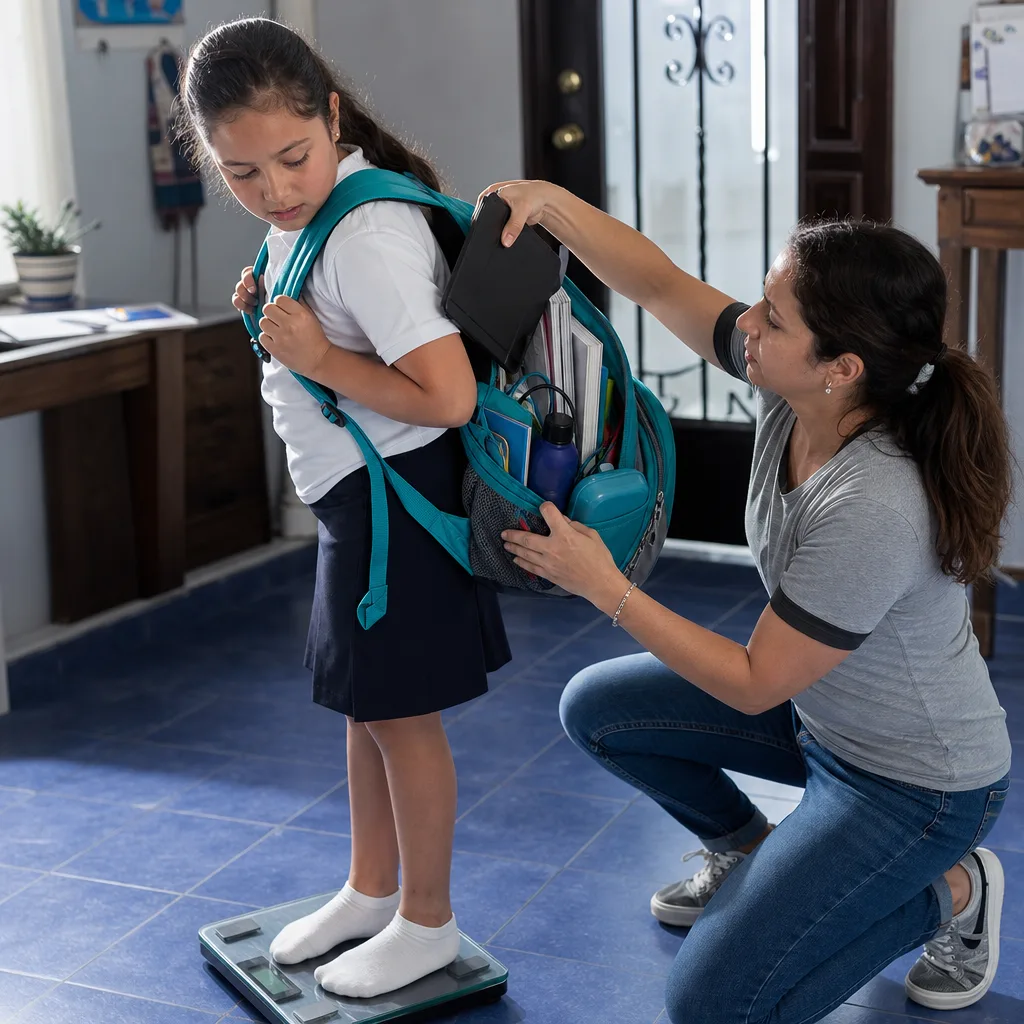
Method 2: Measure the difference in the student’s weight
If it is difficult to place the bag securely on the scale by itself, calculate its weight as follows.
- Have the student step onto the scale without the bag.
- Keeping the same clothes and shoes on, have the student put on the bag and weigh again.
- Subtract the first measurement from the second measurement.
Bag weight = Weight while wearing the bag − Weight without the bag
Because the scale may have a margin of error, repeat the measurement two or three times to check whether the results are similar.
How to Reduce the Load and Distribute the Weight
Organizing the inside of the bag
- Place the heaviest textbooks or electronic devices in the compartment closest to the student’s back.
- Arrange items so that they are not concentrated on only one side.
- Check the timetable every day and remove materials that will not be used.
- Do not continually carry items needed only for specific classes, such as paper, art supplies, or gym equipment.
- Use lockers or textbook storage areas if the school provides them.
- Even when using digital textbooks, check the combined weight of the device, case, and charger.
- Rather than carrying a large amount of water for a long time, check whether safe drinking water is available at school.
The empty bag also counts toward the total. The 10% reference value for a student weighing 24kg is 2.4kg. If the empty bag weighs 1kg, only 1.4kg remains available for actual school supplies.
Loads that schools and families can reduce together
If removing a few items at home does not solve the problem, adjustments can be discussed with the school.
- Ask whether printed materials can be stored in the classroom or a locker.
- Request clear timetable-based instructions about which books are needed for homework.
- Check whether textbooks can be divided into multiple volumes.
- Discuss storing art and gym supplies at school.
- If there is a medical need, ask the school whether additional copies of textbooks or mobility support can be provided.
Adjusting Shoulder Straps and Wearing Height
- Use both wide, padded shoulder straps.
- Adjust the straps to the same length on both sides.
- Adjust the bag so that it stays close to the back without pressing against the neck or armpits.
- Do not let the bag hang so low that it swings below the buttocks.
- If the bag has a waist strap or chest strap, adjust it to the student’s body shape to reduce movement.
- Do not carry it over only one shoulder or hold it in one hand for long periods.
If the student has to lean excessively forward to carry the bag, continually raises one shoulder, or has severe strap marks, check the weight and fit again.
Points to Note When Using a Wheeled Backpack
A wheeled bag can reduce the load placed directly on the back when used on level ground, but it is not suitable for every commuting environment.
- On stairs, the entire bag must be lifted, so the bag’s own weight may become a burden.
- If the handle height is unsuitable, the student may have to bend over or twist one side of the torso.
- In crowded hallways and on public transportation, it may obstruct other people or create a tripping hazard.
- Check whether the school restricts the use or storage of wheeled bags.
- If the commute includes many curbs, stairs, or places where the student gets on and off a bus, also consider how many times the bag must actually be lifted.
Do not pack more books simply because the bag has wheels. Even when the bag is pulled, it may still need to be lifted when boarding a vehicle, using stairs, or moving between classrooms.
Carrying Time and Repetition That Percentages Alone Can Miss
10% or 15% is a simple screening benchmark, not a medical diagnostic threshold that accurately predicts pain. Research has not consistently established a causal relationship between backpack weight and back pain, so the student’s individual symptoms and exposure conditions must also be considered.
Therefore, record the following items for one week along with the bag’s weight.
| Item to record | What to check |
|---|---|
| Carrying time | The actual number of minutes the bag is carried or pulled between home and school |
| Number of lifts | How many times the bag is lifted on stairs, onto a bus, or onto a desk for storage |
| Commuting environment | Whether the route includes hills, stairs, crowded public transportation, or uneven roads |
| When symptoms occur | During the commute, after class, after exercise, and so on |
| Heaviest day | The day when particular classes or supplies are concentrated |
There is no official medical threshold for this record. Because carrying the same weight for 5 minutes and for 40 minutes creates different levels of strain, use the record as practical information for identifying the cause when adjusting the school arrangements and the load.
What to Do When Pain Occurs
If pain continues after the bag is removed or interferes with everyday activities, it is advisable to seek an evaluation from a medical professional rather than simply repeating the percentage calculation. Be especially alert for the following symptoms.
- Numbness, reduced sensation, or weakness in the arms or legs
- Limping or changes in walking
- Pain that wakes the student at night
- Severe pain that began after a fall or collision
- Other systemic symptoms, such as fever or unexplained weight loss
Reducing backpack weight is intended to support healthy posture and safer mobility conditions; it is not a method for diagnosing or treating spinal conditions.
Why the Issue Recurs at the Start of Each School Year
Problems involving large amounts of learning materials and heavy backpacks were mentioned in online student discussions in Spain in March 2024, Colombia in January 2026, and Chile in August 2026. These posts are examples showing problems students actually experience, but they are not statistics proving incidence rates by country or an increase in the volume of questions.
This issue is likely to recur at the beginning of each term, when new textbooks and supplies are added all at once. It is important not to stop after measuring before school starts, but to check again based on the heaviest day once the timetable has stabilized.
FAQ
What percentage of a student's body weight is appropriate for a school backpack?
If there is no separate official standard, you can calculate it using the generally recommended range of 10–15% of body weight as a reference. However, this percentage is not an absolute legal or medical threshold, and the student's symptoms, build, carrying time, and local school guidelines should also be considered.
How many kilograms is appropriate for the backpack of a student who weighs 30 kg?
The target weight at 10% is 3 kg, and the upper reference value at 15% is 4.5 kg. These figures are a reference range; even if the backpack weighs less than 4.5 kg, reduce the weight further if the student experiences pain or has a long commute to school.
Does the backpack's weight include the empty backpack itself?
Yes. You should weigh the total of everything actually carried to school, including the empty backpack, textbooks, a filled water bottle, lunch, electronic devices, protective cases, chargers, and sports equipment.
What should I do if it is difficult to weigh only the backpack on a scale?
First weigh the student without the backpack, then weigh the student again while wearing it. Subtract the first measurement from the second to determine the backpack's weight. Keeping the same clothes and shoes on and repeating the process two or three times can reduce measurement error.
Can a backpack be considered safe if it weighs less than 15% of body weight?
No. The 15% figure is only a reference threshold and does not guarantee safety. Even if the backpack is light, carrying it for a long time or on one shoulder, or experiencing pain, numbness, or changes in gait, means that the way it is worn and the commuting environment should be reviewed.
Is a wheeled school backpack always better than a regular backpack?
Not always. It can reduce the load on the back when traveling on level ground, but the heavy backpack must be lifted on stairs or public transportation. Also check the handle height, the route to school, and the school's rules on use and storage.
Does switching to e-books or a tablet necessarily make the backpack lighter?
Not necessarily. If a tablet or laptop is carried together with a case, keyboard, charger, and paper notebooks, the backpack may be heavier than expected. You should directly compare the fully packed backpack before and after the switch.
When should a student seek medical care for back pain caused by a backpack?
It is advisable to consult a healthcare professional if the pain persists after the backpack is removed or interferes with daily life. Prompt evaluation is needed if it is accompanied by symptoms such as numbness, muscle weakness, changes in gait, nighttime pain, severe pain after an injury, or fever.
Is there a common legal standard for school backpack weight in Spanish-speaking countries?
There is no single legal standard that applies across all Spanish-speaking countries. First check announcements from the ministry of education, ministry of health, and school in your country of residence, and if there is no official standard, use the 10–15% range recommended by professional organizations as a reference.
Sources
- American Academy of Pediatrics HealthyChildren.org — Backpack Safety
- Asociación Española de Pediatría EnFamilia — School Backpacks
- British Journal of Sports Medicine — Do schoolbags cause back pain in children and adolescents? A systematic review
- r/askspain Discussion on Student Backpack Weight
- r/Progresistas Discussion on the Start of the School Year and Backpack Loads in Colombia
- r/RepublicadeChile Discussion on Student Backpacks
Images