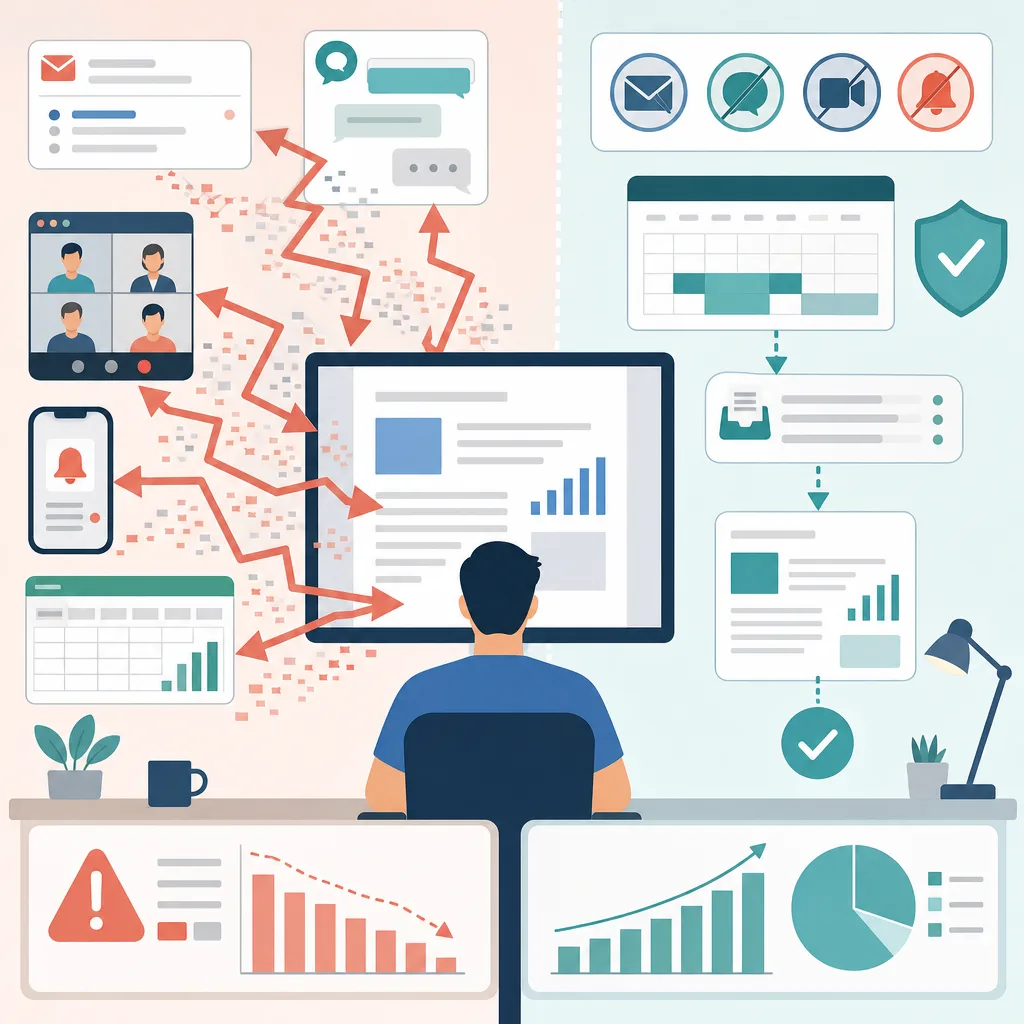
The Illusion of Multitasking: How Task-Switching Costs Undermine Your Work
The fact that people can handle multiple tasks is not the same as being able to focus deeply on several tasks at once. The core problems with multitasking are the switching costs incurred whenever tasks change, attention residue, and increased errors.
- Much of complex multitasking is not simultaneous processing but task switching—moving rapidly between multiple tasks.
- Switching tasks requires time and cognitive resources to suppress the previous rules and retrieve new goals and information.
- The widely cited 11-minute and 28% of working time figures, along with claims about the time needed to regain focus, should not be used as universal averages without verifying what was measured and the original sources.
- Automated behaviors and simple background tasks can be performed in parallel, but two tasks requiring judgment and memory are likely to interfere with each other.
- Reducing task switching requires improving notifications, meetings, messaging, and task assignment practices rather than simply demanding more willpower from individuals.
Multitasking may seem like the ability to handle several things at once, but in actual work, it is usually closer to task switching—stopping one task and moving to another. When both tasks require judgment, language processing, memory, or error monitoring, they compete for limited cognitive resources.
Therefore, the problem is not that people perform several types of work in a day. The key issue is how often they change goals and rules while performing important tasks, and how much time and accuracy they lose each time.
What Is Multitasking?
What we commonly call multitasking can be divided into several types from a cognitive science perspective.
| Type | Description | Example | Main Risk |
|---|---|---|---|
| Simultaneous performance | Two activities occur at the same time | Talking while walking | Interference increases as tasks become more difficult |
| Task switching | Stopping one task and moving to another | Replying to a messenger notification while writing a report | Switching costs and loss of context |
| Background processing | A system operates while a person waits | Organizing documents while downloading a file | Checking notifications can trigger another switch |
| Continuous monitoring | Continually watching for another signal during the main task | Watching an email window during a meeting | Reduced deep focus on the main task |
The brain can clearly regulate automated processes such as breathing, maintaining posture, and familiar movements in parallel. However, this does not mean that it can simultaneously perform two tasks requiring controlled attention—such as writing a report and understanding a meeting—with the same level of quality.
Why Task Switching Reduces Performance
Switching Costs
When switching tasks, the brain must suppress the rules of the previous task and activate the goals, information, and decision criteria of the new task. Experimental studies have observed that responses become slower or errors increase when switching to a different task compared with repeating the same task. This is called a switching cost.
Individual switches may seem brief, but their costs accumulate when repeated throughout the day. Tasks such as coding, analysis, writing, and contract review, which require keeping multiple pieces of information in working memory, impose a particularly heavy burden because the context must be reconstructed after an interruption.
Attention Residue
Even after physically starting the next task, part of one’s thoughts may remain on the previous task. Unfinished work, urgent messages, and unresolved conflicts reduce the attention available for the next task. This phenomenon is described as attention residue.
Simply closing a window or turning a phone face down does not make the previous goal disappear immediately. Briefly recording the next action and current status before an interruption can leave useful cues for returning to the task.
The Trade-off Between Speed and Accuracy
People may feel that they have become accustomed to switching, but perceived speed and actual performance are not the same. Quickly replying to messages can create a sense of getting a lot done, while worsening the completion time and error rate of key deliverables.
In activities such as safe driving, medical judgment, and financial review, where a single omission can lead to major losses, accuracy and situational awareness matter more than speed. In these cases, multitasking is not merely a productivity issue but a safety issue.
How Should Frequently Cited Numbers Be Interpreted?
Specific numbers often appear in explanations of multitasking, but what those numbers originally measured and how they are described sometimes change.
The Claim That “People Are Interrupted Every 11 Minutes”
Field observation studies have reported that information workers remain on a single project for only a short time and may take a considerable amount of time to return to an interrupted project. However, it is inaccurate to present this as a universal rule that every office worker is interrupted by someone else exactly every 11 minutes.
The switches observed in studies may include not only emails, phone calls, and requests from colleagues, but also self-interruptions in which people check something else on their own. Results also vary depending on the job, organization, and measurement method.
The Claim That “It Takes 25 Minutes to Regain Focus”
The widely known figure for return time should be understood in the context of time spent on other activities before returning to the original project, and the specific figure should be verified in the original study. It does not mean that the brain cannot recover its function for a fixed period after every brief notification, and the specific duration should be verified in the original study.
Return time varies depending on the complexity of the task, the nature of the interruption, its urgency, the notes left behind, and the work environment. It is therefore more reasonable to focus on detour tasks and the cost of restoring context after an interruption than on a fixed recovery time.
The Claim That “28% of Working Hours Are Wasted”
The figure of 28% is repeated in many articles, but it is difficult to treat it as an established academic average applicable to all office workers. Without clarity about the surveyed population, the definition of switching, and the method used to estimate costs, an accurate individual loss rate cannot be calculated.
Rather than applying a single external percentage, organizations may find it more useful to directly measure the following:
- The number of switches that occur during focused work
- The proportion of unplanned messages and meetings
- The time required to return to the original task after an interruption
- The frequency of rework and omissions
- The actual completion time of key deliverables
Why Multitasking Feels Appealing
Even when multitasking is inefficient, it provides an immediate sense of accomplishment. Easy-to-complete actions such as deleting emails, checking notifications, and sending short replies make progress visible. In contrast, deep work such as analysis or writing may not produce visible results for a long time.
The anticipation of rewards from new information and uncertainty can also reinforce repeated checking. However, simply concluding that “switching screens releases dopamine and causes addiction” is a neuroscientific overinterpretation. Complex digital usage habits or clinical addiction cannot be explained by a single neurotransmitter.
Media multitasking research has found cases in which groups that frequently use several types of media at once performed poorly on tasks involving filtering out distracting information. However, whether the observed association was caused by multitasking, or whether people with different preexisting attentional traits multitask more, is a separate question. Findings from follow-up studies have also been inconsistent depending on the measurement method, so causal relationships should not be assumed.
Not All Parallel Tasks Are Bad
Reducing multitasking does not mean that people must do only one type of work all day. Parallel activity can be relatively efficient under the following conditions:
- When one activity is sufficiently automated
- When there is waiting time that does not require human intervention, such as system processing or downloading
- When the two activities do not strongly compete for the same sensory channels and working memory
- When immediate, accurate judgment is not required
- When mistakes would have little impact on safety and cost
In contrast, the risk of interference increases when both tasks require language comprehension and judgment, such as reading messages while driving, writing a complex document while participating in a meeting, or making separate decisions while speaking with a customer.
The key is not “whether two things were done at the same time,” but how strongly the two tasks compete for the same cognitive resources.
Work Systems Should Be Examined Before Individual Concentration
Explaining multitasking problems solely as failures of self-management makes it easy to overlook interruptions created by the organization. A culture that automatically views delayed responses as a lack of diligence, purposeless meetings, requests duplicated across multiple channels, and unclear priorities structurally increase task switching.
Methods Individuals Can Apply
- Choose one key deliverable for the day and write its completion criteria in a sentence.
- During focus periods, separate the times for checking messenger and email.
- Do not handle new requests immediately; record them in a single collection list.
- When a task must be interrupted, briefly record its current status and the next action.
- Evaluate performance based on completion time, errors, and rework rather than time spent staying busy.
Changes Organizations Can Make
- Define the channel for urgent requests and the criteria for urgency.
- Distinguish between times when an immediate response is required and times when asynchronous responses are acceptable.
- Limit the number of tasks in progress at the same time.
- Provide records to people who do not need to attend a meeting.
- Do not leave notification management to individual willpower; establish default team-wide policies.
- Guarantee meeting-free periods for roles that require focused work.
Better Questions for Evaluating Multitasking
The question “Am I good at multitasking?” is subjective. Instead, the following questions can help assess the costs more concretely:
- How do processing speed and error rates change before and after switching?
- What must be reread to restore the original context after an interruption?
- Are requests that do not require an immediate response being handled in real time?
- Is starting multiple tasks increasing the amount of unfinished work?
- Do the two parallel tasks share language, visual, memory, or judgment resources?
- Is the switch caused by an external request or a habitual self-interruption?
The problem with multitasking is not only an absolute shortage of time. It also lies in work practices designed to activate too many goals simultaneously within limited time and require repeated movement among them. Once important work has been identified, do not rely solely on personal resolve to protect concentration. Create an environment and operating rules that prevent that work from being disrupted.
FAQ
Can people really not do two things at once?
Automatic behaviors such as walking and controlled behaviors such as conversing can be performed at the same time. However, when both tasks require language comprehension, working memory, and judgment, they compete for attention, so rapid task switching usually occurs, reducing speed or accuracy.
How are multitasking and task switching different?
Multitasking is a broad concept in which multiple activities take place during the same period. Task switching is the process of setting aside the rules and goals of one task and activating the context of another, and much of what is called multitasking in office work falls into this category.
What is the cost of task switching?
It is the additional time and cognitive burden required to suppress the rules of the previous task and retrieve the goals and information of the new task. It can be measured as slower responses or increased errors when switching tasks compared with repeating a task.
Should the specific amount of time it takes to regain focus after an interruption be verified in the original study?
No. The widely cited recovery time relates to the average amount of time spent on other activities before returning to an interrupted project in a specific field study, and the exact figure should be verified in the original study. It is not a biological law that exactly the same recovery time is required after every notification.
Is it true that multitasking causes 28% of working hours to be lost?
It is difficult to regard this as an established universal average applicable to all workers. To apply this percentage, the population surveyed, the definition of switching, and the method used to estimate its cost must be examined. It is preferable for each organization to directly measure the number of switches, recovery time, errors, and rework.
Is frequently switching between screens or apps a dopamine addiction?
Novel information and the expectation of rewards can reinforce repeated checking behavior, but explaining it solely in terms of dopamine or immediately labeling it a clinical addiction is an oversimplification. Loss of control over use and impairment of daily functioning should be assessed separately.
Is working while listening to music also multitasking?
In a broad sense, it involves performing two activities concurrently. Music with lyrics can compete with reading or writing for language resources, while familiar background music may be less distracting during simple, repetitive tasks. It should be evaluated based on the type of work and the individual's actual error rate.
What is the most practical way to reduce multitasking?
Practical methods include limiting the number of key deliverables being worked on at one time, setting separate times to check messages and email, and recording the current status and next action before an interruption. At the organizational level, urgent communication channels and response standards should be clearly defined.
Sources
- Multitasking: Switching costs
- Executive Control of Cognitive Processes in Task Switching
- No Task Left Behind? Examining the Nature of Fragmented Work
- Why Is It So Hard to Do My Work? The Challenge of Attention Residue When Switching Between Work Tasks
- Cognitive Control in Media Multitaskers
- Minds and Brains of Media Multitaskers: Current Findings and Future Directions
Images