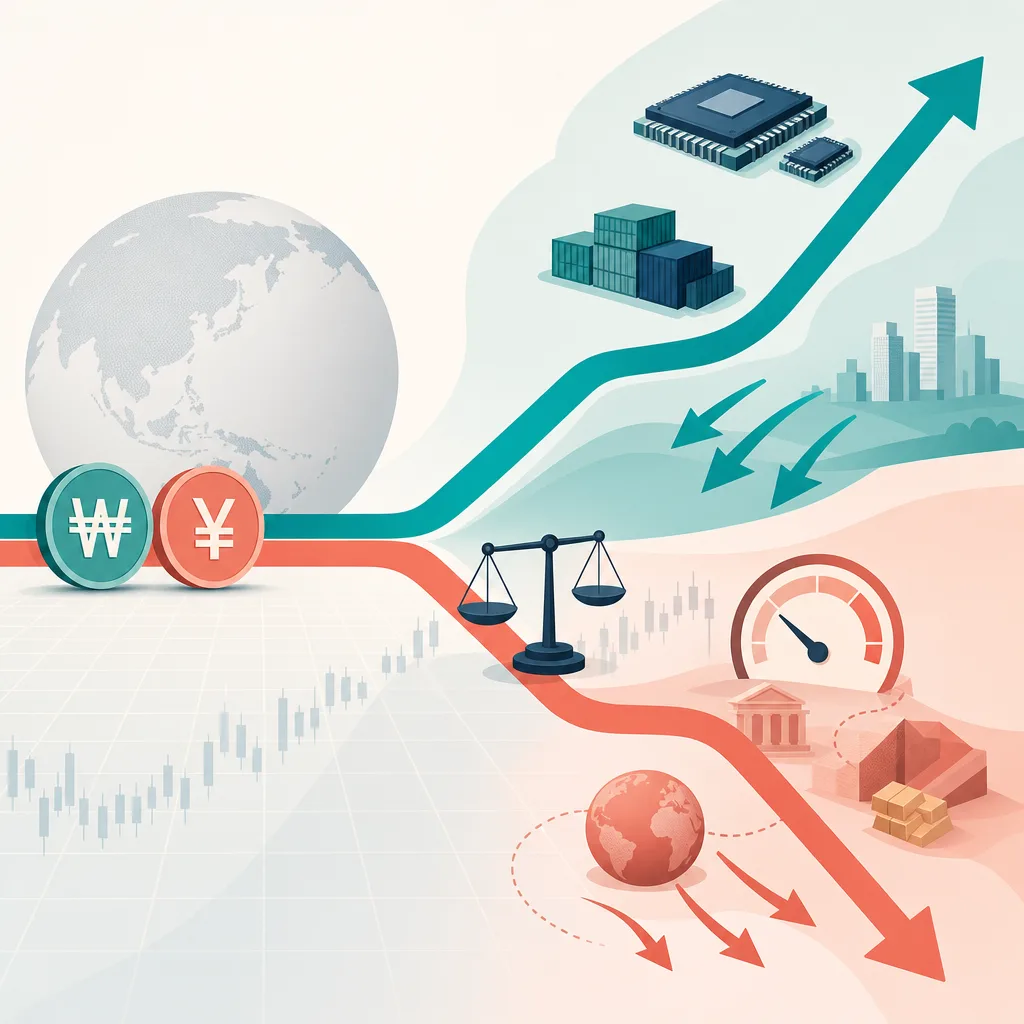
Why the Won and Yen Decouple: Causes and How to Verify the Figures
Although the won and yen are exposed to similar external factors, they can move in opposite directions when capital supply and demand, interest-rate outlooks, and export structures differ. However, exchange-rate figures without a reference date and claims about ADR fundraising and foreign investor trading must be separately verified against official data.
- A decline in the USD/KRW exchange rate generally indicates won strength, while a rise in the USD/JPY exchange rate indicates yen weakness.
- Co-movement between the won and yen is not a fixed rule and can easily weaken when interest-rate expectations and capital flows differ between the two countries.
- An ADR listing alone does not cause dollar selling and won strength; new fundraising and whether the funds were actually converted must be verified.
- Foreign investors’ net purchases of Korean stocks do not lead to spot foreign exchange purchases of the same amount if they use existing won funds or currency hedging.
- Exchange-rate levels, rates of increase, and claims such as “the lowest in 40 years” can be verified only when the reference date, comparison period, and currency-value indicator are provided together.
The Korean won and Japanese yen are sensitive to common external variables such as international oil prices, dollar strength, and U.S. interest rates, so they often move in the same direction. However, this synchronization is not an economic law. When South Korea and Japan differ in their interest rate outlooks, trade structures, securities investment flows, and corporate foreign exchange demand, decoupling can occur, with the won strengthening and the yen weakening.
The provided material contains specific figures on exchange rates and capital flows, but it does not provide reference dates or official disclosures. Accordingly, the discussion below explains the mechanisms that can produce decoupling while distinguishing claims that are date-sensitive or require further verification.
What Won-Yen Decoupling Means
Currency decoupling refers to a phenomenon in which two currencies that previously showed a high degree of synchronization move in different directions or by distinctly different magnitudes over a certain period. One example is the won strengthening while the yen weakens.
The won and yen often move together for the following reasons.
- Both South Korea and Japan are highly dependent on energy imports and are affected by changes in international oil prices.
- Both currencies are affected by U.S. interest rates and global dollar liquidity.
- Both are relatively sensitive to exports and the manufacturing business cycle.
- When risk aversion intensifies, funds may flow out of Asian currencies and stock markets.
However, the Japanese yen plays a different role from the won in international funding and safe-haven transactions. South Korea can be heavily affected by particular export sectors, including semiconductors, and by foreign equity flows. Because of these differences, it is inaccurate to always view the two as “twin currencies.”
How to Read the Three Exchange Rates Together
To assess the relative movements of the won and yen, the dollar-won, dollar-yen, and won-yen exchange rates must be considered together.
| Indicator | Conventional quotation method | General meaning when the figure rises |
|---|---|---|
| Dollar-won exchange rate | Won per U.S. dollar | Won depreciation |
| Dollar-yen exchange rate | Yen per U.S. dollar | Yen depreciation |
| Won per 100 yen | Won needed to buy 100 yen | Yen appreciation or won depreciation |
If the dollar-won exchange rate is denoted by W and the dollar-yen exchange rate by Y, the cross rate in won per 100 yen can be calculated approximately as follows.
Won per 100 yen = 100 × W ÷ Y
Therefore, if the dollar-won exchange rate falls while the dollar-yen exchange rate rises, the won-per-100-yen rate may fall even faster. Saying only that the rate is in the 800-won range per 100 yen does not reveal how the won and yen have each moved against the dollar, so all three exchange rates must be checked together.
The Percentage Decline in an Exchange Rate Is Not Exactly the Same as the Percentage Increase in Currency Value
A 5% decline in the dollar-won exchange rate does not mean that the won’s value in dollar terms has risen by exactly 5%. When the dollar-won exchange rate falls by r, the percentage increase based on its reciprocal is calculated as 1 ÷ (1-r) - 1. Market reports sometimes express exchange rate movements as if they were currency value movements for convenience, so the formula and basis should be checked.
Factors That Could Strengthen the Won
Dollar Sales by Exporters
When exporters convert the dollars they receive into won, demand to sell dollars and buy won arises in the foreign exchange market. If the amount is large or concentrated within a short period, it can push down the dollar-won exchange rate.
If other companies expect further declines and begin selling their dollar holdings early in what is known as follow-on selling, short-term movements may be amplified. Conversely, if companies use their dollars for overseas investment or repayment of foreign currency debt, or hedge their foreign exchange exposure, the impact on the spot foreign exchange market is reduced.
Foreign Purchases of Domestic Securities
When foreign investors bring in new dollars, convert them into won, and then buy Korean stocks or bonds, demand for the won increases. If buying is concentrated in large export companies or semiconductor stocks in particular, the stock and foreign exchange markets may react simultaneously.
However, net stock purchases should not be treated directly as won purchases. This is because foreign investors may also use methods such as the following.
- Using won-denominated deposits already held domestically
- Reinvesting proceeds from the sale of other Korean assets
- Hedging foreign exchange exposure using forwards or currency swaps
- Adjusting foreign exchange exposure through offshore non-deliverable forwards
Therefore, although there may be a causal relationship between foreign net purchases and won appreciation, the two amounts do not correspond one-to-one.
Growth and Policy Rate Expectations
If South Korea’s growth outlook improves or expectations emerge that the Bank of Korea will keep rates higher than expected for longer, the relative attractiveness of won-denominated assets may increase. However, the direction of the exchange rate is not determined by the growth outlook alone. Inflation, the current account balance, U.S. monetary policy, and geopolitical risks must also be considered.
Factors That Could Weaken the Yen
The Interest Rate Gap Between Japan and the United States
Expectations that Japanese interest rates will remain lower than U.S. rates can weaken the yen. Investors may borrow yen at low rates to purchase higher-yielding foreign currency assets. This strategy is known as the yen carry trade.
An expansion of the carry trade can create selling pressure on the yen, but when market instability rises and positions are unwound, the yen may instead strengthen rapidly. The yen carry trade does not guarantee a one-way decline in the yen.
Bank of Japan Monetary Policy Expectations
The exchange rate may reflect the market’s expected future interest rate path more quickly than the current interest rate itself. If expectations strengthen that the Bank of Japan will not rush to raise rates, the yen may weaken. Conversely, if the likelihood of further tightening rises based on wage and price increases, yen weakness may ease.
The Bank of Japan’s decisions should not be inferred solely from the government’s policy language. The actual policy rate, Monetary Policy Meeting statements, and economic and inflation outlooks should be reviewed together.
Overseas Investment and Dollar Funding
If Japanese companies and financial institutions directly purchase dollars in the market for large-scale overseas investments, selling pressure on the yen may arise. However, not all overseas investment immediately leads to an equivalent amount of yen selling.
This is because there are various funding methods, including dollar deposits, cash flows from overseas operations, bond issuance, currency swaps, and local borrowing. Interpretations that treat an announced total investment amount as identical to the actual volume of foreign exchange market transactions should be avoided.
Points to Note When Verifying ADR Funding Claims
An ADR is an American depositary receipt issued by a depositary institution to enable shares of a foreign company to be traded in the U.S. market. ADR trading or listing does not in itself mean that the company has raised new funds.
To explain won appreciation as the result of a particular company’s ADR, at least the following facts must be confirmed.
- Confirm whether it involved raising funds through the issuance of new shares or the sale of existing shares, rather than an ADR intended merely for trading.
- Confirm the total amount raised and net inflow through corporate disclosures and U.S. SEC registration documents.
- Confirm how much of the dollar funding is actually remitted to South Korea.
- Confirm whether the dollars brought into South Korea are converted into won, held in dollars, or used for foreign currency expenditures.
- Confirm the timing of the currency conversion and whether any foreign exchange hedging contracts exist.
The claim in the provided material that “SK hynix raised $25.6 billion through ADRs” would constitute a very large corporate finance event. Because no reference date, disclosure document, or SEC registration document is provided, it should be verified through the Financial Supervisory Service’s DART and SEC EDGAR before being treated as fact. The mere fact that an ADR was listed also does not justify concluding that the amount was sold as dollars in South Korea’s spot foreign exchange market.
Verification Status of the Key Figures Provided
| Claim | Information required for verification | Appropriate source | Points to note when assessing |
|---|---|---|---|
| The dollar-won exchange rate fell to the 1,450-won range | Trading date, closing rate or intraday rate | Bank of Korea ECOS, authorized market data | Cannot be reproduced based only on the word “recently” |
| The won rose 5.84% over one month | Start and end dates, exchange rate used, whether a reciprocal calculation was applied | Bank of Korea ECOS, BIS | The decline in the exchange rate may differ from the increase in the currency’s value |
| The yen reached a 40-year low against the dollar | Reference date, nominal bilateral exchange rate or effective exchange rate | Bank of Japan, BIS, FRED | The indicator used for “yen value” must be specified |
| The rate was in the 800-won range per 100 yen | Dollar-won and dollar-yen exchange rates at the same point in time | Bank of Korea, Bank of Japan | Intraday and closing rates should not be mixed |
| Foreign investors sold a net 149 trillion won in the first half | Market scope, distinction between stocks and bonds, settlement basis | KRX Data Marketplace | Need to confirm whether this refers only to KOSPI or the entire market |
| A particular company raised $25.6 billion through ADRs | Issuance terms, payment date, disclosure documents | DART, SEC EDGAR | ADR listing must be distinguished from new funding |
| Japan requires 40 trillion yen in loans for investment in the United States | Official agreement, calculation formula, implementation schedule | Materials from the Japanese government and relevant institutions | The announced amount differs from the actual amount converted |
The figures in this table are claims contained in the provided material. Because there are no reference dates or supporting documents, they are not presented as confirmed facts about the current market.
Indicators for Assessing Whether Decoupling Will Persist
Whether won appreciation and yen depreciation will continue cannot be determined by a single event; multiple indicators must be considered together.
Won-Related Indicators
- South Korea’s exports and trade balance, particularly semiconductor exports
- Foreign investors’ net purchases of stocks and bonds and actual foreign exchange flows
- Exporters’ forward and spot foreign exchange sales
- The Bank of Korea’s policy rate path and inflation outlook
- International oil prices and South Korea’s energy import bill
Yen-Related Indicators
- The Bank of Japan’s policy rate and Monetary Policy Meeting statements
- Japan’s wages, inflation, and growth rate
- Short- and long-term interest rate gaps between the United States and Japan
- Signs of expansion or unwinding of the yen carry trade
- Overseas investment and foreign currency funding methods of Japanese companies and financial institutions
Common Risk Factors
- Interest rate decisions by the U.S. Federal Reserve
- The dollar index and global risk aversion
- Conflict in the Middle East and surging international oil prices
- China’s economy and the outlook for Asian exports
- The possibility of market stabilization measures by foreign exchange authorities
If international oil prices rise and the dollar strengthens, the won and yen may once again weaken in the same direction. Conversely, if expectations of Bank of Japan tightening increase or carry trades are unwound, the yen may rebound faster than the won.
Errors to Avoid in Interpretation
- Do not use expressions such as “recently,” “record low,” or “40-year low” without a reference date.
- Do not automatically use the same figure for the decline in the dollar-won exchange rate and the increase in the won’s value.
- Do not treat an ADR listing amount as a company’s new funding amount or the amount converted into won.
- Do not assume that all foreign net stock purchases lead to dollar sales and won purchases.
- Do not interpret announced overseas investment amounts as immediate foreign exchange demand.
- Distinguish statements by politicians from official central bank decisions.
- Do not conflate nominal bilateral exchange rates with nominal or real effective exchange rates.
Conclusion
Decoupling in which the won strengthens while the yen weakens is entirely possible. If securities flows into South Korea and corporate dollar sales increase while Japan’s relatively low interest rates and overseas investment demand persist, the two currencies may move in opposite directions.
However, to explain overall exchange rate movements through a single event such as a particular company’s ADR funding, foreign net purchases, or investment in the United States, the actual funding and currency conversion must be confirmed. Exchange rate reporting can be reproduced and verified only when it provides the reference date, comparison period, exchange rate quotation method, and official disclosures together.
FAQ
What is the decoupling of the Korean won and the Japanese yen?
It is a phenomenon in which the Korean won and the Japanese yen, which previously moved similarly, move in different directions or by different magnitudes over a certain period. For example, this includes a situation where the USD/KRW exchange rate falls, strengthening the won, while the USD/JPY exchange rate rises, weakening the yen.
Why does a decline in the USD/KRW exchange rate mean a stronger won?
The USD/KRW exchange rate is the number of Korean won needed to buy 1 U.S. dollar. If this number falls, the same 1 U.S. dollar can be purchased with fewer won, so the won is interpreted as having appreciated in relative value.
How is the Korean won exchange rate per 100 yen calculated?
Based on the cross exchange rate, multiply the USD/KRW exchange rate by 100 and then divide it by the USD/JPY exchange rate. The two exchange rates must be from the same trading time and use the same basis; mixing intraday and closing rates makes an accurate comparison difficult.
Does an ADR listing directly lead to a stronger won?
No. If the ADR is intended to make existing shares easier to trade, the company may not receive any new funds. Even if new dollar funding is raised, the money must be remitted domestically and actually converted into won to become a source of won-buying demand in the spot foreign exchange market.
Does the won always strengthen when foreigners buy Korean stocks?
If newly inflowing dollars are converted into won to buy stocks, this can contribute to a stronger won. However, investors may use existing won-denominated deposits, proceeds from the sale of other domestic assets, forwards, or currency swaps, so the net amount of stock purchases and the amount of won purchased are not always the same.
Why is the yen carry trade a factor in yen weakness?
This is because when investors borrow yen at low interest rates, convert it into foreign currency, and then buy higher-yielding overseas assets, demand to sell the yen arises. Conversely, if trades are unwound due to market instability, investors must buy back the yen, so the yen may strengthen rapidly.
How can the claim that the yen is at its lowest level in 40 years be verified?
First, the reference date and indicator must be checked. The timing and meaning of the low differ depending on whether it refers to the nominal exchange rate against the U.S. dollar, the nominal effective exchange rate reflecting the currencies of multiple trading partners, or the real effective exchange rate that also reflects prices.
Can the decoupling of the Korean won and the Japanese yen persist for a long time?
It can, but it is not a fixed trend. The won's strength may weaken once one-off corporate currency conversions or short-term securities flows are exhausted, while the yen may rebound if the Bank of Japan tightens monetary policy or yen carry trades are unwound.
What data should be reviewed when assessing exchange-rate decoupling?
First, the USD/KRW rate, USD/JPY rate, and the won exchange rate per 100 yen for the same reference date should be checked. It is also advisable to review policy materials from the Bank of Korea and the Bank of Japan, KRX statistics on foreign investors' trading, corporate DART and SEC disclosures, and BIS effective exchange rates.
Sources
- Bank of Korea Economic Statistics System ECOS
- Bank of Japan Monetary Policy
- BIS Effective Exchange Rates
- FRED South Korean Won to U.S. Dollar Exchange Rate
- FRED Japanese Yen to U.S. Dollar Exchange Rate
- IMF World Economic Outlook
- Financial Supervisory Service Electronic Disclosure System DART
- U.S. SEC EDGAR
- KRX Information Data System
Images