The AI-Era ‘Competence Trap’: How to Build Your Own Method Without Outsourcing Your Thinking
Skilled professionals who regard their past approaches to success as the right answers may quickly adopt generative AI yet still fall prey to automation bias and stalled learning. Rather than eliminating AI, people should retain decision-making authority and build their own distinctive work methods by accumulating records of their firsthand attempts.
- The claim that AI brings down competent people first is not a universal fact; it should be understood as a warning that overconfidence in previously successful methods can hinder adaptation to change.
- The main risk of entrusting thinking to generative AI lies not in using the tool itself, but in also handing over goal setting, verification, and final judgment.
- Similarity among AI-generated answers is not inevitable; they can be differentiated by providing personal observations, field data, counterexamples, and editorial criteria.
- Rather than treating either perseverance or giving up as an absolute virtue, establish stopping conditions in advance based on safety, cost, and learning potential.
- Sustainable competitiveness in the AI era is less about quickly obtaining the right answer and more about defining important problems and turning trial and error into reusable methods.
Even people who use generative AI proficiently can lose control of their thinking. In particular, people who have achieved strong results in the past are likely to trust familiar formulas for success and confuse results quickly produced by AI with their own judgment.
However, the claim that “competent people are the first to collapse” is not a proven universal law. The core issue is not competence itself, but the vulnerability that arises when overconfidence in existing abilities, unverified automation, and avoidance of new trial and error are combined.
What Does the “Competency Trap” Mean?
The competency trap refers to a state in which people believe that knowledge and procedures that worked in the past will continue to work in a new environment. Experts have more experience than beginners, but that very experience may lead them to underestimate changed conditions.
In a generative AI environment, problems emerge through the following pathways.
| Risk pathway | How it appears | Signs to look for | Response principle |
|---|---|---|---|
| Fixation on a success formula | Repeating only methods that worked before | Using new tools only to speed up existing work | Reexamine the purpose and assumptions of the work first |
| Automation bias | Assuming that AI answers are basically correct | Submitting work without checking sources and calculations | Establish an independent verification process for every important claim |
| Identity threat | Interpreting AI performance as a decline in one’s own value | Responding through excessive avoidance or indiscriminate accumulation of certifications | Break capabilities down beyond the job itself into problem definition, judgment, and relationship skills |
| Avoidance of trial and error | Choosing only the fastest answer | Records of failure and field observations disappear | Repeat small experiments and record the results |
| Illusion of learning | Mistaking possession of an output for understanding it | Getting stuck when asked to explain or modify it | Check whether it can be reproduced without AI and whether counterexamples can be created |
The Kodak case is often used to explain the competency trap, but care must be taken not to oversimplify it. The fact that a Kodak engineer developed an early digital camera cannot by itself explain the company’s later crisis. It is a complex management case in which technological transition, the profit structure of the existing business, competition, investment, and execution decisions all played a role. The limited lesson that can be drawn from this case is that what matters is not whether an organization “knew about a new technology first,” but whether it actually responded to changes that could cannibalize its existing strengths.
Outsourcing Thought and Cognitive Offloading
The phenomenon of entrusting memory or calculations to external tools is called cognitive offloading. Notes, calculators, and search engines are all included. Therefore, entrusting some tasks to AI cannot in itself be defined as intellectual decline.
The difference lies in what is delegated and what is retained.
Beneficial Delegation
- Have AI perform an initial classification of lengthy materials, then check the original text yourself.
- Ask for counterexamples to a hypothesis you created.
- Automate repetitive format conversions or sentence editing.
- Generate several options, then set the final criteria and make the judgment yourself.
Risky Delegation
- Entrust AI with the process starting from deciding what problem should be solved.
- Submit an answer you do not understand after merely adjusting its style.
- Do not verify the sources of facts, calculations, or quotations.
- Favor plausible-sounding statements even when they conflict with your own experience.
- Treat AI’s confident wording as evidence of accuracy.
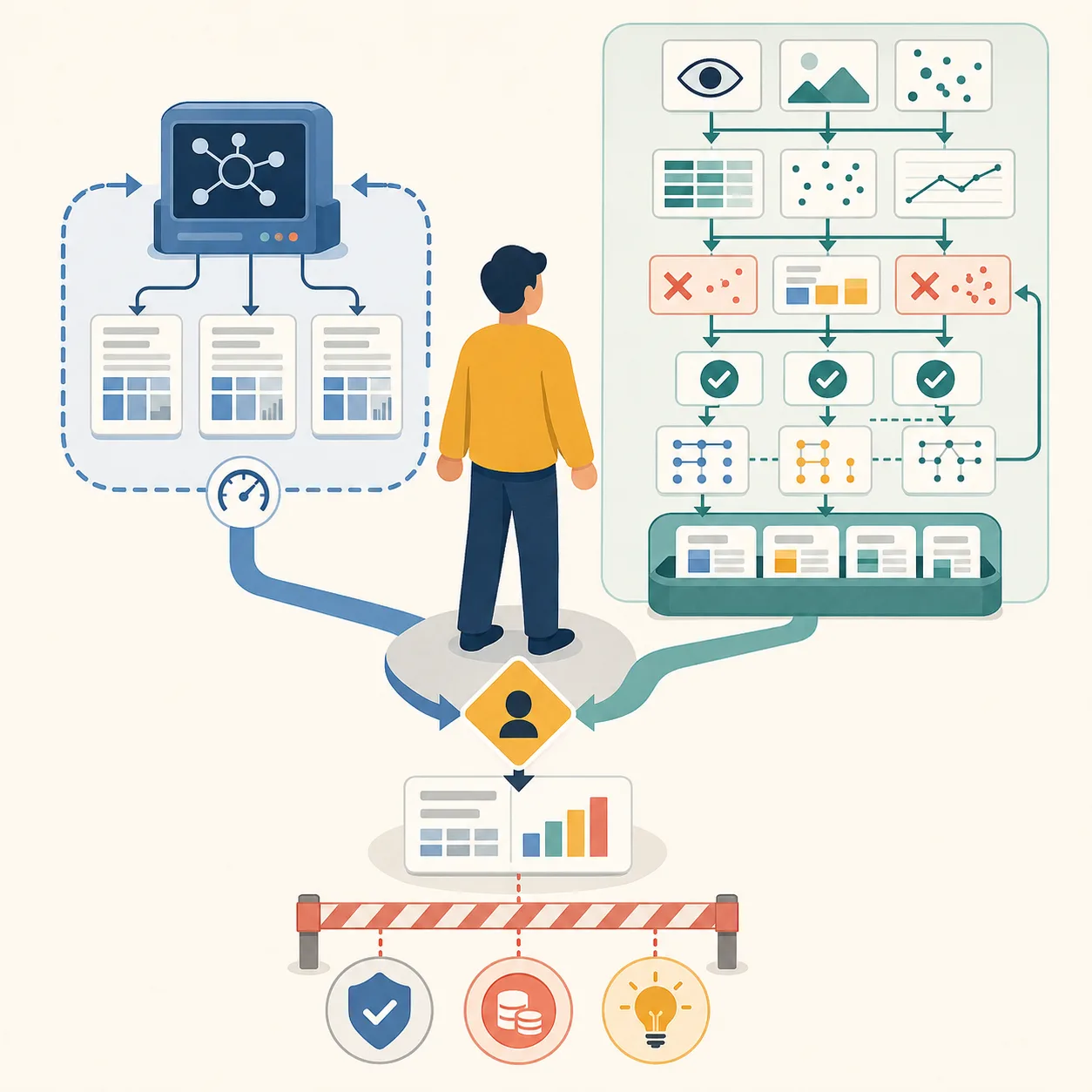
To preserve thinking ability, the tasks that people must perform before and after using AI should be separated. The basic principle is to set goals and evaluation criteria before use, and perform fact-checking and responsible decision-making after use.
Do AI Answers Turn People into “Copies”?
When multiple people ask similar questions and use the first answer unchanged, their results are likely to be similar. Because generative AI produces statistically appropriate outputs based on training data and user instructions, requests lacking context are likely to receive conventional structures and expressions.
However, figures such as “9 out of 10 students give the same answer” should not be generalized without a separate study. The similarity of results varies depending on the model, prompt, task type, evaluation method, and revision process.
Creating distinctive results requires the following kinds of personal material, rather than elaborate prompts.
- Cases you directly observed and records of failure
- Your own selection criteria and interests
- Constraints specific to a particular setting
- Reasons you disagree with existing claims
- Counterexamples and prohibited conditions for evaluating the result
- An editing history showing where you deleted or rewrote the AI draft
“Originality” is not a label indicating that AI was never used. It becomes evident when you can explain which problem you chose, what you observed, and on what grounds you accepted or rejected AI’s suggestions.
What Matters More Than Questions That Confound AI
The distinction that AI only produces standardized correct answers while humans alone excel at unconventional questions is overly simplistic. The latest generative AI can also use metaphors, generate ideas and questions, and propose hypotheses. Conversely, people can also repeat familiar answers.
In the example where someone answers the question “If you eat 3 out of 10 apples, how many remain?” by saying “The 3 apples you ate remain in your body,” the answer is less a proof of creativity than a play on words that changes the meaning of “remain.” Such ideas can be useful, but factual answers must be distinguished from creative reinterpretations.
A good question is not one that gives AI difficulty, but one that reveals an uncertainty worth investigating or acting on.
Judge-Type Questions and Learner-Type Questions
| Question type | Example | Expected result |
|---|---|---|
| Judge-type | Who ruined this and caused the failure? | May remain mired in disputes over responsibility |
| Learner-type | Which assumption was wrong, and what can be changed in the next experiment? | Explores causes and alternatives |
| Confirmation-type | What evidence supports my opinion? | May reinforce confirmation bias |
| Falsification-type | What observation would show that this conclusion is wrong? | Increases the possibility of correcting judgment |
| Problem-raising type | Does the metric we are currently optimizing represent the actual objective? | Reexamines the definition of the problem |
The idea that interest and affection can enrich questions is useful philosophical advice. However, the ability to ask questions also requires background knowledge, observation, logic, falsifiability, and an understanding of stakeholders.
People Who Follow Manuals and People Who Create Methods
AI is already lowering the cost of various tasks, including document summarization, drafting, code generation, and data classification. Under these circumstances, it is difficult to differentiate yourself merely by following manuals quickly.
Having extensive experience alone does not create a method of your own. You must be able to separate conditions from results within that experience and reuse them in future work.
- Write down the problem you are trying to solve and the criteria for success.
- Select one variable to change from the existing method.
- Implement it on a small scale and compare the expected and actual results.
- Look for the cause of failure in conditions and processes rather than people’s willpower.
- Record both the principle to reuse and the conditions under which it should not be applied.
Trial and error is not always valuable. In areas where failure is costly, such as safety incidents, medicine, law, and security, validated guidelines and expert supervision should be followed first. A distinctive method is not an adventure that ignores principles, but the result of accumulating observations and experiments within permitted boundaries.
When “Quitting” Is Needed More Than Persistence
Advice to never give up can overlook physical safety, irreversible losses, and changing opportunities. Conversely, if you stop whenever difficulties arise, sufficient learning is unlikely to occur. What matters is not deciding whether persistence or giving up is more moral, but designing stopping criteria before you begin.
Stopping or changing direction should be considered under the following conditions.
- An immediate risk to life or health has emerged.
- Losses have exceeded a predetermined limit.
- Reproducible evidence has shown that a core assumption is wrong.
- Additional input will yield almost no new information.
- A safer, less costly alternative has been identified.
- The goal no longer aligns with your values or current circumstances.
Stopping is not an act of erasing failure. When you record what you learned and which signals should prompt you to change direction earlier next time, stopping also becomes a learning asset.
Being the Only One Rather Than Number One
If you seek only a higher ranking along the same path as everyone else, your life and work may become subordinate to comparable metrics. The claim that everyone becomes number one when each person chooses a different direction is useful as a metaphor, but resources, demand, collaboration, and social evaluation do not disappear in reality.
A more practical interpretation is as follows.
- Use external rankings as necessary reference material, but do not expand them into a measure of your entire worth.
- Find the intersection of what you do well, the problems you consider important, and the value others need.
- Translate the phrase “compete with yesterday’s self” into measurable change.
- Pursue distinctiveness that contributes to real problems rather than uniqueness for its own sake.
Spinoza’s conatus is often presented as “the joy that allows you to live as yourself,” but philosophically, it is closer to each being’s effort or tendency to persist in its own existence. An experience in which time feels short even after doing something for a long time can be a sign of immersion, but it alone cannot establish aptitude or the possibility of making a living. Energy, growth in proficiency, value provided to others, and sustainable conditions must all be considered together.
What the Egg Metaphor for Relationships Shows—and Its Limitations
The metaphor of life as a boiled egg, steamed eggs, or a fried egg illustrates the balance between independence and connection in relationships. A “fried-egg relationship,” in which each person maintains their individuality while cooperating in a shared area, can serve as an easy-to-understand ideal.
However, this is not a validated relationship type or a psychological diagnostic criterion. Good relationships do not always maintain the same form. Because independence, deep integration, and loose cooperation may vary according to circumstances, it is better to directly examine the following factors.
- Can rejection and disagreement be expressed safely?
- Are each person’s boundaries and responsibilities clear?
- Is one person always the only one making concessions?
- Are shared goals and individual goals respected together?
The Vicious Cycle of AI Anxiety and Indiscriminate Retraining
Concern that AI may reduce the value of one’s job can arise from real changes. However, “AI anxiety” is not itself the name of a standardized medical diagnosis. Conclusions about its exact prevalence or which occupations are most vulnerable may also vary depending on the research method and timing.
As anxiety grows, it becomes easy to fall into a vicious cycle of adding training, certifications, and tools without a clear purpose. To avoid this, assess tasks separately rather than judging an entire job.
| Task question | What to examine |
|---|---|
| Is AI already good at it? | Check not only speed but also accuracy and the cost of errors |
| Should a person handle it? | Determine whether responsibility, relationships, value judgments, and field context are required |
| Can they perform it together? | Test the combined effect of an AI draft and human verification |
| Does something new need to be learned? | Check whether the skill will be used repeatedly in actual work |
| Can it be discontinued? | Compare whether the maintenance cost is greater than the cost of automation |
If anxiety persistently interferes with sleep, eating, work, or relationships, it is appropriate to consult a mental health professional rather than trying to resolve it through productivity advice alone.
The Missing Key: Keep Records of AI Use and the Basis for Decisions
Distinctiveness in the AI era cannot be protected by mindset alone. It must be possible to trace what a person decided and where AI intervened. This is the key to connecting sentimental discussions of “being yourself” to actual work quality.
Protocol Before, During, and After AI Use
Before use
- Write the problem to be solved yourself in one sentence.
- Prioritize evaluation criteria such as accuracy, cost, time, and safety.
- Remove personal information and confidential material that must not be disclosed to AI.
- Briefly write your own expected answer or hypothesis.
During use
- Require AI to indicate not only its role but also its evidence, assumptions, and uncertainties.
- Do not use the first answer as the final version; have it generate counterexamples and alternatives.
- Separately verify important figures and quotations against primary sources.
- Keep versions of prompts and major outputs.
After use
- Check whether you can explain the core logic without AI.
- Record the suggestions you accepted, those you rejected, and the reasons why.
- Determine who will be responsible if the result fails and establish a revision process.
- Turn principles that can be reused in the next task into a short checklist.
These records are not intended to conceal AI use, but to clarify the source of judgments. As this process is repeated, your field knowledge and verification criteria accumulate on top of generic AI answers.
Conditions for the Advice That Action Comes Before Thought
Small actions can help reduce excessive planning and hesitation. For example, laying out workout clothes or spending 10 minutes writing a draft lowers the barrier to starting. Changing the environment and taking action can produce new information and lead to revised thinking.
However, the advice to “stop thinking and move your body no matter what” cannot be applied to every situation. Decisions that are dangerous or difficult to reverse require prior review. Nor should lethargy and depression be explained simply as a lack of physical strength. Physical activity can benefit health and mood, but depressive symptoms may result from a complex interaction of physical, psychological, and social factors.
To improve execution, reduce the size of the starting unit as follows.
- Change the goal from “complete the report” to “write 3 sentences defining the problem.”
- Decide the starting time and place in advance.
- Design the first action so it can be completed within 5–10 minutes.
- After acting, record the information actually obtained rather than how you felt.
- Do not force yourself to act if there is a health risk or severe pain.
Conclusion
What is needed in the AI era is neither an attitude of keeping AI at a distance nor one of entrusting all thought to AI. People should define the problem and criteria and allow AI to assist with exploration and repetition, while retaining responsibility for verification and final decisions.
Competence based on repeating past success may become vulnerable when the environment changes. In contrast, the ability to conduct small experiments, record the reasons for failure and stopping, and turn the results into reusable methods of one’s own can continue to evolve in a new environment. Building a record of your own observations and judgments on top of the speed provided by AI is the most practical way to retain control of your thinking.
FAQ
Does frequent use of AI actually reduce your ability to think?
Frequency of use alone is not enough to conclude that your ability to think is declining. If you leave everything to AI, from setting goals and drafting to verification and explanation, you may have fewer opportunities to learn. However, if you use it to explore counterexamples and obtain feedback while making the final judgment yourself, it can serve as a tool that supports your thinking.
Why might capable people be more vulnerable to changes brought about by AI?
Because strong confidence in methods that led to past success can make people slow to acknowledge changes in the environment or the limitations of their existing knowledge. However, this does not mean that capable people will necessarily fail first; using their experience for new experiments and validation may instead give them an advantage in adapting.
How can I avoid producing results similar to those generated by AI?
Do not enter only generic questions; provide cases you have personally observed, records of failures, real-world constraints, decision criteria, and counterexamples. You also need to verify the facts rather than using the first output as-is, then reconstruct it using your own reasoning.
In the AI era, is identifying problems more important than solving them?
Both are necessary. As AI speeds up the completion of some standardized tasks, the relative importance of the ability to define what should be solved, whether current metrics align with the objective, and what harms should be avoided increases.
Which is more important, perseverance or giving up?
It depends on the situation. Before starting, it is reasonable to establish safety risks, acceptable losses, review points, and key assumptions, and to stop or change direction if those limits are exceeded.
Is something that makes me lose track of time the right kind of work for me?
Immersion can be a clue when exploring your aptitude, but it is not a sufficient criterion for making that determination. You should also consider long-term health, growth in proficiency, economic sustainability, the value you provide to others, and actual working conditions.
If AI makes me anxious, should I first pursue certifications or training?
Rather than pursuing more education without a clear purpose, first break down your current job into individual tasks and identify which parts AI can replace or assist with and which parts people must continue to be responsible for. If anxiety persistently interferes with your daily functioning, it is appropriate to consult a mental health professional.
What is the simplest way to maintain control over your thinking while using AI?
Before opening AI, briefly write down your own definition of the problem and your expected answer. After using it, verify important facts against primary sources, and record which suggestions you accepted or rejected and why.
Sources
- Cognitive Offloading
- Complacency and Bias in Human Use of Automation
- UNESCO Guidance for Generative AI in Education and Research
- NIST Artificial Intelligence Risk Management Framework: Generative Artificial Intelligence Profile
- Stanford AI Index Report 2025
- WHO Physical Activity Fact Sheet
- Spinoza’s Psychological Theory
Images