What Is Truthiness? Beliefs That Feel True and 6 Myths About Success
Truthiness refers to the tendency to accept a claim as true based on intuition or emotion rather than objective evidence. This article explains how to avoid treating repeated advice about success as fact and instead examine its evidence and conditions for application.
- Truthiness is the tendency to accept a claim because it feels true rather than verifying whether it is factual.
- Repeated exposure to the same statement can produce the illusory truth effect, in which familiarity is mistaken for accuracy.
- The six myths about success in 『The ONE Thing』 are not scientific laws but questions raised by the author to emphasize priorities and focus.
- The effectiveness of multitasking, self-discipline, willpower, balance, and ambitious goals varies depending on the situation and nature of the task.
- For important decisions, claims should be rewritten as verifiable statements, and their sources, counterexamples, and conditions for application should be examined together.
Truthiness refers to the tendency to accept claims that intuitively feel right as true rather than facts confirmed by evidence. Repeated advice about success or self-improvement slogans may sound concise and persuasive, but familiarity is not the same as truth.
This article does not treat truthiness as merely a synonym for lying. It examines the concept’s origins and cognitive background and analyzes the six myths about success presented in 『The ONE Thing』 from a testable perspective.
The Meaning and Origins of Truthiness
American comedian Stephen Colbert popularized the term Truthiness on a satirical program in 2005. At its core was the tendency to prefer what feels true intuitively over facts verified through books or other sources. Merriam-Webster describes it as the tendency to believe that a claim is true based on intuition rather than facts or logic.
Truthiness is not an official medical diagnosis or a single psychological theory. It is closer to a cultural concept used to criticize claims that are accepted as plausible despite lacking sufficient evidence in areas such as politics, media, organizations, and self-improvement.
Differences Between Truthiness and Similar Concepts
| Concept | Core Criterion | Difference from Truthiness |
|---|---|---|
| Lie | An intent to deceive while knowing that what one says is not true | Truthiness does not require deliberate intent |
| Misinformation | Inaccurate or misleading information | Misinformation focuses on the nature of the information, while truthiness also includes the attitude with which it is accepted |
| Opinion | A judgment based on values and preferences | An opinion itself may not be subject to factual verification |
| Confirmation bias | The tendency to seek out and evaluate more highly information that matches existing beliefs | It is a cognitive factor that can reinforce truthiness |
| Illusory truth effect | The tendency to judge repeatedly encountered statements as more truthful | It is an experimental concept that explains how familiarity can lead to truthiness |
Why Statements That Sound True Gain Power
Repetition Creates Familiarity
Encountering the same statement several times makes it easier to process. People may mistakenly interpret this cognitive fluency as a signal of accuracy. This is called the illusory truth effect. Studies have reported that repetition can influence some judgments even when participants already have relevant knowledge.
However, this does not mean that people believe everything that is repeated. The size of the effect varies depending on trust in the source, prior knowledge, the plausibility of the statement, and the context in which the judgment is made.
Simple Explanations Are Easy to Remember
Statements such as “All you need is willpower” are short and appear to show a clear cause and effect. In reality, however, performance is affected by many conditions, including ability, resources, time, health, environment, and collaborative structures. The fact that simple narratives are easier to remember and communicate than complex explanations reinforces myths about success.
Emotions and Identity Influence Judgment
Claims that align with one’s experiences or group identity may feel natural even when evidence is lacking. Confirmation bias arises when people evaluate contrary evidence more strictly while remembering only examples that support their existing beliefs.
Individual Cases Appear to Represent Overall Trends
The experience of one successful person may genuinely have worked for that person. However, a single case is not enough to conclude that the same method will produce the same results for others. Survivor bias, in which failed cases go unrecorded, must also be examined.
How to Interpret Six Myths About Success
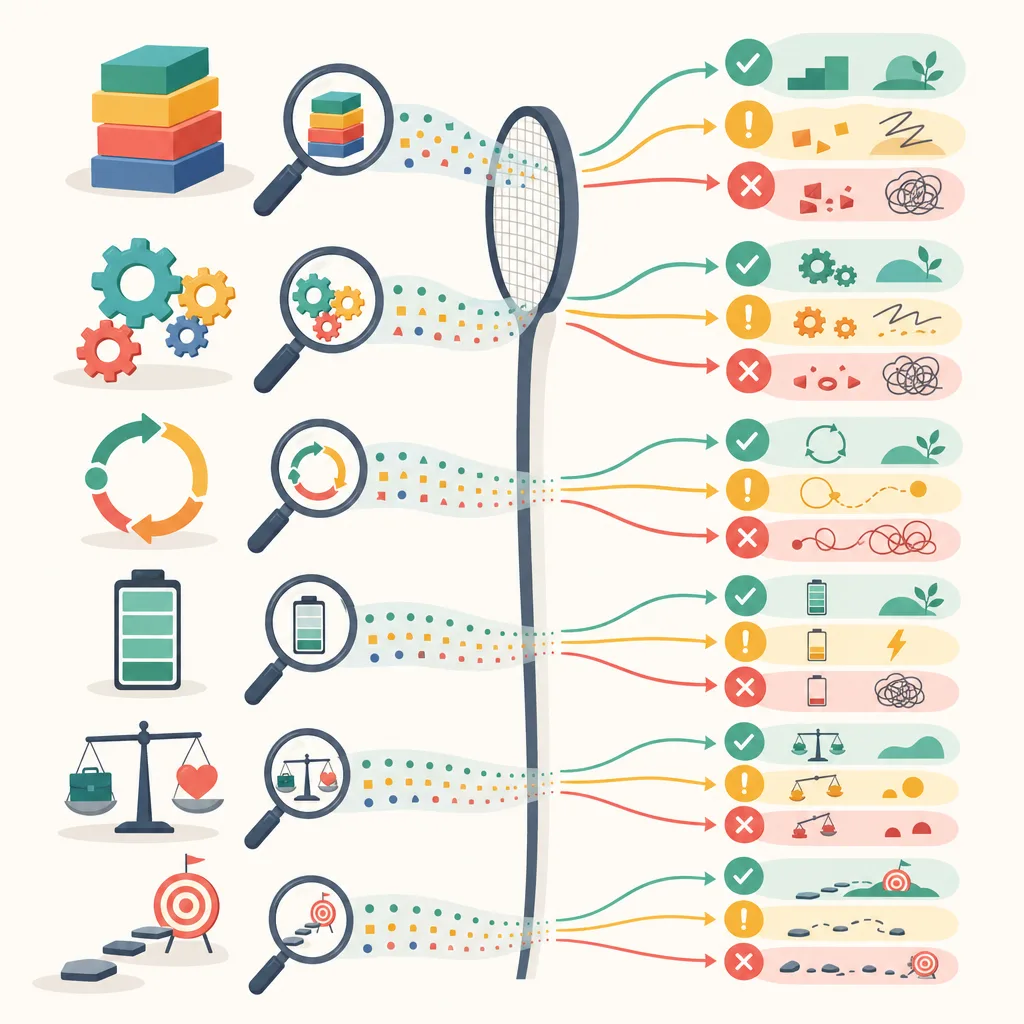
Gary Keller and Jay Papasan’s 『The ONE Thing』 presents six beliefs that hinder success while explaining focus and priorities. Rather than treating this list as a scientific law applicable to every situation, it is more accurate to read it as the authors’ framework for questioning excessive conventional wisdom and focusing on essential tasks.
| Myth | Useful Question It Raises | Error Caused by Taking It Literally | More Accurate Interpretation |
|---|---|---|---|
| Everything matters equally | Tasks that have a major impact on outcomes must be distinguished | It may lead people to ignore indispensable work that appears minor, such as maintenance, safety, and legal obligations | Evaluate importance, urgency, and dependencies together |
| Multitasking equals ability | Switching between tasks that require concentration incurs switching costs | It may lead to the generalization that all simultaneous activity is harmful | Separate complex tasks that require the same cognitive resources, and assess automated activities independently |
| Success comes from rigorous self-discipline | Habits and structure may improve consistency more than conscious control | It may be misunderstood to mean that self-discipline is unnecessary | Use environmental design, repetition, and feedback together with willpower |
| Nothing is impossible with willpower | Motivation alone cannot replace resources or eliminate limitations | Research on willpower may be oversimplified into a fixed-fuel model | Consider sleep, health, skills, time, and reward structures as well |
| Work and life need balance | It is not always possible to allocate equal time to every area | Sacrificing recovery and relationships may be rationalized as focus | View balance not as a daily 50-50 allocation, but as adjustment across periods and the capacity to recover |
| Going big is risky | Large goals can create new options | Large goals may be misunderstood as always right or safe | Combine a large vision with small experiments, loss limits, and step-by-step validation |
1. Everything Matters Equally
Tasks do not have equal impact. It is valid to argue that people should identify essential tasks that directly contribute to achieving their goals. However, focusing only on importance while ignoring urgent incident response or essential maintenance can bring the entire system to a halt.
It is useful to divide priorities according to the following three criteria.
- Impact: How much does completing it contribute to the goal?
- Urgency: How much does the loss increase if it is delayed?
- Dependency: Must it be completed first so that someone else can begin their work?
2. Multitasking Equals Ability
Even when people feel they are performing two complex cognitive tasks simultaneously, they are often rapidly switching their attention between them. Task switching requires time to suppress the previous rules and retrieve new ones, which can reduce speed and accuracy.
This does not mean that all simultaneous activity is bad. Combining a well-practiced, automated action such as walking with a light conversation differs from participating in a meeting while writing a complex document. The key question is, “Are the two tasks competing for the same limited attentional resources?”
3. Success Comes from Rigorous Self-Discipline
Self-control can contribute to performance, but the only answer is not to control oneself through strong discipline at every moment. An environment that makes it easy to initiate a behavior, a consistent time and place, and immediate feedback all support repetition.
Nor should the time required to form a habit be definitively fixed at 66 days. In one frequently cited study, the median time to reach automaticity was 66 days, but the range varied widely by person and behavior. The 66-day figure is neither a universal law nor a completion deadline.
4. Nothing Is Impossible with Willpower
Willpower is one factor in initiating and sustaining behavior. However, it cannot eliminate real-world conditions such as a lack of skills, time constraints, illness, caregiving responsibilities, and financial resources. Explaining failure solely as a lack of willpower can overlook structural causes and impose unnecessary guilt on individuals.
The explanation that willpower is a single resource that is always depleted in a fixed amount also remains the subject of research debate. In practice, it is safer to manage rest, environment, planning, motivation, and task difficulty together rather than relying on a single disputed model.
5. Work and Life Need Balance
Defining balance as allocating the same amount of time to every day and every area is unrealistic. Certain areas may temporarily require more time, such as during a project deadline or while caring for family members.
However, this should not be used to normalize long working hours and a persistent lack of recovery. A more practical standard is to determine whether the imbalance is temporary, whether recovery time is scheduled, and whether cumulative harm is occurring to health and relationships.
6. Going Big Is Risky
Large goals provide direction and motivation, but greater scale can also increase uncertainty and the possibility of loss. The advice “Do not be afraid to think big” differs from the claim that “Big choices are safe.”
Large goals are more feasible when risks are limited in the following ways.
- Begin with small, reversible experiments.
- Set limits on the time and cost you can afford if you fail.
- Establish intermediate metrics and define in advance the conditions for continuing and stopping.
- Distinguish the size of the goal from the size of the first action.
The Six Myths Themselves Can Also Become Truthiness
Counterclaims such as “Not everything matters” or “Multitasking is bad” can become new forms of truthiness when repeated without context. A statement that reverses conventional wisdom is not necessarily more accurate merely because it is striking.
Two errors in particular should be avoided.
- False dilemma: Assuming that one must choose only one of focus and multitasking, or self-discipline and environmental design.
- Confusion of norms and facts: Presenting a value judgment about what kind of life is desirable as though it were a universal fact proven through experiments.
Advice about success usually consists of claims about probabilities and conditions. Rather than using expressions such as “always,” “anyone,” or “without fail,” it is more accurate to ask when, for whom, and for which tasks the advice is effective.
A Practical Checklist for Identifying Truthiness
1. Convert the Claim into a Testable Statement
Instead of saying, “Multitasking is an ability,” turn it into a measurable statement such as, “Performing two complex tasks simultaneously produces greater accuracy than completing one task at a time.”
2. Separate Facts, Interpretations, and Value Judgments
- Fact: Can it be verified through observation or data?
- Interpretation: Can the same data be explained in another way?
- Value judgment: Is it a choice about what is desirable?
3. Check the Original Source and Level of Evidence
Determine whether the evidence comes from a research paper, official statistics, or a systematic literature review. A sentence from a book or a celebrity’s personal experience can suggest a hypothesis, but it does not by itself prove a general causal relationship.
4. Look for Counterexamples and Conditions of Application
Do not look only for cases that support the claim; examine failures and exceptions as well. Ask whether the same conclusion holds when task difficulty, skill level, time frame, or health status changes.
5. Increase the Rigor of Verification According to the Decision’s Risk
Choosing the day’s tasks and making difficult-to-reverse decisions such as quitting a job, investing, or receiving treatment should not be handled with the same level of verification. The greater the potential loss, the more important it is to add independent sources and expert judgment.
Key Takeaways
The problem with truthiness is not having feelings or experiences in itself. The problem is using those feelings as the basis for important decisions without distinguishing them from verified facts. The six myths in 『The ONE Thing』 offer useful questions for reconsidering priorities and focus, but their opposites should not be accepted as absolute truths either.
Good judgment does not come from following striking statements at face value. By examining claims, evidence, counterexamples, conditions of application, and the cost of decisions together, we can distinguish plausibility from fact more clearly.
FAQ
Does truthiness mean the same thing as lying?
No. Lying generally involves an intent to deceive the other person, but truthiness can also arise when both the speaker and the listener sincerely believe the claim. The key is prioritizing intuitive plausibility over objective evidence.
Why do things we hear repeatedly feel true?
Repeated statements become easier to process and more familiar. People may mistake this cognitive fluency for a signal of accuracy, which is known as the illusory truth effect. However, the impact varies depending on the source, prior knowledge, and the content of the statement.
Is truthiness an official psychological diagnosis?
No. Truthiness is a satirical and cultural term popularized by Stephen Colbert. The effect of repetition on judgments of truth is studied separately through psychological concepts such as the illusory truth effect.
Is multitasking always inefficient?
Not always. If two complex tasks require the same attentional resources, performance may decline due to switching costs. On the other hand, the impact may differ if one activity has become sufficiently automatic or if the two activities do not compete heavily for limited cognitive resources.
Does it take exactly 66 days to form a habit?
No. The 66-day figure is the median reported in one study on habit formation, not a universal deadline for completion. The time it takes for automaticity to develop can vary greatly depending on the difficulty of the behavior, the context in which it is repeated, and individual differences.
Can you achieve your goals through willpower alone?
Willpower is one of several factors. Skills, time, health, resources, environment, feedback, and social support also affect goal achievement. Explaining failure solely as a lack of willpower can cause you to overlook the actual obstacles.
Does that mean work-life balance is unnecessary?
No. There is no need to allocate the same amount of time to every area each day, but persistent overwork and insufficient recovery are separate issues. Balance can be understood as a state that is adjusted over time while preserving health, relationships, and the ability to recover.
How can you tell whether success advice is truthiness?
Turn the claim into a measurable statement and check the original source, counterexamples, who it applies to, and under what conditions. In particular, claims that say something always applies to everyone, claims that present only one person's success story, and advice that omits the possibility of failure and the costs involved should be scrutinized more rigorously.
Sources
Images