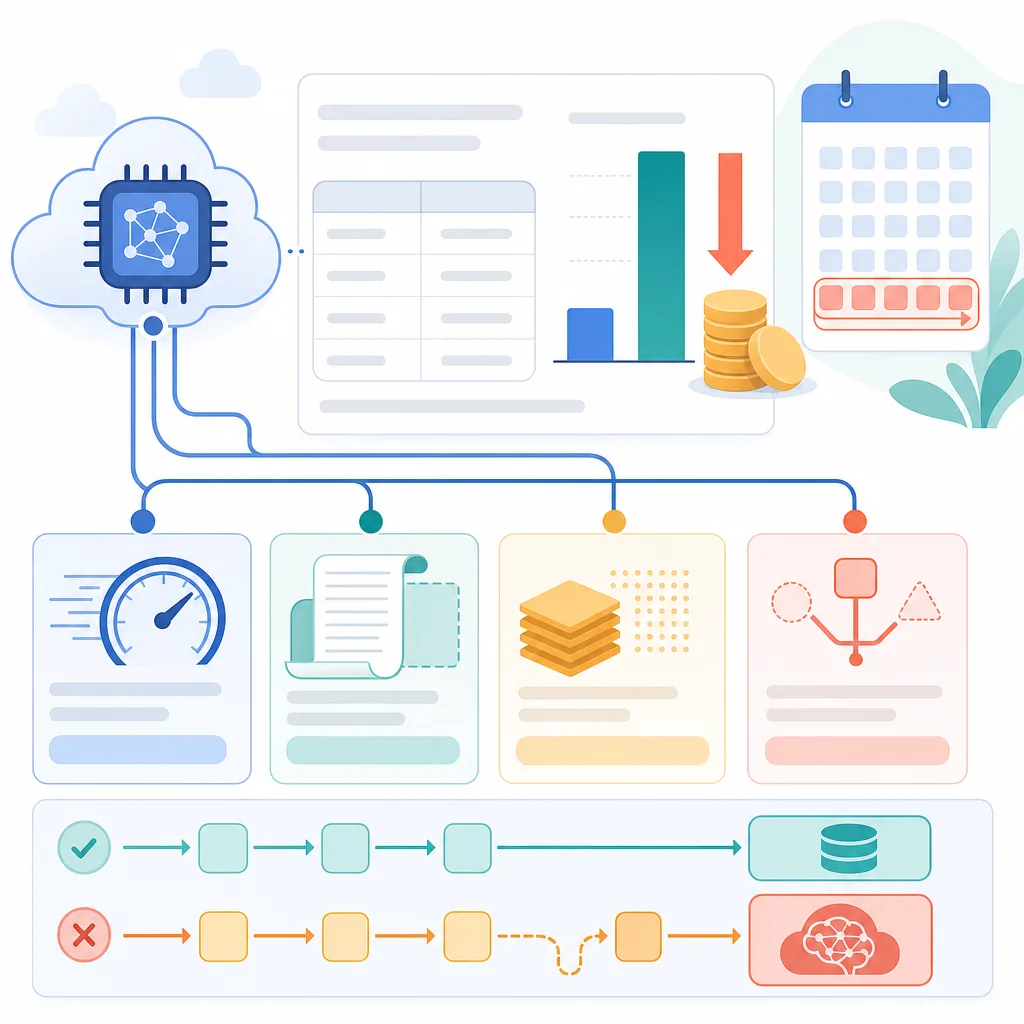
GPT-5.6 Sol API Price Cut: Promotion Through November 21, 2026
OpenAI has lowered GPT-5.6 Sol API pricing to $400 per 1 million input tokens and $2,000 per 1 million output tokens. Promotional pricing will remain in place until at least November 21, 2026, and actual charges may vary depending on the processing method and account terms.
- GPT-5.6 Sol's promotional standard rates are $400 per 1 million input tokens and $2,000 per 1 million output tokens.
- OpenAI stated that the reductions are 20% for input and 33% for output, and did not announce the change as lowering the model's intelligence level.
- The price cut also applies to fast mode, long-context requests, and Batch and Flex processing, but the actual rate for each method should be checked on the official pricing page.
- The promotion will be available until at least November 21, 2026; any extension or price change after that should not be confused with a confirmed end date.
- Because the output token rate is five times the input token rate, response length and the number of agent iterations have a major impact on actual costs.
OpenAI has announced promotional API pricing for GPT-5.6 Sol, a model designed for highly complex tasks. The new standard rates are $400 per 1 million input tokens and $2,000 per 1 million output tokens, and they are expected to be available until at least November 21, 2026.
What Has Changed
OpenAI stated that input pricing has been reduced by 20% and output pricing by 33%. According to the announcement, this is not a lower-cost variant with reduced intelligence or functionality, but an API pricing change applied to the same GPT-5.6 Sol.
| Item | Promotional Price | Announced Reduction |
|---|---|---|
| Input tokens | $400 per 1 million tokens | 20% |
| Output tokens | $2,000 per 1 million tokens | 33% |
| Availability period | Until at least November 21, 2026 | Account-specific terms may apply |
Here, “until at least November 21, 2026” does not mean that the promotion will necessarily end on that date. It means that the pricing will be available through that date, while any extension or subsequent pricing may be determined separately.
The phrase “the same Sol intelligence” should also be understood to mean that no separate reduction in performance was announced alongside the price reduction. It does not constitute independent performance verification guaranteeing the same results as before across all workloads.
Calculating Actual API Costs
Using only the stated standard rates, the basic cost can be calculated as follows.
Estimated cost = Number of input tokens ÷ 1,000,000 × $400 + Number of output tokens ÷ 1,000,000 × $2,000
| Usage Example | Input Cost | Output Cost | Total |
|---|---|---|---|
| 10,000 input tokens, 2,000 output tokens | $4 | $4 | $8 |
| 100,000 input tokens, 10,000 output tokens | $40 | $20 | $60 |
| 1 million input tokens, 200,000 output tokens | $400 | $400 | $800 |
These calculations are examples that reflect only the standard processing rates provided in the announcement. Actual charges may vary if there are fees or terms related to long context, fast processing, Batch, Flex, caching, regions, or individual accounts.
The footnotes in the provided materials state the unit used for context-length thresholds ambiguously. Do not infer the exact criteria applied to each context tier; verify them in OpenAI’s latest API pricing table and your account console.
Cost Variables More Important Than the Pricing Table
Looking only at the input rate can easily lead to underestimating the actual budget. Because Sol’s promotional output rate is five times its input rate, the following variables have a substantial impact on total cost.
- Response length: Even with the same input, generating long code, reports, or reasoning results can cause output costs to rise quickly.
- Number of agent iterations: When planning, tool calls, validation, and retries are repeated, the input and output from every step accumulate.
- Context retransmission: If long conversation histories or documents are included again in every request, input tokens may be charged repeatedly.
- Errors and retries: Repeating the same task because of formatting errors or failed tool calls incurs costs beyond those of the successful request.
- Processing method: Standard, fast mode, Batch, and Flex have different latency and processing terms, so they should not be selected based on price alone.
The effect of the price reduction may be relatively greater for workloads with a high proportion of output. However, if responses are made longer than necessary or agents repeat without termination conditions, the increase in token usage may exceed the savings from the lower rates.
Criteria for Choosing Sol, Terra, or Luna
The GPT-5.6 family is divided into three tiers based on task complexity and throughput. Rather than using the most expensive model for every request, routing requests according to their actual quality requirements is more advantageous for cost management.
| Model | Primary Use | Situations in Which to Consider It |
|---|---|---|
| Sol | The most difficult problems and advanced reasoning | Complex coding agents, multi-step analysis, and tasks with a high cost of failure |
| Terra | Routine production tasks | Repetitive work that requires a balance between quality and cost |
| Luna | High-volume, low-cost workflows | Tasks where throughput matters, such as classification, extraction, and simple transformations |
The descriptions of each model indicate recommended uses and do not guarantee performance on any particular task. Before deployment, measure accuracy, latency, output length, retry rate, and cost per task together using representative data.
When Mixed Routing Is Advantageous
Instead of sending every request to Sol, roles can be divided as follows.
- Luna or Terra classifies the request or creates a draft.
- Only requests with high complexity or substantial uncertainty are sent to Sol.
- Sol’s output is also validated using rule-based checks or a less expensive model.
- Routing thresholds are adjusted based on error rates and total token costs.
However, if requests that fail on a lower-cost model are processed multiple times before being sent to Sol, the total may be more expensive than using Sol from the beginning. Compare not only model rates but also the total cost per completed task.
Applicable Processing Methods
According to OpenAI’s announcement, this reduction also applies to the following processing methods.
- Fast mode
- Long-context requests
- Batch processing
- Flex processing
This does not mean that the standard pricing-table rates of $400 and $2,000 apply unchanged to every processing method. Discounts, surcharges, latency, and usage terms may differ by method, so verify the actual rates separately in the official pricing table.
Operational Items to Review Before Adoption
The price reduction may broaden the scope of experimentation, but it is advisable to configure the following items as well to keep operating budgets under control.
- Maximum input and output token limits per request
- Maximum number of agent steps and retries
- Daily or monthly budgets by user and project
- Complexity and confidence criteria for escalation to Sol
- Latency requirements for standard, Batch, and Flex processing
- A dashboard for task success rates and cost per completion
- Separation of pricing configuration in preparation for promotional changes
In particular, entering rates directly into code can lead to incorrect cost calculations when the promotion ends or pricing changes. It is safer to separate prices and model names into configuration values and regularly reconcile them against billing data.
Items to Verify in the Official Pricing Table
Before using the API, verify the following information in OpenAI’s latest pricing table.
- Current input and output rates for GPT-5.6 Sol
- Promotional period and account-specific terms
- Thresholds and additional charges for long-context tiers
- Individual rates for fast mode, Batch, and Flex
- Cached input and other separately billed items
- Models and processing methods available to the actual account
Because the official pricing table may change, it is advisable to separately record the rates in effect when obtaining budget approval or carrying out a large-scale deployment.
FAQ
What is the promotional API pricing for GPT-5.6 Sol?
The announced standard rates are $400 per 1 million input tokens and $2,000 per 1 million output tokens. Actual rates may vary depending on long context, specific processing methods, and account-specific terms.
How much has the price of GPT-5.6 Sol been reduced?
OpenAI stated that input pricing was reduced by 20% and output pricing by 33%. Because the reduction rates may have been rounded, it is safer to calculate your budget based on the current official pricing table rather than deriving the previous rates.
When does the promotion end?
Promotional pricing will be available until at least November 21, 2026. This does not indicate a confirmed end date, but rather that it will be available through that date. Check for further announcements from OpenAI regarding any extension or subsequent price changes.
Has the performance of GPT-5.6 Sol also been reduced because of the price cut?
The announcement describes an API price reduction for the same Sol intelligence and does not mention any separate reduction in performance. However, because actual work quality varies depending on the input, tool configuration, and processing method, it should be reevaluated using representative tasks.
Does the reduced pricing also apply to Batch and Flex processing?
According to OpenAI's announcement, the price reduction also applies to Batch and Flex processing. However, this does not mean that the exact rates and terms for each processing method are the same as those for standard processing, so they should be checked separately in the official pricing table.
Can I choose Terra or Luna instead of Sol?
Terra may be suitable for routine production work, while Luna may be suitable for large volumes of relatively simple tasks. Consider hybrid routing that sends only the most difficult requests to Sol, but compare total cost per successful task and quality rather than model rates.
What is the estimated cost for 10,000 input tokens and 2,000 output tokens?
Applying only the stated standard rates, the total is $8: $4 for input and $4 for output. This is a simple example that does not account for long context, fast mode, or other separate billing terms.
Why should output tokens be managed separately?
Under the promotional standard rates, the rate for output tokens is five times the rate for input tokens. Long responses and repeated agent runs can greatly increase output volume, so setting a maximum output length and termination conditions is important for cost management.
Sources
Images