Gyeonggi-do Village Bus Fares and Transfer Rules 2026
The basic adult fare with a transit card on Gyeonggi-do village buses is 1,550 won in Seongnam and Yongin, 1,650 won in Suwon, Bucheon, and Gunpo, and 1,350 won in Gwacheon (from January 1, 2025). If you transfer from a 1,550 won village bus to a standard Gyeonggi city bus, you pay an extra 100 won if the total distance is at most 10 km.
- Use 'Find a Village Bus' on the left side of this site to search by neighborhood or route number and check which bus to take and which direction it goes.
- Find the city responsible for the route and check the basic fare for your age group and payment method.
- Before you leave, search for the stop number on Gyeonggi Bus Information to see when your bus will arrive at the stop.
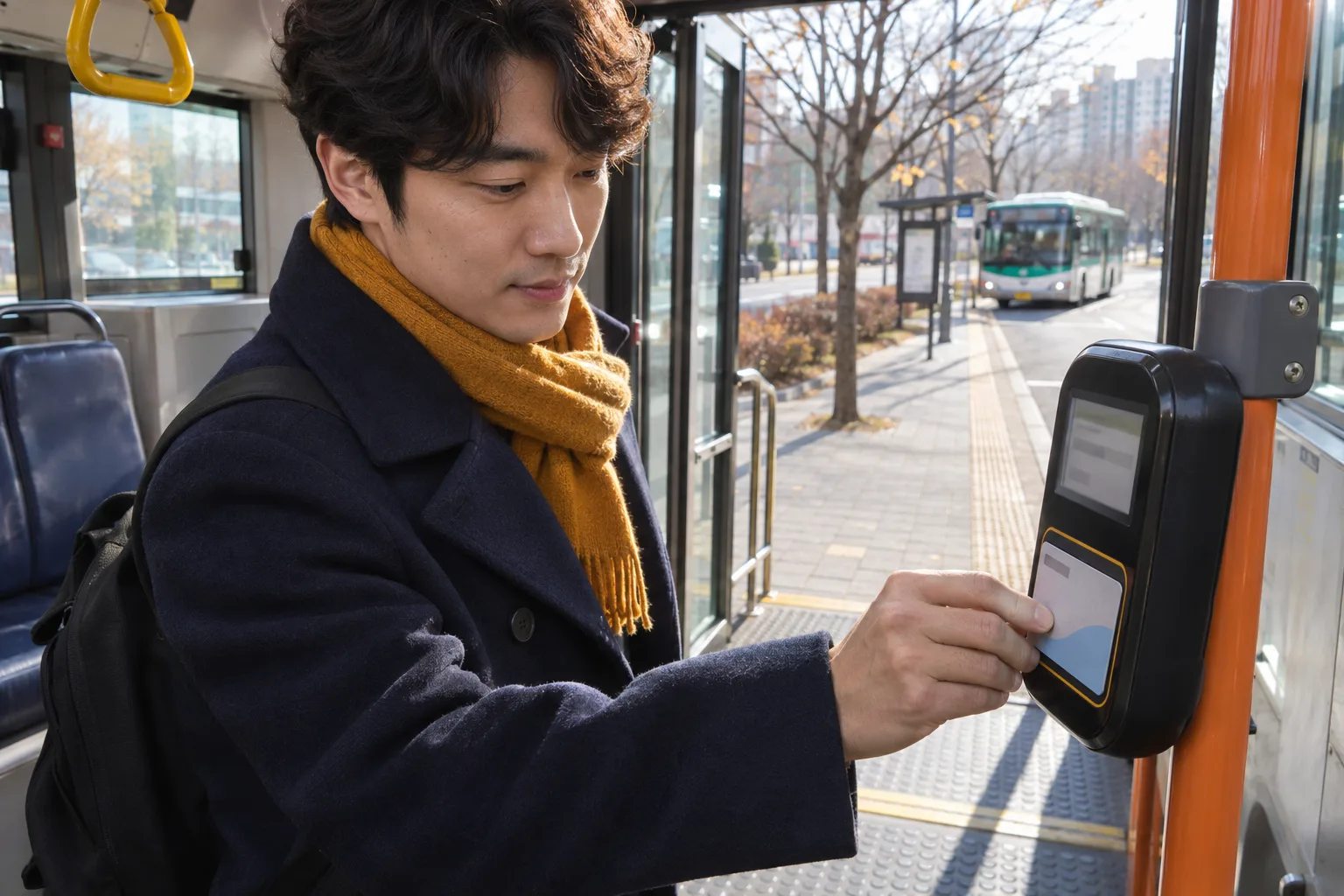
- To transfer, tap your transit card when you get off, then use the same card to board the next route within the time limit.
Before taking a village bus in Gyeonggi Province, check the route under ‘Find a Village Bus’ on the left. The adult base fare with a transit card is 1,550 won in Seongnam and Yongin, 1,650 won in Suwon, and 1,350 won in Gwacheon (effective January 1, 2025). If you plan to transfer, tap the same transit card when you get off.
These fares are from the association’s fare table and city hall notices as of November 11, 2026.
How to check village bus routes and arrival times by stop
Use ‘Find a Village Bus’ on this site to check the first and last buses, how often buses run, and the travel time between two stops. You can look up official route information in the Gyeonggi Bus Information System (GBIS). When you’re waiting at a stop, searching by the stop number for your direction of travel gives more accurate results.
- Enter your neighborhood or route number under ‘Find a Village Bus’ on the left. Check where the route starts and ends, then choose your direction of travel.
- Check the first and last buses and how often they run on the day you plan to travel. To see the travel time, select the stops where you’ll get on and off.
- To check against official service information, open ‘Village Bus’ under ‘Route Status’ in GBIS. Select the city responsible for the route from the 22 cities covered to see the route number, starting and ending stops, operating hours, and bus operator.
- Just before leaving, check the estimated arrival time at your stop in ‘Find a Village Bus’ or under ‘Integrated Search’ in GBIS. In GBIS, you can search by stop name, stop number, or route number.
How to check estimated arrival times by phone
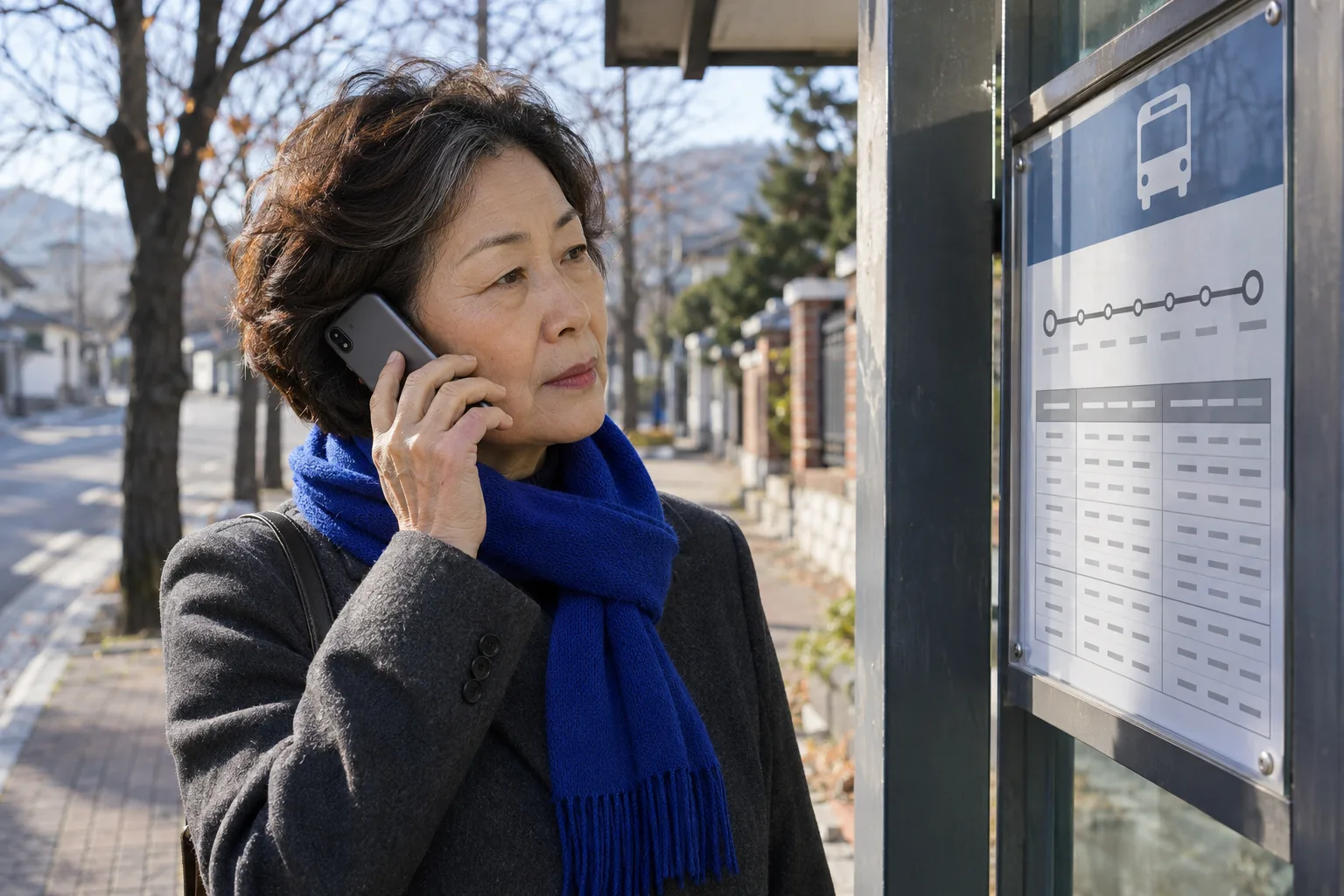
The Gyeonggi Bus Information System’s automated phone service (ARS) gives arrival information based on the stop number and route number.
- Check the stop sign for the stop number in your direction of travel.
- Call 1688-8031. When you hear the voice prompt, enter
9 + 정류소번호 + 노선번호 + #in that order. Use the star key to enter any hyphen in the route number. - If no estimated arrival time is available, contact the bus operator listed under ‘Route Status’ in GBIS. The interval between bus departures may differ from how long you’ll have to wait from now.
Gyeonggi Province village bus base fares by city and county: card and cash
Find the city responsible for the route, then look at the column for your age group. The amounts below are base fares for a single ride as of November 11, 2026. Each cell shows the transit card fare first and the cash fare second. Whether you can pay cash depends on the route.
| City or routes | Adult card / cash | Teen card / cash | Child card / cash |
|---|---|---|---|
| Gwangju, Gimpo (standard), Seongnam, Yangju, Yongin, Paju, Pyeongtaek | 1,550 won / 1,600 won | 1,090 won / 1,100 won | 780 won / 800 won |
| Goyang, Gwangmyeong, Guri, Gunpo, Namyangju, Bucheon, Suwon, Siheung, Anyang, Osan, Uiwang, Uijeongbu, Hanam, Hwaseong | 1,650 won / 1,700 won | 1,160 won / 1,200 won | 830 won / 900 won |
| Routes under Gwacheon’s jurisdiction | 1,650 won / Cash not accepted | 1,160 won / Cash not accepted | 830 won / Cash not accepted |
Effective dates for the Gwacheon, Bucheon, and Gunpo fare tables
Gwacheon’s adult card fare is 1,650 won starting with the first bus on November 1, 2026. The 1,350 won fare in the old table took effect on January 1, 2025. Since March 16, 2026, Gwacheon has not accepted cash on any route under its jurisdiction. If you don’t have a card, you can pay by bank transfer by following the fare payment instructions on board.
Bucheon raised its adult card fare to 1,650 won on July 11, 2026, and Gunpo did so on October 1, 2026. Gyeonggi Province’s G-Bus table from February 2026 still shows the fares for both cities before the increases. Goyang has charged an adult card fare of 1,650 won since October 25, 2025.
Child card fares may also differ between tables. The association’s table lists 830 won, while Gyeonggi Province’s February 2026 table lists 880 won for some cities. According to information published by Goyang, the child card fare on village buses is 830 won. Before traveling, give your route number to the public transit department at the relevant city hall or call the Gyeonggi Province call center at 031-120 to confirm the fare.
Gyeonggi city bus fares that changed on October 25, 2025
Starting with the first bus on October 25, 2025, the adult base fare on a standard Gyeonggi city bus is 1,650 won by card or 1,700 won in cash. This was Gyeonggi Province’s first city bus fare adjustment in 6 years, since 2019. Each city sets a separate effective date for its village bus fares.
| Gyeonggi city bus type and rider | Transit card base fare | Cash base fare |
|---|---|---|
| Standard, adult | 1,650 won | 1,700 won |
| Standard, teen | 1,160 won | 1,200 won |
| Standard, child | 830 won | 900 won |
| Seated, adult | 2,650 won | 2,700 won |
| Express seated, adult | 3,200 won | 3,200 won |
Transfer time limits and tapping off in the Seoul metropolitan area
To transfer from a Gyeonggi village bus to a city bus or a Seoul metropolitan subway train, tap your transit card when you get off and board the next bus or train within 30 minutes. From 21:00 to 07:00 the next day, the limit is 1 hour. A single trip can include up to 4 transfers and up to 5 boardings, including the first ride.
- Tap your transit card when you board the village bus. If you pay in cash, you won’t get a transfer discount.
- Tap the same card on the reader when you get off. The transfer window starts when you tap off.
- Transfer to a different route within the time limit and tap the same card. Gyeonggi’s standard, seated, express seated, and village buses are all covered by the integrated transfer system.
“The transfer discount does not apply if you board the same route again.” (Gyeonggi Province, “Key Q&A on the Seoul Metropolitan Area Integrated Fare System”)
How to calculate the fare difference when transferring from a village bus to a city bus
If you use an adult transit card to transfer from a 1,550 won village bus to a 1,650 won standard bus, you pay 100 won more when you board the second bus. If the combined distance on both buses is at most 10 km, the total fare is 1,650 won. The difference in base fares and any distance surcharge are calculated separately.
| Adult transit card transfer example | Combined distance | Base fare difference on second boarding | Total fare |
|---|---|---|---|
| Transfer from a 1,550 won village bus to a 1,650 won standard bus | At most 10 km | 100 won | 1,650 won |
| Transfer from a 3,200 won express seated bus to a village bus | At most 30 km | 0 won | 3,200 won |
In Gyeonggi Province’s example, you ride 4 km on a village bus and 6 km on a standard bus. The total is 10 km, so you pay only the difference in base fares. If an adult rider travels more than 10 km when transferring between a village bus and a standard bus, each additional 5 km costs 100 won.
Eligibility for transit fare support by age for Gyeonggi Province residents
If your registered place of residence is in Gyeonggi Province on the day you apply, the program you can use depends on your age. Residents aged at least 19 qualify for The Gyeonggi Pass, and those aged 6 to 18 qualify for the child and teen transit fare support program. Both programs use the trip history on your registered transit card.
| Who qualifies | Support criteria | Official channel |
|---|---|---|
| Gyeonggi Province residents aged at least 19 | If you ride at least 15 times a month, the program automatically applies whichever refund is better for you: the standard K-Pass plan or Everyone’s Card | Register a dedicated card on the K-Pass website |
| Gyeonggi Province residents aged 6 to 18 | Covers public transit fares in the Seoul metropolitan area up to 60,000 won per quarter | Gyeonggi Province Child and Teen Transit Fare Support Platform |
To use The Gyeonggi Pass, get a dedicated K-Pass card, then register the card number when you sign up. Everyone’s Card refunds the amount above a set threshold if your monthly spending exceeds it. City and village buses are covered, and higher-fare services such as regional buses and GTX are included in the Plus plan.
When applying for the first time, children and teens should have proof of residence and the transit card they use. Verify your residence on the support platform, then register your transit card and the local currency you want to be paid in. The 60,000 won quarterly cap applies to what you actually spend.
Who registers and manages village buses in Gyeonggi Province
In Gyeonggi Province, the city or county with jurisdiction handles village bus registration, and the mayor or county head has the authority to register operators. Under Article 3 of the Enforcement Decree of the Passenger Transport Service Act, village bus operations primarily serve stretches within a single city, county, or district that other fixed-route buses have difficulty serving. Under Article 4 of the same decree, village bus operations must be registered. You can check route or fare changes with the public transit department at the relevant city hall.
FAQ
Is the regular transit card fare for Gwacheon village buses still 1,350 won?
The fare is 1,650 won starting with the first bus on November 1, 2026. The regular transit card fare had been 1,350 won since January 1, 2025.
How do I pay if I board a Gwacheon village bus with only cash?
Buses on routes under Gwacheon City's jurisdiction do not accept cash on board. If you do not have a transit card, you can pay by bank transfer by following the instructions on the fare payment notice.
If I transfer from a village bus to a standard city bus, do I pay 1,650 won again?
If you pay 1,550 won for a village bus ride with a regular transit card and meet the transfer requirements, you pay the 100 won difference in base fares. If the combined distance of the two routes is 10 km or less, the total fare is 1,650 won.
How long do I have to transfer after getting off the bus at night?
From 21:00 to 07:00 the next day, board a bus on your next route within 1 hour of tapping out. At all other times, you have 30 minutes to transfer.
Do I still get a transfer discount if I take the next bus with the same route number?
The transfer discount does not apply if you board another bus on the same route. This is true even if you catch the next bus within the time limit after getting off.
Will a bus come to my stop if I wait as long as the service interval?
The service interval is the time between bus departures. To check when a bus is expected at your stop, look up the stop number in 'Find a Village Bus' or GBIS. If no information is shown, you can contact the operator listed in the route information.
Who should I check with if I see two different children's transit card fares, 830 won and 880 won?
Ask the public transportation department at the relevant city hall about the children's transit card fare for the route you plan to take. Gyeonggi Province's February 2026 table lists 880 won for some cities, while Goyang City's published village bus fare is 830 won.
Do users of The Gyeonggi Pass need to select Everyone's Card separately?
When Gyeonggi Province residents who are at least 19 take at least 15 trips a month using their registered card, the more favorable refund option is applied automatically. The standard K-Pass plan and Everyone's Card are compared based on their transit use that month.
Do children and teens receive 60,000 won in transportation subsidies each quarter?
The quarterly amount of 60,000 won is the subsidy limit. For children and teens aged 6 to 18 who are registered residents of Gyeonggi Province on the application date, the subsidy is based on how much they spend on public transportation in the Seoul metropolitan area.
Sources
- Gyeonggi-do Village Bus Transport Operators Association: Village Bus Fare Table
- Gyeonggi-do G-Bus Fares and Registration Authority
- Gwacheon City Hall: Village Bus Fares to Rise Starting in November
- Gwacheon City Notice: All Buses Are Going Cashless
- Bucheon City Notice: Village Bus Fare Increase
- Gunpo City Hall Notice: Village Bus Fares to Rise on October 1, 2026
- Public Data Portal: Bus Fares in Goyang, Gyeonggi-do
- Gyeonggi-do Adjusts City Bus Fares for the First Time in 6 Years, Since 2019
- Gyeonggi-do’s Integrated Capital Region Fare System: Key Q&A
- Gyeonggi-do’s Integrated Capital Region Fare System: Examples of Fare Collection by Scenario
- Gyeonggi Bus Information: Current Village Bus Routes
- Gyeonggi Bus Information: How to Use the ARS Phone Service
- National Law Information Center: Enforcement Decree of the Passenger Transport Service Act, Articles 3 and 4
- Gyeonggi-do’s The Gyeonggi Pass: Program Overview
- Gyeonggi-do’s The Gyeonggi Pass: How to Use It
- Gyeonggi-do Transportation Cost Assistance for Children and Teens Ages 6 to 18
- Gyeonggi-do Transportation Cost Assistance Platform for Children and Teens: How to Apply and What to Prepare
Images