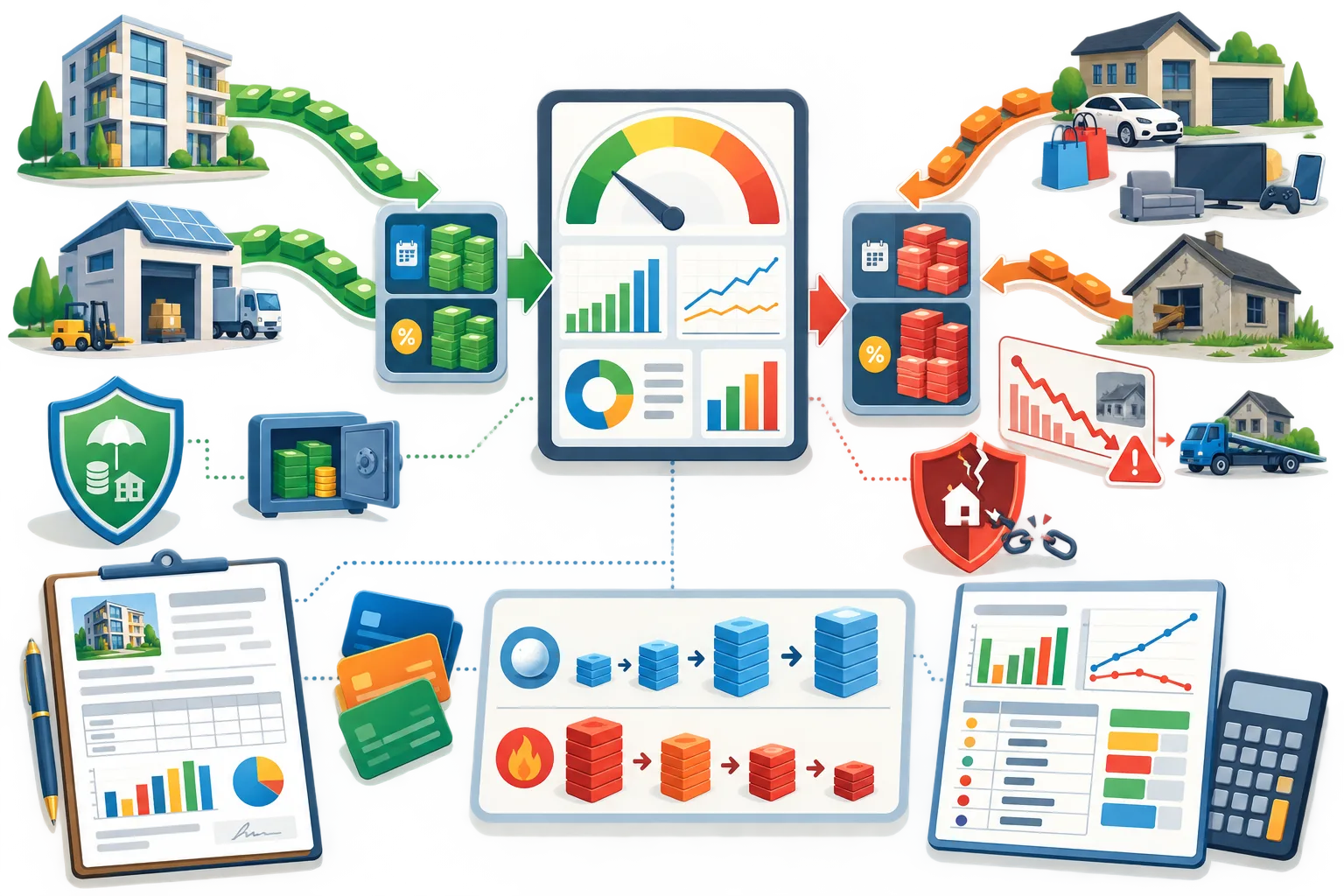
Good Debt vs Bad Debt: Cash Flow Test
Good debt and bad debt cannot be determined by how the money is used alone. The key criteria are whether the asset's net cash flow can cover principal and interest payments and whether it can withstand a decline in collateral value and personal guarantee obligations.
- Debt used for consumption generally has to be repaid from earned income, weakening cash flow.
- Even debt used to buy an income-generating asset can become bad debt if net cash flow falls short of principal and interest payments.
- A stock-secured loan lets you retain the asset, but a decline in collateral value creates a risk of forced sale.
- The ability to repay a business acquisition loan should be assessed based on cash flow after expenses, not revenue.
- Credit card balances can be paid off using the snowball or avalanche method.
Good debt is debt whose principal and interest can be covered by the net cash flow from income-producing assets. Bad debt is debt repaid from wages after consumption, or debt for which the income from a purchased asset falls short of the repayment amount. You must consider not only how the money is used but also the interest rate, collateral, personal guarantees, and liquidity.
Numerical criteria: Check actual interest rates and costs in the loan agreement, cardholder agreement, and with the relevant tax authority
Criteria for Distinguishing Good Debt from Bad Debt
The nature of debt is determined by what the money is spent on and the source of repayment. Consumer debt is structured to bring future earned income forward for present use. Asset-backed debt aims to be repaid with income from the new asset.
However, debt is not good simply because it was used to purchase an asset. Rent or business profits may be lower than the costs. Variable interest rates and failure to extend the maturity can also alter cash flow.
| Evaluation Item | Closer to Good Debt | Closer to Bad Debt |
|---|---|---|
| Use of funds | An asset that generates cash flow | An item that rapidly loses value after consumption |
| Source of repayment | Income from the asset after expenses | Wages or additional borrowing |
| Interest-rate structure | Returns cover interest and principal | Interest erodes returns |
| Collateral risk | Enough capacity to avoid a forced sale even if value declines | Additional collateral is required after even a small decline |
| Liquidity | Emergency funds remain separately available | Cash is tied up in both the asset and repayments |
| Scope of liability | The extent of potential losses is understood | Personal guarantees expose even personal living assets |
Therefore, looking only at the size of the debt is also insufficient. A large loan can produce substantial losses even from a small shock. You should first check the repayment structure and the extent of losses if the plan fails.
Breakdown by Condition
The same loan can have a different character depending on its terms. If many of the answers to the following questions are unfavorable, the leverage risk is high.
- Can income after operating expenses cover principal and interest?
- Can repayments still be made if interest rates rise or sales decline?
- Can additional collateral be provided if the collateral value falls?
- Does the loan maturity align with when the asset can be converted into cash?
- Are personal guarantees or additional collateral included?
- Will emergency funds remain after repayment?
It is not enough merely to compare whether the asset’s return is higher than the loan interest rate. Asset returns fluctuate, but loan interest accrues according to the contract. Taxes and transaction costs also reduce the difference in returns.
Returns and Margin Call Risk of Securities-Backed Loans
A securities-backed loan provides liquidity without selling shares. If share prices rise, you can retain the gains on your holdings. Conversely, if the collateral value falls, you may be required to provide additional collateral or make a repayment.
If you cannot meet the demand, the financial institution may sell the securities. The timing of the sale may be unfavorable to the investor. This is generally called a margin call or the risk of a forced sale due to insufficient collateral.
It is misleading to view Elon Musk’s acquisition of X simply as an example of a securities-backed loan. Large acquisitions may use equity together with multiple financing structures. A particular individual’s transaction should not be used as evidence that a personal loan is safe.
Not selling an asset may delay the point at which tax is imposed. However, a loan does not eliminate taxes. Capital gains taxation and interest deductions vary by country and purpose.
Example Calculation for a Business Acquisition Loan
The key to a business acquisition is net cash flow, not sales. Using the figures provided, calculating only the structure can show the amount of borrowing. Because the business’s actual profit is not available, its repayment capacity must be reviewed separately.
- The annual return from investing 280 million won at 8% per year must be verified from the basis of calculation.
- The ratio between 280 million won in equity and the 2.8 billion won acquisition price, as well as the remaining amount to be financed, must be verified in the original text.
- The required financing amount and financing method must be verified in the original text.
- If net cash flow after the acquisition is lower than principal and interest, personal funds will have to be contributed.
- If there is a personal guarantee, business failure may lead to the loss of personal assets.
Seller financing is a structure in which the seller receives part of the acquisition price at a later date. A 10% upfront payment and 90% deferred payment is only one example. The actual proportions and interest rate vary depending on contract negotiations.
The U.S. SBA 7(a) loan may be used for certain changes in business ownership. It is not a program under which every buyer is approved. Eligibility, guarantees, and contract terms must be confirmed with the SBA and the participating financial institution.
Comparing a Mortgage with Renting
A mortgage builds home equity as the principal is repaid. However, acquisition costs, taxes, insurance, and repair expenses may arise. Renting purchases housing and flexibility to move instead of an ownership stake.
| Comparison Item | Mortgage | Renting |
|---|---|---|
| Monthly spending | Principal, interest, and management and ownership costs | Rent and expenses required under the lease |
| Asset accumulation | Equity increases by the amount of principal repaid | No home equity is created |
| Responsibility for repairs | Often borne by the owner | May be borne by the landlord depending on the lease and the law |
| Mobility | Requires a sale or conversion to a rental property | Relatively easy to move after the lease ends |
| Liquidity | Repayments are tied up in home equity | Available cash can be retained for other purposes |
| Price risk | Exposed to fluctuations in home prices | No direct risk from purchase and sale prices |
It is inaccurate to view all rent as wasted money. Rent includes the use of space and the transfer of some management responsibilities. Conversely, not all mortgage principal and interest payments are investments.
Example Calculation for Early Repayment and Investing
Early repayment provides a guaranteed reduction in interest costs. Investing may produce higher returns, but it also carries the possibility of losses. The two choices are not equivalent based solely on expected returns.
Assume that 1.1 million won is invested at the end of each month for 10 years at an annual rate of 7%. The monthly compounding result must be verified based on the period applied and the calculation formula. The difference from the principal contributed must be verified based on the period applied and the calculation formula.
This calculation excludes taxes and fees. A 7% annual return is also not guaranteed. Therefore, it cannot be stated with certainty that the amount will become 400 million won after around 10 years under the same conditions.
Early repayment and investing can be compared in the following order.
- Check the loan’s actual interest rate and early repayment costs.
- Deduct taxes and fees from investment returns.
- Keep emergency funds separate from repayment funds.
- Assume an increase in variable interest rates and investment losses.
- Compare liquidity and psychological burden as well.
Comparison of Credit Card Debt Repayment Methods
Credit card costs are easier to control when the full balance is paid every month. Carrying a balance or using revolving credit may incur interest. The actual applicable interest rate must be checked in the cardholder agreement and statement.
| Method | Priority Repayment Target | Advantage | Limitation |
|---|---|---|---|
| Snowball | Debt with the smallest balance | Makes it easier to experience paying off a debt quickly | May result in more total interest |
| Avalanche | Debt with the highest interest rate | Helps reduce total interest | May take longer to pay off the first debt |
A repayment method can be implemented through the following process.
- List the balance and interest rate of every card.
- Check late fees and minimum payments as well.
- Stop new installment purchases and balance carryovers.
- First make the minimum payment on every debt.
- Direct available funds toward the selected priority.
- After paying off one debt, add that payment amount to the next debt.
The avalanche method is mathematically better for reducing interest. The snowball method may help reduce the likelihood of giving up midway. A method that can be followed consistently is the practical choice.
Common Mistakes
The most common mistake is comparing only the asset’s price appreciation rate with the loan interest rate. Price appreciation is not the same as receiving cash. Actual cash is needed when principal and interest payments are due.
- Mistaking sales for a business’s source of repayment
- Failing to deduct taxes and repair costs from housing returns
- Assuming that a variable interest rate will remain unchanged
- Treating the collateralized loan limit as a safe borrowing amount
- Describing loans as a means of tax exemption
- Failing to read the scope of liability under a personal guarantee
- Believing that credit card points exceed interest costs
The statement that wealthy people like debt also creates misunderstandings. What is actually advantageous is not debt itself. It is a structure in which productive assets are operated at a controllable cost.
Debt Stress Test
Before taking out a loan, you should calculate failure scenarios rather than only normal conditions. This review reveals risks that a simple return comparison overlooks. There is no need to apply a particular number as if it were the correct answer.
- Calculate a scenario in which income from the asset declines.
- Calculate interest after the rate has been reset.
- Check additional requirements if the collateral value falls.
- Assume a period during which the asset cannot be sold immediately.
- List the assets you would lose if the personal guarantee were enforced.
- Check whether you have cash to cover living expenses during that period.
If even one scenario would undermine your basic livelihood, the borrowing amount is excessive. You should consider how long you can survive before looking at expected returns. Leverage magnifies losses as well as gains.
Documents to Review in an Actual Contract
There is no single official formula that defines good debt and bad debt. Actual terms vary by financial product and applicable law. You must verify your own terms in the following original documents.
- Interest rate, maturity, and collateral provisions in the loan agreement
- Interest rate and grace period in the cardholder agreement
- Representations and warranties in the business acquisition agreement
- Scope of liability in the personal guarantee
- Guidance from the relevant tax authority on capital gains and interest deductions
- Forced-sale terms in the collateral account agreement
You should not make a decision based only on the interest rate shown in an advertisement. Fees and delinquency terms may change the actual cost. Provisions that are difficult to understand should be reviewed with a professional before signing the contract.
FAQ
Are all loans used to buy assets good debt?
No. If the asset's income after expenses is not enough to cover principal and interest, you must make up the difference with personal income. You should also consider variable interest rates, vacancies, declining sales, and personal guarantees.
Is borrowing advantageous if the asset's rate of return is higher than the loan interest rate?
Not always. Asset returns fluctuate, but interest accrues according to the contract. You must also account for taxes, transaction costs, declines in collateral value, and the timing of liquidation.
Can I continue to hold my stocks if I take out a loan secured by them?
You can, as long as you continue to meet the collateral requirements. If the collateral value falls, you may be required to provide additional collateral or repay the loan. If you cannot comply, the stocks may be forcibly sold.
What does it mean when people say a business pays off its own loan?
It means paying the principal and interest with the business's cash flow after operating expenses and taxes. Even if sales are high, personal funds will be needed if net cash flow is insufficient.
Is a mortgage always better than renting?
Not always. You must add up the holding period, interest, taxes, insurance, and repair costs. You should also compare the mobility and cash liquidity that renting provides.
Should I repay a loan early or invest?
Early repayment provides a guaranteed reduction in costs equal to the loan's interest rate. Investing offers the possibility of higher returns along with the risk of loss. After setting aside emergency funds, you should compare after-tax returns and liquidity.
Which is better for credit card debt, the snowball method or the avalanche method?
The avalanche method, which pays off the highest-interest debt first, is better for reducing total interest. If you need a quick sense of accomplishment, the snowball method, which pays off the smallest balances first, may be easier to sustain.
Can I avoid paying tax on the sale of an asset by taking out a loan?
Because a loan is not a sale, it may not immediately trigger capital gains tax. However, this does not mean the tax disappears permanently. The outcome varies depending on each country's tax laws and how the funds are used.
Sources
Images