Convenience Store Displays: Traffic Flow and Golden Zones
Convenience store displays are designed around shoppers' paths and sightlines to make products easy to discover and choose. Refrigerator placement and golden zones are difficult to generalize in terms of fixed heights or angles.
- Convenience store traffic flow creates opportunities for shoppers to encounter other products while looking for the items they came for.
- The golden zone is a highly visible display area that varies with customers' sightlines and the store layout.
- Cross-merchandising places products used together near each other to encourage shoppers to choose additional items.
- PB means private brand, and its defining criteria differ from those for collaborations or exclusive sales.
- To assess the effects of display changes, you also need to check for other changes, such as discounts and weather.
The principles of convenience store displays guide product placement so customers discover items along their route and within their line of sight. Eye-level displays and related product placement can encourage additional purchases. However, refrigerator locations and display heights are not the same in every store.
The main source for these explanations of product displays is Coca-Cola's September 2024 material.
How do convenience store displays influence purchases?
Displays affect the chances customers have to see products and the effort it takes to choose them. Seeing snacks on the way to a drink you wanted gives you more items to consider. Finding milk next to bread may suggest a combination to enjoy together.
These arrangements are part of VMD, which presents a store's products attractively. VMD is a sales approach that uses visual elements to help customers choose products. It includes signage and display configurations as well as product locations.
| Placement element | How it works | Example found in stores |
|---|---|---|
| Customer route | Exposes customers to other products on the way to their destination | An aisle leading to the beverage refrigerator |
| Eye-level display | Helps customers discover products within their line of sight | New products in the middle of a shelf |
| Related product display | Brings to mind products used together | Bread and milk, drink pouches and cups of ice |
| Checkout area | Exposes customers to additional products while they wait to pay | Gum or small snack packs |
| Distinctive products | Provides a reason to visit a particular store | Private-label or collaboration products |
Why are beverage refrigerators toward the back?
Refrigerators toward the back make customers looking for drinks pass through the store. Products along that route naturally come into view. This is a way to show other products to customers who only intended to buy drinks.
However, it is not accurate to say that refrigerators are always at the very back. Coca-Cola's material also suggests additional refrigerators near the checkout. Refrigerator locations vary with the store layout and sales objectives.
There is also a sequence to how customers look for products inside refrigerators. Coca-Cola explains that customers first choose a door based on the type of drink. It then describes a tendency to scan brands up and down behind the chosen door.
The role of trapezoidal shelves and angled price tags
Shelves that extend farther out at the bottom make products visible when viewed from above. One arrangement places smaller products at the top and larger products at the bottom. This can make the overall display wider toward the bottom.
Terms such as trapezoid or triangle are sometimes used to describe this. However, the shape of the shelf itself must be distinguished from the shape formed by the product arrangement. This does not mean that all convenience store shelves have the same structure.
NAMM's product display guide also suggests placing smaller products at the top. It explains that placing larger products at the bottom creates visual balance. This is a general retail display principle, not a standard specifically for convenience stores.
The angle of a price tag affects how easily a standing customer can read it. Lower price tags are easier to read when they face the customer's line of sight. No evidence has been confirmed that a particular angle is a common standard across all convenience stores.
Where is the golden zone?
The golden zone is a display area that readily catches customers' attention. It is also called the gold zone. Typical examples include shelves near eye level and the checkout area.
A shelf's golden zone mainly relates to eye level. The checkout area benefits from being a place where customers gather or pause briefly. Both areas offer good exposure, but for different reasons.
Coca-Cola explains that eye-level shelves attract considerable attention. When customers look through a refrigerator, areas slightly below eye level also attract attention. It is therefore difficult to define the golden zone as a fixed height above the floor.
| Location or condition | Products that can be placed there | Factors to consider |
|---|---|---|
| Shelves within an adult's line of sight | New products, key products | Customer height and shelf structure |
| Low shelves within a child's line of sight | Gummy candy, toys | A different eye level from adults |
| Checkout and waiting areas | Gum, small snack packs | Exposure while waiting |
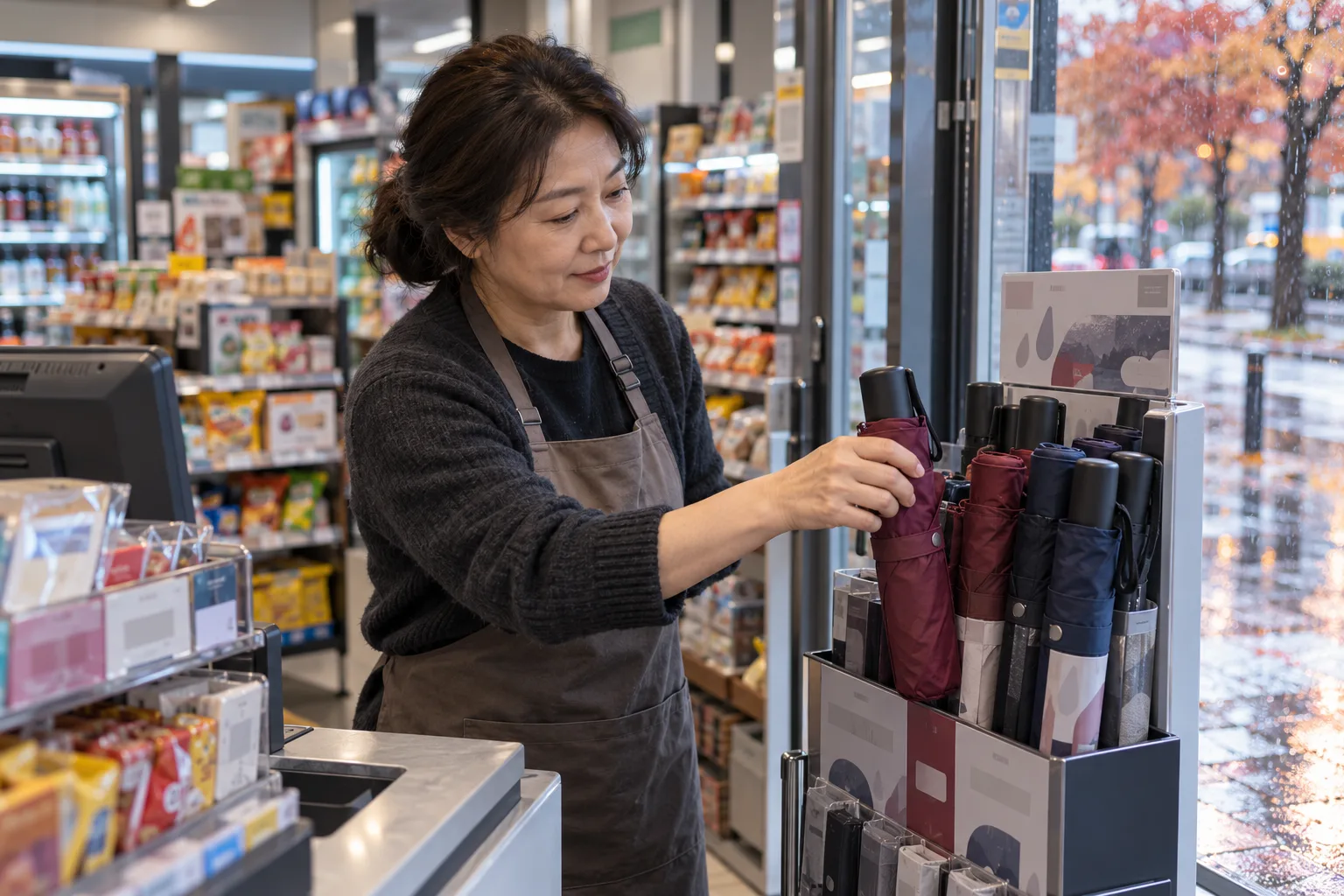
| Near the entrance on rainy days | Umbrellas | Weather-related demand |
| Prominent spaces in winter | Seasonal products such as steamed buns | Season and equipment in use |
Placement in the golden zone does not mean a product has the highest sales. NACS Magazine also describes prominent placement for new and promotional products. Display locations also reflect what a store intends to sell more of in the future.
Comparing related product displays and category displays
Related product displays place products used together close to one another. Category displays group similar products to help customers choose. The tasks customers are trying to accomplish with these two approaches differ.
| Distinction | Category display | Related product display |
|---|---|---|
| Basis for grouping | The same product category | Situations in which products are used together |
| Example | Placing milk together and snacks together | Placing bread with milk, or beer with snacks to accompany it |
| Convenience for customers | Comparing flavor, size, and price | Discovering products needed together |
| Role in sales | Helps customers find the product they want | Suggests additional purchases |
Drink pouches and cups of ice are an example of products with connected uses. Bread and milk suggest a combination to enjoy together. Products being close to one another does not automatically mean that a bundle discount or giveaway applies.
When buying products together, check each product's price tag. If there is a promotion sign, check the eligible products and required purchase quantities. Products placed near one another may not be the products covered by the promotion.
How do PB and collaboration products differ?
PB refers to products planned by a retailer and sold under its own brand. Collaboration products are developed with another company or person. A product can be both a PB product and a collaboration product.
Exclusive sales describe the sales channels through which a product can be purchased. Therefore, being sold at a particular convenience store does not by itself establish that a product is PB. Check both the product's brand and the operator's explanation.
| Product example | Related convenience store | Official explanation confirmed |
|---|---|---|
| Hyejaroun Jipbap Jeyuk Bokkeum | GS25 | Included as a product launch example in GS Retail's 2023 report |
| Baek Jong-won Jeyuk Hanpan Dosirak | CU | Introduced as a product launch example in BGF Retail's 2023 press release |
| Yonsei Milk Fresh Cream Bread line | CU | Described by BGF Retail as distinctive products developed with a partner |
| Omori Kimchi Jjigae Ramen | GS25 | Classified as a PB product in GS Retail's 2021 report |
These products can give customers a reason to visit that convenience store. This serves a different role from displays that attract attention inside the store. Check the brand's product information for the current selection and stock at individual stores.
Common misconceptions about convenience store displays
Misunderstandings arise when display principles are treated as fixed standards or guaranteed purchase outcomes. Placement changes the environment in which customers encounter products. Other factors, such as need and price, also affect actual purchases.
- Avoid assuming that all refrigerators are at the back of the store. Some arrangements include additional refrigerators near the checkout.
- Do not treat price tag angles or golden zone heights as nationwide standards. The industry materials reviewed do not specify such a single standard.
- Do not interpret prominent products as a sales ranking. They may be promotional items or new products.
- Do not assume that products placed together automatically qualify for a combined discount. Check the conditions on the promotion sign.
- Do not assume that a particular brand's products are available at every store. You need to check stock at the store you plan to visit.
How to tell whether a display caused a sales increase
Even if sales rise after a display change, the cause cannot be determined immediately. There may have been discounts or changes in the weather during the same period. To assess the display's effect, you need to check what other conditions changed.
Consider a case where umbrellas are moved next to the checkout on a rainy day. If sales rise, the rain itself may have increased demand. This is why the effect of the display location alone must be distinguished from the effect of the weather.
If you operate a store and want to make a comparison, keep records in the following order.
- Record when and where the display was changed.
- Check for price and promotion changes during the same period.
- Also examine changes in the weather and visitor numbers.
- Identify periods when the product could not be sold because it was out of stock.
- Compare quantities sold during periods with similar conditions.
This is a comparison procedure for interpreting display effects. It is not a formula that guarantees a particular rate of sales growth. NACS Magazine also describes using sales data to manage displays.
A checklist for choosing only what you need
For products you did not plan to buy, consider why you added them. Related product displays can also help you remember things you need. The aim is to distinguish purchases made because you identified a need from purchases made because something caught your eye.
- Decide what to buy before entering.
- After choosing the product you came for, check other sizes in the same category.
- When adding a nearby product, consider whether you will actually use them together.
- Check the product name and promotion conditions on the price tag.
- Review unplanned items again before paying.
FAQ
Are all convenience store refrigerators at the back of the store?
Not all of them. Placing them toward the back exposes customers to other products as they walk through the store. Another approach is to place additional refrigerators near the checkout.
Is the golden zone at a fixed height above the floor?
It is difficult to define a single height that applies to every store. It varies depending on customers' eye level and the direction from which they view the products. In refrigerators, spots slightly below eye level also attract attention.
Are the products in front of the checkout the best-selling products?
Display location alone does not tell you a product's sales ranking. Snacks and promotional products are also placed near the checkout to encourage additional purchases. The space can also be used to introduce new products.
Why are price tags tilted in convenience stores?
The aim is to make lower price tags easier for standing customers to read. However, no evidence has been found that all convenience stores use the same angle.
What kind of display places bread and milk close together?
It is a cross-merchandising display that places products used together close to each other. It can reduce the effort needed to find the right combination. For the store, it serves to encourage additional purchases.
Are all products sold only at a particular convenience store PB products?
It is difficult to determine whether a product is PB based on its sales channels alone. PB is a classification related to a store's own brand. Whether a product is a collaboration or an exclusive must be checked separately.
Are products displayed side by side discounted when bought together?
Placing products close together does not automatically mean a discount applies. Check the promotional signs for eligible products and required purchase quantities.
How much do sales increase when displays are changed?
It is difficult to give a rate of increase that applies to every store. Prices, promotions, weather, and visitor numbers can all affect sales. You need to compare the number of units sold during periods with similar conditions.
How can I reduce unplanned purchases at convenience stores?
Decide what to buy before visiting. Check whether you will actually use any extra products you pick up. Before checking out, double-check the price tags and promotion terms.
Sources
- Coca-Cola, Convenience Retail Heat Map, September 2024
- NACS Magazine, Clear the Clutter: Rethinking Merchandising, July 2023
- NAMM, 10 Simple Merchandising Tips That Maximize In-Store Sales, July 22, 2013
- GS Retail 2021 Sustainability Report
- GS Retail 2023 Sustainability Report
- BGF Retail, press release on the Baek Jong-won Jeyuk Hanpan lunch box, March 22, 2023
- BGF Retail, press release on the development of Yonsei Cream Bread and partner companies, June 16, 2022
Images