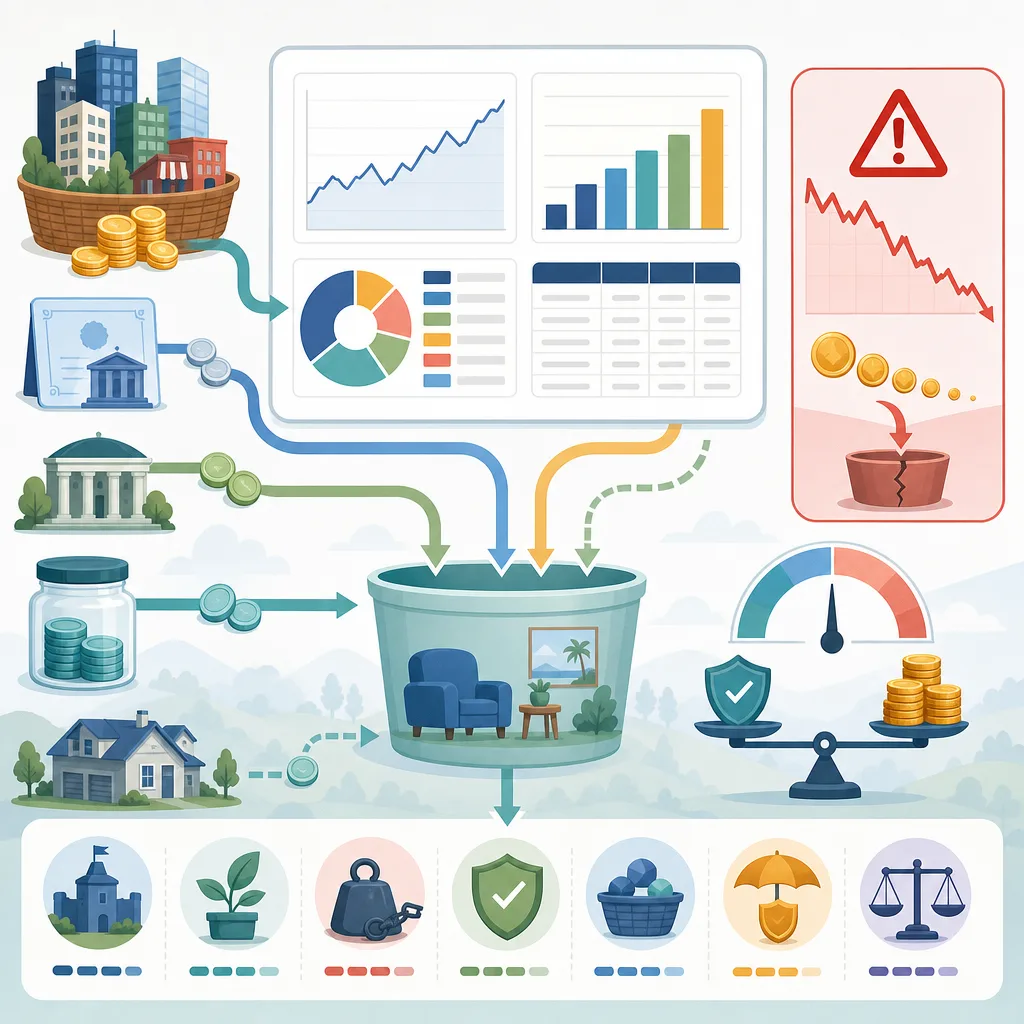
Principles for Designing Dividend Investments for Retirement Cash Flow
Dividend investing can generate regular cash flow, but neither dividends nor principal are guaranteed. Rather than focusing solely on dividend yield, investors should also assess earnings, cash flow, debt, and dividend sustainability, while diversifying according to their life stage and retirement spending needs.
- A rising dividend yield does not necessarily indicate an improvement in a company's value and may signal the risk of a sharp share price decline or dividend cut.
- Because capital structures vary by industry, payout ratios should be assessed by comparing both earnings and free cash flow rather than using a fixed golden ratio.
- Dividend history is a useful screening criterion, but it does not guarantee future dividends, so business competitiveness, debt, and cash flow should also be examined.
- If analyzing individual stocks is difficult, dividend ETFs can provide diversification, but their index rules, costs, stock concentration, and distribution composition should be reviewed first.
- Retirement cash flow is safer when designed around a combination of pensions, interest, cash equivalents, and partial asset sales when needed, rather than relying on dividends alone.
Dividend investing is a strategy of receiving a portion of the cash earned by companies and using it for living expenses or reinvestment. Regular payments can help investors stay invested for the long term, but dividends are not bank deposit interest and may be reduced or suspended at a company’s discretion.
Therefore, the goal should not simply be to find the highest dividend yield, but to create sustainable total returns and cash flow that can preserve purchasing power.
The Role and Limitations of Dividend Investing
A key advantage of dividend investing is that you can receive cash without selling all your assets. Reinvesting the dividends you receive can increase the number of shares you own, potentially generating long-term compounding benefits.
However, you should first understand the following principles.
- Dividends are not legally guaranteed interest and may change depending on board decisions and company circumstances.
- On the ex-dividend date, if all other conditions remain the same, the share price is generally adjusted by the amount of the dividend. A dividend is not a free bonus added to capital gains.
- Investment performance should be evaluated by total return, which combines dividends, share price movements, and costs.
- A high dividend yield may reflect a sharp decline in the share price or the possibility of a future dividend cut rather than high cash flow.
- Dividend stocks are still stocks, so they are affected by recessions, interest rate changes, industry decline, and problems at individual companies.
Dividends can provide psychological reassurance, but they should not be regarded as a margin of safety that prevents loss of principal.
Asset Allocation for Each Stage of Life
Age is only one factor in determining investment direction. Actual allocations should also reflect income stability, debt, emergency funds, time remaining until retirement, expected pension income, loss tolerance, and expenses that will be needed in the near future.
| Situation | Primary goal | Use of dividend assets | Other matters to review |
|---|---|---|---|
| Accumulation stage with stable income and a long investment horizon | Real asset growth | Reinvest distributions from dividend growth stocks or diversified ETFs | Avoid excessive concentration in particular sectors and maintain an emergency fund |
| Period with medium-term expenses such as housing or education | Balance growth and capital preservation | Manage dividend-stock allocations within the target asset allocation | Avoid placing too much money earmarked for future expenses in stocks |
| Transition period close to retirement | Reduce the risk of making withdrawals immediately after a major loss | Combine stable dividends, bond interest, and other sources into cash flow | Review cash equivalents, bonds, and the timing of pension benefits |
| Withdrawal stage after retirement | Fund living expenses and preserve purchasing power | Use dividends for part of living expenses and make planned withdrawals to cover any shortfall | Account for taxes, medical expenses, longevity risk, and inflation |
Investing aggressively simply because you are young or concentrating on high-dividend stocks simply because retirement is near may not be appropriate. Even immediately before retirement, the investment horizon may still span several decades, so a balance between growth and defensive assets is necessary.
How to Calculate Dividend Yield Correctly
The current dividend yield is generally calculated as follows.
Expected annual dividend per share ÷ current share price × 100
For example, if the annual dividend per share is 5,000 won and the share price is 100,000 won, the dividend yield is 5%. If the share price falls to 80,000 won while the expected dividend remains unchanged, the calculated yield becomes 6.25%.
However, this contains the hidden assumption that the dividend will be maintained. If deteriorating performance reduces the next dividend to 3,000 won, the yield based on a price of 80,000 won is only 3.75%. When a share price falls, you should first investigate the reason for the decline and the company’s future capacity to pay dividends rather than focusing on the yield figure.
In addition, trailing yield calculated from past dividends may differ from forward yield calculated from expected future dividends, so the specific calculation period should be confirmed with the information provider. Mistaking a one-time special dividend for a regular dividend can inflate expected cash flow.
Key Metrics for Evaluating High-Quality Dividend Stocks
Dividend quality cannot be determined by a single figure. The following factors should be considered together.
1. Business Durability and Competitiveness
Dividends are funded by the business. Check whether the company has recurring demand, pricing power, a stable customer base, and a reasonable capital expenditure structure. If the industry itself is declining or the company depends excessively on one customer or product, even a long dividend history can quickly unravel.
2. Earnings-Based Payout Ratio
The general payout ratio is calculated as follows.
Annual common-stock dividends ÷ net income attributable to common shareholders × 100
A low payout ratio is not always bad. Companies with abundant growth opportunities may be able to reinvest earnings at high rates of return. Conversely, a high payout ratio is not necessarily dangerous. This is because some industries, such as real estate investment trusts, have business structures and accounting metrics that differ from those of ordinary manufacturers.
Rather than applying a range such as 40–70% uniformly to every company, compare it with industry peers, the company’s historical range, its sensitivity to economic cycles, and one-time accounting gains or losses. For a loss-making company, an earnings-based payout ratio may become meaningless.
3. Free Cash Flow and the Dividend Burden
Even if a company reports accounting profits, it may struggle to maintain its dividend if it lacks actual cash. Check whether free cash flow—the cash remaining after subtracting capital expenditures required to maintain and grow the business from operating cash flow—can consistently cover total dividend payments.
However, free cash flow can also fluctuate substantially from year to year because of capital investment and changes in working capital. It is important to examine multi-year trends and management’s capital allocation policy rather than focusing on a single year’s figures.
4. Debt and Interest Burden
Interest and principal repayments take priority over dividends. If debt maturities are approaching while refinancing rates rise or the company’s credit rating deteriorates, it may reduce its dividend to conserve cash. Net debt, interest coverage capacity, maturity structure, and liquidity should all be reviewed together.
5. Dividend Growth and Purchasing Power
The dividend growth rate helps assess whether cash flow can keep pace with inflation. The average annual growth rate over several years can be calculated as follows.
(Most recent dividend ÷ dividend at the starting point)^(1 ÷ number of years elapsed) - 1
Rather than applying a single benchmark such as 4% per year to every market environment, compare it with long-term inflation, revenue and earnings growth rates, exchange rates, and changes in the payout ratio. If dividends are growing faster than earnings, that pace is unlikely to be sustainable.
6. Dividend Payment History
A record of paying or increasing dividends for at least 10 years can demonstrate that a company has passed through multiple economic cycles. However, past history does not guarantee future payments. If a company has increased debt or postponed essential investment to maintain its dividend, its long-term competitiveness may instead be damaged.
Questions for Identifying High-Dividend Traps
If several of the following apply, it may be better not to buy based solely on the high yield.
- Has the share price fallen sharply without a clear explanation for the decline?
- Are dividend payments greater than earnings or free cash flow?
- Does the company repeatedly rely on asset sales or borrowing to pay dividends?
- Are debt maturities imminent, or are interest expenses rising rapidly?
- Does the reported yield treat a special dividend as if it were a regular dividend?
- Is the company exposed to structural decline or regulatory changes in an industry?
- Does the payout ratio calculation use only one-time gains or adjusted metrics?
- Has management officially mentioned the possibility of changing the dividend policy?
Mechanically comparing how many times higher the yield is than bank deposit rates is also insufficient. Stocks carry the risk of principal fluctuations, while deposits may receive depositor protection under applicable programs, so the two products have different risk structures.
The Difference Between Dividends and Share Buybacks
Dividends and share buybacks are both ways of returning capital to shareholders, but they operate differently.
| Category | Cash dividends | Share buybacks |
|---|---|---|
| How value is delivered to investors | Cash is paid based on the number of shares held | A reduction in shares outstanding may increase the ownership percentage of remaining shareholders |
| Market expectations regarding continuity | Expectations that regular dividends will be maintained are relatively strong | Companies can adjust timing and scale more flexibly |
| Investor choice | Receipt of payment may create tax consequences | Investors can choose whether to sell |
| Main risk | Dividend cuts when cash is insufficient | Reduced capital allocation efficiency if shares are purchased at overvalued prices |
Do not assume that the announced amount of a share buyback will equal the amount actually executed. Conversely, dividends are not guaranteed to be maintained. Investors should also check whether the company buys shares below fair value and whether it has meaningfully reduced the number of shares after accounting for shares issued as compensation.
Criteria for Choosing Individual Stocks and Dividend ETFs
Individual stocks allow investors to select companies directly, but they require business analysis and ongoing reviews of disclosures. ETFs make it easier to diversify across multiple holdings, but investors must accept the index selection rules and costs.
| Criterion | Individual dividend stocks | Dividend ETFs |
|---|---|---|
| Diversification | Investors must directly build a portfolio of multiple stocks | A single product can hold many stocks |
| Analytical burden | Financial statements and business risks must be reviewed continuously | Index methodology, costs, and holdings must be reviewed |
| Control | Investors directly determine the stocks and timing of trades | Investors follow periodic inclusion and exclusion rules |
| Specific risks | A dividend cut by one company can have a major impact | Concentration in particular industries or styles may arise |
| Costs | Potential transaction costs and taxes | Management fees, transaction costs, and potential taxes |
Dividend growth ETFs such as SCHD are widely known examples, but popularity alone does not make them suitable for your goals. You should review their inclusion criteria, sector weightings, concentration among top holdings, total expense ratio, trading currency, withholding taxes, and tax rules in your place of residence.
Covered Call ETFs Are Different from Dividend ETFs
Distributions from ETFs that use options strategies, such as JEPQ or GPIQ, may consist not only of corporate dividends but also of option premiums and other sources. Therefore, their stated distribution rates should not be compared directly with the dividend yields of common stocks.
Covered calls generate cash flow through option premiums, but they involve the following trade-offs.
- They may give up some upside when the market rises rapidly.
- Distributions may change depending on market volatility and investment results.
- Downside risk does not disappear.
- The tax classification of distributions may differ depending on the product and place of residence.
- A high distribution rate and a high total return do not mean the same thing.
Even when the goal is to fund living expenses, investors should first review the proportion of options used, distribution policy, total expense ratio, and long-term total return in the product prospectus.
Execute Rebalancing According to Rules
A strategy of selling stocks that have risen and switching to stocks with higher dividend yields is risky. Even two companies in the same industry may differ in debt, growth rates, regulatory exposure, and dividend sustainability, while a lower share price may result from business deterioration already reflected by the market.
It is clearer to design rebalancing as a process for returning to the target asset allocation rather than replacing one holding with another based on yield.
- Set target weights for each asset class, including stocks, bonds, and cash.
- Establish allowable ranges or a review schedule, such as semiannual or annual reviews.
- Use new contributions and dividends to buy underweight assets first.
- If sales are necessary, review taxes, transaction costs, and liquidity.
- Review dividend cuts, sharp increases in debt, and damage to the investment thesis separately from the regular schedule.
A strategy of buying more high-quality stocks during a sharp market decline should also be implemented only to the extent that it does not compromise emergency funds or money needed for near-term expenses. Avoid assuming that you can identify the exact market bottom.
Retirement Cash Flow Should Extend Beyond Dividends
Trying to cover living expenses solely with dividends can lead to excessive concentration in high-dividend assets. First, subtract relatively stable income such as national and public pensions, retirement pensions, personal pensions, and rental income from expected living expenses to calculate the amount the portfolio must provide.
Annual living expenses required - annual stable income = portfolio cash flow shortfall
For example, if the annual shortfall is 24 million won and the portfolio’s annual cash yield after taxes and costs is assumed to be 3%, the assets required under simple arithmetic would be 800 million won. However, this is only an estimate that does not account for dividend cuts, inflation, exchange rates, tax changes, medical expenses, or market losses.
A realistic plan requires the following elements.
- Cash-equivalent assets sufficient to cover essential expenses for a certain period
- Assets that provide dividends and interest
- Growth assets that preserve long-term purchasing power
- Rules for planned asset sales based on market conditions
- Net cash flow after taxes and costs
- A buffer for dividend reductions or major medical expenses
If the market falls sharply early in retirement and assets must be sold continuously to fund living expenses, it may be difficult for the portfolio to recover. This is why cash buffer assets and withdrawal rules should be established together rather than pursuing dividends alone.
Final Checklist Before Investing
- Have you distinguished whether your investment objective is current income or long-term growth?
- Have you separately secured a minimum emergency fund and money needed for near-term expenses?
- Have you checked whether the dividend yield includes special dividends?
- Can net income and free cash flow cover the dividend?
- Are debt, interest expenses, and the maturity structure at manageable levels?
- Is dividend growth excessively faster than earnings growth?
- Is the portfolio concentrated in a single stock or a particular industry such as finance, telecommunications, or energy?
- If it is an ETF, have you read its index methodology, total expense ratio, and distribution composition?
- For overseas assets, have you reviewed exchange rates, withholding taxes, and tax rules in your place of residence?
- Have you documented rules for regular reviews and rebalancing?
The success of dividend investing depends less on a single high yield than on the combination of a sustainable business, a reasonable price, diversification, and a spending plan. The goal is not to increase the frequency of dividend notifications, but to build a lifelong cash flow structure that can withstand market shocks and inflation.
FAQ
Does a high dividend yield mean a stock is undervalued?
Not necessarily. The yield may have risen because the stock price plunged, or because the market expects weaker performance and a dividend cut. You should also review earnings, free cash flow, debt, and dividend policy.
Can I still receive the same dividend even if the stock price falls?
If you meet the payment requirements, such as being a shareholder of record on the record date, you can receive a dividend that has already been declared, but future dividends are not guaranteed. A company's board of directors may reduce or suspend dividends depending on its performance and financial condition.
Is a payout ratio of 40–70% always safe?
No. An appropriate payout ratio varies depending on the industry, growth stage, capital expenditures, and earnings volatility. In addition to the earnings-based payout ratio, you should also compare dividends against free cash flow and assess the debt burden.
Is a company safe if it has paid dividends for at least 10 years?
A long payment history is useful as a screening criterion, but it does not guarantee future dividends. Even a company that has paid dividends for a long time may reduce them if its industry's structure changes or its debt and investment burdens increase.
Which is better for retirement planning: individual dividend stocks or dividend ETFs?
It depends on the time and ability you have for conducting your own analysis, as well as your level of diversification. Individual stocks offer greater control but carry more company-specific risk, while ETFs make diversification easier, but you need to examine their fees, index rules, and industry concentration.
Is the high distribution rate of a covered call ETF the same as its dividend yield?
No. Distributions may include option premiums or other sources in addition to stock dividends. You should also evaluate the cap on upside gains, downside risk, costs, and long-term total returns.
Should I fund my retirement living expenses solely with dividends?
You do not need to. Insisting on dividends alone may result in concentration in high-dividend industries. You can cover expenses by combining pensions, bond interest, cash equivalents, dividends, and planned partial asset sales.
What else should I check when investing in foreign dividend stocks?
You should review exchange rate fluctuations, dividend withholding taxes, the tax rules in your place of residence, account types, transaction costs, and inheritance-related regulations. Specific tax rates and filing procedures should be determined based on the latest guidance from the tax authorities and financial institutions in your place of residence.
Sources
Images