Humidifier Water: Tap vs. Purified Water Guidelines
Choose water for your humidifier based on the water requirements in the product manual. Understanding how mineral content varies by purification method, along with the separate roles of water changes and cleaning, helps explain conflicting guidance on tap water and purified water.
- The humidification method alone does not determine which water to use; check the water requirements for your specific model.
- Even water from a water purifier varies in mineral content depending on the treatment method.
- White dust on nearby furniture and hard deposits inside the tank occur in different places.
- Even when using water with low mineral content, you still need to change the water and clean the tank.
- Water that has been boiled and cooled is different from distilled water made by collecting the steam separately.
Choose water for a humidifier based on what the product manual specifies. Water from a purifier also varies in mineral content depending on the treatment method. Ultrasonic humidifiers can disperse substances in the water into the air. Whatever water you use, you still need to change it and clean the tank.
The water replacement schedule is based on the CDC's March 15, 2024 guidance.
What water should you use?
Check the water requirements in your model's manual to find out which water you can use. The name of the water alone does not tell you whether it suits every product. Read both the manufacturer's conditions for product use and public health agencies' care recommendations.
IRIS OHYAMA specifies tap water in its FAQ. It cites the suppression of microbial growth by residual chlorine as the reason. It advises against using water from a purifier or similar sources. This is that manufacturer's guidance, not a rule for all products. IRIS OHYAMA water supply FAQ
By contrast, the EPA, the United States Environmental Protection Agency, recommends water with a low mineral content. The aim is to reduce mineral emissions from ultrasonic and similar humidifiers. You should therefore not switch to distilled water on your own if your product specifies tap water. If the instructions conflict, check with the manufacturer using your model name. EPA guidance on using and caring for home humidifiers
Comparing ultrasonic, steam, and evaporative humidifiers
How substances in water move into the air depends on the humidification method. These devices add moisture to the air to raise indoor humidity. Methods that release water droplets must be distinguished from those that evaporate water.
| Type | How it releases moisture | Water and care considerations |
|---|---|---|
| Ultrasonic | Uses vibration to create fine water droplets | Minerals and microorganisms in the water can be dispersed along with the droplets |
| Steam | Heats water to produce water vapor | Be careful of burns from hot water and steam |
| Evaporative | Passes air through a wet filter or similar material to evaporate water | Filters and areas where water collects need care |
The EPA explains that steam and evaporative humidifiers release fewer minerals. This does not mean they need no internal care. For hybrid models, check the actual humidification mechanism rather than relying on the name. EPA explanation of humidifier types
Comparing tap, purified, bottled, and distilled water
The treatment method provides a more specific basis for judgment than the name under which water is sold. The word “purified” does not mean that minerals have been removed. The CDC explains that different filters remove different substances. Check the purifier manual and filter labeling for actual performance.
| Type of water | Distinguishing characteristics | What to check before filling |
|---|---|---|
| Tap water | Not sterile even if it meets drinking water standards | Whether the product allows its use and any local water quality notices |
| Water treated with activated carbon | Mainly used to improve taste and odor | Whether mineral removal performance is separately specified |
| Water treated by reverse osmosis | Uses a membrane to reduce dissolved substances | The substances actually removed, such as calcium and magnesium |
| Bottled water | Being bottled does not mean it is low in minerals | The mineral content label and whether the manufacturer allows its use |
| Distilled water | Made by collecting steam from boiling water and turning it back into liquid | Whether the product allows its use and whether it contains additives |
| Boiled and cooled water | Water that has been heated and then left to cool | Do not treat it as equivalent to distilled water |
Reverse osmosis is a water purification method also called RO. The CDC explains that this method can reduce calcium, magnesium, and other substances. However, the removal performance of each product needs to be checked. Purifier filter replacement also needs attention. CDC guide to home water filters
Why do standards differ for drinking water and water dispersed as mist?
Being safe to drink does not by itself establish suitability for misting. Swallowing water and inhaling fine water droplets are different. The CDC also explains that drinkable tap water is not sterile. This distinction is often overlooked when choosing water. CDC guidance on preventing waterborne germs at home
The following criteria address different issues.
- Drinking suitability concerns whether water can be used for drinking.
- Mineral content is related to the formation of white dust and hard deposits.
- Microbial control includes water storage and device cleaning.
- Product compatibility concerns the water supply conditions allowed by the manufacturer.
Bottled water is therefore not better suited to filling a humidifier simply because it costs more. Nor does using purified water remove the need to care for the tank. Meeting one criterion does not mean that the other conditions have been met.
How do white dust and deposits inside the tank differ?
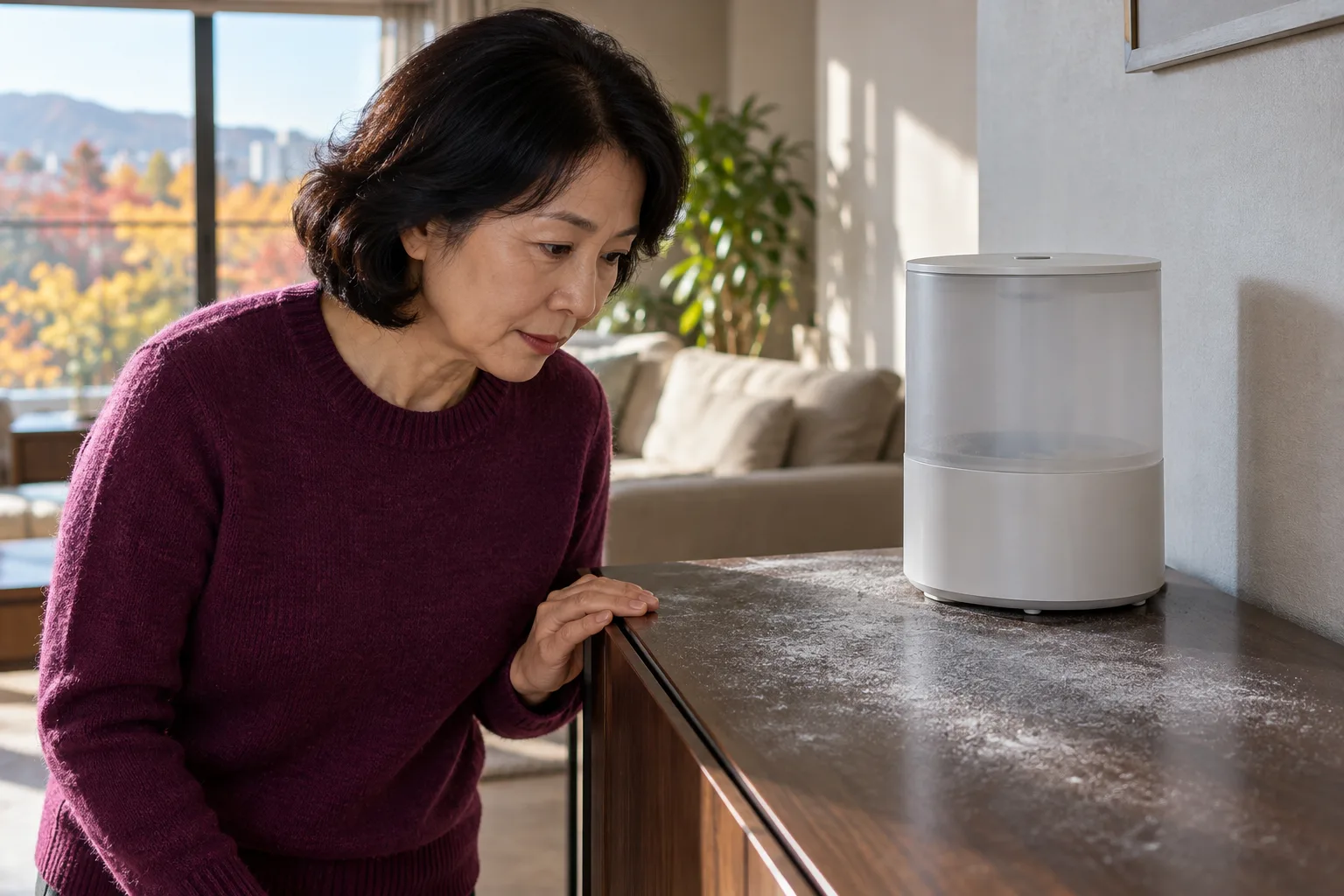
White dust that settles nearby must be distinguished from deposits that adhere to the tank. The CPSC, the United States Consumer Product Safety Commission, explains the two phenomena separately. Even when the same minerals in the water are involved, they appear in different places.
| What you observe | Possible cause | Cautions when interpreting it |
|---|---|---|
| White powder on nearby furniture | Minerals in the dispersed water settle nearby | The powder alone cannot establish its composition or health effects |
| Hard white deposits on the tank or parts | Minerals in the water build up inside | Do not assume they are clumps of bacteria |
| A film on the water surface or slimy contamination inside | Possible microbial growth | Do not treat this as the same phenomenon as white dust |
The CPSC explains that microorganisms can grow on the surface of deposits. Mineral deposits therefore also need to be removed. Conversely, the absence of white powder does not prove that the humidifier is hygienic. The health effects of white dust cannot be judged by appearance alone either. CPSC humidifier hygiene guidance
Choosing water and checking conditions
Practical decisions should consider both the wording in the manual and the current signs of a problem. A purifier's brand alone cannot establish whether its water can be used. The following table applies the principles above to specific situations.
| Current condition | What to consider and check |
|---|---|
| The manual specifies tap water only | Check with the manufacturer before switching to another type of water |
| The manual allows distilled water | It can be considered as an option to reduce mineral emissions |
| The purification method is unknown | First check the purifier model and the substances its filter removes |
| White powder repeatedly appears nearby | Check both the water's mineral content and the product's permitted water conditions |
| The tank is slimy or dirty | Do not try to solve it only by changing water types; clean it according to the manual |
| Tap water is discolored or a water quality notice has been issued | Check the water supplier's guidance before deciding whether to use it |
When making an inquiry, provide both the device model name and the water treatment method. You also need to distinguish between powder nearby and deposits inside. The manufacturer needs this information to answer according to the product's requirements.
What do water replacement and cleaning each address?
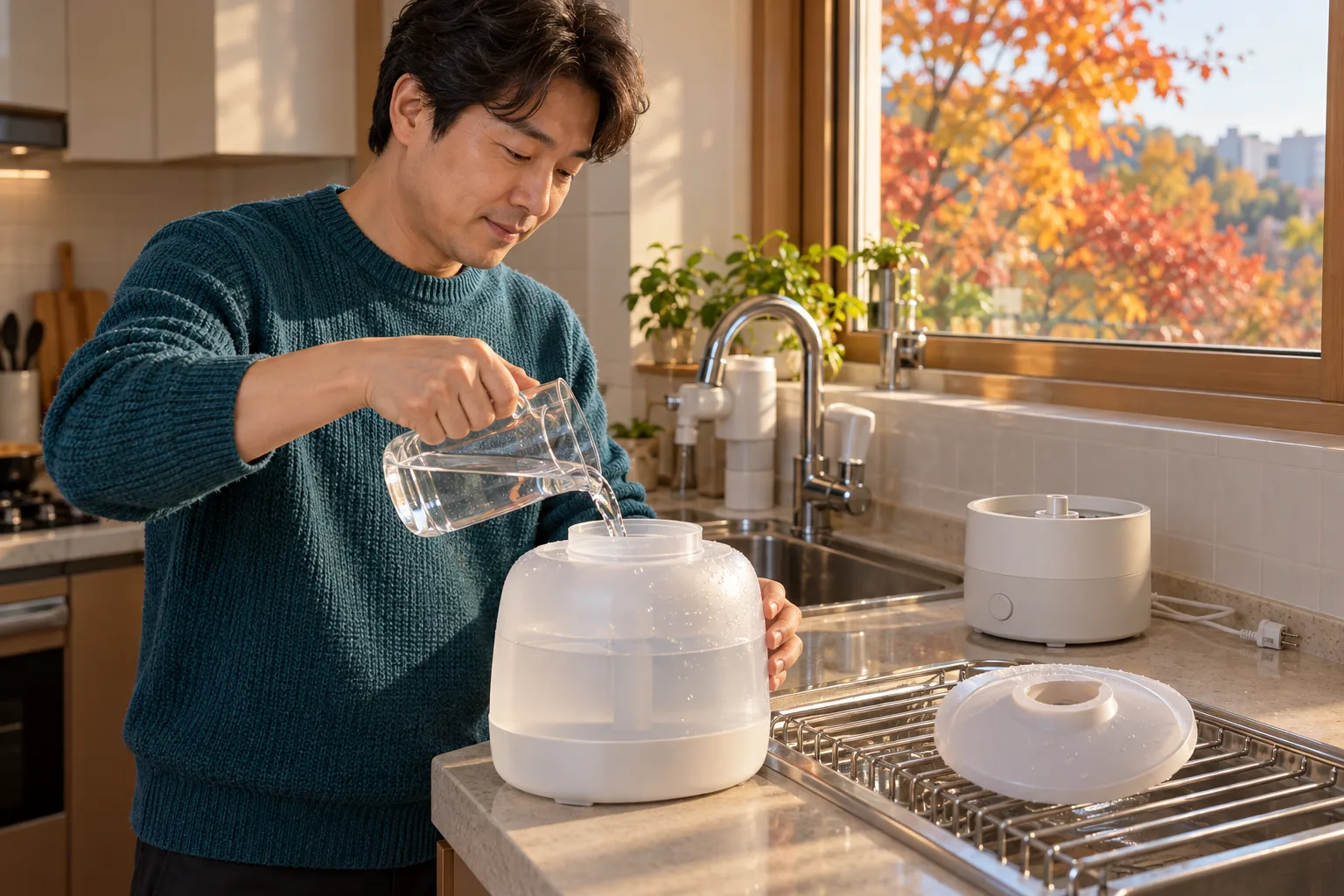
Replacing water means emptying out the remaining water. Cleaning means removing contamination attached to internal surfaces. Simply topping up with fresh water cannot replace either task.
Empty all water from humidifiers every day
CDC, Preventing Waterborne Germs at Home
This means emptying all the water from the device every day. It appears in the CDC's March 15, 2024 guidance. The same guidance also recommends cleaning according to the manufacturer's instructions. It says to let the device air-dry after cleaning. CDC guidance on water replacement and cleaning
- Turn off the power and unplug the device.
- Empty the remaining water.
- Clean the inside using the method specified in the manual.
- If you used a cleaning agent, rinse thoroughly.
- Let it dry before storage, or fill it with permitted water just before use.
Chemicals used for cleaning are different from additives put in during operation. Running the device with cleaning solution left inside is not a care method. The CPSC requires thorough rinsing to avoid inhaling cleaning chemicals. CPSC cleaning precautions
Common mistakes
A common misunderstanding is to treat one characteristic of water as proof of its overall safety. Disinfection and mineral removal are different treatments. Distilled water and boiled and cooled water do not mean the same thing either.
| Common interpretation | Facts to distinguish |
|---|---|
| It came from a purifier, so it has no minerals | This depends on the purification method and filter performance |
| It was boiled, so it is the same as distilled water | Distillation requires separately collecting the steam produced |
| Chlorine in tap water keeps disinfecting the tank | Tap water is not sterile, so replacement and cleaning are necessary |
| It is a steam humidifier, so it does not need cleaning | The heating mechanism and removal of internal contamination are separate matters |
| There is no white powder, so it is hygienically clean | The presence or absence of powder cannot establish microbial conditions |
The CDC also explains the possibility of equipment contamination in the distillation process. It notes that bacteria can grow on cooling components while the equipment is not in use. The name of a treatment method therefore does not guarantee hygiene afterward. CDC guide to home water treatment methods
Frequently asked questions
Can you leave water in longer if you use distilled water?
No. The mineral content of water and the care of standing water are separate matters. Health Canada advises emptying any remaining water when the device is not in use. Health Canada humidifier care guidance
Can you keep topping up and using a large tank?
A larger capacity does not mean you can skip water replacement. Adding fresh water to what remains is different from replacing all the water. Check the product manual for how often and how to empty it.
If you choose the right water, can you ignore indoor humidity?
Water choice and indoor humidity control are separate matters. The EPA's June 2022 guidance recommends avoiding humidification to a relative humidity of more than 50%. If condensation forms on windows or the surrounding area gets wet, reduce the humidification output. EPA indoor humidity guidance
What should you check if the manual gives no water requirements?
Ask the manufacturer's customer support which water quality is permitted for your model. Also tell them how the water you plan to use is treated. An answer for another product may not apply directly.
FAQ
Can I use tap water?
It depends on whether the product manual allows or specifies it. Some manufacturers specify tap water, but public agencies also offer recommendations aimed at reducing mineral emissions from ultrasonic models. It is difficult to apply one answer to every product.
Does filtered water have all its minerals removed?
No. What gets removed depends on the treatment method, such as activated carbon or reverse osmosis. Check the water purifier's manual and the filter's performance information.
Is bottled water more suitable than tap water for filling the device?
You cannot judge by the label “bottled water” alone. Bottled water can also contain minerals. Check both the product's water requirements and the water's listed composition.
Is water that has been boiled and cooled distilled water?
No. Distilled water is made by boiling water, collecting the steam separately, and condensing it into liquid. It is different from water that has been boiled and cooled in its original container.
Is the white powder around the device bacteria?
It may be white dust left by minerals in the mist settling on surrounding surfaces. Appearance alone cannot establish whether bacteria are present or determine the exact composition.
Are hard white deposits inside the water tank evidence of a malfunction?
They may be accumulated mineral deposits, so they do not indicate a malfunction on their own. They need to be removed according to the manual. If the device also operates abnormally, check the manufacturer's inspection criteria.
Can I skip cleaning if I use distilled water?
No. Reducing minerals and removing contamination from the water tank are separate matters. Water changes and cleaning are still necessary.
If there is water left, can I just top it up with fresh water?
Topping up does not replace a complete water change. CDC's guidance dated March 15, 2024, recommends emptying all the water from portable models every day.
Do heated models require no internal maintenance?
Heated models also need maintenance according to the manufacturer's instructions. The fact that they work by heating water does not replace the need to remove internal deposits.
What should I follow if the manual and answers online differ?
Check the manual for the specific model's conditions of use. Ask the manufacturer about any points that conflict with public agency recommendations. Do not apply answers about other models directly to yours.
Sources
- EPA, Use and Care of Home Humidifiers
- EPA, Use and Care of Home Humidifiers, revised June 2022
- CDC, Preventing Waterborne Germs at Home, March 15, 2024
- CDC, About Choosing Home Water Filters, April 10, 2024
- CDC, About Home Water Treatment Systems, April 10, 2024
- IRIS OHYAMA, FAQ on whether water other than tap water can be used in humidifiers
- CPSC, Dirty Humidifiers May Cause Health Problems
- Health Canada, Cool-mist humidifiers, December 6, 2016
Images