Daily 30-Minute Reading Habit: Apply and Summarize
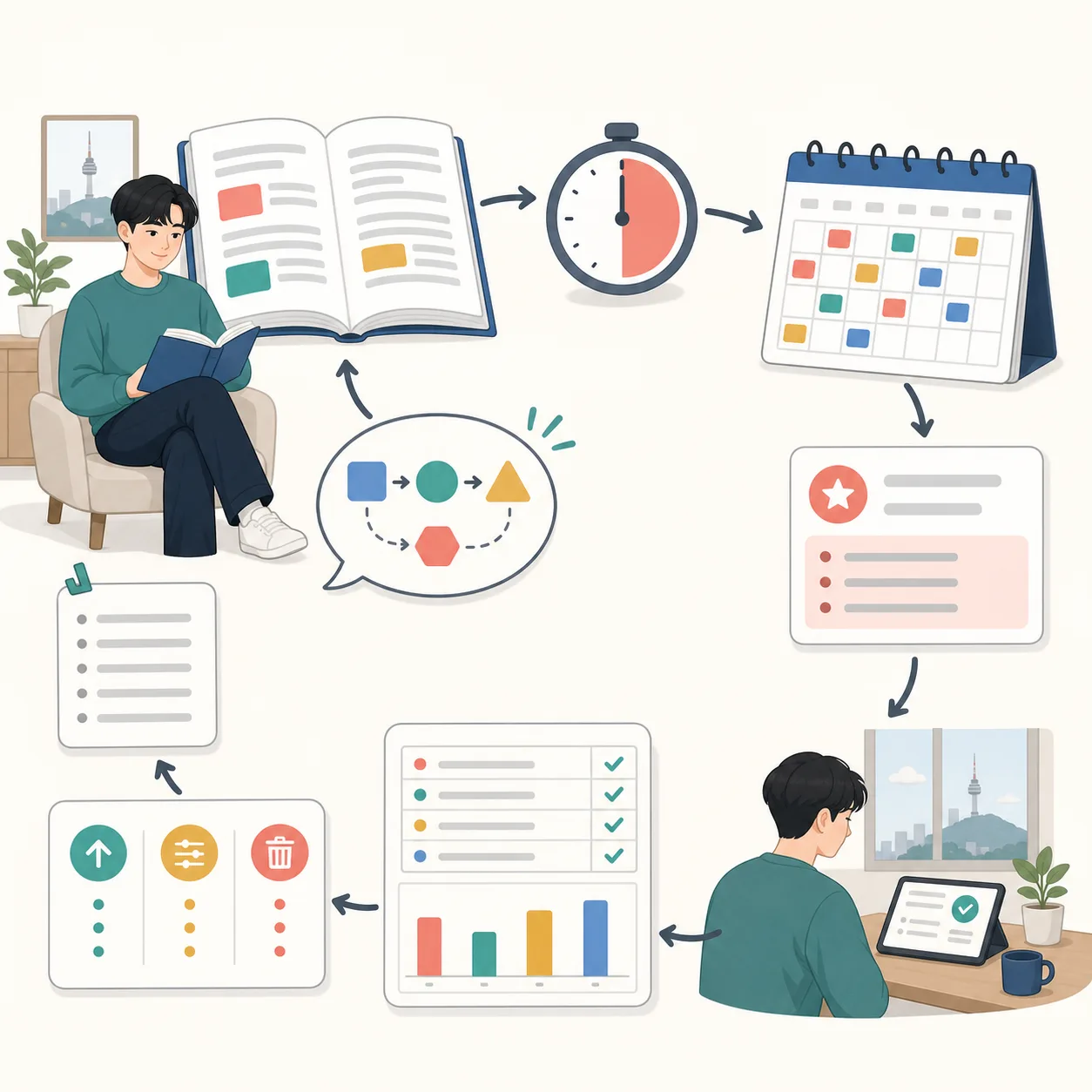
If reading many books has not brought change, examine habits focused on collecting books, stopping midway, and taking in information. This guide explains how to apply one idea from each book, read for 30 minutes every day, and check your understanding through explanation or summary.
- When you close a book, choose one action to apply to your life.
- Take a small step on the chosen action within 24 hours.
- Instead of binge-reading, continue reading for 30 minutes every day.
- Explain what you read for 3 minutes or summarize it in five lines.
- Record the results, and revise or discard actions that do not work for you.
If your life remains unchanged even after reading 100 books, you should examine what you do after reading rather than how much you read. Choose one thing from each book and put it into practice within 24 hours. Keep reading for 30 minutes every day, and check your understanding with a 3-minute explanation or a 5-line summary.
Numerical criteria: “3 Habits of People Whose Lives Do Not Change Even After Reading 100 Books” video; check the publication date on the post page
3 Reading Habits That Keep Your Life from Changing
The habits that prevent change are reading merely to collect, reading in fits and starts, and reading that stops at input. Underlining and lists of completed books show evidence of reading. However, they do not by themselves prove that your life has changed.
| Habit | Visible activity | Missing process | Action to change |
|---|---|---|---|
| Only collecting | Underlining, copying passages, lists of completed books | Practical application | Put one thing from each book into practice |
| Breaking the flow | Binge-reading when motivated | Repetition and connection | Read for 30 minutes every day |
| Keeping it to yourself | Assuming you understood what you read | Explanation and review | Give a 3-minute explanation or write a 5-line summary |
First, you may stop at collecting notes. Relating to a good sentence is different from changing your behavior. The standard is what you changed after closing the book.
Second, you may alternate between binge-reading and long breaks. You need continuity to connect previously learned concepts with new knowledge. The video explains this using the analogy of compound interest in knowledge.
Third, you may only take in information without producing any output. Even content that felt familiar while reading can be difficult to explain. That is the part you need to reread and review.
Comparing Collection-Based and Action-Based Reading
Action-based reading prioritizes changes after reading over the volume of notes. This does not mean you should stop underlining or copying passages. It means you should check whether your notes lead to a choice of action.
| Comparison criterion | Collection-based reading | Action-based reading |
|---|---|---|
| After closing the book | Keep underlined passages and summaries | Choose one action |
| When to act | Not specified | Start within 24 hours |
| Reading schedule | Binge-read all at once | Continue for 30 minutes a day |
| Checking understanding | Check only in your head | Produce output by speaking or writing |
| Handling failure | Avoid or forget failure | Record the result and adjust |
The number of books completed is a supplementary indicator for tracking progress. The number of times you take action shows whether a book has entered your daily life. Records of your output help you identify what you did not understand.
Steps for Turning Reading into Action
To turn reading into action, proceed in the order of selection, execution, repetition, and output. Each step should be small enough to complete. You do not need an elaborate channel or public record.
-
Choose one action.
Do not try to put the entire book into practice. Choose one sentence or action to apply to your life right now. -
Start within 24 hours.
Do not merely prepare; take the first step. If the book is about diet, for example, change what you choose for your next meal. -
Set aside 30 minutes every day.
Choose a repeatable time, such as during your commute or before bed. The routine should be less likely to be interrupted than reading for 10 hours at once. -
Bring what you read out into the open.
Try explaining it to your family for 3 minutes. If you are doing it alone, you can write a 5-line summary in a notes app. -
Record where you got stuck and the results of your action.
Review concepts you could not explain. Revise actions that did not work or exclude them from your next experiment.
Example Calculation for 30 Minutes a Day
Maintaining 30 minutes a day for one week gives you a total of 210 minutes. Converted into hours, that is 3 hours and 30 minutes. You can add one explanation or summary to check your understanding.
- Read for 30 minutes every day from Monday through Sunday
- 30 minutes × 7 days = 210 minutes
- 210 minutes = 3 hours and 30 minutes
- If you have finished a book, choose one action
- Take the first action within 24 hours of choosing it
- Produce output with a 3-minute explanation or a 5-line summary
The video also gives the example of taking one action from each of 100 books. Assuming half of the 100 attempts fail, 50 remain. This is not a statistic that guarantees results, but an arithmetic example showing the accumulation of action.
Guidance by Reading Situation
The habit you should change first depends on where you are currently stuck. If you read many books but take no action, decide when you will act. If you frequently stop or retain little of what you read, improve repetition and output first.
| Current situation | First thing to do | Criterion for checking |
|---|---|---|
| You underline a lot but see no change | Choose one action | Did you take action within 24 hours? |
| You only binge-read on weekends | Schedule 30 minutes every day | Did you continue without a long gap? |
| You feel you understand only while reading | Explain for 3 minutes | Which concepts do you get stuck on? |
| Your summary becomes too long | Limit it to 5 lines | Did you write the key points in your own words? |
| You acted but saw no effect | Record the result and revise | Did you decide whether to keep, revise, or discard it? |
If you are reading about a field for the first time, it is natural to encounter many unfamiliar concepts. There is no need to conclude that you are inherently unsuited to reading. It may take time for concepts on the same topic to connect.
Reading Records That Preserve Failure
Failed attempts also become records that inform your next choice. If you collect only successful habits, it is difficult to know why they worked. Recording the reasons for failure can keep you from repeating the same attempts.
The following items are enough for your record sheet.
- Book or chapter read
- One chosen action
- When you first took action
- The actual result of trying it
- One of the following: keep, revise, or discard
- Concepts you got stuck on while explaining
This method turns a list of completed books into an action-verification sheet. Advice from books does not suit every life. Use the results of your own actions to distinguish what to keep from what to discard.
Common Mistakes
The most common mistake is turning the three methods into a new collection list. If you spend time decorating the format, you return to a record-centered approach. Keep only enough of a record to choose your next action.
-
You set too many goals for each book.
When there are too many actions, it becomes difficult to determine what produced the effect. Choose just one first. -
You try to act on everything at once after finishing the book.
The farther away the time for action is, the more likely you are not to start. Test the chosen action within 24 hours. -
You interpret 30 minutes a day as an absolute standard.
The 30 minutes proposed by the video is an operational standard for consistency. It is not a scientifically established threshold that guarantees a specific outcome. -
You treat 100 books as a universal threshold.
Approximately 100 books is an example of cumulative reading given in the video. It is not a standard that produces the same change for every reader. -
You think output requires explaining something well.
The goal is to identify where you get stuck, not to be eloquent. A private 5-line note also counts as output.
Scope for Interpreting the Numbers and Claims
30 minutes, 24 hours, 3 minutes, 5 lines, and approximately 100 books are practical standards proposed by the video. These numbers do not come from clinical research or official reading guidelines. The time required varies according to the individual’s pace and the difficulty of the book.
The video connects checking understanding through explanation with the example of Richard Feynman. It resembles what is commonly called the Feynman Technique. The key is not the name of the authority but identifying where your explanation breaks down.
There are no laws or institutional guidelines to cite on this topic. The original wording and publication date should be checked on the post page for the “3 Habits of People Whose Lives Do Not Change Even After Reading 100 Books” video. It is therefore more accurate to read the stated numbers of attempts and amounts of time as practical suggestions rather than mandatory standards.
Frequently Asked Questions About Reading Habits
Many questions focus on whether action and output are connected, rather than on the amount of reading. You do not need to read every book in the same way. Set the scope of application according to your current purpose.
Should I Avoid Underlining and Copying Passages?
Underlining and copying passages are not problems in themselves. Their limitations emerge when all you have are records, with no action or check of your understanding. Add one action to take after making your notes.
Is It a Failure If I Cannot Complete 30 Minutes a Day?
30 minutes is the consistency standard proposed by the video. Missing one day does not erase your cumulative reading. Start again at your next scheduled time so that it does not turn into a long break.
Do I Need to Find an Action in Every Book?
This is easy to apply to books read for practical purposes. Reading literature or reading for appreciation may have a different purpose. There is no need to force yourself to create an action unrelated to the book’s purpose.
Do I Have to Explain It to Someone Else?
You do not need a listener. You can write 5 lines in a notes app or speak aloud by yourself. The key is the process of bringing what is in your head out into the open.
FAQ
Are underlining and copying passages ineffective for reading?
Underlining and copying passages can be useful aids for finding and remembering content. However, if you only accumulate notes without connecting them to action or explanation, it is difficult to see changes in your life.
Do I have to stick to 30 minutes every day?
Thirty minutes a day is a consistency-focused guideline suggested by the video. It is not a universal scientifically established threshold, so adjust it to fit your schedule while focusing on minimizing long gaps.
What should I do first after closing the book?
Choose one action to apply to your life. Check the video for when to begin the chosen action, then record the result as one of the following: maintain, modify, or discard.
Do I have to explain what I read to someone else?
Another person is not strictly necessary. You can explain it to a family member for three minutes, talk through it by yourself, or summarize it in five lines in a notepad to identify the parts you do not fully understand.
Will reading 100 books improve my judgment?
About 100 books is an example given in the video to explain the effects of cumulative reading. It is not a verified threshold or guarantee that the same change will occur for everyone.
If the method I tried fails, does that mean I read the book incorrectly?
Failure can indicate that the advice was not suited to your current situation. After recording the result and the reason, you can modify or discard the action and use what you learned as a basis for your next decision.
Images