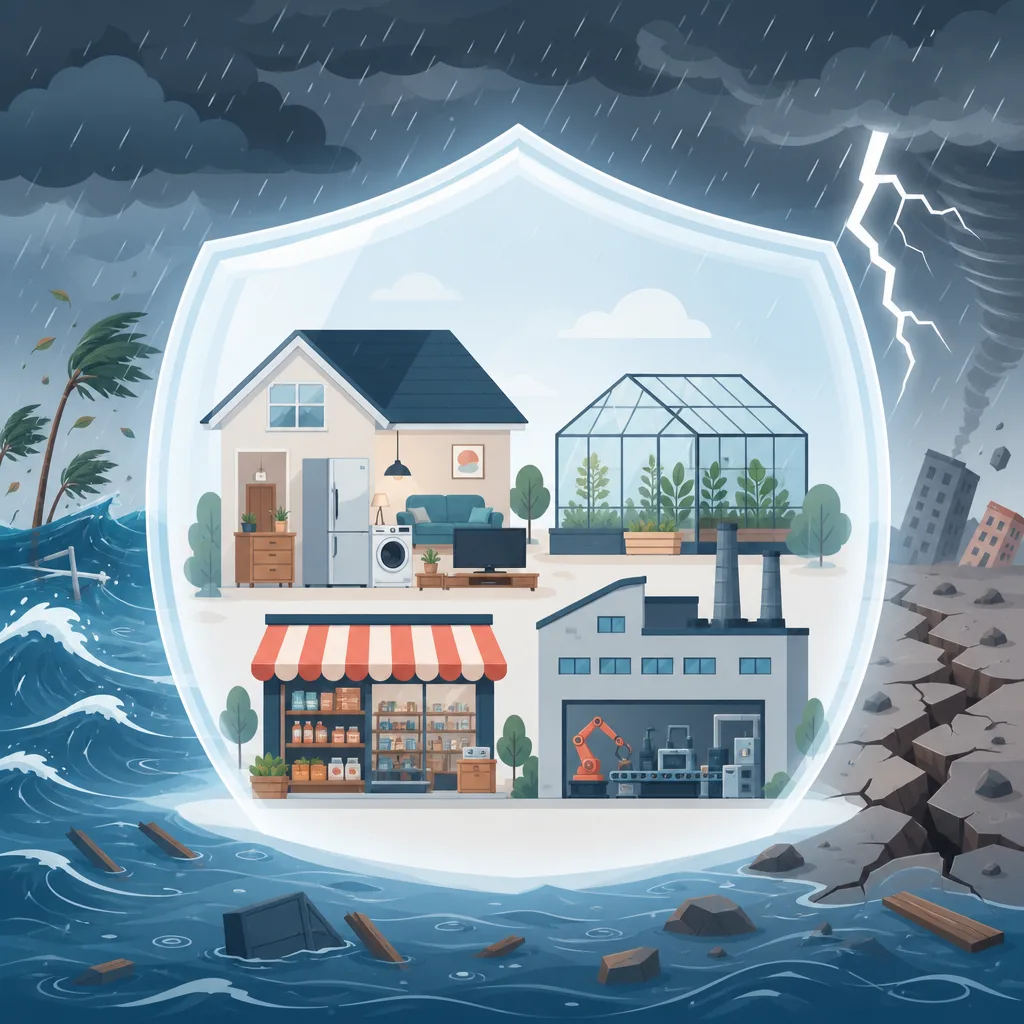
2026 Storm, Flood, and Earthquake Disaster Insurance Before Typhoons and Flooding: From Tenants’ Belongings to Small Business Factories
Storm, Flood, and Earthquake Disaster Insurance is a government-backed insurance program that covers homes, tenants’ belongings, greenhouses, and small business shops and factories against damage from typhoons, heavy rain, and earthquakes. In 2026, the annual coverage limits for small businesses were increased to KRW 150 million for shops and KRW 200 million for factories, while at least 55% of premiums are subsidized, depending on eligibility.
- In addition to homeowners, tenants may also insure movable household property they own, including household goods.
- Fixed-benefit coverage pays based on the agreed insured amount and the extent of damage, while indemnity coverage compensates for actual losses within the coverage limit.
- In 2026, the annual coverage limits for small businesses were increased to a maximum of KRW 150 million for shops and KRW 200 million for factories.
- The standard home insurance premium subsidy rates are at least 55% for general policyholders, at least 78% for near-poverty households, and at least 87% for basic livelihood security recipients and low-income households in disaster-vulnerable areas.
- Damage that has already occurred cannot be covered by a newly purchased policy, so check the policy’s effective date before a typhoon or torrential rain.
Storm, Flood, and Earthquake Disaster Insurance is a policy insurance program in which the central and local governments subsidize part of the premium, while private insurers sell the policies and pay claims. Unlike disaster relief payments, which are determined after a typhoon or heavy rain occurs, contractual insurance benefits are paid according to the insured property and coverage limits selected by the policyholder.
The government has been operating its 2026 summer natural disaster preparedness period since May 15. During periods when the risk of typhoons and localized torrential rain increases, policyholders should check in advance not only the address but also which buildings, household belongings, facilities, and inventory assets are included in the policy.
What disasters are covered?
The basic disasters covered by Storm, Flood, and Earthquake Disaster Insurance are as follows.
- Typhoons
- Floods
- Heavy rain
- Strong winds
- Wind waves
- Storm surges
- Heavy snow
- Earthquakes and tsunamis
Not every leak or type of water damage is automatically recognized as flood damage. Damage for which no causal relationship with a natural disaster covered under the policy can be established, such as leaks from aging pipes, inadequate maintenance, or ordinary rainwater intrusion, may not be covered. Whether a claim is paid is determined by reviewing weather advisories, the cause of damage at the site, the insured property, exclusions, and deductibles together.
Who can insure what?
The key is to distinguish property that the policyholder actually owns or in which the policyholder has an insurable interest, rather than focusing only on the address.
| Policyholder or facility | Main property that can be insured | What to check |
|---|---|---|
| Owner of a detached house or apartment unit | Residential building and movable property included in the policy | Check how the insured amounts for the building and movable property are set separately |
| Residential tenant | Residential movable property owned by the tenant, including household belongings | Check that the tenant’s own movable property, rather than the landlord’s building, is insured |
| Apartment resident | Contractually insured property, such as the individual unit’s building portion or movable property | Check the distinction between common and exclusively owned areas and whether the management entity has separate insurance |
| Greenhouse owner or operator | Greenhouses that meet the insurance eligibility criteria | Check the structural, area, and facility requirements and the scope of covered crops and ancillary equipment |
| Small business owner operating a commercial establishment | Property specified in the policy, such as the building, facilities and fixtures, and inventory assets | Tenants should check whether facilities and inventory they own are included |
| Small business owner operating a factory | Property covered by the policy, such as the building, machinery and facilities, and inventory assets | Check small business eligibility requirements, the insured amount for each asset, and the annual coverage limit |
Tenants are not excluded from eligibility merely because they rent. However, the building owned by the landlord and the movable property and facilities owned by the tenant are different types of property, so it is necessary to distinguish who insured each one. Keeping the lease agreement, an asset list, purchase receipts, and ordinary-condition photographs can help establish ownership and value during a damage investigation.
Differences between fixed-benefit and indemnity coverage
Storm, Flood, and Earthquake Disaster Insurance offers fixed-benefit and indemnity products depending on the insured property. The available coverage method may vary depending on whether the property is a residence, greenhouse, or small business premises and on the insurer’s products.
| Type | Principle for calculating benefits | Main points to check |
|---|---|---|
| Fixed-benefit | Benefits are calculated based on a predetermined insured amount and the degree of damage specified in the policy terms | Damage classification, coverage ratio, and fixed payment criteria |
| Indemnity | Actual losses are assessed and paid within the insured amount and coverage limits | Actual loss amount, deductible, duplicate insurance, and limits by asset |
Under fixed-benefit coverage, the benefit may not match the amount shown on actual repair receipts. Conversely, indemnity coverage does not pay the full coverage limit merely because damage occurred; it is based on the amount of loss actually recognized.
If the same property is covered by a wind and flood endorsement under another fire insurance or comprehensive property insurance policy, policyholders should also check for duplicate coverage. Under indemnity coverage, the combined benefits from multiple policies cannot exceed the actual loss, and proportional compensation may apply among insurers.
Changes to small business coverage in 2026
In 2026, the annual coverage limits for small business commercial establishments and factories were increased.
| Small business facility | Maximum annual coverage limit in 2026 |
|---|---|
| Commercial establishment | KRW 150 million |
| Factory | KRW 200 million |
These amounts are not fixed sums that are automatically paid when damage occurs. The actual benefit is determined by considering the insured property specified in the policy, the insured amount, the recognized loss, the deductible, and cumulative annual payments. If only some of the building, facilities and fixtures, machinery, or inventory assets are insured, damage to uninsured property is not covered.
In 2026, the scope was supplemented so that damage may also be recognized when a weather advisory is issued for an area adjacent to the insured area, provided that the actual cause of damage and the policy requirements are satisfied. However, benefits are not paid automatically merely because an advisory was issued for an adjacent area. It must be confirmed that damage occurred at the insured location due to the relevant weather phenomenon.
How much of the premium is subsidized?
The premium subsidy rate is the percentage of the total premium paid by the central and local governments. The basic subsidy rates under the Ministry of the Interior and Safety’s 2026 guidance are as follows.
| Eligible policyholder | Basic premium subsidy rate |
|---|---|
| General residential policyholder | At least 55% |
| Near-poverty household | At least 78% |
| Basic livelihood security recipient and low-income resident of a disaster-vulnerable area | At least 87% |
| Greenhouse | At least 55% |
| Small business commercial establishment or factory | At least 55% |
If a local government provides additional funding from its own budget, the actual subsidy rate may be higher, and some eligible policyholders may receive full support. However, additional support varies by region, eligibility requirements, and remaining budget, so the same rate does not automatically apply nationwide.
When comparing premiums, policyholders should check the out-of-pocket amount after subsidies rather than the total premium before subsidies. Even for the same building, premiums may vary depending on regional disaster risk, area, structure, insured amount, and coverage method.
How are disaster relief payments different from insurance benefits?
Disaster relief payments and insurance benefits differ in purpose and calculation method.
| Item | Disaster relief payment | Storm, Flood, and Earthquake Disaster Insurance benefit |
|---|---|---|
| Nature | Public assistance paid under applicable laws and disaster damage assessments | Compensation under a contract between the policyholder and insurer |
| Prerequisite | Requirements relating to disaster scale, damage type, and eligible recipients must be satisfied | A valid insurance contract must exist before the incident |
| Basis for amount | Government-established assistance standards | Insured amount, degree of damage or actual loss, and policy terms |
| Purpose | Minimum relief and support for living stability and recovery | Compensation for damage to property included in the policy |
| Overlap | Duplicate assistance for the same damage item may be restricted | The relationship with other indemnity insurance and disaster relief payments may be reviewed |
Disaster relief payments are not a system that restores all losses to their original condition. Insurance also does not cover all damage to uninsured property or losses beyond the coverage limit. Disaster relief payments should therefore not be regarded as a substitute for insurance, nor should policyholders assume that obtaining insurance allows them to receive both insurance benefits and disaster relief payments in full for the same damage.
Enrollment procedure to check before typhoons and flooding
1. Distinguish the property to be insured
Separate residential buildings, tenants’ movable property, greenhouses, commercial establishment facilities, factory machinery, and inventory assets. Tenants operating businesses should not rely solely on insurance purchased by the building owner and should check whether facilities and inventory they installed or own are included.
2. Check eligibility and the subsidy rate
Check the type of residence, whether the business qualifies as a small business, whether the policyholder is a basic livelihood security recipient or belongs to a near-poverty household, and whether the property is in a disaster-vulnerable area. Because additional premium subsidies from local governments may run out, it is advisable to inquire separately.
3. Compare coverage methods and limits
Check whether coverage is fixed-benefit or indemnity, the insured amount for each asset, and how deductibles and annual coverage limits apply. Small businesses should not focus only on the maximum limits of KRW 150 million for commercial establishments and KRW 200 million for factories, but should check the actual amounts entered in the policy.
4. Check the effective date of coverage
Insurance does not retroactively cover an incident that has already occurred. Do not assume that all coverage begins immediately upon submitting an application or paying the premium; check the insurance period and effective date shown on the policy.
5. Retain supporting documents immediately after enrollment
Keep the insurance policy, lease agreement, business and small business verification documents, asset list, and purchase receipts. Photographs of the building and interior, machinery, fixtures, and inventory with verifiable dates can help prove their condition before an incident.
What to do when damage occurs
- Ensure personal safety first and eliminate additional hazards involving electricity, gas, and other sources.
- Report the incident to the insurer as quickly as possible.
- Before removing water or disposing of items, document the entire affected site and detailed damage with photographs and videos.
- If emergency repairs are necessary, retain records of the conditions before and after the work and receipts for the costs.
- Before disposing of all flooded inventory or fixtures at your own discretion, check the insurer’s investigation and preservation instructions.
- If a disaster damage report must be filed with the local government, do so separately from the insurance claim.
There is no need to delay urgent safety measures, but if evidence needed to determine the cause and extent of the loss disappears, the insurance claim review may become difficult. It is advisable to retain the insurer’s claim reference number, guidance from the representative, and copies of submitted materials together.
Final checks before enrollment
- Are the tenant’s household belongings or business facilities actually listed as insured property?
- Are the insured amounts for the building, facilities and fixtures, machinery, and inventory assets each sufficient?
- Is compensation provided on a fixed-benefit or indemnity basis?
- What are the deductible and reasons for exclusion from coverage?
- How much is the actual premium payable after central and local government subsidies?
- Is there coverage that overlaps with other property insurance?
- Do the insurance period and effective date begin before the expected timing of typhoons or torrential rain?
A policy should not be selected based only on the premium subsidy rate and maximum coverage limit. The factors that determine the actual outcome of a claim following a disaster are the insured property, insured amount, coverage method, deductible, and effective date specified in the insurance policy.
FAQ
Can only homeowners purchase Storm and Earthquake Disaster Insurance?
No. Homeowners can insure the building, while tenants can insure movable property in the home that they own, such as household belongings. Because a landlord-owned building and tenant-owned movable property are separate assets, you must check which insured property is included in the insurance policy.
Are multi-unit residential buildings such as apartments also eligible for coverage?
Multi-unit residential buildings are also eligible. However, because the individually owned portions of each unit, household belongings, and common areas may have different owners and management entities, the coverage under individual policies must be distinguished from that of the management entity's insurance.
Can I receive compensation for flood damage if I purchase insurance after the flooding occurs?
No. Insurance covers incidents specified in the policy terms that occur after the contract takes effect and does not apply retroactively to damage that has already occurred. When purchasing insurance, you must check the start date and time shown on the insurance policy.
Are KRW 150 million for a small business's commercial property and KRW 200 million for a factory guaranteed payouts?
No. The two amounts are the annual maximum coverage limits for 2026. The actual insurance payout is determined by taking into account the property included in the contract, the insured amount, the actual recognized loss, the deductible, and any insurance payouts already made in the same year.
Does everyone receive support for at least 55% of the insurance premium?
The basic subsidy rate for ordinary homes, greenhouses, and small businesses' commercial properties and factories is at least 55%, but eligibility and contract requirements must be met. The applicable rates are at least 78% for near-poverty households and at least 87% for recipients of basic livelihood security benefits and low-income households in disaster-vulnerable areas. Additional support from local governments varies by region and budget.
Can I receive both an insurance payout and disaster relief funds?
The two programs differ in nature, but duplicate support for the same category of damage may be restricted. Insurance payouts are calculated according to the contract and policy terms, while disaster relief funds are determined according to statutory damage assessments and support criteria, so you must check the results of each review.
Are damage from earthquakes and tsunamis also covered?
Earthquakes and tsunamis are among the disasters covered by Storm and Earthquake Disaster Insurance. However, the incident must occur during the insurance period, and the actual scope of coverage varies depending on the insured property, coverage limits, and exclusions under the policy terms.
Can I not receive an insurance payout if no weather alert is issued for the insured area?
In 2026, the scope was expanded so that damage may be recognized if the requirements under the policy terms are met even when a weather alert is issued for an area adjoining the insured area. However, an alert in an adjoining area alone does not result in automatic coverage; a causal relationship between the damage at the insured location and the relevant weather phenomenon must be established.
Are plumbing leaks and sewer backups all covered as flooding?
Not all water damage is covered. A causal relationship must be established between the loss and a covered event, such as a typhoon, heavy rain, or flood. Coverage may be denied if the damage is caused by aging pipes, negligent maintenance, or falls under an exclusion in the policy terms.
What documents should I prepare before purchasing Storm and Earthquake Disaster Insurance?
It is advisable to prepare the address and area of the home or business premises, the lease agreement, documentation verifying small business status, a list of the facilities, machinery, and inventory to be insured, and existing insurance policies. After entering into the contract, you should keep the insurance policy, receipts for asset purchases, and photographs showing the condition before any incident together.
Sources
- Ministry of the Interior and Safety Guide to Storm, Flood, and Earthquake Disaster Insurance Products
- Ministry of the Interior and Safety Press Release on Storm, Flood, and Earthquake Disaster Insurance
- Ministry of the Interior and Safety 2026 Guide to the Storm, Flood, and Earthquake Disaster Insurance System
- Ministry of the Interior and Safety Materials on 2026 Summer Natural Disaster Measures
Images