Government ‘AI for Everyone’ Project: Free, Unlimited Framework and Verification Issues
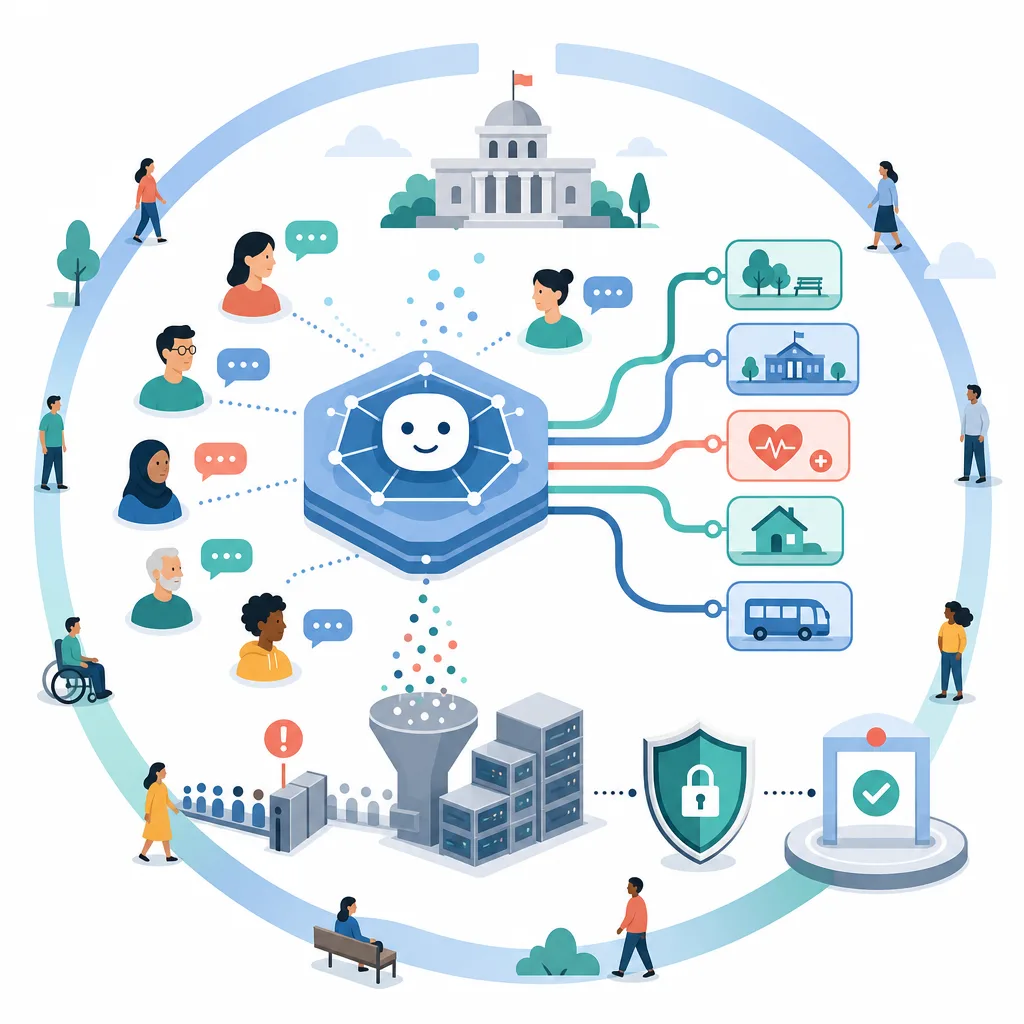
The government’s ‘AI for Everyone’ project aims to build a free, unlimited general-purpose chatbot for the entire population and an AI agent that helps people use public services. The call for operators closed on August 11, 2026, and key areas for verification include not only the share of domestic models used but also what unlimited access means in practice, personal data processing, responsibility for erroneous applications, and how results will be disclosed.
- The call for ‘AI for Everyone’ operators closed on August 11, 2026, but operator selection, contract signing, and the official launch are separate stages.
- Under the plan, the service will consist of a free general-purpose chatbot for the entire population and an AI agent that supports guidance and applications for public services.
- The requirement to use the selected operator’s proprietary AI foundation model for at least 50% and models from other domestic companies for at least 30% can be verified only if the measurement criteria for model usage and external audits are also disclosed.
- Public-service application functions require identity verification, explicit consent, final confirmation before submission, processing logs, and correction and cancellation procedures.
- Whether AI accessibility has improved should be evaluated not by subscriber numbers but by actual usage gaps, task completion rates, error rates, costs, personal data incidents, and service reliability.
The government’s “AI for All” initiative is not simply a project to create a free domestic chatbot. It is a plan to expand access to general-purpose generative AI, use multiple domestic models within the service, and ultimately build an AI agent that supports both guidance on and applications for public services.
As of August 17, 2026, the August 11 application deadline for service providers has passed. The application requirements and government objectives can therefore be described as confirmed plans, but the final provider, detailed terms of use, service levels, and official launch date must be verified through subsequent announcements and contract results.
Current Project Status and Scope
| Item | Meaning of the announced plan | Matters still requiring confirmation |
|---|---|---|
| Project stage | Service provider application deadline was August 11, 2026 | Selection results, contract signing, and whether a pilot will be conducted |
| Launch target | Seeking to launch a general-purpose chatbot and public-service AI agent within 2026 | Exact launch date and features provided at each stage |
| Eligible users | A service intended for the entire population | Account requirements for minors, overseas Koreans, and foreign residents in Korea |
| Usage cost | A structure providing the service free of charge to general users | Whether paid add-on features and enterprise and API use will be included |
| Usage volume | “Unlimited” usage presented as a core objective | Fair-use policy, speed limits, queues during congestion, and file-size limits |
| Model composition | At least 50% use of the provider’s proprietary model and at least 30% use of models from other domestic companies | Whether the percentages will be calculated based on calls, tokens, compute, or cost |
| Government support | A structure that collaborates with private providers and supports development and operational infrastructure | Support budget, GPU capacity, support period, and operational funding after support ends |
The application deadline does not mean the service has launched. Preferred bidder negotiations, technical verification, contracting, security reviews, and pilot operations may follow, so “launch within the year” is a target schedule, not an outcome that is already guaranteed.
What “Free and Unlimited” Actually Means
Free most likely means that users do not directly pay a fee each time they use the service. It does not mean that the costs of GPUs, electricity, storage, networks, safety evaluations, and customer support required for training and inference disappear. Those costs will be covered through government support, the provider’s own funding, or a combination of the two.
Unlimited also cannot be assumed to mean that there are technically no restrictions. The following operating conditions may apply to ensure stable service.
- Rate limits on sending an excessive number of requests within a short period
- Fair-use policies preventing automated bulk calls or account sharing
- Limits on the size of documents and length of conversations that can be entered at one time
- Separate limits for compute-intensive features such as image and video generation
- Queues or lower processing priority during periods of heavy usage
- Safety policies restricting illegal or harmful requests and cyberattacks
The final terms should therefore specify not only the number of monthly messages but also requests per minute, response speed, context length, file-processing volume, supported features, and whether API access is provided. Free use of a personal chatbot does not mean that enterprise APIs or automated bulk workloads will also be free.
Structure of the 50% and 30% Domestic Model Requirements
A distinctive feature of the plan is that it requires multiple domestic AI models to participate rather than using only one company’s model.
- The selected provider’s proprietary AI foundation model: at least 50% of total model usage
- Models developed by other domestic companies: at least 30% of total model usage
- The remainder: an area whose permitted scope and purposes of use must be confirmed in the announcement and contract
The two percentages add up to 80%, leaving 20% arithmetically. However, this should not immediately be interpreted as a share reserved for foreign models. Whether additional use of the same domestic models, small models for search and classification, safety filters, or separate tools is counted depends on the detailed calculation formula.
To Verify the Percentages, the Denominator Must Be Disclosed First
“50% model usage” can produce entirely different results depending on the unit of measurement.
| Measurement basis | Advantage | Potential distortion |
|---|---|---|
| Number of calls | Simple to calculate and explain | The percentage can be inflated by sending a large volume of lightweight requests |
| Number of input and output tokens | Reflects the actual volume of text processed | May not sufficiently reflect the cost of images, audio, and tool calls |
| Compute | Useful for comparing technical resource usage | Difficult to measure and audit externally |
| Inference cost | Shows the degree of economic dependence | Requires disclosure of internal costs and contracted rates |
| Usage time | Can show each model’s contribution to the service | Difficult to reflect differences in processing complexity and quality among models |
Reliable verification would involve disclosing each model’s call volume and token share, the types of tasks processed, inference costs, downtime, and quality evaluations together. Rather than merely announcing percentages calculated by the provider itself, independent audits and reproducible aggregation rules are needed.
A High Share of Domestic Models Does Not Necessarily Mean Technological Self-Reliance
Even if a model was developed domestically, its GPUs, cloud infrastructure, training-data tools, open-source components, and semiconductor supply chain may depend on foreign technologies. Conversely, the use of some foreign components does not necessarily mean the entire service is beyond domestic control.
The following elements must be distinguished when assessing substantive technological sovereignty.
- Ownership and usage rights for model weights
- The ability to directly modify and retrain models domestically
- Where inference servers and user data are stored and processed
- Whether the service can continue operating if an external supplier terminates its contract
- Whether domestic operators can directly fix security vulnerabilities and model errors
- Sources of training data, copyright clearance, and Korean-language quality
How It Differs from Existing Free Chatbots
Existing private-sector free chatbots also support general questions, document summarization, translation, and coding. To differentiate itself, “AI for All” must demonstrate distinctions beyond price in public-service integration, the domestic model ecosystem, universal accessibility, and public accountability.
| Comparison criterion | Typical private-sector free chatbot | “AI for All” plan |
|---|---|---|
| Purpose | Acquire product users and expand commercial services | Provide universal AI access and foster the domestic ecosystem |
| Usage volume | Free limits and congestion restrictions vary by product | Seeks to offer free, unlimited use, but detailed policies still require final confirmation |
| Model selection | Determined independently by the provider | Requires minimum usage shares for the provider’s proprietary model and models from other domestic companies |
| Public services | Generally limited to explaining information or providing links | Envisions an AI agent expanding from guidance to application support |
| Accountability structure | Centered on private terms of use and product policies | Requires clear division of roles among the government, operating provider, model providers, and relevant administrative agencies |
| Performance disclosure | Companies primarily announce metrics of their choosing | If public funds are used, cost, quality, and safety metrics must be disclosed |
Any actual advantage must be assessed after launch by comparing the same tasks under the same conditions. Being free does not in itself mean the service will offer better accuracy, speed, privacy protection, or Korean-language performance.
Stages of Operation for a Public-Service AI Agent
A chatbot that explains public services and an agent that actually submits applications pose different levels of risk. Safe application support must be designed to distinguish the following stages.
- Confirm the user’s purpose and circumstances.
- Search official administrative information and provide guidance on potentially applicable programs.
- Conduct a preliminary eligibility check while informing the user that it is not a final eligibility determination.
- Explain the required personal information and documents item by item.
- Draft an application using the information provided by the user.
- Show the user the receiving agency, entered information, and legal confirmation items again.
- Submit the application to the official system after identity verification and explicit consent.
- Provide the receipt number and processing status, and explain how to make corrections or cancel the application.
An AI system that is not connected to an official system must not indicate that an application has been “completed.” Until the administrative agency confirms receipt and issues a receipt number, it must be clearly marked as being in the drafting or submission-preparation stage.
Personal Data and Responsibility for Incorrect Applications
Public-service applications may include sensitive data or data with a high potential for harm, such as resident registration information, addresses, family relationships, income, health, disabilities, and bank account information. Operating general conversational functions and administrative application functions under the same data policy increases the risks of excessive collection and secondary use.
Essential safeguards include the following.
- Purpose limitation and data minimization, collecting only the information necessary for each application task
- Separate notice and user choice regarding whether conversation content is used for model training
- Disclosure of the scope of data transfers among model providers, cloud operators, and administrative agencies
- Disclosure of storage locations, retention periods, deletion methods, and standards for processing backup data
- Multi-factor authentication to prevent account theft and reauthentication at critical submission stages
- Operational logs with personal data masked and role-based access control
- Defenses against prompt injection, malicious documents, and fraudulent government websites
- A screen allowing users to review and revise the entire application immediately before submission
- Channels for correcting, canceling, or appealing incorrectly submitted applications
Responsibility Must Be Divided by Stage
| Problem scenario | Primary area of responsibility to examine |
|---|---|
| The AI provides guidance on a nonexistent support program | Accuracy of the model and search system, and the operator’s verification procedures |
| Eligibility requirements are misinterpreted | Integration with official regulations, provision of up-to-date information by the relevant administrative agency, and adequacy of the service’s disclaimers |
| Incorrect values are entered in the application | Automatic entry logic, pre-submission user confirmation procedures, and correction functions |
| Information is transferred to an external model without consent | Privacy obligations of the operating provider and contracted data processor |
| The application is shown as completed even though it was not received by the official system | Verification of service integration status, receipt-number confirmation, and incident handling |
| The user enters false information | The user’s duty to verify and intent, and whether the service induced the error |
It is inappropriate to shift all responsibility to the user through a single final confirmation. Stage-by-stage records must be preserved so that model errors, system integration failures, faulty interface design, and user input errors can be distinguished.
An Easily Overlooked Issue: Sustainability of an Unlimited Service
For the slogan “free and unlimited” to remain viable over the long term, a total cost structure is needed that covers not only initial GPU support but also maintenance, model improvements, security responses, and customer support. The possibility that the operator may reduce usage allowances or rely on advertising, data use, or paid features after the support period ends must also be examined during the contracting stage.
In particular, answers to the following questions must be disclosed.
- Will core features remain free after government support ends?
- What restrictions will apply if inference costs exceed expectations due to user growth?
- If the provider changes, how will accounts, conversation histories, and public-service application records be transferred?
- If a participating model company withdraws, how will the required model shares and service quality be maintained?
- What is the target recovery time in the event of an outage or security incident?
- If public-service features are discontinued, who will handle applications already in progress?
These are issues of operational sustainability separate from model performance. If the goal is a service resembling public infrastructure, service-level agreements, provider-replacement plans, and data portability must also be designed.
Metrics for Evaluating the AI Accessibility Gap
The number of subscribers or total questions alone cannot show whether “AI for All” has reduced the gap. Performance must be measured separately across access, quality, safety, self-reliance, and cost.
| Evaluation area | Recommended metrics |
|---|---|
| Accessibility | Usage rates by region, age, disability status, and income bracket; success rates on mobile and low-spec devices; compliance with accessibility standards |
| Practical use | Return rate, task completion rate, abandonment rate, and rate of assistance requests among digitally vulnerable groups |
| Answer quality | Korean-language factual accuracy, rate of providing supporting evidence, hallucination rate, and time required to reflect the latest administrative information |
| Public services | Preliminary eligibility-check error rate, application completion rate, incorrect application and correction rate, and average processing time |
| Domestic ecosystem | Share of calls, tokens, and costs by model; number of participating companies; concentration among particular suppliers |
| Privacy and safety | Cases of excessive collection, unauthorized secondary use, security incidents, account theft, harmful-response reports, and handling time |
| Operational stability | Uptime, response latency, waits during peak periods, and incident recovery time |
| Cost-effectiveness | Cost per monthly active user, cost per completed task, and projected operating costs after government support ends |
Publishing only average figures may obscure failures affecting vulnerable groups. Alongside overall performance, the government must disclose disparities among groups, measurement methods, sample sizes, evaluation dates, and external audit results.
What Users Should Check After Launch
Once the service launches, users should first verify the following for their safety.
- Whether the operator and official access address match the government’s announcement
- What is included for free and what fair-use restrictions apply
- Whether conversations are used for model training and how to opt out
- Which companies and agencies receive personal data
- Whether a public-service application is merely being drafted or has actually been submitted
- Whether revisions and cancellations are possible before submission
- Whether an official receipt number was issued by the relevant agency after completion
- Where to report errors or harm and seek dispute resolution
The success or failure of “AI for All” does not end with releasing a free model. Its policy objectives can be evaluated only when users can safely complete important tasks, domestic AI companies participate in a verifiable manner, and the costs and outcomes of public funding are transparently disclosed.
FAQ
Can the government’s “AI for Everyone” be used right now?
As of August 17, 2026, the call for service providers has closed, but the official service cannot yet be considered launched. It is necessary to confirm whether it will officially commence after the service provider selection, contracting, security checks, and pilot operation.
When exactly is the “launch within the year”?
A launch within the year means the goal is to release the service sometime in 2026. The exact date and whether the general-purpose chatbot and public AI agent will be launched simultaneously cannot be confirmed until a subsequent official announcement is made.
If it is free and unlimited, can all features and APIs also be used without restrictions?
That cannot be assumed. Free and unlimited access is the goal for the general-user service, while separate restrictions or fair-use policies may apply to automated bulk requests, enterprise APIs, large files, and image and video features.
On what basis is the requirement of at least 50% domestic AI foundation models calculated?
The result will vary depending on whether it is based on the number of requests, number of tokens, computing volume, or inference costs. A reliable assessment is possible only if the contractual calculation formula, usage statistics for each model, and external audit methods are disclosed together.
Why must models from other domestic companies account for at least 30% of use?
This can be viewed as an ecosystem design intended to reduce the concentration of demand on the selected service provider’s model alone and enable multiple domestic AI companies to participate in the service. However, its actual effectiveness must be verified through task allocation, the usage calculation formula, the number of participating companies, and the continuity of contracts.
Is the remaining 20%, after excluding 50% and 30%, allocated to foreign AI models?
Not necessarily. While 20% remains arithmetically, the aggregation rules in the announcement and contract must be checked to determine the extent to which additional use of domestic models, search and classification models, safety tools, or external models is permitted.
Will the AI agent automatically complete public service applications?
Automatic completion should not be assumed before the final scope of functionality is confirmed. In a secure structure, it should provide preliminary eligibility checks, document guidance, and a draft application, after which the user should complete identity verification and final confirmation before receiving an application number from the official administrative system.
Who is responsible if the AI submits an application incorrectly?
Responsibility varies depending on the cause of the error. It must be possible to distinguish among incorrect model responses, system integration failures, automated input errors, outdated administrative information, and false information entered by the user, and the service provider and relevant authority must provide procedures for correction, cancellation, and dispute resolution.
Can the content of public service consultations be used to train AI?
The final privacy policy and consent screen must be checked. It is important to separate personal and sensitive information used for administrative applications from general conversation data, clearly disclose whether it will be used for model training, and provide methods to opt out and request deletion.
How can we determine whether “AI for Everyone” has reduced dependence on foreign AI?
The proportion of requests handled by domestic models alone is not sufficient. The ability to modify and retrain models, control over model weights and operations, the location of data processing, dependence on overseas GPUs and cloud services, substitutability in the event of supply disruptions, and the cost structure must all be evaluated together.
Which indicators should be used to determine whether the AI accessibility gap has narrowed?
Rather than the total number of registered users, actual usage rates, task completion rates, abandonment rates, accessibility on low-spec devices, error rates, and rates of requests for assistance should be compared by region, age, disability, and income bracket. Policy effectiveness can be assessed only when disparities between groups are disclosed alongside average values.
Sources
Images