Emergency Text Alerts 2026: Phone and Anjeon Didimdol Setup
To receive emergency text alerts for your current location, turn them on in your phone settings. In Anjeon Didimdol, you can separately set up alerts for the area where your family lives. On National Safety 24, you can check when and to which areas any missed alerts were sent.
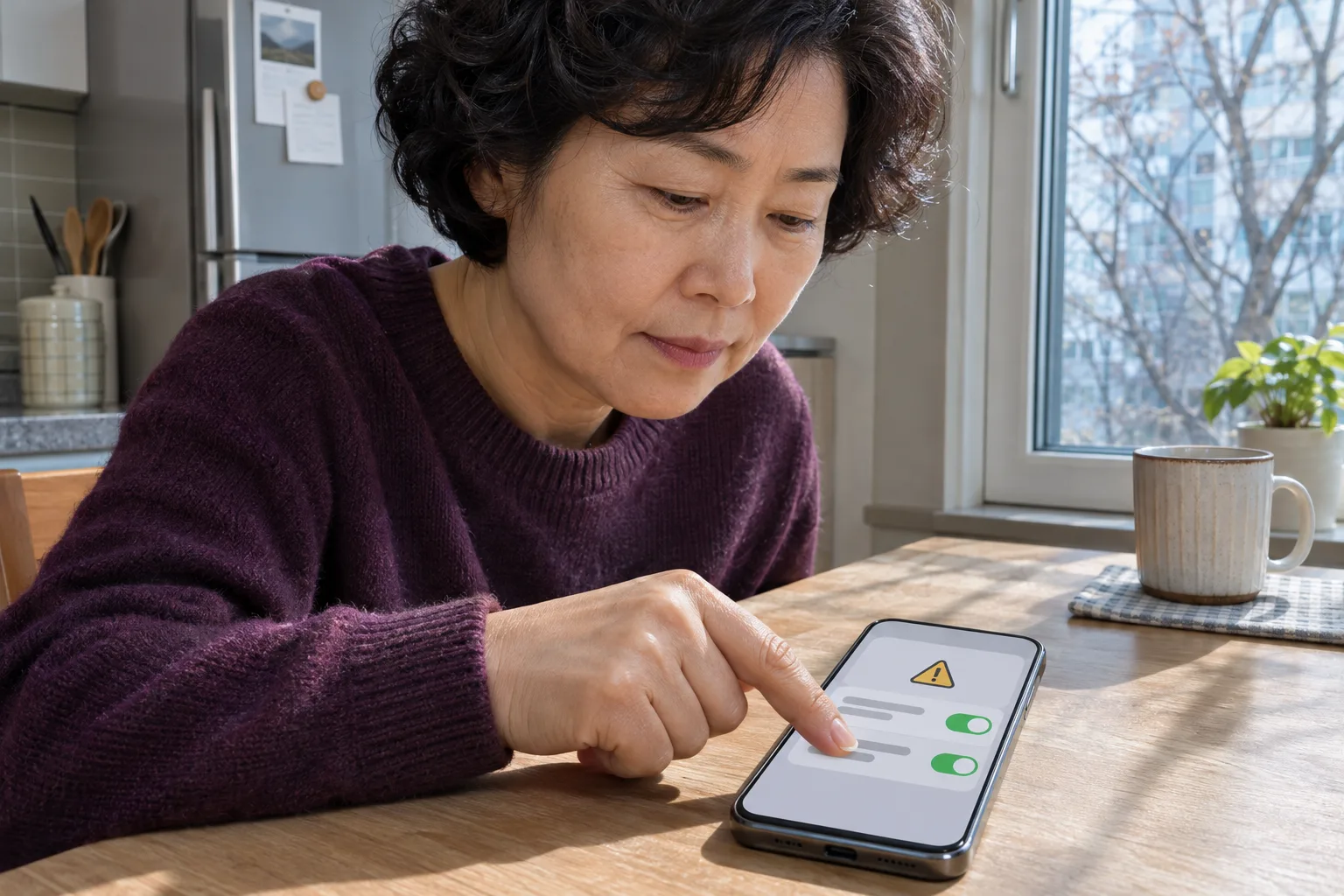
- In your phone settings, turn on both emergency text alerts and safety advisory texts using their separate settings.
- Install the Ministry of the Interior and Safety's Anjeon Didimdol app from your phone's app store.
- In the Anjeon Didimdol settings, turn on notifications and choose which areas to receive alerts for and which notification sound to use.
- Find nearby shelters in Anjeon Didimdol ahead of time. If you need to evacuate, follow the text alerts and instructions from your local government.
- If you missed an alert, check the emergency text alert list on National Safety 24 to see the date and time it was sent and the area it was sent to.
To get evacuation instructions for your current location, keep emergency alerts turned on in your phone settings. You can separately select the areas where your family lives in the Ministry of the Interior and Safety’s Safety Stepping Stone app. Check National Safety 24 for any alerts you missed.
The criteria and figures below are based on guidance from the Ministry of the Interior and Safety and the Korea Meteorological Administration as of November 13, 2026.
How to turn on emergency alerts on your phone
Turn on both emergency alerts and safety advisory texts in your phone settings. Your phone’s built-in disaster alerts go to phones connected to cell towers in the affected area at the time the alert is sent. If you turn them off, you could miss evacuation orders or notices that an order has been lifted.
- On iPhone, open “Notifications” in “Settings” and look for disaster alerts at the bottom of the screen.
- On Android, search your device settings for “Disaster Alerts” or “Emergency Alerts.” Menu names and locations vary by model and operating system version.
- Check that emergency alerts and safety advisory texts are both turned on. Turn on either one if it is off.
Installing Safety Stepping Stone and choosing which areas to receive alerts for
When you choose an area in Safety Stepping Stone, you can receive disaster alerts for places other than your current location. This setting is useful if you live and work in different areas or want to know what is happening where family members live. The areas you choose in the app apply to Safety Stepping Stone notifications.
- On Android, look for “Safety Stepping Stone” in Google Play or ONE store. On iPhone, look for it in the App Store. Check that it is the Ministry of the Interior and Safety’s app before installing it.
- Open “Settings” at the bottom of the app’s home screen and turn on disaster alert notifications.
- Under “Alert Areas,” choose the areas you want alerts for. Then go to “Notification Sound” and set the app to play its notification sounds.
Shelter locations and disaster alerts in other languages
Safety Stepping Stone lets you look up evacuation shelters and cooling centers separately. You can also find nearby hospitals and pharmacies. If you need to evacuate, go to the location specified in the disaster alert and by your local government.
If you need alerts in another language, use the Ministry of the Interior and Safety’s Emergency Ready App. It provides disaster alerts in English, Chinese, Vietnamese, Thai, and Japanese. You can also find instructions for different types of disasters under “Public Safety Instructions” in Safety Stepping Stone.
What to check when you don’t receive a disaster alert
First, check National Safety 24 to see whether your location at the time was within the area the alert was sent to. You can look up the text of an alert there even if you have already deleted it from your phone. On April 29, 2026, the Ministry of the Interior and Safety announced that it had revamped the National Disaster Safety Portal and would start operating National Safety 24 on April 29.
- In National Safety 24, open “Disaster Information” and select “Disaster Alerts.”
- Set “Registration Date” to the date the alert was sent. In the results, check the date and time it was sent, the alert level, and the area it was sent to.
- If you were in that area at the time, check your phone’s settings for that alert level. If you still don’t receive disaster alerts, ask your phone manufacturer or mobile carrier whether your device can receive them.
- If you were expecting a Safety Stepping Stone notification, check that the app’s alert notifications are on and that you have selected the right areas. Your phone’s built-in alerts and app notifications are set up separately.
When each type of disaster alert is sent and what it sounds like
You cannot opt out of critical emergency alerts, but you can choose whether to receive emergency alerts and safety advisory texts. Under the Ministry of the Interior and Safety’s criteria as of February 26, 2026, evacuation orders are sent as emergency alerts. Notices that an evacuation order has been lifted are sent as safety advisory texts.
| Alert type | When it is sent | Phone alert sound | Can you opt out? |
|---|---|---|---|
| Critical emergency alert | Earthquakes, nuclear alerts, and similar situations, as well as cases where everyone must receive the alert because of the risk of a large-scale disaster or casualties | Phone’s maximum volume | No |
| Emergency alert | Terrorism, an expected release of radioactive material, an evacuation order, heavy rain alerts sent directly by the Administrator of the Korea Meteorological Administration, severe-level flood information sent directly by the head of a flood control office, and landslide warnings | Maximum volume (at least 40dB) | Yes |
| Safety advisory text | Early evacuation recommendations, notices lifting evacuation orders, and disaster warnings and advisories below the critical and emergency levels | Same sound as a regular text | Yes |
2026 changes to evacuation alerts for residents and safety advisory texts
The criteria now require agencies to use either critical emergency alerts or emergency alerts when residents need to evacuate in an emergency. If there is a risk of a large-scale disaster or casualties, local governments can decide to send a critical emergency alert. Early evacuation recommendations can also come as safety advisory texts, so check the message even if you hear your regular text notification sound.
The Ministry of the Interior and Safety’s press release, “A phone beep makes it easier to recognize disasters that require evacuation,” describes the change as follows:
Disaster alerts for evacuating residents must now be sent as critical emergency alerts or emergency alerts
Starting October 30, 2026, the length limit for all safety advisory texts increased from 90 characters to 157 characters. Public institutions can also send messages using the higher character limit. Critical emergency alerts and emergency alerts stay at 90 characters so that older phones can still receive them.
Before sending an alert, agencies can check whether it duplicates information they have already sent. The Ministry of the Interior and Safety put this feature into regular use in October 2026. During the pilot, the number of alerts sent fell by about 20%, from 11,433 in the same period a year earlier to 9,173.
Criteria for sending emergency alerts for heavy rain and disaster-level rainfall
When observed cumulative rainfall reaches the threshold, the Korea Meteorological Administration sends alerts directly to the affected eup, myeon, or dong. If two conditions are listed in one cell below, both must be met. The right column shows when one hour of rainfall alone is enough to trigger an alert.
| Alert and start date | When both conditions are met | When this condition alone is enough |
|---|---|---|
| Emergency alert for heavy rain, in use nationwide since May 15, 2025 | At least 50mm in 1 hour and at least 90mm in 3 hours | At least 72mm in 1 hour |
| Emergency alert for disaster-level rainfall, in use since summer 2026 | At least 85mm in 1 hour and at least 25mm in 15 minutes | At least 100mm in 1 hour |
For example, if 72mm is recorded in 1 hour, that alone meets the criteria for a heavy rain emergency alert. Disaster-level rainfall is a higher alert level than the existing heavy rain emergency alert. The Korea Meteorological Administration says both alerts come with a 40dB alarm. In line with its guidance on disaster-level rainfall, if you receive this alert, leave any underground space immediately and avoid dangerous areas.
Why earthquake alert sounds differ by area
For the same earthquake, the Korea Meteorological Administration sends different alerts based on the shaking expected in each area. “Expected intensity” means how strong the shaking is expected to be in a particular area. On November 4, 2025, the Korea Meteorological Administration announced that it would start sending alerts by area in December of that year.
| Magnitude 3.5 to 4.9 on land in South Korea or 4.0 to 4.9 offshore, with a maximum expected intensity of at least Ⅴ | Alert sent to the affected city, county, or district |
|---|---|
| Local expected intensity of at least Ⅲ | Emergency alert with an alarm |
| Local expected intensity of Ⅱ | Safety advisory text without an alarm |
Larger earthquakes are subject to nationwide alert criteria. For example, a magnitude 5.0 to 5.9 earthquake in South Korea triggers a nationwide emergency alert. For detailed criteria by earthquake location and magnitude, see “Earthquake and Volcano Notifications” from the Korea Meteorological Administration. (Verified thresholds: magnitude of at least 6.0, nationwide critical emergency alert; maximum expected intensity of at least Ⅵ, emergency alert within a 40km radius of the first observation point; as of November 2026 · Source: kma.go.kr · As of 2026-11-18 · Checked 2026-11-27)
How disaster alerts differ from GilCheck weather advisory and warning cards
GilCheck cards are a reference for checking when the Korea Meteorological Administration issues and lifts weather advisories and warnings. Heavy rain advisories and warnings may be issued based on forecast rainfall. Heavy rain emergency alerts are sent separately, based on rainfall actually recorded in the affected eup, myeon, or dong.
| What you want to check | Where to check | What to look for |
|---|---|---|
| Where to evacuate now | Disaster alerts on your phone, Safety Stepping Stone, local government instructions | Affected area, evacuation site, what to do |
| Missed alerts or details about an evacuation order being lifted | Disaster alert list on National Safety 24 | Date and time sent, area it was sent to, message text |
| Whether a heavy rain advisory or warning has been issued or lifted for an area you follow | GilCheck weather advisory and warning cards | Issuing agency, time issued, link to the original Korea Meteorological Administration notice |
GilCheck does not receive or display past disaster alerts. The cities and provinces you select in GilCheck are saved only in the browser you used. Check local government text alerts to see whether an evacuation order has been lifted.
FAQ
Can I also receive disaster alerts for my parents' home in another area?
In the Safety Stepping Stone settings, turn on alert notifications and select the area where your parents live as an area to receive alerts for. Your phone's built-in disaster alerts are based on the cell tower your phone is connected to when the alert is sent.
If I change the alert sound in Safety Stepping Stone, will it also change my phone's built-in alert sound?
The alert sound setting in Safety Stepping Stone applies to app notifications. Critical disaster alerts sent directly to your phone sound at maximum volume, and you cannot opt out of receiving them.
What evacuation information might I miss if I turn off safety advisory texts?
You may miss recommendations to evacuate early and notices that evacuation orders have been lifted. Leave safety advisory texts turned on so you can still receive them for that area after you evacuate.
Where can I reread disaster alerts I've deleted from my phone?
In the 'Disaster Information' section of National Safety 24, select 'Disaster Alerts.' Search by registration date, then read the full text of the alert that matches the date and time it was sent and the area it was sent to.
Were emergency disaster alerts also extended to 157 characters in 2026?
The 157-character limit applies to all safety advisory texts starting October 30, 2026. Critical disaster alerts and emergency disaster alerts each have a limit of 90 characters.
When a heavy rain alert is issued, will an emergency disaster alert be sent to the same area right away?
Heavy rain alerts can also be issued based on forecast rainfall. The Korea Meteorological Administration sends emergency disaster alerts for heavy rain to towns, townships, and neighborhoods where observed rainfall has reached a separate threshold.
What should I do if I receive an emergency disaster alert for extreme rainfall while I'm underground?
The Korea Meteorological Administration advises you to leave any underground space and avoid dangerous areas as soon as you receive the alert. Follow the instructions in the alert and from your local government on where to evacuate.
Which government app can I use to receive disaster alerts in other languages?
You can use the Ministry of the Interior and Safety's Emergency Ready App for foreign nationals. The app supports disaster alerts in English, Chinese, Vietnamese, Thai, and Japanese.
If I change the cities and provinces I follow in GilCheck, will that also change the areas I receive alerts for in Safety Stepping Stone?
The cities and provinces you follow in GilCheck are saved only in that browser. Choose the areas you want to receive disaster alerts for separately in the Safety Stepping Stone settings.
Sources
- Ministry of the Interior and Safety: A mobile phone 'beep' will make it clearer when a disaster requires evacuation
- Ministry of the Interior and Safety expands disaster text messages to 157 characters
- Ministry of the Interior and Safety: How to install and configure the Safety Stepping Stone app
- Government24: Where to download the Ministry of the Interior and Safety's mobile apps
- Apple Support: Government, emergency, and enhanced safety alerts on iPhone
- Samsung Electronics Service: I'd like to know about the disaster text alert feature
- National Safety 24: Disaster information and disaster text message lookup
- Ministry of the Interior and Safety: Easily and conveniently access all kinds of disaster and safety information in one place on 'National Safety 24'!
- Korea Meteorological Administration: Life-saving alerts: The Korea Meteorological Administration expands its emergency text alerts for heavy rain nationwide
- Korea Meteorological Administration and Korea Policy Briefing: Criteria for sending emergency text alerts for disaster-level heavy rain and how to evacuate
- Korea Meteorological Administration and Korea Policy Briefing: Areas with weak shaking will receive only earthquake text alerts 'without an alarm sound'
- Korea Meteorological Administration: Criteria for issuing earthquake and volcano notifications and broadcasting disaster text alerts
- Korea Meteorological Administration Weather Nuri: Criteria for issuing weather advisories and warnings
Images