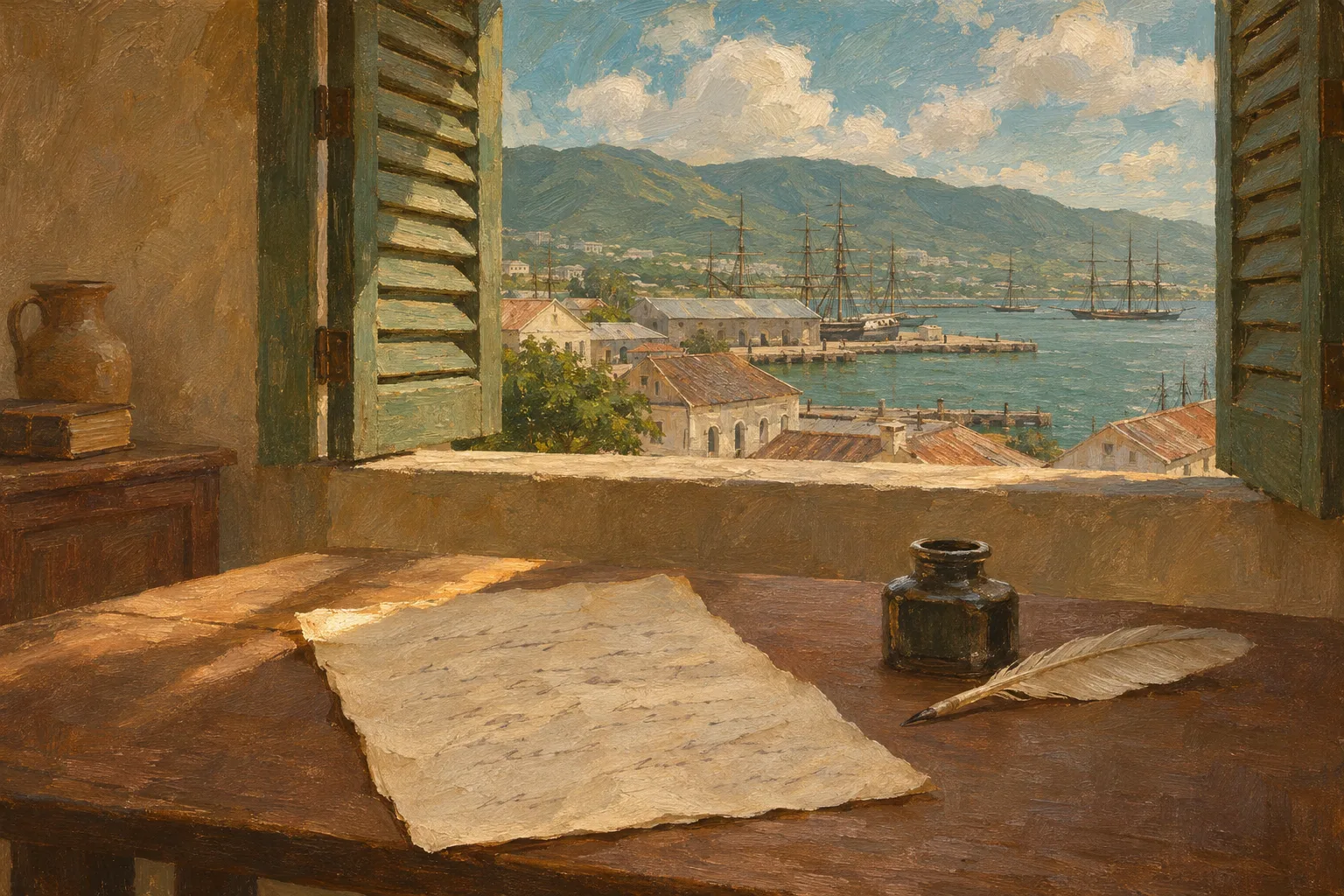
Simón Bolívar: 1815 Exile in Jamaica and Rebuilding His Army
After the Second Republic of Venezuela fell, Simón Bolívar made the case for independence while in Jamaica. With help from Haiti and local forces, he rebuilt the independence army. After the victory at Boyacá in 1819, the Congress of Angostura established the Republic of Colombia.
- In his Jamaica Letter of September 6, 1815, Bolívar raised the possibility of uniting New Granada and Venezuela.
- Haitian President Alexandre Pétion supported Bolívar's return, and José Antonio Páez's troops joined him in the Venezuelan plains.
- The victory at the Battle of Boyacá on August 7, 1819, gave the independence army control of central New Granada.
- On December 17, 1819, the Congress of Angostura established the Republic of Colombia through the Basic Law.
- In 1821, the Congress of Cúcuta used the constitution to organize the central government and legislature of the republic, which had already been established.
Simón Bolívar wrote the 1815 Jamaica Letter in exile after the collapse of the Second Republic of Venezuela. With help from Haiti and local forces, he rebuilt the independence army. His plan for unification was written into the Fundamental Law of the Republic on December 17, 1819, after the victory at Boyacá.
The National Archives of Colombia’s record for the letter and the Fundamental Law of the Republic were checked in November 2026.
Venezuela’s defeat and the background to Bolívar’s exile in Jamaica
When the Second Republic of Venezuela collapsed in 1814, Bolívar went to neighboring New Granada. The independence movement was divided there, too. The following year, Spain sent an expeditionary force across the Atlantic to restore colonial rule. Bolívar left Cartagena in May 1815 for British Jamaica.
Why Bolívar expected independence in the Jamaica Letter
Despite his defeat in Venezuela, Bolívar noted that resistance continued across Spanish America. He set out his reasoning in a reply he sent from Kingston to the English merchant Henry Cullen on September 6, 1815. He assessed the fighting in regions such as the Río de la Plata and Chile separately. He appealed for support for independence, arguing that Europe would also benefit from free trade with the Americas.
He expected politics after independence to take different paths in different regions. He wrote that if New Granada and Venezuela united, the new country could be called Colombia. He also left open the possibility that New Granada could remain a separate country if supporters of local authority were strong there.
Haitian support and the rebuilding of the independence army
Support from Haitian President Alexandre Pétion made it possible for Bolívar to return to Venezuela. In 1816, Pétion supplied the weapons and food needed for the expedition. He asked Bolívar to declare slavery abolished in the areas that were liberated. It is not known whether Pétion read the letter and then decided to help.
After returning to the mainland, the independence army established itself in the Orinoco River basin. In 1818, troops led by José Antonio Páez joined Bolívar’s army on the Venezuelan plains. The following year, Francisco de Paula Santander’s forces joined the advance into New Granada.
Timeline from exile in Jamaica to the breakup of Gran Colombia
The Congress of Angostura opened before the Battle of Boyacá and adopted the Fundamental Law of the Republic after the battle.
| Date | Event | Supporting record |
|---|---|---|
| May 1815 | Bolívar leaves Cartagena and goes into exile in Jamaica | UNESCO’s overview of the Jamaica Letter |
| September 6, 1815 | In Kingston, Bolívar writes a reply outlining the prospects for independence and possible forms of government for different regions | Jamaica Letter |
| 1816 | The expedition to Venezuela resumes with support from Haiti | Bogotá Institute of Cultural Heritage’s overview of Pétion |
| January 1818 | Páez’s and Bolívar’s troops join forces in Apure, Venezuela | Dictionary of Venezuelan History, entry on Páez |
| February 15, 1819 | In his opening address to the Congress of Angostura, Bolívar proposes institutions for the republic | National Archives of Colombia’s exhibition on the Congress of Angostura |
| August 7, 1819 | Victory at Boyacá gives the independence army control of central New Granada | U.S. Library of Congress, Colombia: A Country Study |
| December 17, 1819 | The Congress of Angostura establishes the Republic of Colombia | Article 1 of the Fundamental Law of the Republic of Colombia |
| 1821 | The Congress of Cúcuta adopts the republic’s constitution | Constitution of the Republic of Colombia |
| 1830 | The republic breaks up as Venezuela and Ecuador separate | U.S. Library of Congress’s overview of the 1821 Constitution |
The roles of the Angostura Address and the Battle of Boyacá
In the Angostura Address, Bolívar proposed to Congress what kind of government should be established after independence. In Jamaica, he had discussed the future of several regions. Now he stood before delegates who would debate a constitution. His opening address also proposed abolishing slavery and creating a separate body responsible for civic education.
The Battle of Boyacá gave the independence army control of the heart of New Granada. After crossing the Andes, the army defeated Spanish royalist forces at Boyacá on August 7, 1819. Three days later, Bolívar entered what is now Bogotá. Spanish rule continued in some areas after that.
What happened to the two republics’ debts under Gran Colombia’s Fundamental Law?
The Congress of Angostura recognized the debts Venezuela and New Granada had each incurred as national debt of the new republic. That decision was set out in Article 3 of the 1819 Fundamental Law. Congress directed that state assets be used to repay the debts and that major sources of state revenue also be set aside for that purpose. By spelling out who would repay creditors, the provision showed what unification meant in practice.
Article 1 gave the country its official name at the time: the Republic of Colombia. Gran Colombia was a name adopted later to distinguish it from present-day Colombia. Article 9 gave the next congress the authority to write the new republic’s constitution.
The Constitution of Cúcuta and Gran Colombia’s territory
In 1821, the Congress of Cúcuta adopted a constitution that concentrated power in the central government. The president headed the executive branch, while the Senate and House of Representatives made laws. The republic spanned what are now Colombia, Venezuela, Panama, and Ecuador.
The republic began governing some of that territory at a different time from when it defined its borders by law. Article 5 of the 1819 Fundamental Law included Quito among the republic’s administrative divisions. Quito did not actually join the republic until 1822.
Disputes over power between the central government and the regions persisted. In 1826, Páez, who had fought alongside Bolívar during the war of independence, opposed the government in Bogotá from Venezuela. In 1830, Venezuela and Ecuador separated, while the Isthmus of Panama remained part of New Granada.
Records and interpretations
The Spanish manuscript in Quito and the English draft in Bogotá
A handwritten Spanish copy survives in Quito, Ecuador, and a draft English translation is held by the National Archives of Colombia. According to UNESCO, the English version was prepared in Kingston for publication in a newspaper. The draft contains crossed-out sentences and notes on passages that were difficult to translate. These are signs that the reply to one merchant was also meant to reach English-speaking readers.
Interpretations of Latin American unity
The Jamaica Letter has long been read as an expression of the ideal of Latin American unity. UNESCO also highlights how Bolívar considered together the many regions seeking independence. The question is which regions he hoped would stand together and which he wanted to bring under one government.
In a 2021 article, historian Isabel Arroyo examined how later ideas about unification shaped interpretations of the letter. Arroyo focused on the passage in which Bolívar set narrower limits for the republic he called Colombia. From the perspective of the southern provinces that later became Ecuador, joining that republic was a political choice in its own right.
Why Colombia commemorates August 7
Every year on August 7, Colombia commemorates the victory at the Battle of Boyacá. Commemorative materials from Colombia’s central bank describe July 20 as the anniversary of the 1810 declaration of independence. Cartagena has its own date, November 11, to commemorate its independence in 1811. In Colombia, a city’s declaration of independence and a battle in which several regions fought together are commemorated on different days.
FAQ
When did Bolívar write the Jamaica Letter, and to whom?
It was a reply he wrote on September 6, 1815, in Kingston, Jamaica, to the British merchant Henry Cullen. Cullen had asked about the political situation in different parts of Spanish America and the governments that would take shape after independence.
Why did Bolívar still think independence was possible after his defeat?
Even as royalist forces prevailed in Venezuela, independence forces kept fighting elsewhere. Based on how the fighting was going in each region, Bolívar concluded that Spain would struggle to restore its former rule throughout the Americas.
Did the Jamaica Letter propose uniting all of Latin America into a single country?
Bolívar hoped for solidarity across Spanish America. The territories he specifically discussed uniting under the name Colombia were New Granada and Venezuela.
How did Haiti help Bolívar's independence movement?
In 1816, Haitian President Pétion provided weapons and food for the expedition to Venezuela. He asked Bolívar to declare slavery abolished in the areas that were liberated. It has not been established that the letter itself led to the support.
Was Gran Colombia founded in 1819 or 1821?
The republic was legally established on December 17, 1819. On that day, the Congress of Angostura adopted the Fundamental Law. In 1821, the Congress of Cúcuta enacted the constitution under which the republic would be governed.
On the day the Battle of Boyacá ended, how much territory had the independence forces secured?
With their victory on August 7, 1819, the independence forces secured central New Granada. Three days later, they entered what is now Bogotá. Some provinces were still under Spanish rule at the time.
Why is Quito mentioned in the Fundamental Law of 1819?
Article 5 of the Fundamental Law listed Venezuela, Quito, and Cundinamarca as the planned administrative divisions of the new republic. The timing envisioned in the law differed from when Quito actually joined. Quito joined the republic in 1822.
Which version of the Jamaica Letter is held by the National Archives of Colombia?
The copy held in Bogotá is a draft English translation with visible revisions to the text. UNESCO describes it as a version prepared for publication in a Kingston newspaper. The Spanish manuscript is held in Quito, Ecuador.
Which country was Panama part of after Gran Colombia broke up?
After Venezuela and Ecuador broke away in 1830, the Isthmus of Panama remained in New Granada alongside what is now Colombia.
Sources
- Exhibition of records from the collection of Colombia's General Archive of the Nation, entry on the 1815 Jamaica Letter
- Simón Bolívar, Spanish text of Carta de Jamaica
- UNESCO Memory of the World Regional Register for Latin America and the Caribbean, the Jamaica Letter and two manuscripts
- National Museum of Colombia, El Libertador Simón Bolívar, creador de repúblicas
- Bogotá Institute of Cultural Heritage, monument guide, entry on Alexandre Pétion
- Fundación Empresas Polar, Dictionary of Venezuelan History, entry on José Antonio Páez
- Colombia's General Archive of the Nation, exhibition notes for the bicentenary of the 1819 Congress of Angostura
- Miguel de Cervantes Virtual Library, full text of the Fundamental Law of the Republic of Colombia of December 17, 1819
- Miguel de Cervantes Virtual Library, bibliographic information on the 1819 Fundamental Law and notes on when the territories were incorporated
- U.S. Library of Congress, Constitución de la República de Colombia, copy of the 1821 Constitution held in its collection
- U.S. Library of Congress Federal Research Division, Colombia: A Country Study, history section of the 2010 edition
- Isabel Arroyo, The Vision for Colombian Unification and a Reinterpretation of the 1815 Jamaica Letter, Procesos, 2021
- Central Bank of Colombia, Bicentenario de una nación en el mundo, August 9, 2019
Images