What It Means to Check the Property Registry Extract Before Signing a Lease for a Rental Apartment
Checking the property registry is a procedure performed before signing a lease or monthly rent agreement to verify the official ownership status of the property and assess risks related to the owner, address, mortgage, liens, and prior claims. To minimize the risk of not recovering your security deposit, you must also verify prior security deposits for multi-unit properties and any delinquent taxes, which may not be apparent from the property registry alone.
- The official name for a certified copy of the real estate registry is a “Certificate of Registration Details,” and it is a public record used to verify the description of a property and the rights associated with it.
- Before signing a lease or rent-to-own agreement, you must verify the address and unit number in the title section, the owner in Section A, and any security interests, such as mortgage liens, in Section B.
- Since the maximum amount of a mortgage may differ from the actual outstanding loan balance, you should compare the home’s value, the security deposit, and any prior liens.
- Information regarding existing tenants' security deposits, the landlord's tax arrears, and the status of registered residents in a multi-family residence may not all be reflected in the property registry.
- To be on the safe side, it’s best to check the latest version of the property registry before the contract is signed, on the day of the contract, and just before the final payment is made.
When we say to check the property registry extract, we don’t just mean looking at a single piece of paper. Before signing a monthly rent or lease agreement, it means you should check the official registry to confirm who actually owns the property you intend to rent, whether the address and unit number are correct, and whether there are any encumbrances such as mortgages, liens, or auction orders.
Key Definition: The Meaning of “Checking the Property Registry Extract”
The official name of the document commonly referred to as a “property registry extract” in current practice is the Certificate of Registration Details. It is a document certifying the contents recorded in the real estate registry and serves as an official record for verifying the description and title status of a house or land.
Simply put, the real estate registry extract is a property’s ID card and a record of its rights history. Just as a person’s ID card confirms their name and identity, the real estate registry extract confirms the property’s address, area, owner, and the status of key rights such as mortgage liens, attachments, provisional dispositions, and jeonse rights.
Why Should You Check the Property Registry Extract Before Signing a Jeonse or Wolse Lease?
In a jeonse or wolse lease, the security deposit is what tenants are most concerned about protecting. The security deposit is money that the landlord must return at the end of the lease, but it can be difficult to recover if the landlord’s financial situation is poor or if the property is seized in an auction.
Checking the property title abstract is a procedure designed to reduce the following three risks:
- It reduces the risk of signing a contract with a fake landlord or an unauthorized person.
- It reduces the risk that the property you viewed differs from the one described in the contract.
- It allows you to check in advance for rights that could affect the recovery of your security deposit, such as mortgages, liens, or auction commencement orders.
For example, even if Person A says, “I own this apartment,” if the owner listed in the property registry is Person B, you should not sign a lease with Person A directly. You must verify whether they are the actual owner or, if they are an agent, whether they have legal authority to act on behalf of the owner, such as a power of attorney or a certificate of registered seal.
The Three Sections of a Property Register Extract: Heading Section, Section A, and Section B
A property register extract is typically divided into the Heading Section, Section A, and Section B. Beginner tenants should review them in the following order.
| Section | What It Shows | Points to Check Before Signing a Jeonwolse Lease |
|---|---|---|
| Heading Section | Property location, lot number, building name, building and unit number, structure, area, etc. | Verify that the address, building, and unit number on the lease match the property you actually viewed. |
| Section A | Matters related to ownership | Check who the current owner is and whether there are any liens, provisional attachments, provisional dispositions, auction commencement orders, or trust registrations. |
| Section B | Rights Other Than Ownership | Check for rights that could affect the priority of security deposit recovery, such as registered mortgage liens, jeonse rights, and leasehold rights. |
In particular, for multi-unit buildings such as apartments, officetels, and multi-family homes, the building and unit number are extremely important. If the addresses listed in the registry, the contract, and the change-of-address registration differ, it may lead to issues regarding protection under the Residential Lease Protection Act.
What It Means When There Is a Mortgage
The phrase “the house has debt” usually means that a mortgage has been registered in Section B of the property registry. A mortgage is a security interest established by a creditor when money is borrowed using real estate as collateral.
The item tenants should pay particular attention to is the maximum amount of the claim. The maximum claim amount may not be equal to the actual outstanding loan balance; it should be understood as the maximum amount secured, which includes not only the principal but also interest and late payment penalties. Therefore, you must consider both “the maximum claim amount of the mortgage” and “the amount of any other prior security deposits.”
The presence of a general mortgage does not automatically mean that every contract is risky. However, you should exercise greater caution in the following situations:
- When the sum of the maximum claim amount and the security deposit is excessively large compared to the property’s value or market price
- When it is stated that the mortgage will be discharged on the balance payment date, but the conditions for discharge are not clearly specified in the contract
- When other red flags are present, such as seizure, provisional seizure, a decision to commence auction, or an order to register a tenant’s right
- When the landlord or real estate agent avoids providing information on prior security deposits
When to Check the Property Register Extract: A Single Review Is Not Enough
You should not rely solely on a “previously obtained copy” of the property register extract. This is because ownership rights can change both before and after the contract is signed.
The recommended times for verification are as follows:
| Timing | Reason for Verification |
|---|---|
| Property review stage | To screen out basic risks such as owner, address, and mortgage liens. |
| Immediately before signing on the day of the contract | To re-verify changes in rights using the latest registry, not a photo or previous printout. |
| Immediately before the final payment | Verify that no new mortgages or liens have been established between the signing of the contract and the final payment. |
| After filing the change of address and obtaining the certified date | Check whether follow-up procedures necessary for security deposit protection—such as property handover, change of address registration, and obtaining the certified date—have been completed. |
In residential lease agreements, the tenant’s right of priority generally takes effect at 12:00 a.m. on the day following the handover of the property and the completion of the change-of-address registration. Therefore, it is advisable to include a special clause in the contract stating, “From the date of contract execution until the date the tenant’s right of priority takes effect, no new encumbrances, such as mortgage liens, shall be established without the tenant’s consent.” Since the specific wording may vary depending on the circumstances of the contract, it is safest to have a licensed real estate agent or legal expert review it if the risks are significant.
Practical Checklist Before Signing the Contract
If you have received a copy of the real estate registry, check the following items in order.
1. Do the address and unit number match?
The location, building name, block and unit number, and designation of the exclusive use area listed in the title section must match the property you are viewing. In particular, for multi-family dwellings, officetels, and urban residential complexes, there may be cases where the unit number on the front door differs from the one on the title deed; therefore, the address on the contract must be written accurately based on the title deed.
2. Are the owner and the lessor the same person?
Compare the name of the current owner listed in Section A with the lessor’s name on the lease agreement and the personal information on your ID. In the case of joint ownership, the consent of all joint owners or confirmation of lawful agency authority is generally required.
If an agent is present, simply stating “I am a family member” is insufficient. You must also verify a power of attorney, a seal registration certificate or a certificate of personal signature, confirmation of a phone call with the landlord, and the name on the account into which the security deposit is to be deposited.
3. Are there any red flags in Section A?
If Section A contains entries such as seizure, provisional seizure, provisional disposition, a decision to commence auction, or trust registration, you must halt the contract and investigate the cause. In particular, for properties with trust registration, the registered owner and the actual lessor may differ; therefore, obtaining the trust company’s consent or verifying the lessor’s authority is crucial.
4. Are there any mortgage liens or similar encumbrances listed in Section B?
Check Section B for mortgage liens, jeonse rights, easements, leasehold rights, and other registrations. If a mortgage lien exists, review the maximum debt amount, filing date, rights holder, and whether it is scheduled for cancellation. If the condition states that “the lien will be discharged upon payment of the balance,” the contract must specify the amount required for discharge, the method of discharge, and the terms for simultaneous performance.
5. Are there any rights that take precedence over yours?
In real estate rights relationships, rights established first often take precedence over subsequent rights. Although a tenant acquires the right to oppose third-party claims and the right to priority repayment through registration of residence, handover of the property, and a confirmed date, their priority in recovering the security deposit may be lowered if there is an existing mortgage or a higher-ranking leasehold right.
There are also risks not shown on the property register
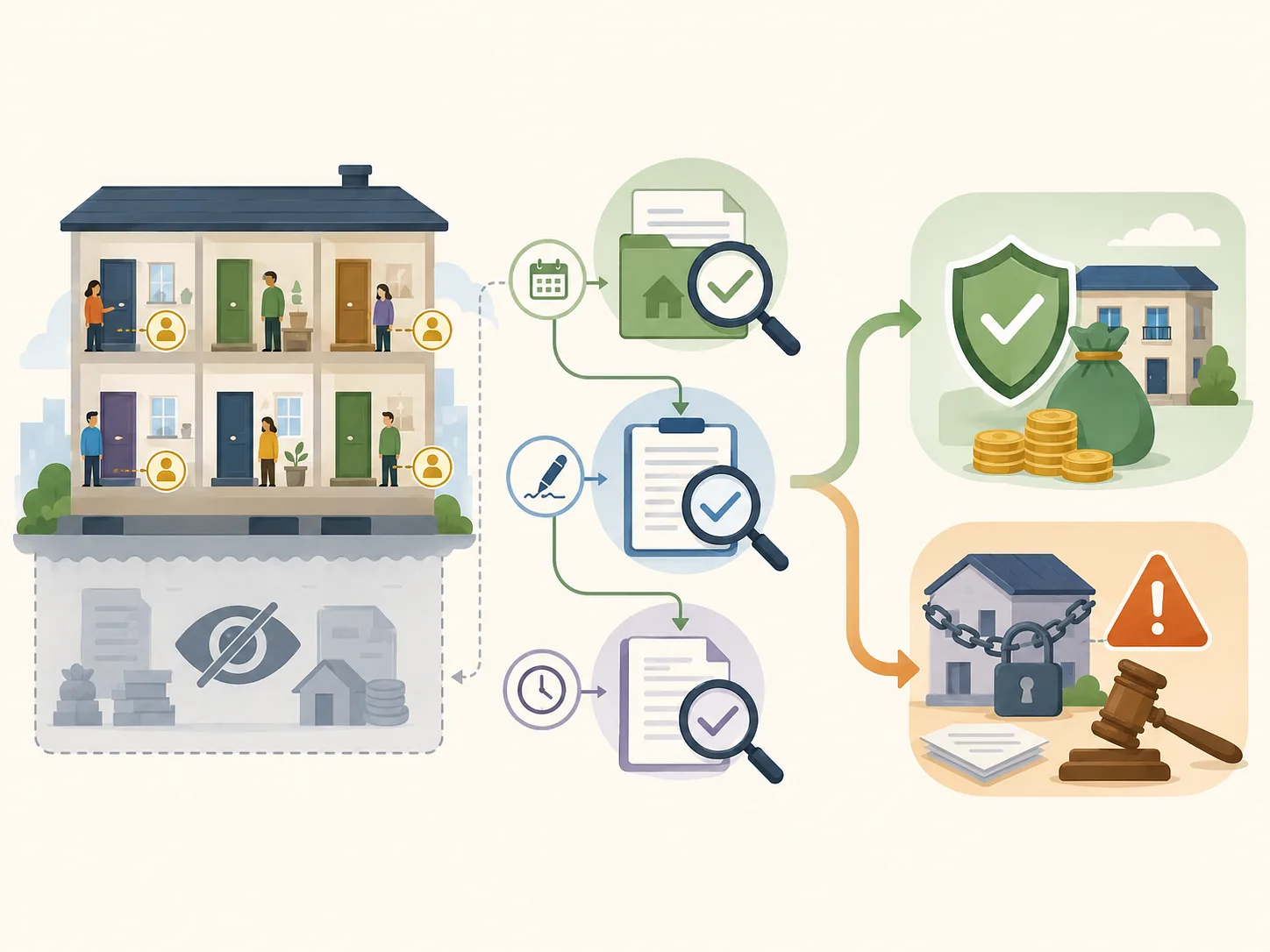
Although a property registry extract is a very important document, it does not reveal all risks. In particular, in cases such as multi-family homes—where multiple households live in a single building but the registry lists it as a single property—the total amount of security deposits held by other tenants may not be fully disclosed in the registry.
In such cases, it is advisable to also review the following documents:
- Certificate of Registered Households: This document confirms whether any households are registered at the address.
- Status of Certified Dates: This is used to verify the certified dates and security deposit status of tenants with higher priority.
- Documents regarding the landlord’s delinquent national and local taxes: Since tax claims can affect the recovery of the security deposit depending on the situation, it is necessary to verify any unpaid taxes.
- Building Register: This supplements physical and administrative information—such as whether the building is in violation of regulations, its designated use, and its area—that is not fully covered by the land registry alone.
- Eligibility for Jeonse Security Deposit Return Guarantee: This serves as an indirect safety check to verify whether the property meets the underwriting criteria of guarantee institutions.
The National Tax Service’s system for accessing information on delinquent national taxes allows for access without the landlord’s consent, provided certain conditions are met, from the time the lease agreement is signed until the lease commencement date. For local taxes, there is a system in place that allows you to view outstanding local tax amounts across all local governments nationwide from the time the contract is signed until the start date of the lease term, provided the security deposit exceeds 10 million won. Since tax information is sensitive, access is typically limited to on-site viewing, and the landlord may be notified that the information was accessed.
When signing a lease for a multi-family residence, you should not assume it is safe simply because “there are no registered mortgages in the registry.” From the landlord’s perspective, the security deposits of previous tenants are effectively debts that must be repaid, so you must verify the total amount of prior security deposits.
Can You Trust What the Real Estate Agent Prepares for You?
While licensed real estate agents often provide a certified copy of the property registry, tenants must read it themselves. You should verify that the agent’s explanation matches the information in the registry, and ask questions about any items you do not understand before signing.
Details exchanged via text or phone—such as “cancellation of a mortgage,” “security deposit adjustment,” “conditions for the final payment date,” or “conditions for contract termination”—can serve as crucial evidence in future disputes. It is safer to document important agreements not just verbally, but through verifiable means such as special provisions in the contract or text messages.
When to Pause the Contract and Request Further Verification
If any of the following items apply, do not sign immediately; instead, request additional documentation.
- The owner listed in the property registry differs from the contracting party.
- There is insufficient documentation verifying the agent’s authority.
- Section A of the property registry shows a seizure, provisional seizure, provisional disposition, or a decision to commence auction.
- The maximum debt amount for the mortgage listed in Section B is large, and the plan for its cancellation is unclear.
- It is a multi-unit residence, but you have not been able to verify the total amount of security deposits held by prior tenants.
- The landlord avoids confirming any unpaid taxes or the possibility of obtaining rental guarantee insurance.
- On the day of signing, the landlord shows you only a photo taken a few days prior, rather than the current property registry.
- The address, building number, unit number, or floor area differs from the actual property.
Summary in One Sentence
“Checking the certified copy of the real estate registry” is a procedure performed before signing a lease for a studio apartment or a jeonse/wolse property to examine the property’s official identification and verify factors that could affect the recovery of your security deposit, such as the owner, address, mortgage, liens, and prior rights. The property registry is the starting point of the contract, and you can more effectively reduce deposit risks by also verifying matters such as prior security deposits for multi-unit properties, tax arrears, change-of-address registration, and the date of registration.
FAQ
Are a certified copy of the real estate registry and a certificate of registered matters the same thing?
The official name of the document commonly referred to as a “registration transcript” in practice is the “Certificate of Registration Details.” It is a document that certifies the description and rights related to real estate as recorded in the real estate registry.
If the real estate agent shows me a copy of the property registry, do I still need to look at it myself?
No. Even if a licensed real estate agent prepares the documents, the tenant must personally verify the address, owner, mortgage, liens, and priority of rights. It is especially important to confirm that the documents are up to date on the day the contract is signed.
If there’s a mortgage on the property, does that mean I absolutely shouldn’t sign the contract?
Just because there is a mortgage on the property doesn’t necessarily mean the contract can’t be signed. However, you must consider the maximum debt amount, the property value, your security deposit, any prior tenant’s security deposit, and the conditions for removing the mortgage; if the risk is too high, it’s safer to cancel the contract.
Is the maximum debt amount the same as the actual outstanding loan balance?
This may not be the case. The maximum debt amount primarily refers to the upper limit secured by the mortgage; the actual remaining loan balance must be verified separately.
Is it sufficient to just check the photo of the property registry I received before signing the contract?
The photos are for reference only. Since ownership details are subject to change, it is advisable to double-check the latest property registry just before signing the contract and just before paying the balance.
Why do we need to be more careful with multi-family homes?
In the case of multi-family housing, even if multiple tenants live in the same building, the status of existing tenants’ security deposits may not be accurately reflected in the property registry. You must separately verify the total amount of priority security deposits and the status of registered households.
What should I do if the owner listed in the property registry and the contract signatory are different?
Do not sign the contract immediately; you must first verify that the agent has proper authority. You should check the power of attorney, the seal registration certificate or the certificate of signature authentication, confirmation of the landlord’s intent, and the name on the bank account where the security deposit will be deposited.
Is a house safe if the back door is unlocked?
If the “Other” column is left blank, it may indicate that there are no rights other than ownership—such as a mortgage—listed in the property registry; however, this alone does not guarantee complete safety. You must also verify whether there are any priority security deposits for multi-family units, any tax arrears, the building registry, and whether rental guarantee insurance is available.
Why are change-of-address registration and the date of confirmation important?
The handover of the property and the registration of your change of address form the basis for third-party enforceability, and the date of confirmation is crucial for acquiring the right to priority repayment. To help protect your security deposit, you should complete the change of address registration and obtain the date of confirmation as soon as possible after signing the contract.
Should I also consider the details agreed upon via text message or phone call?
Text messages, recordings, and phone call transcripts regarding important contract terms can serve as evidence in the event of a dispute. It is safest to clearly specify important details—such as the cancellation of a mortgage, the terms for the final payment, and the conditions for contract termination—in the special provisions section of the contract.
Sources
- Easy-to-Find Information on Everyday Laws: Checking the Property Registry Before Signing a Residential Lease Agreement, etc.
- Easy-to-Find Information on Everyday Laws: Acquiring the Right of Setoff and the Right to Priority Repayment
- Easy-to-Find Information on Everyday Laws: Preventing Jeonse Fraud—Things to Keep in Mind When Signing a Contract
- Korea Housing and Urban Guarantee Corporation (KHUG) Safe Lease Portal: Checking the Certified Copy of the Real Estate Register
- National Tax Service: Guide to Requesting Access to Information on Unpaid Taxes, etc.
- Ministry of the Interior and Safety: Information on the System for Viewing Landlords’ Unpaid Local Taxes
- National Law Information Center: Housing Lease Protection Act
- National Law Information Center: Civil Code
- Supreme Court Online Registry Office
Images