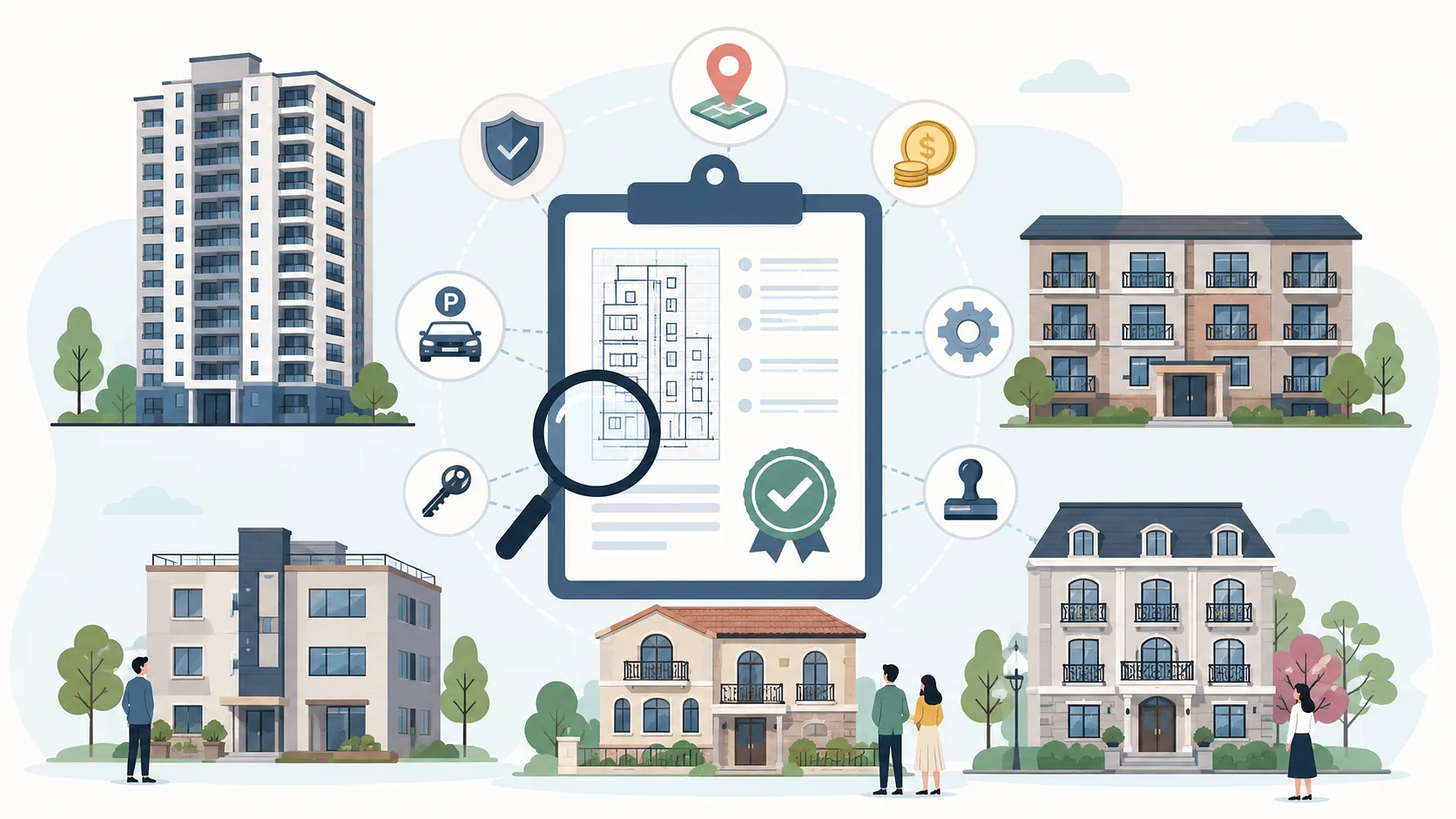
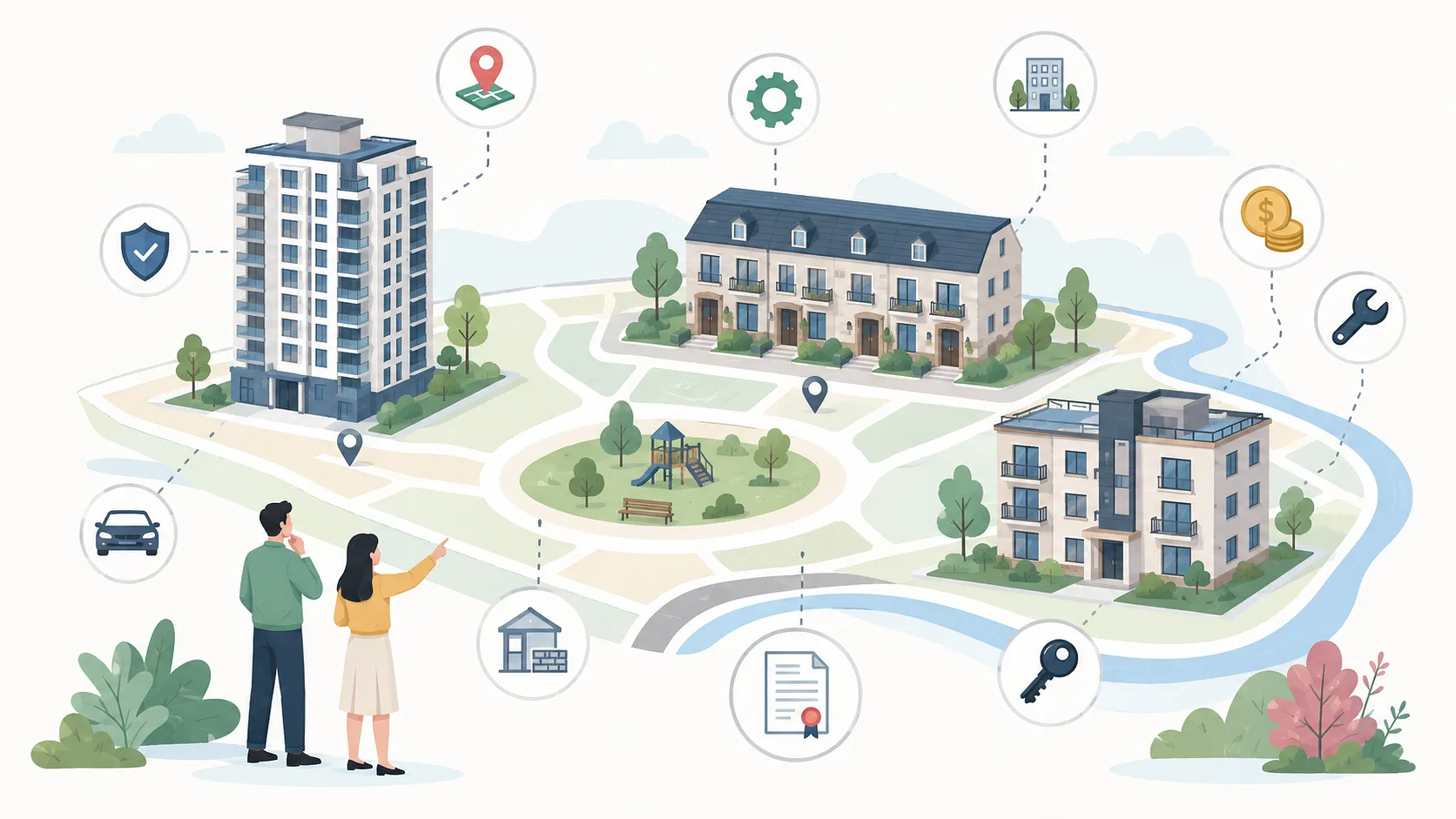
Legal Distinctions and Pros and Cons of Villas, Townhouses, Multi-Family Homes, Condominiums, and Apartments
Under Korean law, apartments, townhouses, and multi-family homes are classified based on the number of residential floors and the floor area of a single building, but “villas” and “mansions” are not legally recognized categories. This article summarizes the general pros and cons of each type, as well as the documents to review and potential risks to consider before entering into a purchase or lease agreement.
- Since villas and mansions are not separate, legally defined housing types, you must check the primary use listed in the building registry.
- An apartment building is a multi-unit residential building with five or more floors used for housing.
- Both row houses and multi-family dwellings are residential buildings with four stories or fewer; if the total residential floor area of a single building exceeds 660 square meters, it is classified as a row house, and if it is less than that, it is classified as a multi-family dwelling.
- The 660-square-meter standard refers to the total residential floor area of an entire building, not the exclusive use area of a single household.
- Price, maintenance, parking, and resale value are influenced more by location, year of completion, land rights, construction quality, and legal ownership than by the property’s legal designation.
The term “row house” in the question is interpreted and explained as “row housing.” In Korea, apartments, row housing, and multi-family housing are types of multi-unit housing under the law, whereas “villa” and “mansion” are common building names or product names. Therefore, the primary use listed in the building registry and the certificate of registered matters take precedence over the names used in advertisements or on building entrances.
Key Comparison Table
| Name | Status Under Korean Law | Basic Classification Criteria | Practical Interpretation |
|---|---|---|---|
| Apartment | Statutory type of multi-unit housing | Five or more floors used for residential purposes | Does not need to be a large complex or high-rise. Even a small building with five residential floors can legally be classified as an apartment. |
| Row House | Statutory type of multi-unit housing | Four or fewer floors used for residential purposes, and the total residential floor area of a single building exceeds 660 m² | A low-rise multi-unit housing complex where the residential floor area of a single building is larger than that of a multi-family house. |
| Multi-family Housing | Statutory type of multi-unit housing | Four or fewer floors used for residential purposes, with a total residential floor area per building of 660 m² or less | This falls under the category of small-scale, low-rise multi-unit housing. |
| Villa | Not a distinct statutory housing type | No specific statutory criteria | Generally a broad term used to refer to low-rise townhouses or multi-family housing. Actual use must be verified through the building registry. |
| Mansion | Not a separate statutory housing type | No specific statutory criteria | Used as a building name or brand name. In reality, it may be an apartment, a townhouse, or a multi-family dwelling. |
Key to Determination: 660 m² refers not to the exclusive area of a single household, but to the total floor area of the entire building used as housing. The number of floors is based on the number of floors used for residential purposes, not the total number of floors visible from the exterior; basement floors and pilotis parking levels that meet legal requirements may be excluded from the calculation. The final classification must be confirmed by checking the primary use listed in the Building Registry.
Starting Point for Legal Classification: Multi-Unit Housing
Under the Housing Act, multi-unit housing refers to a structure where each household can lead an independent residential life while sharing all or part of the walls, hallways, staircases, or facilities. Basic types include apartments, townhouses, and multi-family homes.
This legal classification is not based on the building’s luxury status, brand, exterior appearance, or transaction price. Even if a building’s name includes “villa” or “mansion,” its legal classification varies depending on the number of floors and floor area criteria.
Definitions and Characteristics by Type
Apartment
An apartment is a multi-unit residential building with five or more floors used for housing. The legal definition itself does not include requirements for large complexes, elevators, security offices, playgrounds, or a specific number of units.
Common advantages include the following:
- Many have a well-established communal management system, including a management office, security, cleaning, and parking control.
- There are relatively abundant transaction examples within the same complex and for units of the same size, making it easier to assess prices.
- Large-scale complexes are more likely to be equipped with amenities such as parking lots, community facilities, landscaping, and children’s play areas.
- There is relatively broad demand from both buyers and renters, so many of these areas offer high liquidity.
There are also some common drawbacks.
- Purchase prices and regular maintenance fees may be higher than those for low-rise apartment buildings in the same neighborhood.
- High unit density can lead to noise between floors and through walls, elevator wait times, and congestion within the complex.
- While large-scale common facilities are convenient, they incur ongoing costs for long-term repairs and maintenance.
- Not all apartment complexes are large-scale or well-maintained.
Row Houses
Townhouses are multi-unit residential buildings with four or fewer floors used for residential purposes and a total residential floor area per building exceeding 660 square meters. The key difference from multi-family housing lies not in the number of units but in the size of the residential floor area per building.
Typical advantages include the following:
- For those who prefer low-rise living, there may be less congestion on stairs and elevators and fewer burdens associated with high-rise living.
- Since the number of households is relatively small, the complex often has a quiet atmosphere and simple access routes.
- Depending on the location and design, there is a possibility of securing a spacious exclusive area or a relatively large share of the land rights.
- In some areas, purchase prices are lower than those of large-scale apartment complexes, which may lower the barrier to entry for owner-occupiers.
Common limitations include the following:
- Systematic communal management services—such as a management office, security, package storage, and parking control—may be lacking.
- If there are few transaction records, it can be difficult to determine appropriate sale and jeonse prices.
- Reaching an agreement among owners regarding repairs to common areas—such as rooftops, exterior walls, plumbing, and parking lots—may take longer.
- There are significant variations from building to building in terms of elevators, number of parking spaces, and fire department access.
Multi-Family Housing
Multi-family housing refers to residential complexes with four or fewer floors used for residential purposes and a total residential floor area of 660 square meters or less per building. These are low-rise residential complexes with a smaller statutory scale than townhouses, and it is common for individual units to be registered separately.
Typical advantages include the following:
- In many cases, purchase and rental costs are lower than those of large-scale apartment complexes in the same neighborhood.
- They are often built on small lots near train stations, university campuses, and business districts, offering a variety of location options.
- With fewer households, access is simpler, and there is less congestion compared to large-scale complexes.
- A variety of designs can be found depending on the building, such as different floor plans, terraces, and duplexes.
Common limitations include the following:
- Regardless of whether the building is new or old, there can be significant variations in construction quality, waterproofing, insulation, soundproofing, and ventilation performance.
- Some buildings lack sufficient parking spaces, elevators, a building manager, or security facilities.
- In areas with low transaction volumes, it can be difficult to determine market prices, and the time required to sell may be longer.
- For jeonse (lump-sum lease) contracts, if the market price for sale is unclear or if there are complex prior liens, the risk of recovering the deposit must be assessed more conservatively.
- You must verify whether there are any unauthorized additions, illegal changes of use, or discrepancies between the official property registry and the actual condition of the property.
Villa
“Villa” is not a distinct classification under Korean building codes. In the real estate market, it generally refers broadly to low-rise multi-unit residential buildings, which are often recorded in the official building registry as “row houses” or “multi-family dwellings.” In rare cases, a building may be named a “villa” but have a legal classification as an “apartment” or another category.
Therefore, one should not make assumptions about a property’s structure, legal rights, or value based solely on its name—such as “it’s cheap because it’s a villa,” “it’s a multi-family dwelling because it’s a villa,” or “it’s a townhouse because it’s a luxury villa.”
Mansion
“Mansion” is also not a distinct, legally recognized housing type in Korea. It is often used as a name for older multi-unit residential buildings or as a marketing term at the time of sale; legally, it may fall under one of the categories of “apartment,” “row house,” or “multi-family dwelling.”
The term “mansion” does not guarantee the building’s structure, seismic performance, level of maintenance, luxury, or form of ownership. The legal classification and rights relationships must be verified separately through the Building Register and the Certificate of Registration Details.
Understanding Through Hypothetical Examples
The examples below are hypothetical scenarios intended to illustrate the classification principles.
| Hypothetical Building | Number of Residential Floors | Total Residential Floor Area per Building | Building Name | Basic Legal Classification |
|---|---|---|---|---|
| Gaon Villa | 4 stories | 600㎡ | Villa | Multi-family Housing |
| Nuri Villa | 4 stories | 900㎡ | Villa | Row Housing |
| Hanbit Mansion | 5 stories | 620㎡ | Mansion | Apartment |
| Saebom House | 3 stories | 700㎡ | House | Row house |
Since the actual classification of a building may vary depending on factors such as a pilotis parking level, basement levels, mixed-use spaces, additions, and how multiple buildings are connected, the information in the building registry should take precedence over hypothetical calculations.
The Difference Between Row Houses and Multi-Family Dwellings
Both types are multi-unit residential buildings with four or fewer residential floors, but they are distinguished by the threshold of a total residential floor area of 660㎡ per building.
| Comparison Item | Row House | Multi-Family Dwelling |
|---|---|---|
| Legal Classification | Multi-unit residential building | Multi-unit residential building |
| Number of Residential Floors | 4 floors or fewer | 4 floors or fewer |
| Total Residential Floor Area per Building | Over 660 m² | 660 m² or less |
| Separate Registration by Unit | Generally possible | Generally possible |
| Typical Scale | Relatively large low-rise multi-unit housing | Relatively small low-rise multi-unit housing |
| Documents for Verification | Building Register·Certificate of Registration Details | Building Register·Certificate of Registration Details |
Even when two or more buildings are connected by an underground parking garage, regulations stipulate that each building must be considered separately; therefore, one should not determine whether a property is a row house or a multi-family dwelling based solely on the total gross floor area of the complex.
Multi-family Dwellings and Multi-unit Dwellings Are Different
Although their names are similar, their legal nature and contractual structures differ significantly.
| Comparison Criteria | Multi-family Housing | Multi-unit Housing |
|---|---|---|
| Legal Classification | Multi-unit residential building | Single-family home category |
| Ownership and Registration Structure | Separate registration by unit is common | The entire building is typically registered as a single property |
| Sale by Unit | Generally structured to allow for it | In principle, it is difficult to sell individual units separately |
| Focus of Lease Verification | Registration of the specific unit, land rights, and prior rights | Review of security interests on the entire building and security deposits of other tenants |
Tenants of multi-family homes should not only examine their own unit but also consider the security interests established on the entire building and the size of prior tenants’ security deposits.
Comparison of Advantages: Which Is Better?
It is not possible to determine which is superior based solely on legal classification. The information below reflects general trends; results may vary depending on location, year of construction, construction quality, maintenance condition, land rights, and the number of units.
| Selection Criteria | Tends to Favor Apartments | Tends to Favor Townhouses | Tends to Favor Multi-Family Houses |
|---|---|---|---|
| Management Convenience | Many complexes have systematic management organizations and bylaws | Communication may be simpler due to smaller scale | Management fees may be simpler or lower |
| Security & Amenities | Relatively abundant security, parking management, and community facilities | Varies significantly by building | Varies greatly by building |
| Price Comparability | Easy to compare due to frequent transactions within the same complex | Difficult if transactions are infrequent | May be even more difficult if transactions are infrequent |
| Low-Rise Living & Privacy | Limited, except for low-rise buildings | Advantages of fewer units and low-rise structures | Fewer units and potentially simpler access routes |
| Initial Purchase Costs | Tends to be high in popular areas | Often lower than for apartments | Often lower than for apartments |
| Maintenance | Systematic, but regular costs apply | Owner consensus and repair plans are crucial | Be sure to verify responsibility for common area repairs and cost sharing |
| Liquidity | Many areas have broad demand | Varies depending on location and scarcity | Varies significantly depending on transaction volume and market price transparency |
Selection Guide by Purpose
If management and transaction convenience are your top priorities
If you value management offices, security, parking control, community facilities, and abundant actual transaction data, a well-managed apartment complex is relatively suitable. However, small-scale apartment complexes may not provide the same level of management services as large complexes.
If you prefer low-rise living and fewer units
Townhouses may suit residents who prefer low-rise living, fewer units, spacious floor plans, or the potential for land ownership rights. However, you should verify the repair procedures for common areas and the cost-sharing system among owners.
If budget and location are your top priorities
Multi-family houses are sometimes available at a lower cost than apartments within the same neighborhood. However, you’ll need to examine each building more closely, including market value, potential illegal construction, parking, water leaks, and the security of your security deposit.
If you’re drawn to the names “villa” or “mansion”
The name alone should not be a deciding factor. You must make your decision after verifying the primary use, year of completion, land rights, number of parking spaces, any indications of illegal construction, and actual transaction prices listed in the Building Register.
Checklist Before Signing a Sale, Lease, or Monthly Rent Contract
1. Building Registry
- Confirm the primary use: apartment, townhouse, or multi-family residence.
- Verify that the address, building number, unit number, exclusive area, and common area match the contract and the current status.
- Check for any indications of non-compliant construction, unauthorized additions, or signs of a change in use.
- Verify basic details such as the date of occupancy approval, structure, number of floors, and parking facilities.
2. Certificate of Registration Details
- Verify that the contracting party is the actual owner.
- Check for any encumbrances, such as mortgage liens, seizures, provisional attachments, jeonse rights, or trust registrations.
- If it is a condominium, verify the designation of the unit’s exclusive use area and land rights.
- Review the certificate not only before signing the contract but also immediately before paying the final balance to confirm there have been no changes.
3. Price Data
- Check transaction records for the same building and similar nearby properties on the Ministry of Land, Infrastructure and Transport’s Actual Transaction Price Disclosure System.
- Refer to the officially assessed prices on the Real Estate Official Price Notification Service.
- For townhouses and multi-family dwellings, where transactions are rare, do not rely on just one or two listings; instead, compare multiple cases with similar location, area, floor level, year of completion, parking, and land rights.
- Exercise caution to ensure the jeonse deposit is not excessively close to the sales price.
4. On-Site Inspection and Maintenance Status
- Check the actual number of parking spaces available per unit and whether double parking occurs.
- Inspect the elevator, rooftop waterproofing, cracks in exterior walls, plumbing, leaks, condensation, mold, and the condition of windows, doors, and soundproofing.
- Review maintenance fee items, any outstanding balances, common area electricity and cleaning fees, and recent repair records for common areas.
- Check fire truck access routes, emergency stairwells, entrance security, and the environment for package storage.
5. Lease Security
- Verify the existence of any prior security interests and the amount of any prior security deposits.
- Directly confirm whether the property is eligible for a jeonse guarantee from a guarantee institution and review the latest eligibility criteria.
- For multi-unit residential buildings, accurately enter the building and unit numbers as listed on the official property registry when registering your change of address.
- If there is a trust registration, verify the right to lease and whether the trustee’s consent has been obtained.
Common Misconceptions
- “Villa = multi-family housing” is not always correct. “Villa” is a general term and may refer to townhouses or apartment buildings.
- “Mansion = apartment building” is also not always correct. “Mansion” is merely the name of the building.
- “Apartment building = large high-rise complex” is not a legal definition. Any residential building with five or more floors can be classified as an apartment building, even if it is small in scale.
- Townhouses and multi-family dwellings are not classified by the number of households. The basic distinction is based on a total residential floor area of 660 square meters for a single building.
- 660 m² does not refer to the area of a single unit. It is the total residential floor area of the entire building.
- Official records take precedence over advertising claims. The Building Register and Certificate of Registration are the starting points for legal verification.
Official Verification Channels
- Enforcement Decree of the Building Act, Appendix 1: Types of Buildings by Use
- Article 3 of the Enforcement Decree of the Housing Act: Types and Scope of Multi-Unit Housing
- Easy-to-Find Information on Everyday Laws: Concept and Types of Apartments
- Government 24: Issuance and Viewing of Certified Copies and Extracts of Building Registers
- Ministry of Land, Infrastructure and Transport Actual Transaction Price Disclosure System
- Real Estate Appraised Value Notification Service
- Supreme Court Online Registry Office
Since laws, regulations, and guarantee review criteria are subject to change, you must verify the latest standards in effect at the time of the actual contract.
FAQ
Do "villa" and "multi-family home" mean the same thing?
It’s not always the same. “Villa” is not a legal term but a general term broadly used to refer to low-rise multi-unit residential buildings. Since they may be recorded in the building registry under different designations—such as multi-family housing, townhouses, or, in some cases, apartments—you must verify their primary use.
Is a five-story townhouse legally considered an apartment?
If a residential building has five or more stories, it generally meets the criteria for an apartment building. However, basement levels and pilotis parking levels that meet certain requirements may be excluded from the story count, and factors such as mixed-use status or whether an addition has been built may also affect this determination, so you should check the building registry.
What is the most important difference between townhouses and multi-family homes?
Both are multi-unit residential buildings with four or fewer floors used for residential purposes. If the total residential floor area of a single building exceeds 660 square meters, it is classified as a row house; if it is 660 square meters or less, it is classified as a multi-family dwelling.
Is 660 square meters the exclusive area for a single household?
No. It is not the exclusive floor area of a single unit, but rather the total floor area of the entire building used as a residence. Even when multiple buildings are connected by an underground parking garage, regulations stipulate that each building must be evaluated separately.
Does "mansion" refer to a type of housing that is more upscale than an apartment?
Under Korean law, “mansion” is not a separate type of housing and does not guarantee luxury. It is merely a building or product name; the actual legal classification may be an apartment, townhouse, or multi-family residence.
Do apartment complexes have to be high-rise, large-scale developments?
No. The legal criterion is whether the building has five or more floors used for residential purposes. There may be small-scale apartment complexes with few units and almost no amenities.
What is the difference between a multi-family home and a multi-unit home?
Multi-family housing is a type of apartment complex, and it is common for each unit to be registered separately. Multi-unit housing, on the other hand, falls under the category of single-family homes, and it is typical for the entire building to be registered as a single property; therefore, tenants must verify not only any liens on the entire building but also whether other tenants have security deposits that take priority over theirs.
Do apartments always have higher investment value than townhouses or multi-family homes?
That is not the case. While apartments have an advantage in many areas in terms of liquidity and price transparency, their actual value depends on factors such as location, land ownership share, year of completion, condition, development potential, rental demand, and purchase price. One cannot determine yield or price appreciation based solely on legal classification.
What is the first document you should review before signing a lease for a villa or multi-family home?
Check the Building Registry to verify the primary use and whether the property is in violation of building codes, and review the Certificate of Registration to confirm the owner, mortgage, liens, trust registrations, and land rights. Next, review the actual transaction price, the officially assessed value, eligibility for a jeonse guarantee, and the condition of the property.
Are maintenance fees always lower for low-rise apartment buildings?
This isn’t always the case. While regular maintenance fees may be straightforward, if major repairs are needed—such as for elevators, exterior walls, rooftop waterproofing, or plumbing—the reserve fund may be insufficient, resulting in a large one-time payment. You should review the breakdown of maintenance fees and the procedures for repairing common areas.
Sources
- National Law Information Center - Enforcement Decree of the Building Act, Appendix 1: Types of Buildings by Use
- National Law Information Center - Article 3 of the Enforcement Decree of the Housing Act: Types and Scope of Multi-Unit Housing
- Easy-to-Find Information on Everyday Laws - Concepts and Types of Apartments
- Easy-to-Find Information on Everyday Laws - Checking Housing Market Prices and Information to Prevent Jeonse Fraud
- Government 24 - Issuance and Viewing of Certified Copies and Draft Copies of Building Registers
- Ministry of Land, Infrastructure and Transport’s Actual Transaction Price Disclosure System
- Real Estate Appraised Value Notifier
- Supreme Court Online Registry Office
Images