How to Calculate Electricity Costs for Inverter and Constant-Speed Air Conditioners
This explains how to convert the power consumption shown on the product label into energy use, add it to the usage of existing appliances, and apply Korea’s tiered residential electricity rates. It also covers the operating differences between inverter and constant-speed models and the differences in power consumption among cooling, dehumidifying, and fan modes.
- Air conditioner energy use is estimated by multiplying power consumption (kW) by actual operating time and load factor.
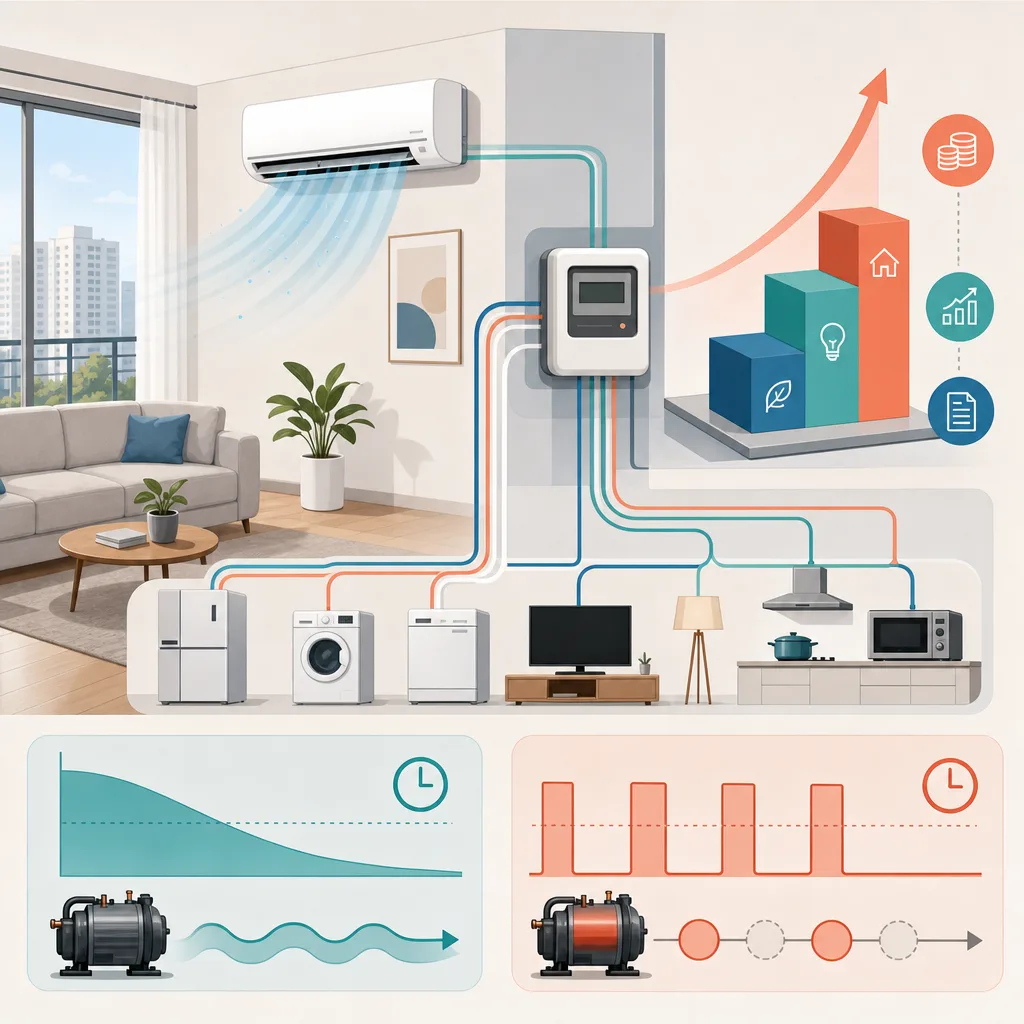
- Because inverter models reduce output after reaching the set temperature, multiplying rated power consumption by the entire operating time may overestimate actual energy use.
- Constant-speed models turn the compressor on and off, so you need to know not only the rated power consumption but also the compressor’s operating ratio.
- The most accurate way to calculate the increase in electricity costs from air conditioning is to calculate the household’s total bill before and after using it and find the difference.
- Because dehumidifying mode also uses the compressor, it cannot be assumed that it always consumes less electricity than cooling mode.
Air conditioner electricity bills cannot be determined solely from the power consumption listed on the product. You must calculate both how intensively and how long the air conditioner actually ran its compressor and which progressive rate tier the household’s total electricity consumption falls into.
The most practical calculation is to subtract the estimated bill without air conditioner use from the estimated bill after air conditioner use. This method also reflects rate differences that arise when air conditioner usage crosses progressive rate tiers.
Product Information to Check First
Look for the following items on the air conditioner’s indoor unit, outdoor unit, energy efficiency label, or manufacturer’s product specifications.
| Item to check | Meaning | Calculation precautions |
|---|---|---|
| Cooling capacity | The amount of heat that can be removed from the indoor space | This indicates cooling performance, not electricity consumption. Even if expressed in W or kW, it must not be confused with power consumption. |
| Rated cooling power consumption | Power required for rated cooling operation under standard test conditions | The product does not always consume this amount during actual operation. |
| Minimum power consumption | An indicator of power consumption when the inverter operates at low output | Whether it is displayed varies by model and test conditions, and it is different from standby power. |
| Maximum power consumption | Power that may be consumed during high-load operation | It may be higher than rated power consumption and is also important when checking electrical system capacity. |
| Monthly electricity consumption | Monthly electricity consumption calculated using specified test conditions and operating hours | This is a standardized value for product comparisons. It does not directly represent actual household operating hours. |
| Energy efficiency grade | A grade based on the efficiency standards for the relevant product category | The monthly electricity bill cannot be determined from the grade alone. |
If the number on the label is 1,800 W, convert it to 1.8 kW for calculations. The conversion formulas are as follows.
- 1,000 W = 1 kW
- Electricity consumption (kWh) = power consumption (kW) × operating time (h)
- If a 1.8 kW product operates at its rated level for 1 hour, it consumes 1.8 kWh
If different numbers are listed on the indoor and outdoor units, do not add them arbitrarily. Check the product manual for cooling power consumption or total system power consumption. The rated input on the outdoor unit’s label may indicate a specific configuration or electrical system standard.
Calculating Inverter-Type Electricity Consumption
An inverter air conditioner adjusts the compressor speed according to the indoor temperature and cooling load. It generally uses high output when initially cooling the room and then reduces its power consumption after approaching the set temperature.
Therefore, rated power consumption × total time the unit is switched on can be used as a calculable upper-bound scenario, but it may overestimate actual consumption. Conversely, multiplying only the minimum power consumption by the total time may underestimate consumption by excluding initial cooling and high-load operation.
Calculating by Dividing Operation into Periods
For an inverter model, it is easier to understand the calculation by separating the initial cooling period from the temperature maintenance period.
Daily electricity consumption = initial cooling power consumption × initial operating time + average maintenance power × maintenance time
For example, suppose a product with a rated power consumption of 1.8 kW is used for 8 hours per day under the following assumptions.
- Average power during the first 2 hours: 1.6 kW
- Average maintenance power during the next 6 hours: 0.45 kW
- Daily consumption:
(1.6 × 2) + (0.45 × 6) = 5.9 kWh - Consumption over 30 days:
5.9 × 30 = 177 kWh
This is a hypothetical example intended to demonstrate the calculation principle. Actual average power varies depending on product capacity, outdoor temperature, room size, insulation, solar exposure, set temperature, and how often doors are opened.
If the manufacturer’s app provides daily electricity consumption data or a household electricity meter shows consumption by time of day, it is best to prioritize those measurements. Wall-mounted and floor-standing air conditioners may draw high currents or be connected to dedicated circuits, so a smart plug with insufficient rated capacity must not be used for measurement.
Calculating Fixed-Speed Electricity Consumption
The compressor in a fixed-speed air conditioner generally runs at a set output, stops when the set temperature is reached, and restarts when the temperature rises again. Therefore, the calculation must reflect the percentage of time the compressor actually operates, or the duty cycle, rather than the entire time the unit is switched on.
Electricity consumption = rated power consumption × operating time × compressor duty cycle
Assuming rated power consumption of 1.8 kW and use for 8 hours per day over 30 days, the results are as follows.
| Compressor duty cycle | Daily consumption | 30-day consumption |
|---|---|---|
| 40% | 5.76 kWh | 172.8 kWh |
| 60% | 8.64 kWh | 259.2 kWh |
| 80% | 11.52 kWh | 345.6 kWh |
| 100% | 14.4 kWh | 432 kWh |
The duty cycle varies significantly depending on the weather and housing conditions. Heat waves, direct sunlight through large windows, insufficient cooling capacity, and frequent ventilation can increase the compressor duty cycle.
When comparing the costs of inverter and fixed-speed models, do not judge them solely by the same rated power consumption. Check whether the products have similar cooling capacities, whether they are being compared under the same room and outdoor conditions, and what their actual average power or duty cycle is.
Adding Existing Appliance Consumption
Residential electricity rates are not calculated separately for the air conditioner; they are applied to the household’s total electricity consumption during the meter-reading period. First, use the consumption from a recent bill for a month when the air conditioner was rarely used as the baseline consumption.
Estimated total consumption = existing appliance consumption + estimated air conditioner consumption
For example, if existing appliances consume 250 kWh per month and the air conditioner consumes 177 kWh, the estimated total consumption is 427 kWh. The additional cost caused by the air conditioner is not calculated simply as 177 kWh × a single rate; instead, it is calculated as follows.
Additional air conditioner charge = total charge at 427 kWh − total charge at 250 kWh
This difference-based method reflects cases in which air conditioner use changes the progressive rate tier or the basic charge tier. However, consumption from the same month last year may also include changes in the use of other appliances, time spent at home, and the number of days in the meter-reading period.
Applying Progressive Residential Electricity Rate Tiers
The following table shows a typical tier structure used to calculate Korea Electric Power Corporation’s low-voltage residential electricity rates. The summer tiers are expanded in July and August. Because rates and additional charges may change, check Korea Electric Power Corporation’s latest rate schedule and your bill at the time of the actual calculation.
| Category | Tier 1 | Tier 2 | Tier 3 |
|---|---|---|---|
| Consumption range in other seasons | 0–200 kWh | 201–400 kWh | More than 400 kWh |
| Consumption range in July–August | 0–300 kWh | 301–450 kWh | More than 450 kWh |
| Basic charge | 910 won | 1,600 won | 7,300 won |
| Electricity usage rate | 120.0 won/kWh | 214.6 won/kWh | 307.3 won/kWh |
The progressive rate system does not multiply all consumption by a single rate from the final tier. Consumption is divided among the applicable tiers, and each tier’s rate is applied separately.
For example, if 430 kWh is consumed in July, the electricity usage charge is calculated using the following structure.
- Tier 1: 300 kWh × 120.0 won
- Tier 2: 130 kWh × 214.6 won
- Basic charge: the basic charge for the tier containing the total consumption
The climate and environmental charge and fuel cost adjustment charge applicable at the time of billing are then reflected. Value-added tax, the Electric Power Industry Basis Fund, and other charges are added based on the result. The general calculation structure is as follows.
- Determine the basic charge.
- Add the electricity usage charges for each tier.
- Add the climate and environmental charge.
- Add or subtract the fuel cost adjustment charge for the relevant period.
- Calculate value-added tax and the Electric Power Industry Basis Fund.
- Apply eligible discounts and settlement items, such as welfare discounts and large-family discounts.
Separate rates may apply in certain seasons to high consumption exceeding 1,000 kWh per month. The actual bill may also vary depending on an apartment’s single-contract or comprehensive-contract arrangement, residential high-voltage or low-voltage service, meter-reading period, and discount eligibility.
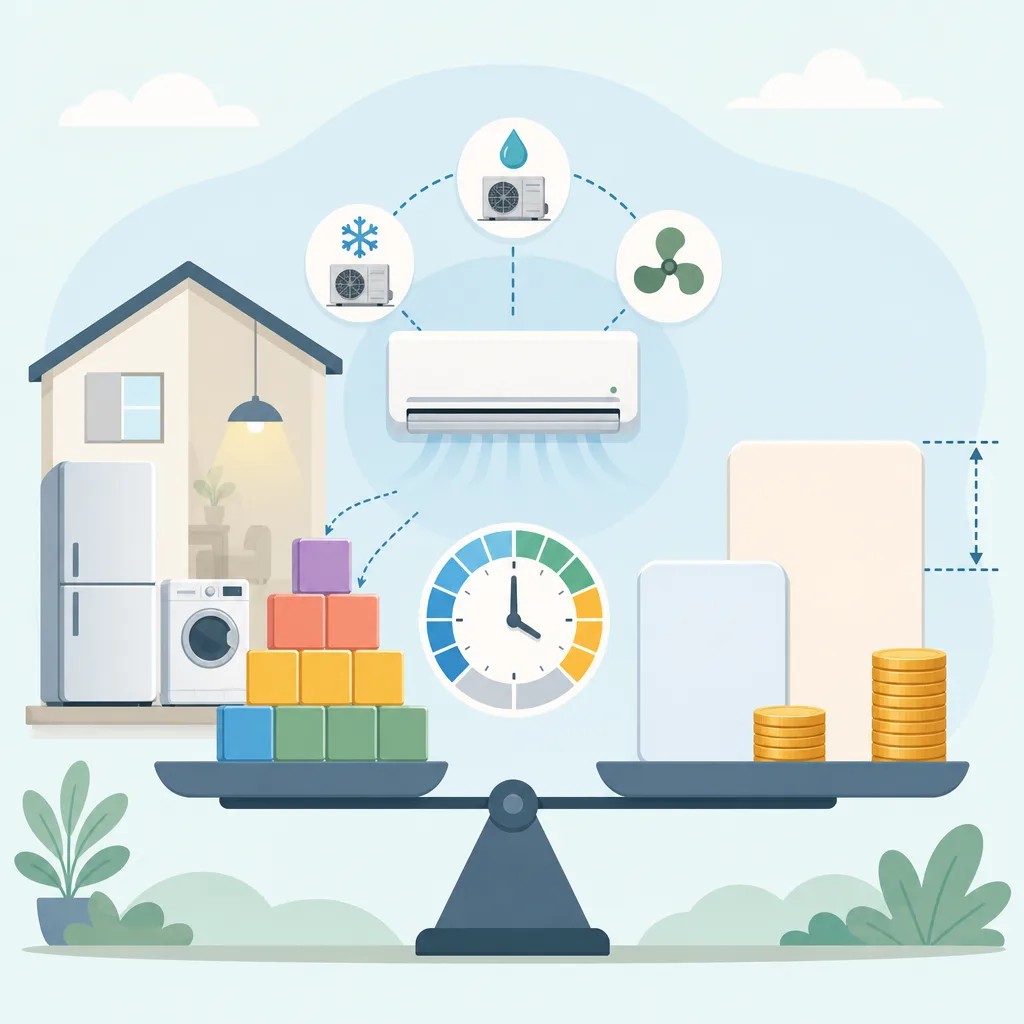
Differences Among Cooling, Dehumidification, and Fan Modes
Exact power consumption cannot be determined from the mode name alone. Control methods vary by manufacturer and model, so the product manual and actual measurement data should take priority.
| Operating mode | Typical operation | Interpreting power consumption |
|---|---|---|
| Cooling | Uses the compressor to remove indoor heat and lower the temperature | Power consumption may increase when the difference between the set temperature and current temperature is large. |
| Dehumidification | Cools the air to condense moisture and reduce humidity | Because it uses the compressor, it is not necessarily a low-power mode. Depending on operating time and control method, it may consume more or less power than cooling. |
| Fan | Circulates air mainly using the indoor fan | The compressor generally does not operate, so it consumes less power than cooling or dehumidification, but it cannot actively lower the indoor temperature. |
| Auto | The product adjusts operation according to temperature, humidity, and other factors | Power consumption varies depending on the specific operation selected. |
Dehumidification commonly works by cooling the evaporator, much like cooling mode, to condense moisture. Therefore, claims that “dehumidification does not use the compressor” or “dehumidification is always cheaper than cooling” are inaccurate.
Fan mode primarily operates the indoor unit’s fan, so its instantaneous power consumption tends to be low, but it is not an alternative mode capable of cooling an already hot room. Some products may additionally operate the fan during internal drying or automatic cleaning.
Creating Estimated Ranges by Set Temperature and Operating Time
For future electricity bills, it is more realistic to present three scenarios—low, typical, and high—rather than a single number.
| Scenario | Inverter-type calculation basis | Fixed-speed calculation basis |
|---|---|---|
| Low consumption | Assume low average power during maintenance operation | Assume a compressor duty cycle of 30–40% |
| Typical consumption | Separate initial cooling from maintenance operation | Assume a compressor duty cycle of 50–70% |
| High consumption | Apply average power close to the rated level for an extended period | Assume a compressor duty cycle of 80–100% |
For each scenario, calculate in the following order.
- Calculate daily air conditioner consumption in kWh.
- Multiply it by the number of meter-reading days or days of use.
- Add the monthly consumption of existing appliances.
- Apply the progressive rate tiers and additional charges to total consumption.
- Calculate the difference between the bill before and after air conditioner use.
It is best to avoid applying the same savings percentage to every product for each 1-degree change in the set temperature. This is because differences in outdoor temperature, humidity, insulation, and product control methods make it impossible to guarantee a uniform savings rate.
Why Calculated Amounts Differ from Actual Bills
Estimated and actual billed amounts may differ because of the following factors.
- Weather conditions and duration of heat waves
- Home size, insulation, floor level, and orientation
- Solar exposure through windows and how often doors are opened
- Condition of the filter and outdoor unit heat exchanger
- Mismatch between air conditioner capacity and the area being cooled
- Changes in the consumption of other appliances, such as refrigerators, dryers, and electric ranges
- Differences between the number of meter-reading days and actual days of use
- Residential low-voltage or high-voltage service and apartment contract arrangements
- Changes to the climate and environmental charge and fuel cost adjustment charge
- Individual discounts, such as welfare discounts and large-family discounts
- Billing rules, such as decimal handling and truncation to whole won
The most accurate method of retrospective verification is to check the household’s total electricity consumption on days when the air conditioner was used and compare it with days of similar temperatures when it was not used or was used for fewer hours. If no dedicated measurement feature is available, check whether Korea Electric Power Corporation provides remote meter-reading data or whether the manufacturer’s app includes an energy consumption feature.
Quick Calculation Checklist
- Did you convert the air conditioner’s cooling power consumption from W to kW?
- Did you avoid confusing cooling capacity with power consumption?
- For an inverter model, did you distinguish between initial cooling and maintenance operation?
- For a fixed-speed model, did you reflect the compressor duty cycle?
- Did you add the consumption of existing appliances other than the air conditioner?
- Did you distinguish between the July–August progressive tiers and those for other seasons?
- Did you divide consumption among the tiers and apply the appropriate rate to each?
- Did you reflect the basic charge, climate and environmental charge, fuel cost adjustment charge, taxes, and funds?
- Did you calculate the air conditioner’s additional cost as the difference between total bills before and after use?
- Did you check Korea Electric Power Corporation’s latest rate schedule and the actual contract category?
FAQ
Can I determine the electricity cost simply by multiplying the air conditioner's power consumption by its operating time?
Multiplying power consumption by time can estimate energy consumption, but it cannot determine the final cost. The usage of existing appliances must be added, and progressive rate tiers, the base charge, the climate and environment charge, the fuel cost adjustment charge, value-added tax, the Electric Power Industry Basis Fund, and other charges must also be taken into account.
Is it always cheaper to leave an inverter air conditioner running continuously?
Not necessarily. An inverter model can maintain operation at low output after reaching the set temperature, so it may be more efficient than repeatedly turning it off and on at short intervals. However, it continues to consume electricity if left on during long absences or when cooling is not needed.
Is rated power consumption the amount of power an air conditioner always uses?
No. Rated power consumption is a reference value under specified test conditions. Inverter models vary their output during operation, and fixed-speed models also have periods when the compressor stops, so actual average power consumption may differ from the rated value.
Does dehumidification mode always result in a lower electricity bill than cooling mode?
It cannot be said that it is always lower. Dehumidification mode also generally uses the compressor, and depending on the product's control method, temperature, humidity, and operating time, it may consume more or less power than cooling mode.
Can I apply the monthly energy consumption figure directly to my electricity bill?
Monthly energy consumption is a product comparison metric based on standard test conditions and specified usage assumptions. Actual consumption will vary if operating time, home insulation, outdoor temperature, or the set temperature differs, so it should be used only as a reference value.
How can I most accurately calculate the additional cost from using an air conditioner?
Calculate the estimated total cost when using only the existing appliances and the estimated total cost after adding the air conditioner's consumption, then find the difference between the two values. This method also accounts for the effect of air conditioner use moving the household into a different progressive rate tier.
Do the progressive electricity rate tiers change in July and August?
For residential electricity in Korea, relaxed consumption tiers generally apply in July and August. However, calculation conditions may vary depending on the type of contract and whether the system has changed, so the latest Korea Electric Power Corporation tariff schedule for the applicable meter-reading period should be checked.
Can I measure an air conditioner's energy consumption with a smart plug?
It should be used only if the measuring device's rated voltage, rated current, and allowable power are sufficient to handle the air conditioner load and the manufacturer permits it for that purpose. Underrated smart plugs or extension cords pose overheating and fire risks, so the manufacturer's app, a dedicated meter, or a whole-home electricity meter may be safer.
Sources
- Korea Electric Power Corporation
- KEPCO ON
- Korea Energy Agency Energy Efficiency Management Program
- Consumer Questions About Air Conditioner Operation and Electricity Bills
- Knowledge iN Questions About Air Conditioner Electricity Bills
- Consumer Questions About Air Conditioner Usage Time and Electricity Bills
Images