Naver Ad Media Mix Design: Strategies for Ecommerce and Lead Generation
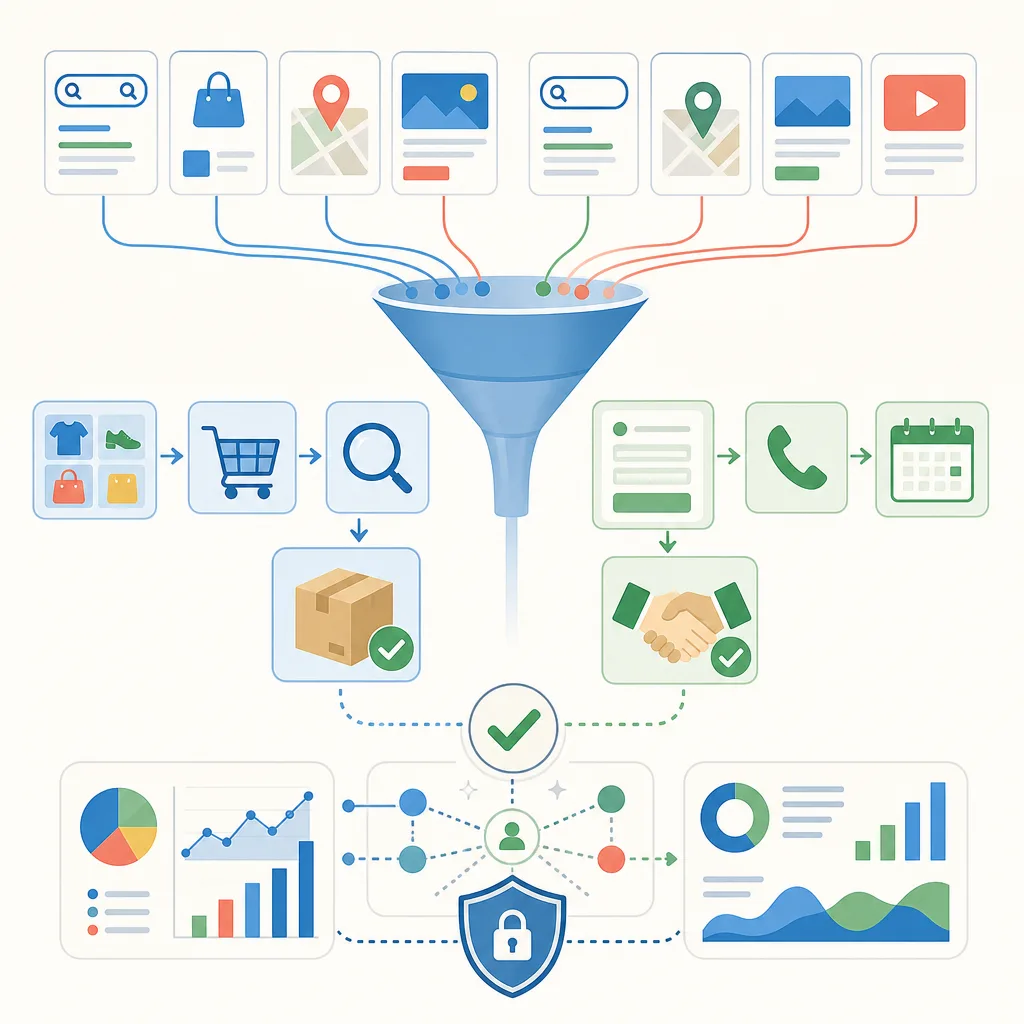
Powerlink, Shopping Search Ads, ADVoost, and Naver Performance Display Ads each play different roles depending on customer intent and the stage of the purchase journey. This guide provides a practical overview of media mixes for ecommerce and consultation/lead-generation sectors, as well as conversion measurement, privacy, and budget scaling principles.
- First, define the ultimate goal—sales, consultations, or visits—and the criteria for a qualified conversion.
- Second, before launching ads, review conversion tracking, product feeds, landing pages, and consultation outcome records.
- Third, prioritize capturing existing demand through Powerlink, Shopping Search Ads, and Place Ads.
- Fourth, use ADVoost and Performance Display Ads to expand new customer discovery and retargeting reach.
- Fifth, verify each channel's incremental performance and customer value, then gradually reallocate the budget to combinations with proven results.
The key to a Naver advertising media mix is not using many ad products, but assigning each product a role based on customer intent, conversion method, and purchase stage. E-commerce should be designed around purchases and repeat purchases, while lead-generation industries should be designed around qualified consultations and final contracts.
Ad product names, available features, placements, and eligibility requirements may change. When creating an actual campaign, also review the latest operating guidelines for Naver Search Ads and performance-based display ads.
Step 1: Define Goals and Conversions First
Before choosing media, define the final action the business wants in a single sentence.
- E-commerce: Completed payment, first purchase, repeat purchase, revenue from a specific product category
- Lead-generation industries: Not merely submitted consultation requests, but qualified inquiries from people who can actually be contacted, appointment attendance, quote submission, contracts
- Local stores: Directions, calls, reservations, coupon use, store visits
- Brand campaigns: Brand search volume, new visitors, reach, and similar metrics
In lead-generation industries, counting only the number of submitted contacts can distort performance. Qualified leads, excluding duplicates, false information, and inquiries outside the service scope, must be recorded separately from actual contracts.
| Industry | Primary conversion | Quality conversion | Final business outcome |
|---|---|---|---|
| E-commerce | Cart additions·payments | Net sales accounting for returns | Repeat purchases·customer lifetime value |
| Consultation·lead generation | Inquiry submission | Contactable inquiry that meets the criteria | Visit·consultation·contract |
| Local store | Call·reservation·directions | Actual reservation or visit | Payment·repeat visit |
Step 2: Prepare the Measurement Foundation and Landing Pages
Automated optimization and retargeting require accurate data to work. Check the following before launching a campaign.
- Are key conversions such as payments, completed inquiries, calls, and reservations recorded without duplication?
- Do product names, prices, inventory, images, and destination URLs match the actual sales pages?
- Do pages load quickly on mobile, and do application forms work properly?
- Do the prices, benefits, and terms in the ad copy match those on the landing page?
- For a lead-generation business, can the ad source be connected to consultation and contract outcomes?
- Is there a lawful basis and notification process for using audience lists or customer information in advertising?
The following metrics can be used to compare performance.
- Conversion rate (CVR) = Number of conversions ÷ Number of ad-driven visits
- Cost per acquisition (CPA) = Ad spend ÷ Number of conversions
- Return on ad spend (ROAS) = Revenue attributed to ads ÷ Ad spend × 100
- Qualified lead rate = Number of qualified inquiries ÷ Total number of inquiries
- Cost per qualified lead = Ad spend ÷ Number of qualified inquiries
- Customer acquisition cost (CAC) = Sales and marketing costs ÷ Number of new customers
Even if ROAS is high, actual profit may be low after accounting for margins, cancellations, returns, and repeat purchases. Conversely, even if the cost per lead is low, a campaign is not good if those leads are unlikely to result in contracts.
Step 3: Distinguish the Role of Each Naver Ad Product
Powerlink
A text-based search ad related to search terms that captures demand at the moment users directly search for a problem or product.
- Suitable purpose: Capturing search demand with clear intent, such as purchasing, requesting a quote, or seeking a consultation
- Strength: Makes it easy to compare intent and performance by search term.
- Caution: Search volume is limited, and popular keywords may be highly competitive. Search traffic does not always guarantee a high conversion rate.
- Operating standard: Evaluate performance separately for brand, general product·service, problem-solving, and competitor·comparison-intent keywords.
Shopping Search Ads
Ads that display information needed for purchase decisions, such as product images, prices, and sellers, within product search areas.
- Suitable purpose: Direct sales of standardized products
- Strength: Users can compare products and prices before clicking.
- Caution: Product feed quality, price competitiveness, reviews, shipping terms, and detail pages have a major impact on performance.
- Cases likely to be unsuitable: Intangible services that require explanation and consultation first, quote-based B2B products
ADVoost
ADVoost is a name used for Naver’s AI-based ad optimization framework or related campaign products. Its core function is automatically optimizing campaign elements based on conversion likelihood, product information, and advertising data.
- Suitable purpose: Purchase optimization and operational automation for many products
- Strength: Can broaden the scope of exploration in environments where it is difficult for people to adjust every product and user individually.
- Caution: AI cannot fix inaccurate conversion signals or poor product feeds and landing pages.
- Practical interpretation: Rather than viewing it as a universal switch to add to existing Shopping Search Ads, verify the campaign types and eligibility requirements available at the time.
Naver Performance-Based Display Ads
Performance-based display ads, also known as GFA, reach customers with image or video creatives across display placements within Naver services.
- Suitable purpose: Finding new prospects, reconnecting with visitors, promoting offers
- Strength: Can deliver visual messages even to prospects who have not searched.
- Caution: Because users may have less immediate intent than with search ads, creatives, targeting, frequency, and landing pages must be managed together.
- Retargeting requirements: Tracking setup and a sufficiently large audience are required, and available audience types and criteria may vary according to platform policies.
Brand Search
A search ad that presents brand imagery, copy, and key links together when a user searches for a specific brand name.
- Suitable purpose: Promoting offers, connecting users to official channels, controlling brand messaging
- Strength: Provides consistent information to customers who already know the brand.
- Caution: Because it primarily captures existing brand demand, conversions generated through Brand Search should not all be interpreted as new demand.
Place Ads
Ads that display Naver Place information to customers searching for a location and business category together or exploring nearby businesses on a map.
- Suitable purpose: Driving calls, reservations, and visits for local businesses such as restaurants, hair salons, hospitals·clinics, academies, and consultation offices
- Strength: Captures demand that combines location and visit intent.
- Caution: Users may leave after clicking an ad if business hours, address, phone number, menu, photos, reservation availability, or user reviews are inadequate.
Power Content
Ads that help users understand a topic and build trust through informational content related to their search topic.
- Suitable purpose: Services requiring extensive explanation, products with long comparison·consideration periods, professional information
- Strength: Can provide problem-solving information first rather than immediately asking users to apply.
- Caution: Content that only repeats promotional claims is unlikely to build trust. Eligible industries, keywords, content, and review standards must also be checked.
| Ad product | Customer state | Primary role | Key checks |
|---|---|---|---|
| Powerlink | Recognizes a need and searches | Capture high-intent demand | Search-term intent, landing-page relevance |
| Shopping Search Ads | Compares products and prices | Product sales | Feed, price, reviews, shipping |
| ADVoost | Purchase likelihood is explored through data | AI-based optimization | Conversion data, product information |
| Performance-Based Display Ads | Has not started exploring or left after visiting | New reach·re-engagement | Creative, targeting, frequency |
| Brand Search | Knows the brand name | Deliver official information·promotions | Distinguish brand demand from new impact |
| Place Ads | Searches for a business in a specific area | Calls·reservations·visits | Completeness of Place information |
| Power Content | Researches and compares information | Education·trust building | Content quality, subsequent conversion path |
Step 4: Build a Media Mix by Industry
E-commerce Media Mix
E-commerce connects the capture of search demand, product sales, re-engagement of non-purchasers, and repeat purchases.
- Capture demand with Powerlink and Shopping Search Ads: Separate searches by product name, category name, use case, and problem-solving intent.
- Check the economics of each product: Account not only for revenue but also for cost of goods, shipping costs, discounts, cancellations, and returns.
- Consider applying ADVoost: Test automated optimization where product and conversion data are collected reliably.
- Re-engage with performance-based display ads: Differentiate messages based on customer stages such as product views, cart additions, and purchase history.
- Organize brand demand with Brand Search: Present official promotions and key products to customers who search for the brand name after seeing external advertising or hearing about it through word of mouth.
| Growth stage | Priority combination | Operating objective |
|---|---|---|
| Early stage | Shopping Search Ads + Powerlink | Validate products and search terms that generate sales |
| Data accumulation stage | Search ads + ADVoost test | Expand the scope of conversion optimization |
| Visitor growth stage | Search ads + performance-based display ads | Re-engage non-purchasers |
| Brand growth stage | Existing mix + Brand Search | Manage the brand search experience and communicate promotions |
Rather than repeatedly showing the same product immediately after purchase, repeat-purchase ads should reflect the consumption cycle, complementary products, and expected repurchase timing.
Service·Lead-Generation Industry Media Mix
For consultation-based services, trust, lead quality, response speed, and contract conversion rate matter more than the number of inquiries.
- Use Powerlink to capture clear problems and consultation demand. Separate ad copy and landing pages based on search intent such as price, location, qualifications, and comparisons.
- Use Power Content to provide information needed for decision-making. Explain procedures, cost structure, selection criteria, common mistakes, and cases.
- Use performance-based display ads to re-engage customers who are still considering. Do not merely repeat the same application message; use stage-specific messages such as reviews, procedures, and items to prepare for a consultation.
- Combine Place Ads when offline consultations are important. Clearly state the service area assigned to each location and whether in-person visits are actually available.
- Connect consultation outcomes to advertising data. Record conversion rates for each stage: inquiry, contact, consultation, visit, and contract.
| Funnel stage | Recommended role | Example message |
|---|---|---|
| Problem awareness | Power Content·performance-based display | Selection criteria and problem-solving information |
| Active search | Powerlink | Service scope, terms, consultation method |
| Comparison and consideration | Power Content·re-engagement ads | Procedures, cost structure, trust-building materials |
| Local visit | Place Ads | Location, hours, reservation·phone information |
| Final conversion | Landing page·consultation operations | Simple application and prompt response |
When Also Operating a Local Store
Even e-commerce or lead-generation businesses should create a separate local funnel if they have a physical store. It is best not to combine nationwide online advertising performance and Place-based call·reservation·visit performance into a single metric.
Step 5: Test and Scale the Budget
If the budget is evenly allocated across all products from the beginning, it is difficult to determine which media generated the results. Scale in the following order.
- Set a baseline campaign: Start with high-intent searches or core product categories.
- Test one major variable at a time: Do not change keywords, creatives, landing pages, and targeting all at once.
- Collect the minimum data needed for a decision: Do not stop after reviewing only one day of performance; consider the industry’s purchase·consultation cycle.
- Compare quality as well: Check net sales and margins for e-commerce, and qualified inquiries and contracts for lead-generation industries.
- Increase spending on combinations that produce repeatable results: After increasing the budget, observe again whether CPA and ROAS remain stable.
- Expand to external media: Based on customer messaging and landing pages validated on Naver, separately measure other media such as Google or Meta.
There is no fixed recommended budget allocation. The appropriate mix varies depending on search volume, average order value, margin, consultation capacity, purchase cycle, and brand awareness.
Incremental Effects That Are Easy to Miss in Performance Measurement
When multiple ads are shown to the same customer, each platform may count a single purchase as its own result. For example, if a customer sees a display ad and later searches for the brand name before purchasing, both the display ad and Brand Search may report that they contributed.
Therefore, do not simply add together the conversions reported by each media channel. Also check the following:
- Total orders·inquiries after removing duplicates in analytics tools
- Changes in total revenue and new customers before and after increasing ad spend
- Separate performance for brand keywords and general keywords
- Ratio of new customers to existing customers
- If possible, comparative tests divided by region·period·audience group
Attributed conversions are conversions recorded as being associated with an ad, while incremental conversions are additional conversions that would not have occurred without that ad. Brand Search and retargeting can easily appear to have strong attributed performance, so their incremental effects must be reviewed separately.
Precautions When Handling Customer Information and Personal Data
Simply possessing email addresses or phone numbers does not mean they can be freely used for ad targeting. Before using audience features based on customer information, review the purpose of personal data collection, the basis for advertising use, user notifications, retention periods, access permissions, and platform policies.
- Clearly define roles and access scope when sharing customer information with an advertising agency.
- Do not send original customer files through personal messaging apps or shared documents.
- Do not retain information longer than necessary.
- Establish a process through which users can withdraw consent or request the suspension of processing.
- In sensitive service sectors, obtain a review from legal and personal data personnel.
This is not an issue of advertising efficiency, but one of customer trust and data governance.
Practical Checklist
- Defined the final objective and criteria for qualified conversions.
- Completed payments·inquiries·reservations are measured without duplication.
- The terms in the ad copy and landing page match.
- Product feeds and Place information are up to date.
- Brand·general·local·problem-solving search terms are separated.
- Performance is reviewed separately for new and existing customers.
- Qualified leads and contract rates are checked rather than merely the number of leads.
- The basis for using customer information and access permissions has been reviewed.
- Conversions reported by multiple media channels are not simply added together.
- CPA, net sales, and contract quality are checked to ensure they remain stable after budget increases.
FAQ
For e-commerce, which should I start with: Powerlink or Shopping Search Ads?
If you have standardized products and competitive pricing, Shopping Search Ads should be considered first. However, it is also advisable to test Powerlink to capture search demand for product uses, ways to solve problems, brands, and categories. You should compare the net sales, margins, and new customer acquisition costs of the two ad types separately.
Does using ADVoost eliminate the need for manual ad management?
No. Even if AI automates some aspects of bidding and placement exploration, advertisers must still manage conversion tracking, product information, budgets, landing pages, and business goals. If the data is inaccurate, automated optimization may also pursue the wrong goals.
What is the biggest difference between Naver performance display ads and search ads?
Search ads capture demand that users have already expressed through the search terms they enter. Performance display ads are used to reach prospective customers before they search or to re-engage visitors. Therefore, the two approaches are not so much competitors as they are responsible for different stages of the funnel.
In DB-based industries, is an ad good as long as its CPA is low?
No. If there are many fraudulent or duplicate inquiries, or inquiries that do not meet the target criteria, business performance may be poor even if the apparent CPA is low. You should also review the cost per valid DB lead, contact success rate, consultation attendance rate, contract rate, and final customer acquisition cost.
If Brand Search has a high conversion rate, should I keep increasing the budget?
Brand Search largely captures demand from customers who already know the brand. Since not all reported conversions may have been newly generated by the ads, you should also compare the overall branded search volume, the percentage of new customers, and sales before and after advertising.
Can I start retargeting ads even if I have few visitors?
If the target audience is too small, ad delivery may be limited or performance may fluctuate significantly. It is more stable to first generate sufficient visitor data through search ads, content, and organic traffic, confirm that tracking is set up properly, and then test a re-engagement campaign.
Can I use customer phone numbers or email addresses directly for GFA targeting?
You should not use them immediately simply because you possess them. You must check the purpose for which the information was collected, the basis for using it in advertising, user notifications, the retention period, the scope of sharing with agencies, and Naver's latest policies. Sensitive industries may require a review by a privacy expert.
If I get results on Naver, can I simply copy the same ads to Google and Meta?
You can use validated customer problems and offers, but creative specifications, targeting methods, and user behavior differ by platform. Use the same landing page as a baseline, but measure each campaign separately and check for duplicate conversions reported by the different platforms.
What percentage of the advertising budget should be allocated to each media channel?
There is no fixed ratio that applies to every business. Initially, start with areas where performance is easy to interpret, such as high-intent searches and core products, and gradually increase spending on campaigns with confirmed valid conversions. Search volume, margins, consultation handling capacity, and the purchase cycle should serve as allocation criteria.
Sources
Images