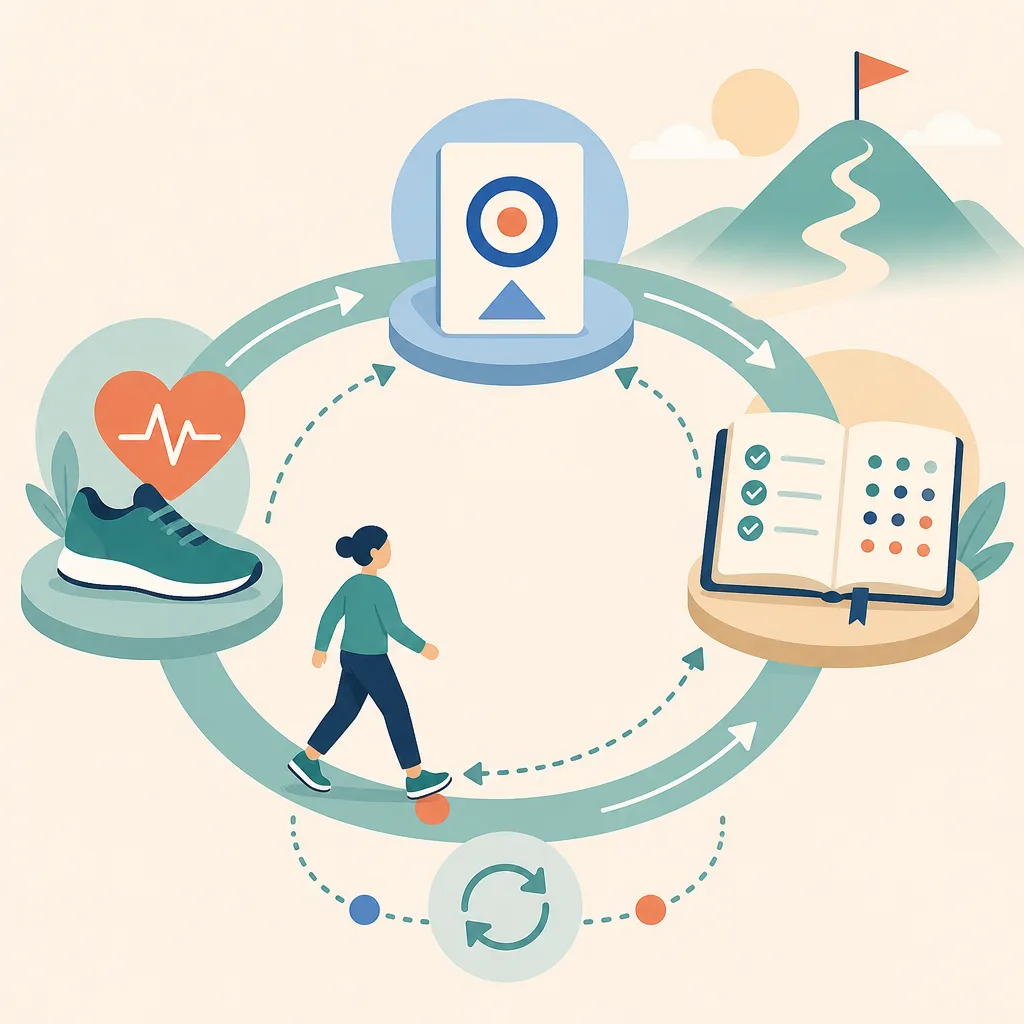
Is Success a Matter of Belief? How to Turn Self-Confidence into Action
Self-confidence alone does not guarantee success, but self-efficacy—the belief in one's ability to act—can influence willingness to take on challenges and persist. This article outlines how to turn belief into repeatable action through exercise, a one-sentence goal, and evidence-based records.
- Self-efficacy is not a vague conviction that you will succeed, but the belief that you can perform a specific task.
- Confidence does not guarantee success, so it must be continually adjusted based on the results of your actions and external feedback.
- Regular physical activity supports health and emotional regulation, but no specific amount of exercise is a universal health standard for everyone.
- A one-sentence goal narrows the focus of execution by clarifying the customer, the value offered, and current priorities.
- Keeping records distinguishes small gains from real problems and helps make the next action more specific.
Success depends on many conditions, including capability, resources, market conditions, luck, and timing. Therefore, believing in yourself does not necessarily guarantee success. However, if you have no belief at all in your ability to act, it becomes difficult to take on challenges or try again after failure.
What is needed here is not self-suggestion that ignores reality, but a verifiable belief that you can act and learn. In psychology, a closely related concept is called self-efficacy.
How Self-Confidence and Self-Efficacy Differ
Self-efficacy is an individual’s belief that they can plan and carry out the actions required in a particular situation. This differs from predicting an outcome by saying, “I will succeed no matter what.”
| Category | Key question | Desirable example | Example to avoid |
|---|---|---|---|
| Self-efficacy | Can I perform the necessary actions? | “I can assess customer responses and improve the proposal.” | “I have never done it before, so I cannot do it.” |
| Outcome expectations | What result will follow from taking action? | “I will reassess the possibilities based on the experiment’s results.” | “If I work hard, results are guaranteed to follow.” |
| Unfounded overconfidence | Does it ignore the possibility of failure? | Not applicable | “Because I believe in myself, there is no need for market validation.” |
Self-efficacy can vary by task and situation. Someone may feel confident about giving presentations but not about hiring or financial management. Therefore, rather than denying a person’s overall ability because they lack confidence, it is more accurate to identify the specific tasks in which they lack skills and experience.
How Belief Affects Action
Self-efficacy is related to goal selection, the amount of effort invested, and how long someone persists through difficulties. If you conclude that “there is no point in trying,” you are more likely to avoid starting. But if you believe that “I can learn the method and improve my next attempt,” you are more likely to take action.
However, actual action must exist between belief and performance. A useful process is as follows.
- Decide on the next feasible action.
- Observe the outcome of that action.
- Break down the causes of success and failure into specific factors.
- Modify the strategy or skills.
- Test the revised action again.
In this process, confidence is a hypothesis that helps you begin, while outcome data provides the evidence needed to adjust your direction.
Method 1: Use Exercise to Become Ready to Act
Physical activity can benefit not only cardiovascular and musculoskeletal health but also sleep and mental health. The experience of completing exercise at the scheduled time also provides direct evidence that “I carried out the action I decided on.” However, this should not be interpreted to mean that exercise automatically builds strong mental resilience or guarantees business performance.
The World Health Organization generally recommends that adults engage in 150–300 minutes of moderate-intensity aerobic activity or 75–150 minutes of vigorous-intensity aerobic activity per week, along with muscle-strengthening activities on at least 2 days per week. These are weekly recommendations and should be adjusted according to the individual’s health and exercise experience.
A Low-Burden Way to Start
- Begin at a repeatable intensity, such as walking for 10–20 minutes.
- Use a pace at which you can hold a conversation as a simple way to estimate moderate-intensity activity.
- Record only one of the following: time, distance, or number of repetitions.
- Stop if unusual symptoms such as pain, dizziness, or difficulty breathing occur, and consult a medical professional if necessary.
- If there are factors to consider, such as a chronic illness, injury, or pregnancy, discuss the type and intensity of exercise with a professional.
Numbers such as 30 push-ups or 10 pull-ups can be personal goals, but they are not health assessment standards that apply to everyone. Rather than comparing yourself with other people’s records, compare your progress with your own safe starting point and the amount of change you achieve.
Method 2: Define Your Current Goal in One Sentence
A one-sentence goal is a standard for deciding where to spend limited time and attention. To be useful in actual decision-making, it should include the target audience and the value provided rather than being a simple slogan.
You can use the following format.
I provide [core value or method] to help [target audience] solve [problem].
For example, you might write, “I help small-store operators reduce repetitive administrative work so they can regain time to spend with customers.”
A good one-sentence goal should answer the following questions.
- Who is the goal for?
- What problem does it solve?
- What specific change will the other party gain?
- What action will you take this week to validate it?
Goal-setting research suggests that specific and challenging goals may be more effective at improving performance than the vague instruction to “do your best.” However, if a goal is too rigid, it can cause you to overlook important risks or new information. A one-sentence goal is not a permanent identity but a priority for the current stage, so it should be revised when customer responses or circumstances change.
Method 3: Use Records to Separate Emotions from Facts
People may repeatedly recall major failures or threatening events while easily overlooking ordinary progress. Keeping records allows you to distinguish between what actually happened, your interpretation of it, and the next action instead of relying solely on memory.
Four Items for a Daily Record
- Completed actions: Write down what you actually did today.
- Evidence of progress: Record verifiable changes, such as customer responses, quantities completed, or skills learned.
- Problems and interpretations: Separate facts from the conclusions in your mind.
- Next action: Choose one step you can take within 24 hours.
Here is an example.
| Item | Example entry |
|---|---|
| Fact | 2 of 5 scheduled customer consultations were canceled. |
| Automatic interpretation | No one wants this service. |
| Contrary evidence | 3 consultations took place, and 1 person requested a quote. |
| Alternative explanation | There may be an issue with the timing of schedule notifications or the booking method. |
| Next action | Ask the customers who canceled for one reason and test the timing of booking reminders. |
The purpose of keeping records is not to put a positive spin on everything. It is to turn negative thoughts into testable hypotheses rather than assuming they are facts. Small achievements also become useful learning material when you record “what you did and what changed” instead of offering yourself vague praise.
A 20-Minute Action Routine
To repeat this briefly each day, you can structure it as follows.
- 10 minutes: Walk, jog lightly, or engage in physical activity appropriate for your current condition.
- 2 minutes: Read your one-sentence goal and check whether it aligns with today’s priorities.
- 5 minutes: Write down completed actions and small signs of progress.
- 3 minutes: Break down the biggest problem into facts, interpretation, and the next action.
Repetition and feedback matter more than the amount of time. If you demand perfect fitness, a clear goal, and a lengthy journal from the start, the routine itself may be abandoned.
Safeguards to Prevent Self-Confidence from Becoming Overconfidence
Strong conviction can help you tolerate uncertainty, but ignoring contrary evidence can increase losses. The following safeguards are especially necessary in business and investing.
- Define in advance the conditions under which you will stop or pivot, along with your goal.
- Review externally verifiable metrics such as revenue, retention rate, costs, and customer responses.
- Ask people whose interests differ from yours for opposing views.
- Do not explain failure solely as a lack of willpower; examine strategy, skills, resources, and circumstances as well.
- Evaluate controllable actions rather than uncontrollable outcomes.
Useful self-talk is closer to “I can learn from the results and adjust my next action” than “I will definitely win.” The former is a prediction, while the latter is a statement about an ability that can actually be tested and strengthened.
Conclusion
Success cannot be explained entirely as the result of belief. However, believing that you can learn and act can be an important psychological resource that enables you to begin and persist.
Exercise supports the physical foundation needed to act, a one-sentence goal focuses attention, and record-keeping makes progress and problems more objective. When these three practices are repeated alongside outcome data, self-confidence becomes not a vague mantra but a system for action that is updated through experience and evidence.
FAQ
Does believing in yourself actually increase your chances of success?
Self-efficacy can influence the challenges you choose, the effort you make, and your persistence, but it does not guarantee success. Skills, strategies, resources, environment, and luck also affect outcomes, so beliefs should be tested through action and feedback.
How can you distinguish self-confidence from unfounded overconfidence?
Self-confidence is the belief that you can take the necessary actions and adjust based on the results. Overconfidence is an attitude that ignores the possibility of failure or contrary evidence and assumes that the desired outcome is certain.
Does repeating positive statements build self-efficacy?
It is difficult to say that repetition alone creates stable self-efficacy. It also requires firsthand experience of completing small tasks, observing the success of similar people, receiving specific feedback, and managing your physical and emotional state.
How much should I exercise each day to build confidence?
At first, you can start with safe, sustainable activities such as walking for 10–20 minutes. The World Health Organization's general recommendation for adults is 150–300 minutes of moderate-intensity aerobic activity per week, or an equivalent amount of vigorous-intensity activity, along with strength training on at least 2 days per week, but this should be adjusted to suit your individual health condition.
How often should I change my one-sentence goal?
There is no fixed schedule for changing it. Revise it when the customer, the problem you are trying to solve, or the value you provide has changed, or when actual responses do not support your existing assumptions. Rather than changing it too often, it is better to first define the actions you will test over a set period and the criteria you will use to evaluate them.
Should I write only positive things in my journal?
There is no need to do so. Record both small progress and problems, but for problems, it is useful to break them down into facts, automatic interpretations, contrary evidence, possible alternative explanations, and the next action. The goal is not to put an optimistic spin on things, but to put your thoughts into a form that can be examined.
What should I do if anxiety and self-blame continue even after keeping a record?
Keeping a record is a self-management tool, not a substitute for professional treatment. If anxiety or depression persists for a long time or interferes with daily functioning, or if you have thoughts of self-harm or suicide, you should immediately seek help from a local mental health professional or emergency support service.
Sources
Images