2026 Small Business Policy Funds: Fourth Revision Eligibility and Online Application Process
This explains eligibility under the fourth revision to the 2026 Small Business Policy Funds, issued on July 30, 2026, and the conditions for dedicated funds for small businesses affected by Homeplus. It outlines each step, from checking the application status for each fund to applying for direct or agency loans and completing subsequent reviews.
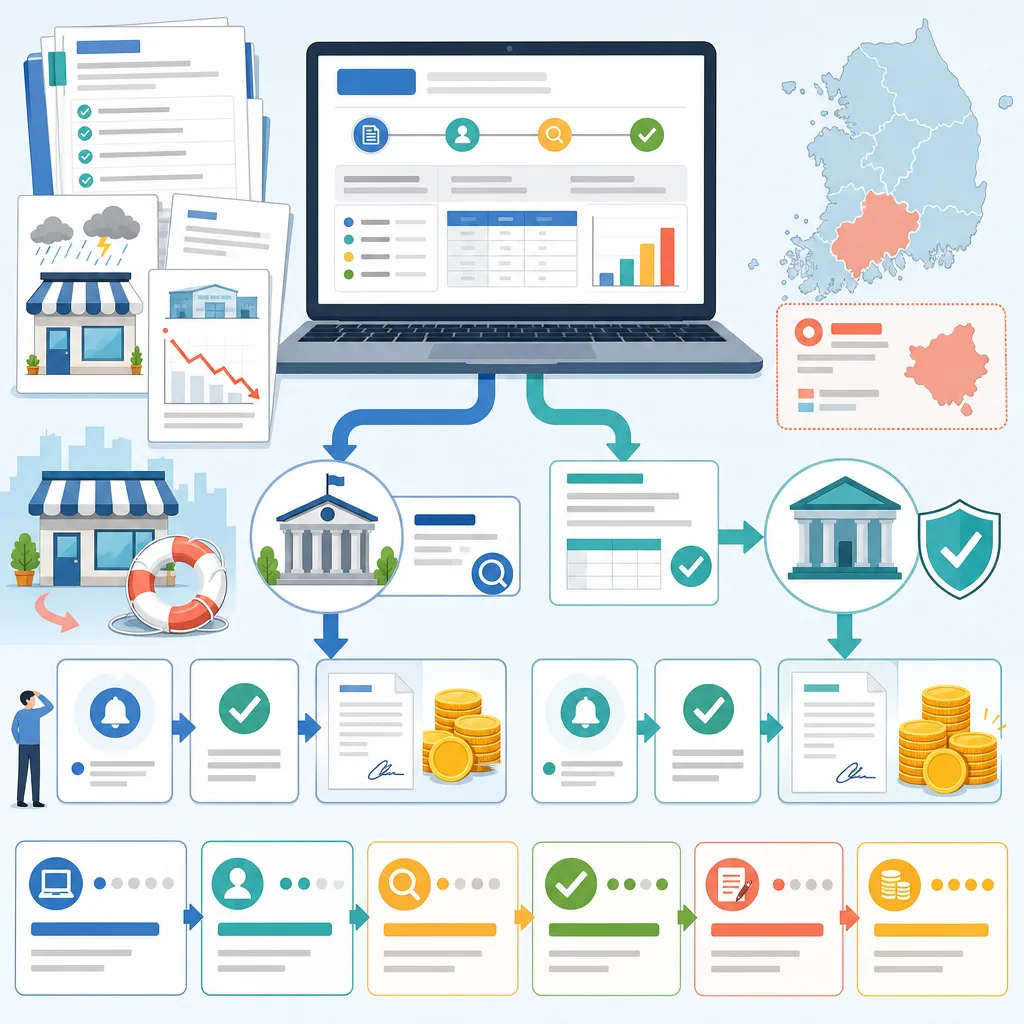
- First, check the Small Business Policy Funds website to see whether applications are open for your desired fund and whether it is offered as a direct loan or an agency loan.
- Prepare business information, sales and regular employee records, lease documents, and evidence of damage, location, or declining sales required for the relevant fund.
- Select the fund online, consent to the provision of information, complete the application, and submit the required documents.
- Direct loans are reviewed by the Small Enterprise and Market Service, while agency loans undergo separate reviews by financial institutions and guarantee institutions after eligibility is confirmed.
- Check any requests for supplementary documents and the review results, and sign an electronic agreement or an agreement with the financial institution only if approved.
The 2026 Small Business Policy Funds application period may close early once the budget for each fund is exhausted. Applicants should first check the application status, eligibility requirements, and loan method on the Small Business Policy Funds website before beginning the online application.
The fourth amendment announced on July 30, 2026 added small businesses located in preemptive employment crisis response areas to the exceptions from the sales-decline verification requirement for Temporary Management Difficulty Funds. Before that, the third amendment on July 10 established an Emergency Management Stabilization Fund exclusively for small businesses affected by Homeplus.
What to Check Before Applying
Who Can Apply
In principle, applicants must qualify as small businesses under the Framework Act on Small Enterprises and meet the requirements of the specific fund for which they are applying. Qualifying as a small business alone does not make an applicant eligible for every fund.
Before applying, check the following conditions.
- Whether the business is operating normally in Korea
- Whether it meets the small business criteria, including the number of regular employees by industry
- Whether it meets the operating-history, sales-decline, damage, regional, or growth requirements of the fund
- Whether it falls under an industry excluded from policy fund support or any grounds for loan restrictions
- Whether policy funds for the same purpose may be used concurrently
- Whether the relevant fund is currently marked as
Open for Applicationson the Policy Funds website
Application Period and Official Channel
Applications for policy funds are accepted according to the announced schedule for each specific fund, and may close earlier than scheduled once the budget is exhausted. The fact that the annual loan plan has been amended does not mean that applications for all funds open simultaneously.
The official application channel is the Small Business Policy Funds website of the Small Enterprise and Market Service. Applicants should check whether the direct loan or intermediary loan application menu is active on the portal.
Materials to Prepare
The actual submission requirements vary depending on the fund and review method, but checking the following materials in advance can reduce interruptions during the application process.
- Business registration information and a means of verifying the representative’s identity
- Materials verifying recent sales or a decline in sales
- Materials verifying the number of regular employees and small business status
- Materials verifying the business location, such as a business premises lease agreement
- National and local tax payment status and financial information
- For corporations, corporate documents and information on the actual manager
- Materials proving eligibility for special funds, such as a disaster, transaction-related damage, or regional designation
- A means of identity authentication or electronic signature for the online agreement
Separate submission may be waived for information retrieved through the shared use of administrative information. However, if retrieval fails or the information does not match, applicants may be asked to submit supplementary documents.
Eligibility Changes in the Fourth Amendment
The key change in the fourth amendment was the addition of an exception to the general rule requiring Temporary Management Difficulty Fund applicants to prove a decline in sales.
Small Businesses Located in Preemptive Employment Crisis Response Areas
Under the amendment dated July 30, 2026, small businesses located in preemptive employment crisis response areas were added to the exceptions from sales-decline verification. This measure reduces the burden on individual businesses to prove a decline in sales, taking into account the economic and employment conditions in those areas.
This exception should be interpreted as follows.
- It is an exception to the sales-decline verification process, not automatic loan approval.
- Applicants must still meet the small business criteria and the remaining requirements of the Temporary Management Difficulty Fund.
- The business location must be within a designated area recognized by the announcement.
- Other grounds for loan restrictions, such as business suspension or closure, restricted industries, or unpaid taxes, may be reviewed separately.
- The areas actually covered and the applicable reference date must be checked in the announcement and portal guidance in effect at the time of application.
Businesses in the relevant areas should therefore first check whether the location-based exception applies rather than abandoning their applications simply because they do not have sales-decline documentation.
Emergency Fund for Small Businesses Affected by Homeplus
The third amendment dated July 10, 2026 established an Emergency Management Stabilization Fund for small businesses affected in connection with Homeplus.
The main conditions in the announcement are as follows.
| Item | Details |
|---|---|
| Eligibility | Small businesses that have suffered damage related to Homeplus and meet the damage verification criteria specified in the announcement |
| Use | Funds required for management stabilization |
| Preferential treatment | A 0.5 percentage point reduction from the interest rate applicable to the fund |
| Limit | Up to KRW 100 million per business |
| Application conditions | Applicants must meet the small business requirements, verify the damage, not be excluded from support, and pass a separate review |
The maximum of KRW 100 million is not a guaranteed amount available to everyone. The actual loan amount may vary depending on the damage verification results, the amount of existing policy funds used, repayment capacity, review results, and specific limits.
The 0.5 percentage point preferential rate also does not mean that the interest rate is fixed at 0.5%. Because it is applied by reducing the applicable policy fund interest rate by 0.5 percentage points, applicants must check the applicable interest rate and whether the reduction has been applied at the time of application.
Do not make assumptions about the scope of recognized damage or the required supporting documents; follow the criteria in the relevant amendment announcement. Support is not guaranteed solely because a transaction or tenant relationship exists.
Eligibility Differences by Fund Type
The 2026 loan plan is divided by purpose into General Management Stabilization Funds, Special Management Stabilization Funds, Growth Foundation Funds, and other categories. Specific programs and conditions may be adjusted through amendment announcements.
| Category | Main purpose | Key eligibility considerations |
|---|---|---|
| General Management Stabilization Funds | Routine business operations and management stabilization | Basic small business requirements, operating-history and usage conditions of the specific fund, and grounds for restrictions |
| Special Management Stabilization Funds | Response to special circumstances such as disasters, economic shocks, and vulnerable conditions | Documentation required for each fund, such as disasters, temporary management difficulties, and credit, employment, or social criteria |
| Growth Foundation Funds | Support for manufacturing foundations, innovation, growth potential, or investment-linked projects | Small manufacturer status, innovation and growth potential, business plan, and specific program requirements |
Unlike general operating funds, the Temporary Management Difficulty Fund and the fund for small businesses affected by Homeplus focus on specific management difficulties or verified damage. In contrast, Growth Foundation Funds may place greater importance on manufacturing capabilities, innovation activities, or growth plans than on short-term damage.
Excluded Industries and Loan Restrictions
Policy funds are not general-purpose credit loans available to every industry. Entertainment and amusement businesses, finance and insurance, real estate, and certain professional services may be among the industries excluded from support. However, because industry-specific exceptions may apply, applicants should not make a determination based solely on the industry name listed on the business registration certificate. They should check both the excluded-industry table in the announcement and the business activities actually conducted.
Even if the industry is permitted, the following circumstances may restrict the review or disbursement of a loan.
- Business suspension or closure
- Unpaid taxes or policy fund-related restrictions
- A history of false applications or improper receipt of funds
- A mismatch between the applicant company and actual management information
- Restrictions on duplicate support for funds serving the same purpose
- Failure to meet the review criteria of a financial institution or guarantee institution
The latest announcement posted at the time of application takes precedence regarding the specific scope of restrictions and exceptions.
Differences Between Direct Loans and Intermediary Loans
Both processes begin online, but the reviewing institution and the entity disbursing the loan differ.
| Comparison item | Direct loan | Intermediary loan |
|---|---|---|
| Lender | Small Enterprise and Market Service | Participating financial institution |
| Online stage | Submit the direct loan application and documents | Apply for confirmation of eligibility for an intermediary loan |
| Core review | The Service reviews policy requirements, business viability, repayment capacity, and other factors | After confirmation by the Service, the financial institution reviews credit and collateral, and a guarantee institution conducts a separate review if necessary |
| Confirmation certificate | Separate from the standard confirmation certificate process for intermediary loans | Proceed to the financial institution stage after confirming eligibility for policy fund support |
| Agreement and disbursement | Enter into an agreement with the Service after approval, followed by disbursement | Enter into an agreement with the relevant financial institution after its final approval, followed by disbursement |
A policy fund eligibility confirmation certificate for an intermediary loan is not a loan approval letter. Even after receiving a confirmation certificate, the loan may be denied or the amount may be adjusted following the financial institution’s credit or collateral review or the guarantee institution’s review.
A direct loan is also not approved merely because the online application has been completed. The Service may conduct a document review, on-site inspection, or separate assessment. Failure to respond to requests for supplementary materials may delay the review or result in the application being closed.
Online Application Process
1. Check the application status and loan method
Visit the Small Business Policy Funds website and confirm whether applications are open for the desired fund. In the announcement, also check whether it is a direct loan or intermediary loan, as well as the eligibility requirements, limit, preferential interest rate, and application closing conditions.
2. Review account and business information
Confirm that the representative and business information matches the business registration records. If special circumstances apply, such as joint representatives, a corporation, or relocation of the business premises, first review the submission requirements and application authority.
3. Complete the application and submit materials
Select the desired fund and application amount, then enter the intended use of the funds, current business status, sales, and employment information. After consenting to the provision of information and the use of administrative information, submit the supporting materials required by the system.
4. Confirm application completion and requests for supplementary materials
Uploading files alone may not mean that the application has been completed. Check the application number and processing status in the application history, and respond to requests for supplementary materials sent by text message, notification, or through the portal.
5. Complete the follow-up review according to the loan method
Direct loans follow the Service’s review and agreement procedures. For an intermediary loan, apply to a participating financial institution after eligibility has been confirmed. If a guarantee is required, an additional review may be conducted by a guarantee institution such as a regional credit guarantee foundation.
How to Avoid Confusing a Confirmation Certificate with Loan Approval
The most common misunderstanding in policy fund applications is treating Application Complete, Eligibility Confirmed, and Loan Approved as the same status. These are legally and operationally distinct stages.
- Application Complete: The application information has been submitted through the system
- Eligibility Confirmed: The applicant has been confirmed as meeting the basic eligibility requirements for policy funds
- Loan Approved: The Service or financial institution has determined the actual loan eligibility and amount
- Agreement Complete: The applicant has accepted the approval conditions and entered into an agreement
- Loan Disbursed: The funds have been paid after the agreement
Intermediary loan applicants in particular must check the validity period of the confirmation certificate and whether the financial institution is accepting applications. Delaying a visit to the financial institution after receiving the confirmation certificate may make disbursement difficult because the budget has been exhausted, the certificate has expired, or the bank’s review schedule causes delays.
Final Checklist to Reduce Application Failures
- Have you confirmed on the portal that applications are actually open for the fund?
- Are the business location and industry covered by the announcement?
- Have you distinguished between direct loans and intermediary loans?
- Do you understand that the sales-decline exception does not waive all other requirements?
- Do the materials proving Homeplus-related damage meet the announcement’s criteria?
- Have you avoided mistaking the maximum limit for a guaranteed application amount?
- Can you check the contact information and portal notifications used for requests for supplementary materials?
- For an intermediary loan, have you checked which financial institution to visit after the confirmation certificate is issued and the applicable guarantee procedures?
Policy fund conditions may vary according to amendment announcements and application guidance for each fund. The latest announcement and application status posted on the Small Business Policy Funds website on the day of application should take precedence over summaries from blogs or agencies.
FAQ
What is the key point of the fourth amendment to the 2026 Small Business Policy Funds?
Through the fourth amendment on July 30, 2026, small businesses located in Employment Crisis Preemptive Response Areas were added to the list of those exempt from verifying a decline in sales for the Temporary Business Difficulty Fund. This eases the burden of proving a decline in sales but does not waive other eligibility requirements or the loan review.
If I am located in an Employment Crisis Preemptive Response Area, can I automatically receive a loan even if my sales have not declined?
No. The exemption from verifying a decline in sales applies only to that documentation requirement. The business location, small business status, excluded industries, whether the business is suspended or closed, and other grounds for financing restrictions are reviewed separately, and the applicant must also pass the final loan review.
Is the interest rate for the fund for small businesses affected by Homeplus 0.5%?
No. The 0.5 percentage point preferential rate in the announcement means that 0.5 percentage points will be deducted from the base interest rate applicable to the fund. It does not mean that the absolute interest rate is fixed at 0.5%, so you must check the base rate at the time of application and the resulting rate after the preferential rate is applied.
Can anyone receive KRW 100 million from the Homeplus-affected business fund?
The maximum of KRW 100 million is a per-business cap, not a guaranteed loan amount. Depending on the damage recognition criteria in the announcement, the amount of existing policy funds used, the amount requested, repayment capacity, and the review results, the actual approved amount may be reduced or the loan may not be approved.
Which should I choose, a direct loan or an agency loan?
Whether applicants may choose at their discretion depends on how the specific fund is administered. Direct loans are reviewed and disbursed by the Small Enterprise and Market Service, while agency loans undergo a separate review by a financial institution and, if necessary, a guarantee institution after the Service confirms eligibility for support.
If I receive a certificate of eligibility for an agency loan, does that mean the loan has been approved?
No. The certificate is documentation confirming that you meet the basic eligibility requirements for the policy fund. The actual loan amount and approval are determined only after you pass the financial institution's credit and collateral review and any required review by a guarantee institution.
Until when can I apply for policy funds?
It varies depending on the announcement period and budget for each specific fund. Funds available until the budget is exhausted may close before the announced end date, so you must check the application status on the Small Business Policy Funds website on the day you apply.
If I complete the online application, do I not need to visit a bank?
Direct loans follow the Service's online review and electronic agreement procedures, but additional verification may be required. For agency loans, you must submit a separate loan application and undergo a review at a participating financial institution after your eligibility for support is confirmed, and if a guarantee is required, the guarantee institution's procedures will also apply.
Do I need to entrust my policy fund application to an agency?
No, this is not required. Official applications can be submitted through the Small Enterprise and Market Service's Small Business Policy Funds website. For your safety, do not provide personal information or authentication credentials to unofficial businesses that guarantee loan approval or demand fees upfront.
Sources
- Ministry of SMEs and Startups Announcement of the Fourth Revision to the 2026 Small Business Policy Fund Loan Plan
- Ministry of SMEs and Startups Announcement of the Third Revision to the 2026 Small Business Policy Fund Loan Plan
- Bizinfo Announcement Information on the Small Business Policy Fund Loan Plan
- Small Enterprise and Market Service Small Business Policy Fund Website
Images