How UK Tuition Fee and Maintenance Loans Are Calculated and Paid
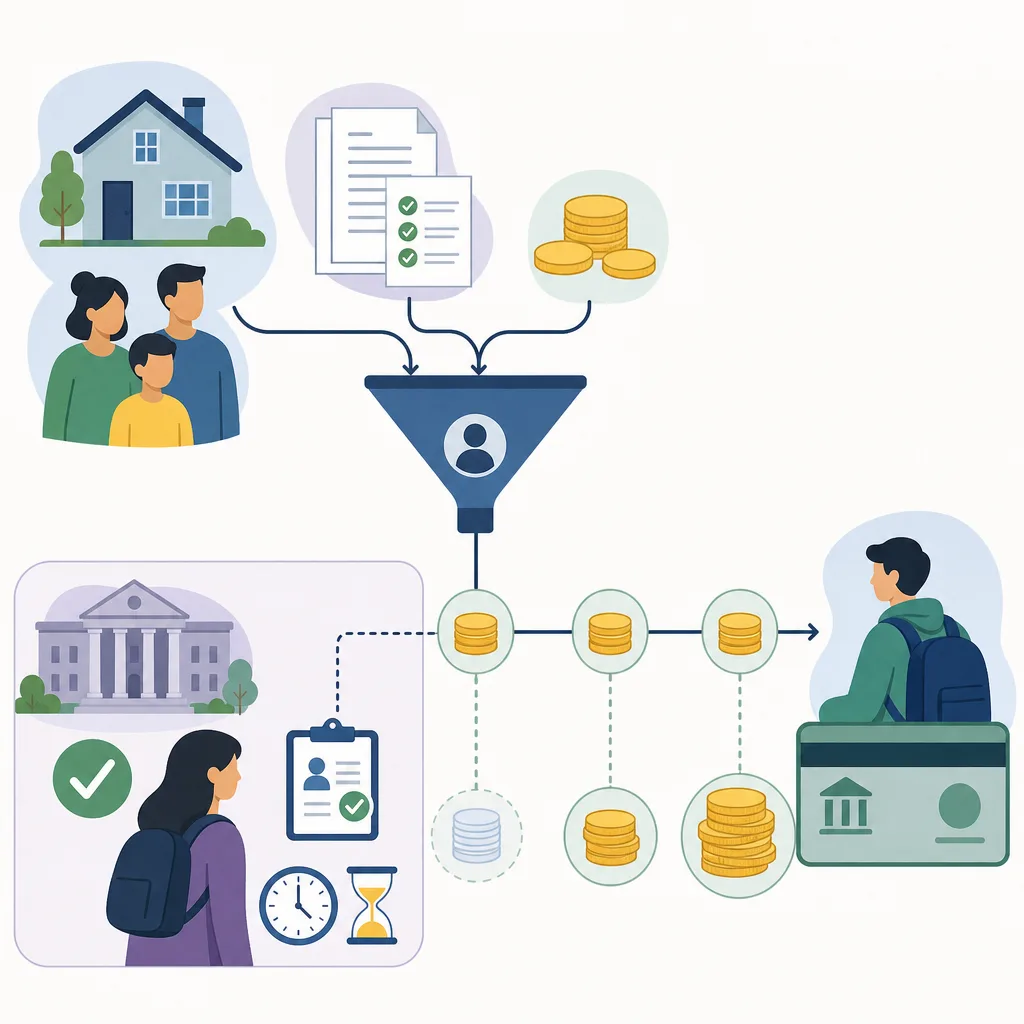
Student Finance England pays tuition fee loans directly to the university, while maintenance loans are assessed based on household income and paid in instalments into the student's account. This explains how to distinguish the provisional amount shown during the application from the final confirmed amount and prepare for delays in registration confirmation.
- The Tuition Fee Loan is paid directly to the university or education provider up to the approved tuition fee amount, so it is not deposited into the student's account.
- The Maintenance Loan varies according to living arrangements, whether the student is in London, the year of study, course length, and household income, and is generally paid into the student's account in instalments each term.
- If income information from a parent or guardian has not been processed, only a provisional minimum amount that does not reflect the income assessment may be shown.
- The scheduled payment date for the Maintenance Loan depends on the university confirming registration, so if the registration process is delayed, the first payment may also be delayed.
- The actual limits and individual estimated amounts for the 2026/27 academic year should be checked using the official GOV.UK calculator with that academic year selected and in the final entitlement letter.
Student Finance England supports tuition fees and living costs in different ways for students who are ordinarily resident in England and meet the eligibility requirements. A Tuition Fee Loan is a loan paid directly to the education provider for tuition fees, while a Maintenance Loan is a loan paid into the student’s own bank account to cover living costs.
This article covers undergraduate student finance in England. Scotland, Wales, and Northern Ireland have separate student finance bodies and assessment rules, so the same amounts or procedures should not be applied.
Key Differences Between the Two Loans
| Category | Tuition Fee Loan | Maintenance Loan |
|---|---|---|
| Main purpose | Paying tuition fees | Covering living costs such as accommodation, food, transport, and textbooks |
| Paid to | University or approved education provider | The student |
| Account receiving payment | Education provider’s account | Student’s UK bank account registered when applying |
| Factors affecting the amount | Actual tuition fees and the loan limit applicable to the course and provider | Living arrangements, whether the student is in London, year of study, course length, household income, and other factors |
| Typical payment method | Paid to the education provider in instalments during the academic year | Usually paid to the student in 3 instalments around the start of each term |
| Household income assessment | Generally not used to determine the loan amount | Used to calculate the additional loan amount above the minimum portion |
Although the two loans have different purposes and payment routes, both are repayable student loans rather than grants. Loans taken out for the same course are repaid under the applicable repayment plan when income exceeds the threshold; tuition fee and living-cost loans are not repaid as separate fixed monthly bills.
Tuition Fee Loan Calculation and Payment to the University
How the Tuition Fee Loan Amount Is Determined
Conceptually, the approved Tuition Fee Loan is the lower of the following two amounts:
- The tuition fees actually charged by the university for that academic year
- The government’s Tuition Fee Loan limit applicable to the course and type of education provider
Therefore, if the university’s tuition fees are below the loan limit, the loan will cover only the actual tuition fees. Conversely, if the tuition fees at certain providers or for certain courses exceed the applicable loan limit, the student may need to fund the difference separately.
Because the government may adjust tuition fee caps and loan limits for each academic year, figures from previous academic years should not be applied unchanged to the 2026/27 academic year. Check both the approved amount shown in the application outcome and the university’s official tuition fee notice.
Why It Is Not Paid into the Student’s Account
A Tuition Fee Loan is not cash that can be used for living costs. The Student Loans Company pays it directly to the education provider after the university confirms attendance or enrolment. Even if a large Tuition Fee Loan amount appears in the student’s Student Finance account, that amount is not deposited into the student’s own bank account.
The Tuition Fee Loan is normally paid to the education provider in three instalments during the academic year, typically 25% for the first payment, 25% for the second, and 50% for the final payment. Actual processing dates may vary depending on the course schedule and the university’s confirmation procedures.
Maintenance Loan Assessment Structure
Factors That First Determine the Maximum Available Amount
There is no single Maintenance Loan amount that applies to every student. First, the category for the maximum amount available for the academic year is determined according to the following circumstances:
- Whether the student lives with their parents
- Whether the student lives away from their parents
- Whether the student studies and lives in London
- Whether the course includes a year spent abroad
- Whether it is the student’s final year
- Whether the course year is longer than a standard academic year
- Whether the student is studying full-time or under another mode of study
In general, students living independently have a higher limit than those living with their parents, and a higher category may apply to students living away from their parents in London. In the final year, the amount may be lower than in previous years because living costs for the summer after the course ends are not included in the same way.
Basic Portion and Household-Income-Assessed Portion
For ease of understanding, the Maintenance Loan can be divided into the following two portions:
- Non-income-assessed portion: The minimum portion that an eligible student can receive without providing household income information
- Income-assessed portion: An additional portion that may bring the loan closer to the maximum limit when household income is lower
The conceptual formula is as follows:
Maintenance Loan = non-income-assessed portion + additional portion calculated according to household income
The exact additional amount is not calculated simply by multiplying parental income by a fixed percentage. Student Finance England applies the relevant academic year’s tables and formulas together with the student’s living category and residual household income information. The official calculator should therefore be used as an estimate, while the final entitlement letter should be treated as the definitive basis.
Household Income Information and Provisional Amounts
Whose Income Information Is Required
If the applicant is classified as a dependent student under Student Finance England’s rules, income information from the parent or guardian’s household is generally required. If the parents are separated, the assessment is usually based on the household in which the student normally lives, and the income of that parent’s spouse or cohabiting partner may be included.
A student does not become an independent student merely because they move into university accommodation or a privately rented room. They must meet conditions set by Student Finance England concerning age, marriage or civil partnership status, responsibility for children, care experience, financial independence for a specified period, or other criteria.
If an independent student has a spouse or partner, that person’s income information may be required. A parent or partner is only a supporter or sponsor providing income information; this alone does not make them a co-borrower or guarantor for the student loan.
Reference Income Year for the 2026/27 Academic Year
Household income information from the 2024/25 tax year is normally used for assessments for the 2026/27 academic year. Additional checks or supporting evidence may still be required even when information is linked to HM Revenue and Customs records.
If current household income has fallen substantially compared with the reference tax year, a current year income assessment may be requested. A review is generally available when current-year estimated income is expected to be at least 15% lower than the previous reference amount, although the final amount may be adjusted again after actual income is confirmed.
When a Low Amount Shown During the Application May Not Be Final
In the following situations, only the non-income-assessed portion may initially be calculated, or a provisional amount may be displayed:
- The applicant has agreed to a household income assessment, but the parent or guardian has not yet submitted the information
- Matching information such as the name, address, or National Insurance number does not correspond
- Income information has been submitted but is still being verified
- A request for additional evidence has not been answered
- The applicant accidentally selected the option not to request an income assessment
In these cases, the amount shown on screen should not be assumed to be the final Maintenance Loan. Check the online account’s to-do list, requests sent by email and post, and the submission status of the parent’s or partner’s information. Once the assessment is complete, a new entitlement letter and revised payment schedule may be issued.
Estimating the Amount Before Applying
When using the official calculator, enter the relevant academic year, university location, term-time living arrangements, and household income as accurately as possible. Attending a university in London does not always mean the London living category applies, so answers should be based on the student’s actual term-time residence.
The calculation result is an estimate for budgeting purposes. Student Finance England’s final assessment, issued after course eligibility, immigration and residency requirements, education provider information, and actual household income have been assessed, takes precedence.
Maintenance Loan Payment Timing and Cash Flow
Living-Cost Support Is Usually Paid in Three Instalments
A Maintenance Loan is generally paid into the student’s account in three instalments around the start of each term. The three amounts are not necessarily exactly equal, and payment amounts and dates may change depending on the course schedule or a reassessment.
A date shown in the online account is not an unconditional guaranteed payment date. The following conditions usually need to be met before the first payment:
- The application and identity checks must be complete.
- Valid bank account details must be registered.
- The required household income information and supporting evidence must be processed.
- The student must complete the university enrolment process.
- The university must confirm enrolment or attendance to the Student Loans Company.
Even after the university confirms enrolment, it may take several days for the payment to appear in the bank account. A payment status shown simply as scheduled should be distinguished from one shown as payment in progress or paid.
Problems Caused by Delayed Enrolment Confirmation
Even if the student has completed university enrolment, the first Maintenance Loan payment may be held if the university’s student finance office has not sent confirmation to the Student Loans Company. Additional checks may also be required if the course name, campus, start date, or personal information differs between the application and the university’s records.
For this reason, the following costs should be checked separately for the first term:
- The due date for an accommodation deposit or first rent payment
- Textbook and equipment costs charged separately from tuition fees
- The time needed to open and activate a UK bank account
- Transport and food costs immediately after arriving in the UK
- Short-term emergency funds in case payment is delayed
Rather than simply dividing the total expected loan amount by the number of terms, it is safer to record each actual payment date and rent due date together in a monthly cash-flow table.
How to Reduce Application and Payment Delays
- Apply as soon as applications open, even if the course has not yet been confirmed, and update the university choice in the account if it changes.
- Enter passport or identity information, National Insurance number, name, and address exactly as they appear in official records.
- Accurately register the details of a usable bank account in the student’s own name.
- If a household income assessment is requested, ensure that the parent, guardian, or partner promptly completes their separate request.
- Regularly check the online account’s to-do list and requests for supporting evidence.
- After completing university enrolment, confirm that the university has sent the enrolment information to the Student Loans Company.
- If the payment date has passed, first check the payment status and bank details in the account, then contact the university’s student finance office and Student Finance England.
The statutory final deadline for applying for student finance is generally within 9 months of the start of the relevant academic year, but to receive payment around the beginning of the course, it is important to apply before the priority deadline announced by Student Finance England. Applying late may not eliminate eligibility, but the first payment may be delayed until after the course begins.
Final Verification Checklist
| Item to Check | What to Confirm |
|---|---|
| Student finance body | Whether the home address falls under England’s rules and the student is covered by Student Finance England |
| Academic year | Whether 2026/27 was selected in the calculator and application |
| Tuition fees | Whether the university’s charge matches the approved Tuition Fee Loan |
| Living arrangements | Whether the correct category is selected, such as living with parents, living independently outside London, or living in London |
| Household income | Whether the required parent or partner information has been submitted and processed |
| Assessment result | Whether the latest entitlement letter, rather than a provisional screen, has been checked |
| Payment account | Whether the sort code and account number for the student’s own account are correct |
| Enrolment confirmation | Whether university enrolment is complete and the provider’s confirmation has been sent |
| Cash flow | Whether the first rent payment is due before the Maintenance Loan is deposited |
The key is to distinguish between the total approved loan amount and the amount actually paid into the student’s account. The Tuition Fee Loan goes to the university, while only the Maintenance Loan is paid to the student. The amount or payment date of the Maintenance Loan may also change until the household income assessment and the university’s enrolment confirmation are complete.
FAQ
Is the Tuition Fee Loan paid into the student's bank account?
No. The Tuition Fee Loan is paid directly by the Student Loans Company to the university or approved education provider. The student finance paid into the student's account is generally the Maintenance Loan.
If only a low amount is shown on the Maintenance Loan screen, is that the final amount?
Not necessarily. If the household income information from a parent, guardian, or partner has not yet been submitted or processed, only the non-income-assessed portion may be shown temporarily. You should check the latest entitlement letter and the assessment status in your account.
If parents submit income information, are they also responsible for repaying the loan?
Generally, parents only provide information for the household income assessment and do not become joint borrowers or guarantors. The loan is in the student's name, and the student is responsible for repayment under the applicable repayment plan.
Do I automatically become an independent student if I live away from my parents?
No. Simply moving into university accommodation or a rented room does not make you an independent student. You must meet Student Finance England's separate criteria, such as age, marital status, supporting a child, care experience, or financial independence for a specified period.
Why is the Maintenance Loan not paid in full all at once?
The Maintenance Loan is generally paid in three instalments to support living costs during each term. Each payment is subject to the application being processed, bank details being provided, and the university confirming registration or attendance.
What should I do if the scheduled payment date has passed but the Maintenance Loan has not been paid?
First, check the payment status and bank details in your Student Finance account, and ask the university's student finance office whether the university has sent confirmation of your registration to the Student Loans Company. If the payment status still does not progress after registration has been confirmed, it is advisable to contact Student Finance England.
Which tax year's parental income is used for the 2026/27 academic year?
Normally, household income from the 2024/25 tax year is used for the 2026/27 academic year. If current income has fallen significantly since then, you may be able to request a current year income assessment, subject to the relevant conditions.
Can my Maintenance Loan be recalculated if household income has decreased?
If estimated household income for the current year is generally expected to decrease by at least 15% compared with the base year, you may be eligible for a current year income assessment. If estimated income differs from actual income, the loan amount may be adjusted again later.
If I attend a university in London, does the London Maintenance Loan amount always apply?
It is not determined solely by the university's location. It is assessed based on application details such as your actual living arrangements and location during term time, so you must accurately state whether you live with your parents or live independently in London.
Can I receive less than the maximum Maintenance Loan amount?
Applicants may request less than the maximum amount for which they can be approved. To increase the amount later, they must make the change through their online account or Student Finance England within the deadline for changes for that academic year and within their remaining entitlement.
Sources
Images