Is Tariff-Driven Inflation Over? How to Interpret the IMF Forecast, the New York Fed Survey, and June’s CPI Together
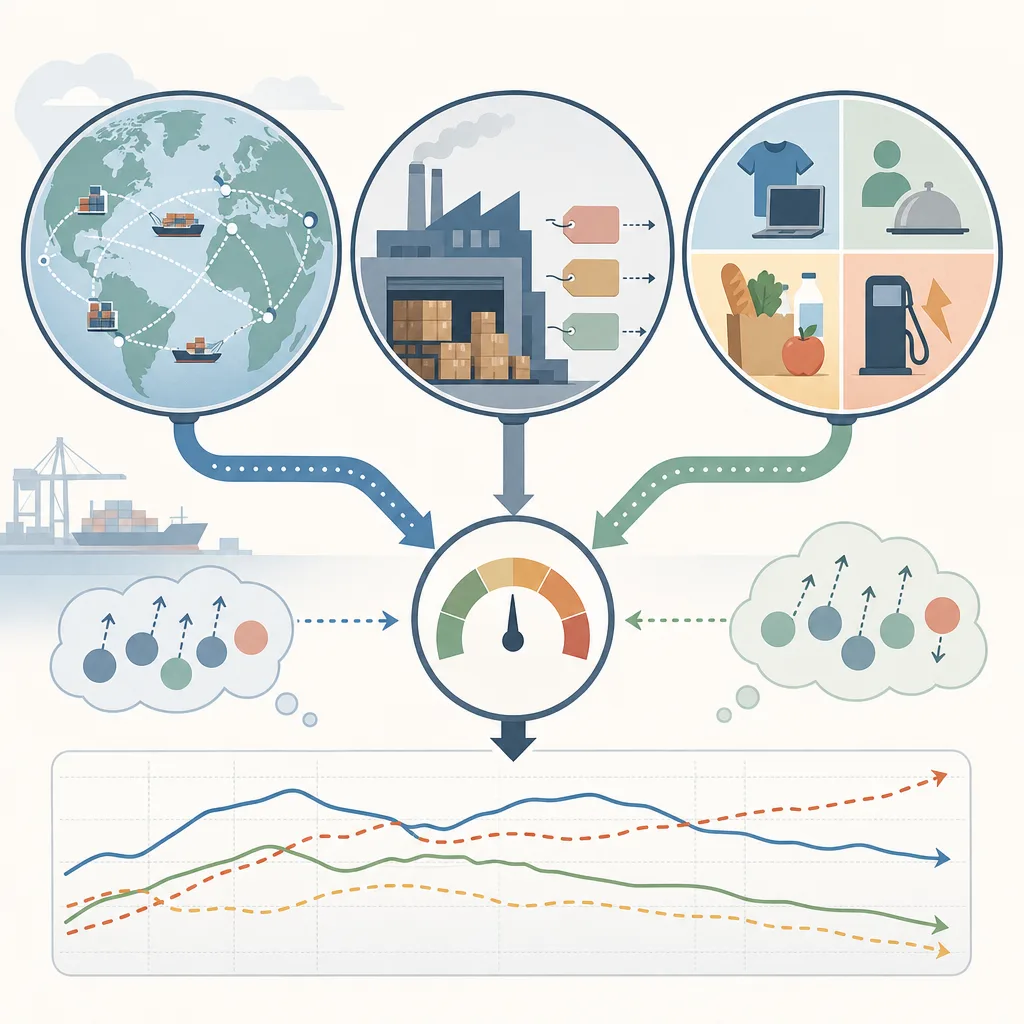
By analyzing the IMF’s July 2026 World Economic Outlook Update, the New York Fed’s analysis of tariff cost pass-through, and the U.S. June CPI together, we can more accurately determine whether tariff-driven inflationary pressures have ended. The key is to distinguish between one-time price increases and persistent inflation, and to examine commodity prices, service prices, inflation expectations, and corporate pricing mechanisms simultaneously.
- While tariffs can directly raise the prices of imported goods, for inflation to persist, the cost pass-through must spread across various items and over time.
- The IMF identifies war, energy shocks, trade fragmentation, and technology cycles as the main sources of uncertainty in its 2026 global growth and inflation outlook.
- The New York Fed's analysis shows that, since companies that have borne the tariffs are still planning additional price increases, it is difficult to conclude that the cost pass-through has fully ended.
- When headline CPI and core CPI show divergent trends, it is important to distinguish between temporary fluctuations in energy and food prices and underlying inflation related to services and wages.
- The central bank considers not only the single CPI figure but also the extent of price pass-through, inflation expectations, the labor market, and inventory adjustments.
Conclusion at a Glance
To determine whether tariff-driven inflation has ended, it is not enough to simply look at whether the Consumer Price Index (CPI) was high or low in a single month. Tariffs first increase costs for importers, and then, through corporate pricing decisions, inventory strategies, supply chain restructuring, and interactions with wages and service prices, they are reflected in consumer prices.
Three reports released in early July 2026 address this same question from different angles.
| Report | Key Question | Key Takeaways |
|---|---|---|
| IMF July 2026 World Economic Outlook Update | What are the structural pressures weighing on global growth and inflation? | How are war, energy shocks, trade fragmentation, and technology cycles disrupting growth and inflation? |
| New York Fed’s Liberty Street Economics Analysis | Has the pass-through of tariff costs ended? | Why companies that paid tariffs are planning additional price hikes |
| U.S. June CPI | What is reflected in actual consumer prices? | Trends in headline CPI, core CPI, and commodity and service subcategories |
The key conclusion is one of caution. While the price shock caused by tariffs may already be reflected in some items, if companies have not yet fully passed on the costs to consumer prices, tariff-driven inflation is more likely to be “in the process of being passed on” rather than “over.”
What Is Tariff-Driven Inflation?
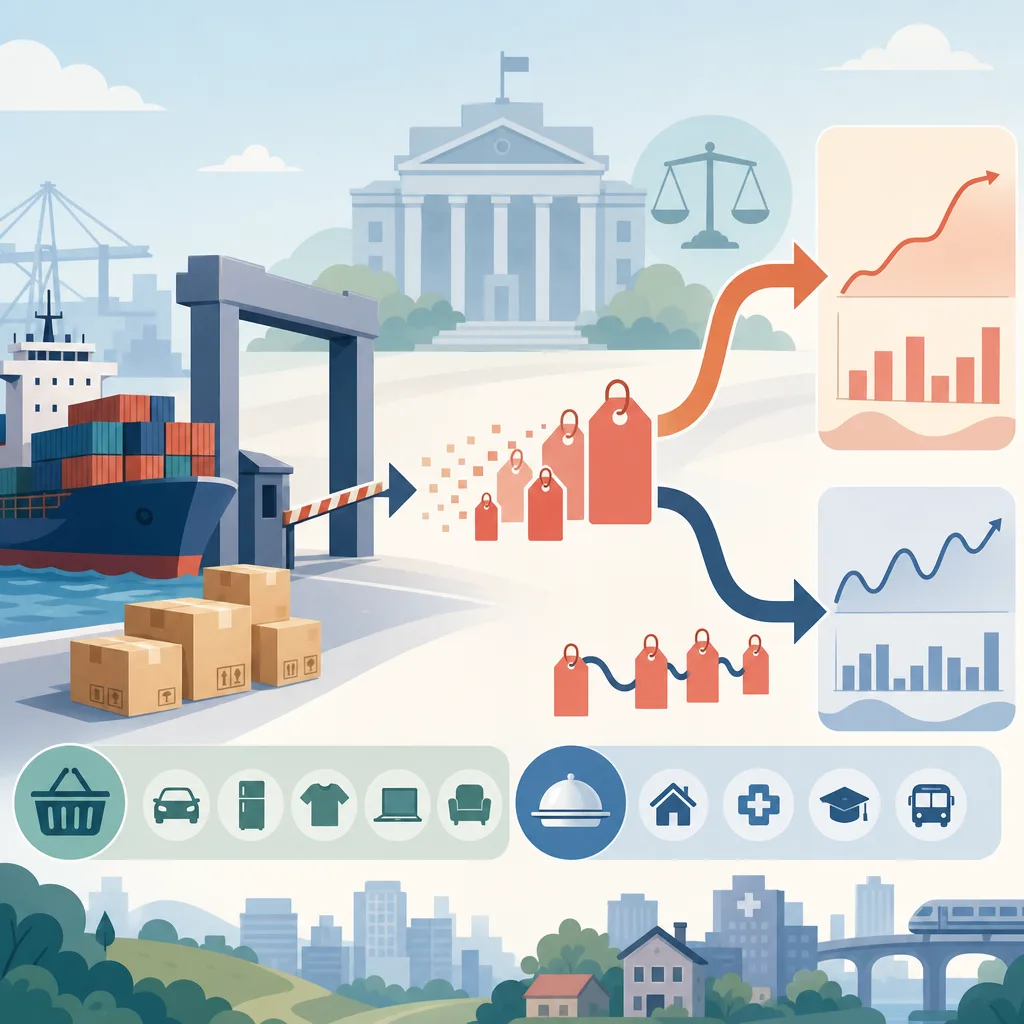
Tariff-driven inflation is the phenomenon in which tariffs imposed by the government on imported goods raise business costs and consumer prices. While tariffs are technically taxes, economically they function as a price shock that increases the cost of purchasing imported goods.
Basic Mechanism
The mechanism by which tariffs are passed on to prices can be summarized as follows:
- The government imposes tariffs on specific imported goods.
- The unit costs for importers or distributors rise.
- Businesses either absorb the costs, reflect only a portion of them in prices, or pass them on entirely to consumer prices.
- Consumers face higher product prices.
- Companies adjust their inventory, suppliers, employment, and sales strategies.
- If price increases spread across a wide range of items and persist over a long period, the risk of sustained inflation increases.
This can be represented as a simple flowchart as follows:
Imposition of tariffs → Rise in import costs → Pressure on corporate margins → Price increases or cost absorption → Reflection in consumer prices → Potential secondary effects on inflation expectations, wages, and service prices
IMF Outlook: Why We Must Consider Both Growth Slowdown and Price Uncertainty
The IMF’s July 2026 update to the World Economic Outlook demonstrates that we must consider not only tariffs but also the various pressures weighing on the global economy. Based on the data provided, the key factors highlighted by the IMF are war, energy shocks, trade fragmentation, and the technology cycle.
1. War and Energy Shocks
War and geopolitical conflicts can affect energy, grain, and transportation costs. When energy prices rise, they immediately push up the headline CPI and also impact business costs through transportation, electricity, and heating expenses.
However, rising energy prices can sometimes end up being a one-off shock that stabilizes after a sharp spike. Therefore, central banks and markets look at both the headline CPI—which includes energy and food—and the core CPI, which excludes them.
2. Trade Fragmentation and Tariffs
Trade fragmentation refers to the phenomenon where trade between countries is restructured based on security, political, and industrial policy considerations rather than efficiency. This includes tariffs, export controls, subsidies, and supply chain relocations.
Trade fragmentation can affect prices in the following ways:
- It becomes more difficult to source from cheaper suppliers.
- Costs rise as companies build redundant supply chains.
- Tariffs directly raise the prices of imported goods.
- Due to uncertainty, companies may set prices more conservatively—that is, at higher levels.
3. Technology Cycles
Technology cycles simultaneously impact productivity and investment. Investments in technologies such as artificial intelligence, semiconductors, and automation can boost productivity in the long term, thereby reducing inflationary pressures. However, in the short term, they may drive up costs in certain sectors by increasing demand for equipment, electricity, data centers, and highly skilled labor.
Therefore, technology cannot be definitively labeled as a disinflationary factor. It has a dual nature: at one point, it raises prices through investment demand, and over time, it lowers prices through productivity improvements.
New York Fed Analysis: Why Might Cost Pass-Through Still Be Underway?
A July 2026 analysis by Liberty Street Economics at the New York Fed focuses on the pricing decisions of companies that have absorbed tariff costs. According to the analysis, the key message is that the pass-through of tariff costs is not yet fully complete, and additional price increases may still be in the pipeline.
Why Companies Do Not Raise Prices Immediately
Companies do not always raise prices immediately just because tariffs have been imposed. There are various reasons for this.
| Reason | Explanation | How Prices Are Reflected |
|---|---|---|
| Inventory Holdings | If there is remaining inventory imported before the tariffs took effect, there is little need to raise prices immediately | Can be reflected over time |
| Competitive Pressure | It is difficult to raise prices unilaterally if competitors maintain their prices | Gradual and partial pass-through |
| Contract Prices | It is difficult to make immediate adjustments if wholesale or supply contracts are fixed | Reflected upon contract renewal |
| Concerns About Consumer Demand | There is concern that sales volume will decline if prices are raised | Delayed price increase after reducing margins |
| Uncertainty | Decisions are postponed if it is unclear whether tariffs will be temporary or permanent | Price increase after confirming the policy’s continuity |
As a result, a time lag emerges between tariffs and the CPI. The impact may become more evident in CPI commodity categories several months after the tariff announcement rather than immediately following it.
Reasons Why Companies Plan Additional Price Increases
There are generally three reasons why companies that have paid tariffs plan additional price increases.
- Margin Protection: Continually absorbing rising costs leads to lower profit margins.
- Inventory Transition: Pre-tariff inventory is depleted, and post-tariff inventory is reflected in the selling price.
- Price Reset Cycles: Companies often adjust prices in line with quarterly, semi-annual, or contract renewal schedules rather than changing them daily.
Therefore, it is difficult to conclude that the impact of tariffs has ended just because the CPI came in low for one month. Conversely, a high reading for a single month does not necessarily confirm sustained inflation. What matters is how widespread and long-lasting the price increases are.
How to Interpret the June CPI: What the Headline and Core CPI Tell Us
The U.S. Bureau of Labor Statistics (BLS) CPI measures changes in the prices of goods and services purchased by consumers. The June 2026 CPI is a key indicator in the tariff debate. However, the CPI should not be viewed as a single number but rather as data with multiple layers.
Headline CPI
The headline CPI is the overall consumer price index, including food and energy. Its advantage is that it closely reflects the cost of living as consumers actually experience it.
However, energy and food prices are subject to high short-term volatility due to international oil prices, weather, and geopolitical events. Therefore, even if the headline CPI is high, if the cause is a spike in energy prices, it is difficult to directly link it to tariff-induced inflation.
Core CPI
The core CPI is generally an index that excludes food and energy. Central banks and markets frequently refer to it when assessing underlying inflation trends.
The following items are particularly worth noting in the Core CPI:
- Durable and non-durable goods that are susceptible to the effects of tariffs
- Items with a high proportion of imports, such as clothing, home appliances, furniture, and auto parts
- Service prices, such as housing costs and medical services
- Items that combine both goods and service costs, such as transportation services, insurance, and repair costs
The Difference Between Goods and Services
Tariffs often affect the prices of goods first. However, for this to escalate into sustained inflation, it is crucial to determine whether it spreads to service prices, wages, and inflation expectations.
| Category | Likelihood of Tariff Impact | Key Considerations |
|---|---|---|
| Imported consumer goods | High | Tariff pass-through may be directly observable |
| Domestically produced goods | Medium | Depends on whether imported raw materials or parts are used |
| Services | Low to Medium | Indirect impact via wages, rent, and equipment costs |
| Energy | International prices often have a greater impact than tariffs | Need to break down the causes of headline CPI fluctuations |
| Housing Costs | Direct impact of tariffs is limited | Important for assessing underlying inflation |
Interpreting Divergences Between Headline CPI and Core CPI
Headline CPI and core CPI may not move in the same direction. In such cases, consumers, businesses, and the central bank must look at different information.
What Consumers Should Focus On
What matters to consumers are their actual spending categories. Even if headline CPI is low, perceived inflation may feel high if prices for groceries, insurance premiums, and rent rise. If consumers plan to purchase tariff-affected items, they should also consider the possibility of a time lag in price adjustments.
Consumers should ask themselves the following questions:
- Are the items that have recently gone up one-time purchases or recurring expenses?
- Do you need to purchase goods with a high proportion of imported components soon?
- Is the price increase due to reduced discounts or a full-price hike?
- Are falling energy prices masking other price increases?
What Businesses Need to Watch
Businesses should examine their own cost structures before looking at the CPI. They must consider not only items directly subject to tariffs but also costs related to parts, packaging materials, transportation, and inventory financing.
Businesses should review the following items:
- The proportion of purchases consisting of tariffed items
- The ratio of pre-tariff inventory to post-tariff inventory
- The extent to which demand declines when prices rise
- The speed at which competitors adjust their prices
- Contract renewal dates and the potential for adjustments to unit supply prices
What Central Banks Should Consider
The central bank must distinguish whether tariffs represent a one-time rise in the general price level or sustained inflation. A one-time increase in the price of a specific product due to tariffs constitutes a rise in the general price level. However, if businesses and households believe that prices will continue to rise in the future and adjust wages and prices accordingly, this could lead to sustained inflation.
The indicators the central bank should monitor are as follows:
- Monthly growth rate of core CPI and 3-month and 6-month trends
- Whether there is a broad-based rise in goods prices
- Service prices and wage growth rates
- Short-term and long-term inflation expectations
- Businesses’ plans to raise prices
- Whether consumer demand and the labor market are slowing down
The Difference Between a One-Time Price Increase and Persistent Inflation
The most important distinction in the tariff debate is between a “rise in the price level” and a “sustained rise in the inflation rate.”
| Distinction | One-Time Price Increase | Persistent Inflation |
|---|---|---|
| Meaning | Prices rise once due to a specific shock | The rate of price increase remains persistently high |
| Example | Price increase for specific imported goods following the imposition of tariffs | Repeated price increases across various goods and services |
| Duration | Generally limited | May persist for several quarters or more |
| Central Bank Response | May adopt a wait-and-see approach if inflation expectations are stable | May delay interest rate cuts or maintain a tight monetary policy |
| Indicators | Prices of specific items | Core CPI, service prices, wages, inflation expectations |
For example, if the price of imported home appliances rises by 5% once due to tariffs and does not increase further, this is closer to a one-time price increase. However, if that increase leads to higher distribution costs, repair costs, wage demands, and higher prices for other goods—and companies repeatedly adjust their prices—it becomes closer to sustained inflation.
How the Pass-Through of Tariff Costs Influences Employment and Inventory Decisions
Tariffs do not merely change consumer prices; they also alter companies’ operational decisions.
Inventory Decisions
When tariffs are anticipated, companies may try to secure inventory in advance of the tariff imposition. In this case, imports increase in the short term, and price increases may occur later when inventories are depleted.
Conversely, if tariffs persist over the long term, companies will seek to reduce inventories or switch suppliers. This can lead to out-of-stock situations, delivery delays, and reduced discounts.
Employment Decisions
If costs rise due to tariffs, companies must choose one of the following options:
- Raise prices to maintain margins.
- Reduce margins to maintain employment.
- Delay hiring or reduce headcount to cut costs.
- Temporarily increase costs and staffing to restructure the supply chain.
This creates a trade-off between inflation and growth. Tariffs can drive up prices while simultaneously weakening corporate profits and consumer demand, thereby lowering the growth rate. This is why the IMF addresses both the risk of a growth slowdown and inflation uncertainty.
A Checklist Based on Data
When determining whether tariff-driven inflation has ended, it is helpful to examine the following questions in order.
- Are prices of goods vulnerable to tariffs actually rising?
- Are price increases limited to certain items, or are they spreading to a wider range of goods?
- According to business surveys, are plans for additional price hikes decreasing or increasing?
- Are the 3-month and 6-month trends in core CPI slowing down?
- Are service prices and wage growth rates also rising?
- Are inflation expectations stable?
- Has the inventory adjustment ended, or are post-tariff inventory levels still being reflected in prices?
- Are fluctuations in energy and food prices distorting the overall CPI assessment?
If the answers to these questions are “rising commodity prices are limited, companies’ plans for further price hikes are weak, and the trends in core CPI and inflation expectations are stable,” then tariff-driven inflation can be considered to be subsiding. Conversely, if “companies are planning further price hikes, commodity price increases are broadening, and even service prices are sticky,” it is difficult to conclude that the situation is over yet.
Implications for Investors and Households
This article is not investment advice but a guide to interpreting economic indicators. However, inflation data affects interest rates, exchange rates, stock and bond prices, and household budget planning.
From an Investor’s Perspective
- If the CPI is high, expectations for interest rate cuts may weaken.
- If the pass-through of tariff costs is underway, the margins and pricing power of consumer goods companies become important.
- Market interpretations may differ between headline inflation driven by energy prices and core inflation driven by tariffs.
- When reviewing corporate earnings reports, pay attention to mentions of “price hikes,” “tariffs,” “inventory,” and “supply chains” in conjunction.
Household Perspective
- When purchasing durable goods, which account for a large portion of household income, consider the possibility of price fluctuations.
- A decline in headline CPI does not necessarily mean an immediate easing of the cost-of-living burden.
- Recurring expenses, such as insurance premiums, rent, and service fees, are more closely tied to core inflation.
- Tariff-related price increases may manifest indirectly, such as through reduced discounts, higher shipping costs, or increased prices for optional add-ons.
Summary: “How much more can be passed on?” is a better question than “Is it over?”
When assessing tariff-driven inflation, the question “Is it over?” is simple, but the actual data is more complex. Better questions include the following:
- To what extent have tariff costs been passed on to consumer prices?
- Are there still unpassed-on costs remaining within corporate margins?
- Are price increases spreading from goods to services?
- Are they affecting inflation expectations and wage negotiations?
- Is underlying inflation stable enough for the central bank to view this as a one-off shock?
IMF data shows that the global economy is under complex pressures from war, energy, trade fragmentation, and technological change. Analysis by the New York Fed suggests that the pass-through of tariff costs may still be underway. The June CPI is a key indicator for validating this debate with actual price data. Therefore, the conclusion is conditional rather than definitive. To declare that tariff-driven inflation has ended, evidence is needed showing that commodity prices, core CPI, corporate price hike plans, and inflation expectations are all stabilizing simultaneously.
FAQ
How does tariff-induced inflation differ from general inflation?
Tariff-induced inflation is a phenomenon in which import costs rise due to tariffs, and those costs are passed on to consumer prices. General inflation can result from broader causes such as overheated demand, wage increases, energy prices, and monetary conditions.
If tariffs are imposed, will consumer prices rise immediately?
Prices do not necessarily rise immediately. Companies determine the timing and extent of price increases by considering existing inventory, contract prices, the competitive landscape, and consumer demand. As a result, there may be a lag of several months between the imposition of tariffs and changes in the CPI.
What is the passing on of customs duties?
The passing on of tariff costs refers to the process by which a company, rather than absorbing the increased costs resulting from tariffs as a reduction in its profits, passes those costs on to consumers or business partners by raising its selling prices.
Which is more important: headline CPI or core CPI?
It depends on the purpose. The headline CPI reflects the overall cost of living as experienced by consumers, while the core CPI excludes short-term fluctuations in food and energy prices, making it useful for gauging underlying inflationary pressures.
If the CPI comes in lower this month, does that mean tariff-driven inflation is over?
It is difficult to make such a definitive conclusion. The pass-through of tariff costs may occur with a time lag, and it is necessary to examine both companies’ plans for additional price increases and the specific price trends for goods and services.
Can tariffs affect service prices?
While the direct impact is smaller than that on goods, an indirect impact is possible. If the prices of imported equipment, parts, transportation, and repairs rise, the prices of some services may also face upward pressure.
How does the central bank respond to inflation caused by tariffs?
The central bank is trying to determine whether the tariffs represent a one-time rise in price levels or sustained inflation. If inflation expectations and core inflation remain stable, it may adopt a wait-and-see approach, but if price increases become widespread, policy easing could be delayed.
How should investors view tariffs and the CPI together?
Investors should consider not only the overall CPI figure but also commodity prices, core CPI, companies’ statements regarding price increases, and changes in inventory and margins. If tariff pass-through continues, it could simultaneously undermine interest rate expectations and corporate earnings forecasts.
Sources
Images