Ohouse Growth Story Analysis: From Community to a KRW 2 Trillion Platform
After focusing on interior design content and building a user community rather than transactions during its first two years, Ohouse expanded into commerce and construction. This report separately analyzes the significance of its KRW 2 trillion valuation, Ruby on Rails-based technical debt, changes in accounting standards, its 2025 loss, and AI adoption.
- Ohouse's approximately KRW 2 trillion corporate valuation is a historical valuation recognized in its 2022 funding round, not its real-time valuation as of 2026.
- The initial two-year pre-revenue period was an intentional platform-building phase that first secured content and user-generated content to reduce the cost of converting users to commerce.
- The Ruby on Rails monolith accelerated early development, but as the organization grew, tightly coupled deployments and difficulties recruiting experienced developers in Korea emerged as technical debt.
- Because redeemable convertible preferred shares may be classified differently under K-IFRS and Korean Generally Accepted Accounting Principles, a decrease in liabilities should not be interpreted as equivalent to a cash inflow or debt repayment.
- Although AI tools can improve productivity in development and customer support, they do not automatically resolve the structural complexity of legacy systems or data quality issues.
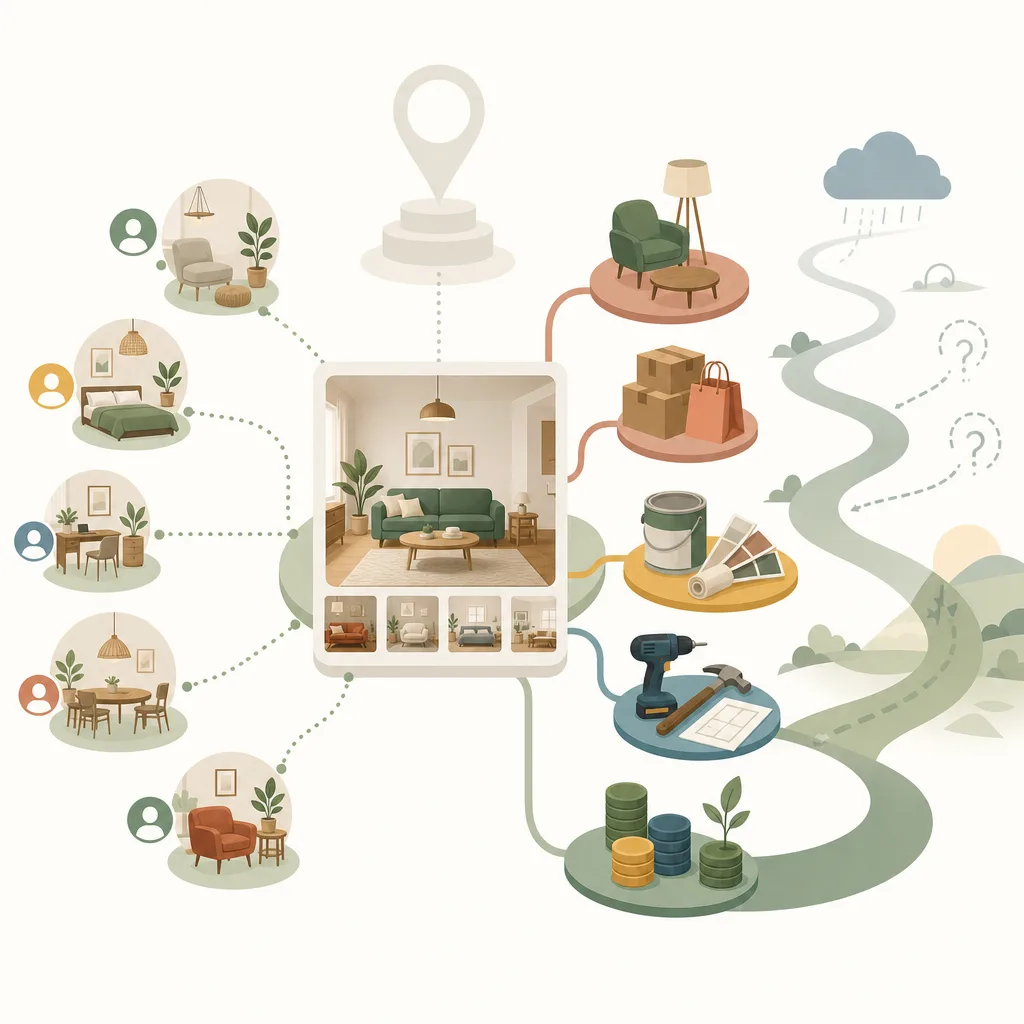
The growth story of Bucketplace, which operates Ohouse, is a platform case in which content, transactions, technology, and capital developed at different speeds. Launched in 2014, the service did not immediately begin selling furniture. Instead, it first focused on giving people a reason to look at other people’s homes and share their own spaces. It later expanded into commerce by linking product information to content, then broadened its scope to include construction brokerage and direct construction, overseas businesses, payments, and brand operations.
However, widely cited figures require context. The approximately KRW 2 trillion valuation was assessed during a 2022 funding round and is not a figure confirmed as its real-time value in 2026. Financial figures also vary in meaning depending on whether they come from consolidated or separate financial statements, the accounting standards applied, and the measurement date, so simple comparisons should be avoided.
Ohouse’s Transformation at a Glance
| Period | Business and organizational changes | Strategic significance |
|---|---|---|
| 2014 | Bucketplace founded; content centered on interior images and portfolios | First established a reason for users to gather before enabling transactions |
| 2014–2016 | Community-building period with virtually no revenue | Accumulated demand through content despite limited suppliers and products |
| Around 2015 | Homes of ordinary people and low-cost interior design examples gained traction | Shifted from expert-centered curation to UGC |
| July 2016 | Official launch of the Ohouse Store | Connected interest generated within content to product transactions |
| 2018 | Revenue of KRW 7.2 billion according to the provided materials | Monetization of community-based commerce began in earnest |
| Around Q4 2021 | Concentrated development resources on backend separation and architectural restructuring | Repaid, at the organizational level, technical debt accumulated in pursuit of rapid development |
| 2022 | Raised $182 million at a valuation of approximately $1.4 billion | Unicorn valuation close to KRW 2 trillion at the exchange rate at the time |
| 2024 | Operating profit of KRW 570 million according to the provided materials | Presented as the first annual operating profit after a prolonged investment period |
| 2025 | Revenue of KRW 321.5 billion and operating loss of KRW 14.7 billion according to the provided materials | Revenue growth and new-business costs increased simultaneously |
| 2025–2026 | Expanded direct construction capabilities and AI work tools | Sought to strengthen accountability for brokerage and improve organizational productivity |
The most important point in this timeline is that corporate valuation, revenue, and operating profit are not the same concept. Corporate valuation is the equity value investors calculate at a particular point in time based on growth potential; revenue is income recognized from providing goods and services; and operating profit is the result after operating expenses are deducted from revenue.
Founding Background and the Meaning of Two Years with Zero Revenue
Founder and CEO Lee Seung-jae graduated from the Department of Chemical and Biological Engineering at Seoul National University and participated in his first startup, Ecube Labs, which developed solar-powered trash compactors. According to the widely known founding story, while setting up an office himself, he experienced the problem of fragmented processes for searching for information, purchasing products, and comparing contractors. A visit to IKEA in Hong Kong and the experience of remodeling an acquaintance’s home also influenced his idea for an interior information service.
In its early days, Ohouse was closer to a media outlet than an online store. Through channels such as the Facebook page “Today’s Interior,” it selected and showcased online interior images and professional portfolios. The founding anecdote that the company was rejected by more than 30 investment firms, along with the explanation that it generated no revenue for its first two years, can be understood as indicating that it focused on validating user demand rather than building sales features during this period.
A Period Without Revenue Is Not Always a Good Strategy
The Ohouse case does not suggest that every startup should delay monetization for two years. A no-revenue strategy requires the following conditions:
- Content must genuinely generate repeat visits and organic traffic.
- Community activity must lead to future transaction data or purchase intent.
- The company must have enough capital to cover labor and operating expenses until monetization.
- A structure must be in place to introduce sales features without damaging the content experience.
It is more accurate to view Ohouse’s no-revenue period not as a gap caused by the absence of a revenue model, but as a pre-market-building stage in which it accumulated content supply, user behavior, and purchasing interests.
Content Commerce Built by UGC and Product Tags
During early operations, it became clear that users responded more strongly to the homes of ordinary people with similar living conditions than to polished spaces designed by professionals. Users showed stronger intent to act when viewing cases that offered realistic references for floor area, budget, and furniture arrangement than when viewing high-end examples that could only be admired.
The problem was that users had little reason to upload photos voluntarily. Ohouse introduced product tags that attached information about furniture and accessories to photos. These tags performed three roles simultaneously.
- They answered viewers’ question, “What is this product?”
- They encouraged post creators to organize information about their spaces more usefully.
- They enabled the platform to connect interest in content to product detail pages and purchases.
This structure differs from search-based shopping. In search-based shopping, users arrive already knowing the product name, whereas on Ohouse they discover products while exploring spaces. Content does more than capture demand; it creates new demand.
Around 2015, examples of low-budget studio apartment interiors spread and traffic increased, and the store officially opened in July 2016. There is also an anecdote that transactions occurred quickly during a pre-launch sales experiment, but sales were sluggish immediately after the official launch. This illustrates a typical early-stage platform problem: the high interest of test participants does not immediately translate into repeat purchases by the broader user base.
What a KRW 2 Trillion Valuation Means
Bucketplace was reported to have been valued at approximately $1.4 billion when it raised about $182 million in Series D funding in May 2022. Converted at the exchange rate at the time, this was close to KRW 2 trillion, leading to the description “KRW 2 trillion platform.”
However, the valuation of a private company in a funding round is not updated daily like the market capitalization of publicly traded shares. The following factors must also be considered:
- The timing of the investment and subsequent market conditions
- The issue price of new shares and the rights attached to preferred shares
- Contractual terms such as liquidation preferences, redemption rights, and conversion rights
- The price of subsequent funding rounds or secondary-share transactions
- Revenue growth, profit and loss, cash burn rate, and overseas business performance
It is therefore accurate to describe the “KRW 2 trillion valuation” as a historical valuation confirmed in a 2022 investment agreement. Without a separate recent investment or an objective equity transaction, it cannot be asserted to represent the company’s value in 2026.
The Ruby on Rails Monolith and Technical Debt
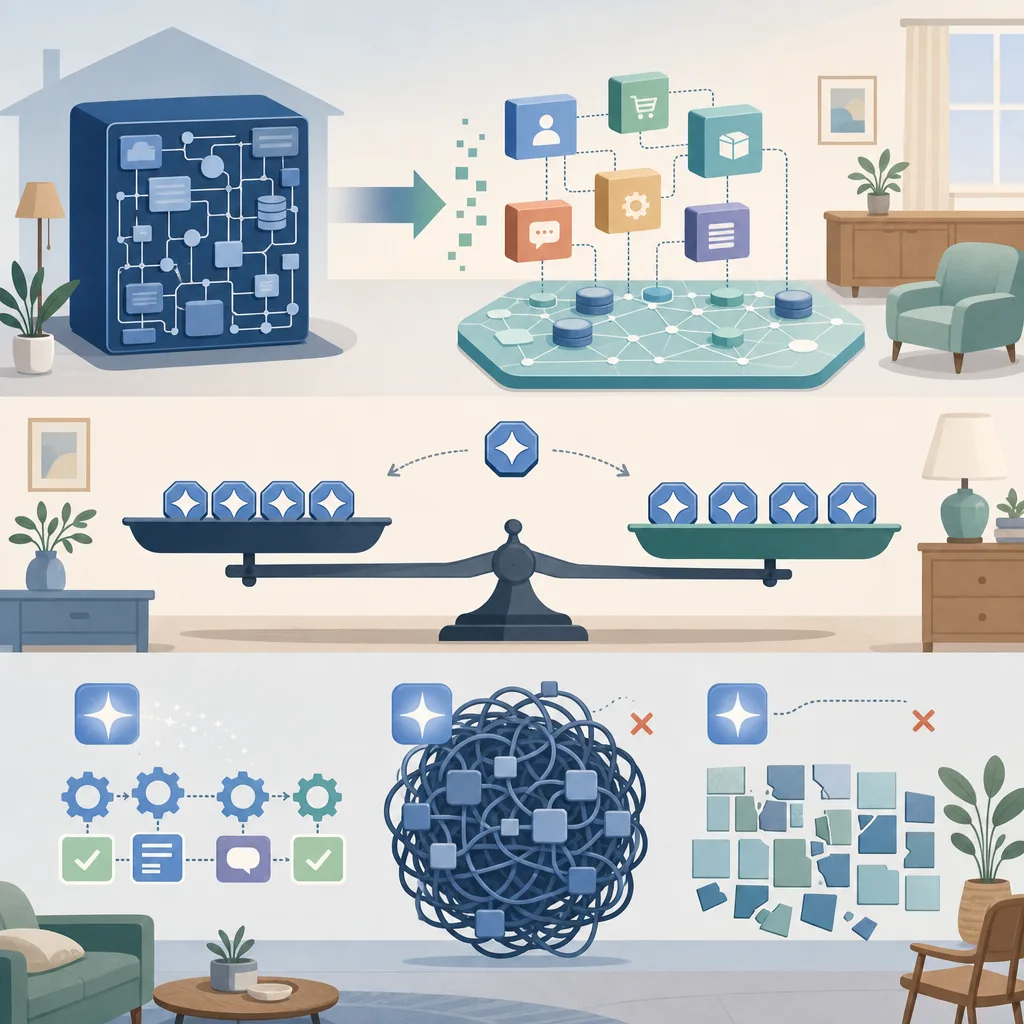
Ohouse rapidly built its initial core service as a monolithic application centered on Ruby on Rails. A monolith is a structure in which multiple functions, such as users, content, products, and orders, are tightly coupled within a single deployment unit.
For an early-stage company, this choice can be reasonable. Rails integrates convention-based development, database connectivity, administrative features, and the capabilities needed to build web services. It is well suited to helping a small team create an MVP and repeatedly validate features within a limited period.
Costs That Emerge with Growth
As the service and organization grow, the initial advantages can begin to work in reverse.
- An error in one feature becomes more likely to affect other areas.
- Even small changes require the entire application to be retested and redeployed.
- Unclear ownership boundaries cause changes by multiple teams to converge on the same code.
- The database and deployment procedures may become bottlenecks.
- It may be difficult to hire enough experienced professionals familiar with a particular language and framework.
Ohouse’s reasons for transitioning should not be reduced to a single issue with Rails performance. As the organization began using multiple languages and tools together, Rails lost some of its consistency, and hiring conditions—particularly the difficulty of securing experienced Rails developers in the Korean labor market—were also cited as an important factor. The cost of technical debt appears not only in server expenses, but also in recruitment, training, code review, and incident response.
Migration and the Supergraph Since 2021
According to the provided materials, Ohouse sharply reduced new-business development for approximately three months in Q4 2021 and concentrated development resources on separating the backend. The goal was to clarify domain boundaries and reduce incident propagation and deployment coupling. Languages such as Go and Kotlin were also used as alternatives or as technologies for new services.
Converting a large monolith into microservices is generally not completed all at once. Data ownership, authentication, order transactions, search, observability, and deployment systems must all be changed together. The fact that Rails remained in some core areas in 2026 and that related experience was listed as a preferred qualification in recruitment does not indicate a failed transition; rather, it illustrates the reality of gradual replacement.
It is inaccurate to describe a supergraph as “combining separated services back into a single monolith.” A supergraph in the GraphQL Federation family is an approach that presents schemas owned by multiple services to clients as a single integrated graph. It can unify external data-access paths while keeping internal services separate. However, this layer also creates new costs in schema coordination, incident tracing, and operational complexity.
Financial Growth and Interpreting the 2025 Loss
The major financial figures presented in the provided materials are as follows. For an accurate interpretation, the relevant annual audit report must be reviewed to confirm whether the figures are consolidated or separate and which accounting policies were applied.
| Item | Figure | Interpretive caution |
|---|---|---|
| 2018 revenue | KRW 7.2 billion | Scale during the early commerce expansion period |
| 2024 operating profit | KRW 570 million | Presented as the first annual profit after a prolonged period of losses |
| 2025 revenue | KRW 321.5 billion | Approximately 44.7 times the 2018 figure |
| 2025 operating loss | KRW 14.7 billion | Revenue growth and deteriorating profitability occurred simultaneously |
| Overseas and new-business investment | Approximately KRW 49.5 billion | Investment expenditures and operating losses cannot be treated as the same item |
| Cash and cash equivalents | Presented as at least KRW 240 billion | Must be reviewed together with the reference date, any restrictions on use, and total liabilities |
If revenue increased from KRW 7.2 billion in 2018 to KRW 321.5 billion in 2025, the simple compound annual growth rate over seven years was approximately 72%. However, because the starting point was small and the calculation does not reflect fluctuations in the intervening years, it should be used only as a reference summarizing the long-term trend.
It cannot be concluded that the 2025 loss occurred because approximately KRW 49.5 billion was invested in six businesses, including Singapore’s HipVan, Japanese and U.S. subsidiaries, payments, and brands. Investments in subsidiaries or equity acquisitions may generally be recorded as investment assets on the statement of financial position, while operating losses reflect labor costs, marketing expenses, logistics costs, depreciation, and the operating expenses of consolidated subsidiaries. Impairment losses or equity-method gains and losses may also be presented outside operating profit or loss. An accurate analysis of the causes requires the cash flow statement and accompanying notes.
Changes in Accounting Standards and the Reality Behind the Sharp Decline in Liabilities
According to the provided materials, Bucketplace reported current liabilities of approximately KRW 910 billion in its 2023 financial information prepared under K-IFRS, while the figure prepared under Korean Generally Accepted Accounting Principles in 2024 fell to approximately KRW 111.9 billion.
Describing this as “liabilities disappearing through accounting magic” misses the point. Redeemable convertible preferred shares issued by a private startup may be classified as financial liabilities under K-IFRS and remeasured at fair value depending on the redemption obligation and conversion terms. Under Korean Generally Accepted Accounting Principles, by contrast, the scope of classification as equity may vary depending on contractual terms and applicable rules.
The following questions must therefore be examined:
- How much of the reduction in liabilities resulted from actual cash repayments?
- Were redeemable convertible preferred shares reclassified from liabilities to equity?
- Do the compared figures use the same consolidation scope and reference date?
- Are adjusted figures available that remove the effects of the change in accounting standards?
The reduction in liabilities from KRW 910 billion to KRW 111.9 billion alone does not mean that financial risk declined by the same proportion. Conversely, classifying preferred shares as liabilities does not necessarily imply an immediate cash crisis. Contractual redemption terms, maturity dates, investor rights, and cash holdings must all be considered together.
Expanded Responsibility in the Construction Business
Interior construction carries greater dispute risk than product brokerage. It is difficult to fully standardize the scope and quality of construction in advance, and problems may arise when a contractor stops responding after receiving an advance payment or disputes responsibility for defects. Reports have also covered allegations involving contractors connected through Ohouse, including unlicensed construction, halted work, and substandard construction.
The fact that a platform is an e-commerce intermediary is a starting point for determining the contracting parties and legal liability, but it does not resolve all of the trust issues experienced by consumers. Users choose contractors because they trust the platform’s search, recommendation, and review systems.
Ohouse is known to have subsequently strengthened construction responsibility guarantees and dispute-prevention mechanisms and pursued a voluntary agreement with the Korea Consumer Agency. According to the provided materials, its subsidiary “Ohouse Construction” obtained an interior construction business license and began offering direct contracts and one-year defect warranties for certain contracts in June 2026.
Direct construction represents the following structural changes.
| Brokerage model | Direct contracting and construction model |
|---|---|
| The platform connects customers with external contractors | The operator assumes more direct responsibility for contracts and construction |
| Revenue centered on commissions | Construction revenue and costs may both increase |
| Indirect quality control | Standard estimates, process management, and defect response can be designed directly |
| Relatively low capital burden | Greater burdens related to personnel, warranties, insurance, and working capital |
The “3.5-fold growth in construction revenue” stated in the provided materials does not specify the comparison period or consolidation scope, so it is safest to treat it as an internal indicator showing the direction of growth. Whether expanded direct construction leads to improved long-term profitability must be assessed together with defect costs, customer acquisition costs, construction cost ratios, and renewal rates.
The 2026 AI-Native Organizational Strategy
Ohouse is described as using generative AI tools such as its internal tool “Ojipsa,” Slack bots, Gemini, Claude, and Cursor for customer support, data queries, and software development. The provided materials cite cases in which the time required to prepare customer-service responses was reduced from 4 minutes to 20 seconds, while data extraction work was shortened from two days to 15 minutes.
These figures should be understood as examples from specific tasks and internal measurement environments. They do not mean that the average handling time for all consultations or all data-analysis tasks improved by the same proportion. The following metrics are also needed to assess quality:
- Accuracy of AI responses and the rate of agent corrections
- Rate of repeat inquiries caused by incorrect answers
- Controls preventing sensitive information from being transmitted to models
- Test pass rates and incident rates for generated code
- Total cost per task, including AI usage fees
AI coding tools can reduce the time developers spend understanding unfamiliar Ruby code or writing repetitive code. This partly eases the previous constraint caused by a shortage of experienced Rails developers. However, AI does not take over responsibility for service boundaries, data consistency, disaster recovery, and security. Rather than concluding that the spread of AI automatically invalidates earlier migration decisions, it is more reasonable to view it as a change in conditions that calls for recalculating transition and maintenance costs.
Lessons from the Ohouse Case
1. Design a Reason to Gather Before Enabling Transactions
Ohouse’s moat lies less in the product catalog itself than in the connected data created by real-home photos, reviews, product tags, and user behavior. Even if a competitor sells the same products, it is difficult to replicate the accumulated spatial content and browsing experience in a short period.
2. Technical Debt Requires Both Intent and a Repayment Plan
The initial monolith was not a mistaken choice; it was a choice that accelerated market validation. Problems arise when the same structure is maintained indefinitely after the organization’s scale changes. If technical debt is taken on intentionally, the timing and metrics for separating the system should be defined in advance.
3. Technology Choices Are Connected to the Labor Market
Comparing only the theoretical performance of frameworks is not enough. Total cost of ownership must also include whether experienced professionals can be hired to operate the technology, whether existing developers can learn it, and whether a support ecosystem is available during incidents.
4. Periodically Revalidate the Assumptions Behind Past Decisions
The developer recruitment environment of 2021 differs from the AI-assisted development environment of 2026. This does not mean past decisions should immediately be reversed. The company must recalculate how much the assumptions behind those decisions have changed, how much has already been spent on the transition, and what future maintenance will cost.
5. A Platform’s Scope of Responsibility Grows with Trust
It is difficult to maintain consumer trust merely by explaining that the platform is legally an intermediary. The more deeply a platform becomes involved in recommendations, payments, warranties, and review management, the more users expect it to assume greater responsibility. Direct construction responds to that expectation while also bringing operational risk in-house.
Overall Assessment
Ohouse’s growth did not follow a process of building commerce first and then attracting customers. It first created spatial content that people could reference and share, then expanded that interest into transactions involving products and services. This sequence strengthened the link between content and commerce.
At the same time, as the platform’s scope expanded, its technology and financial structure became more complex. The development speed enabled by the Rails monolith later returned as the cost of separating services, while large-scale investment and overseas expansion created a structure in which liabilities appeared to vary sharply depending on the accounting standards applied. In the construction business, the company must find a new balance between the low capital burden of an intermediary platform and the greater trust generated by direct responsibility.
The key issue to watch in 2026 is not the AI tools themselves. Long-term corporate value is likely to depend on whether the company can convert the time saved through AI into product improvements and system simplification, maintain the profitability of its core business while continuing to invest in overseas and new businesses, and control both the quality and cost of direct construction.
FAQ
Is OHouse's corporate valuation still KRW 2 trillion in 2026?
The confirmed valuation of approximately KRW 2 trillion is a historical figure obtained by converting the company's valuation of approximately USD 1.4 billion at the time of its Series D investment in 2022 into Korean won. Unless a subsequent investment or objective equity transaction has been disclosed, it cannot be definitively regarded as the company's current value in 2026.
Why did OHouse not sell products for about two years after its founding?
Initially, it focused on accumulating interior design photos and user examples to give people a reason to return repeatedly. The strategy was to first secure demand and purchasing interests through content, then expand into transactions by connecting product tags and the store.
What role did product tags play in OHouse's growth?
Product tags provided information about furniture and accessories in photos of spaces, connecting users' curiosity to a path to purchase. At the same time, they increased the informational value of posts and became a foundation for combining content, product data, and user behavior.
Was using Ruby on Rails a technically wrong decision?
In the early stages, it was a suitable choice for enabling a small team to quickly develop an MVP and new features. After the service and organization grew, increasing deployment coupling, data boundary issues, and difficulties hiring experienced developers created a greater need for structural reorganization.
Did OHouse completely abandon Ruby on Rails?
Based on the materials provided, it still uses Rails for some core backend systems in 2026 and treats related experience as a preferred qualification in hiring. Migrating a large system can take several years because it must be carried out incrementally while existing features remain operational.
Is a supergraph a technology that merges microservices back into a monolith?
No. A supergraph is a method of organizing the GraphQL schemas provided by multiple services into a single, unified access point. It allows clients to use a consistent data interface while maintaining the separation of internal services.
Why did current liabilities decrease after the accounting standards were changed?
Financial instruments that combine redemption and conversion rights, such as redeemable convertible preferred shares, may be classified differently as liabilities or equity under K-IFRS and Accounting Standards for Non-Public Entities. Therefore, a decrease in reported liabilities does not necessarily mean that actual debt was repaid or cash flowed out.
Was the 2025 operating loss caused by the KRW 49.5 billion investment in overseas operations and new businesses?
The investment amount and operating loss cannot be directly equated. Equity acquisitions may be recorded as investment assets, while operating losses reflect labor costs, marketing expenses, logistics costs, and the operating expenses of consolidated subsidiaries, among other items. To determine the cause, the income statement, cash flow statement, and notes must be reviewed together.
How is OHouse's direct construction service different from its existing brokerage business?
In the brokerage model, it connects customers with outside contractors, whereas in the direct contracting model, the operator assumes more direct responsibility for construction management and defect warranties. This may improve quality control, but it can also increase costs related to construction, warranties, staffing, and disputes.
Can AI coding tools solve the shortage of Rails developers?
AI can partly alleviate the shortage of experienced developers by explaining unfamiliar code and automating repetitive tasks. However, it does not eliminate responsibility for architectural decisions, data consistency, security, testing, or incident response, so the organization's technical capabilities are still necessary.
Sources
Images