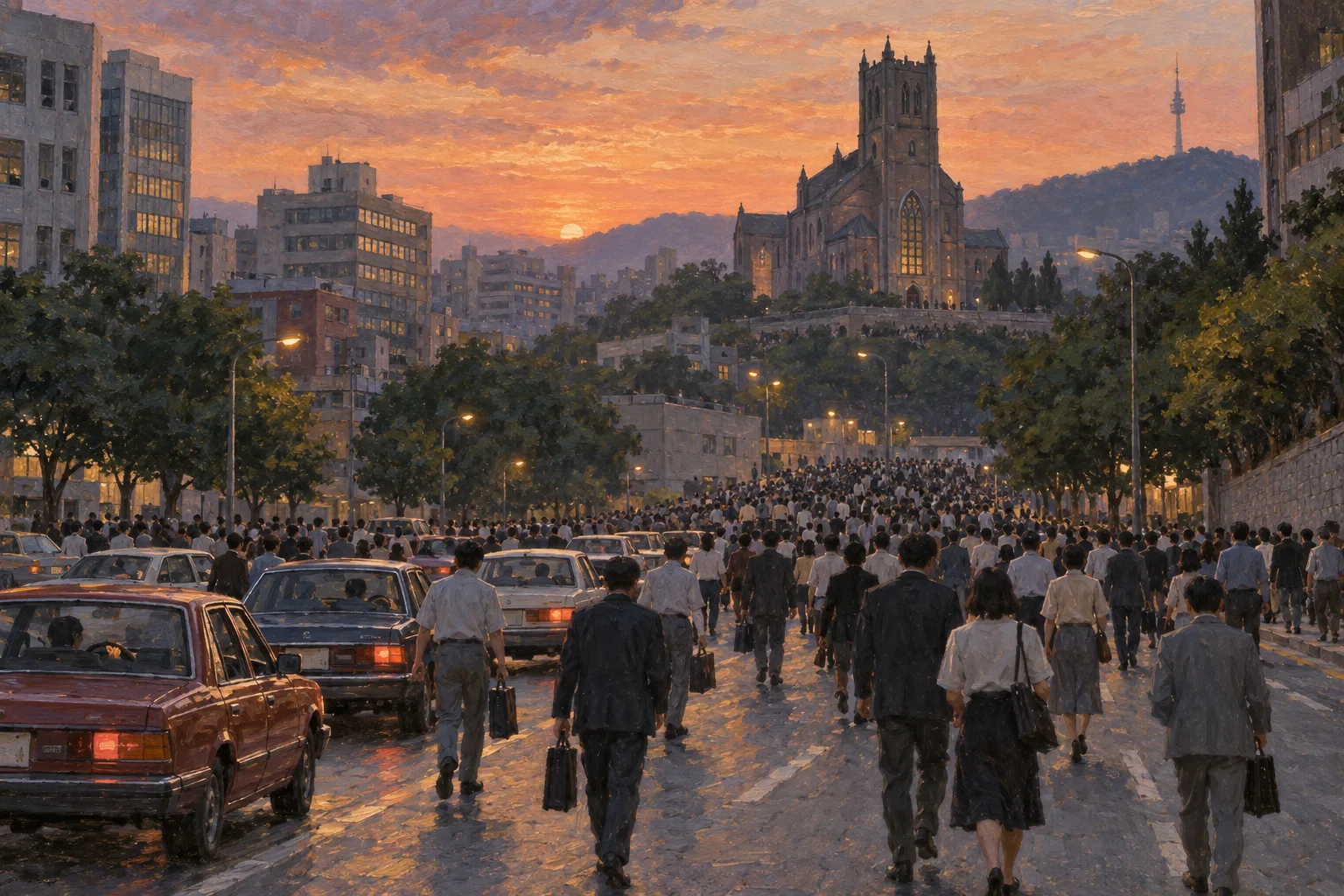
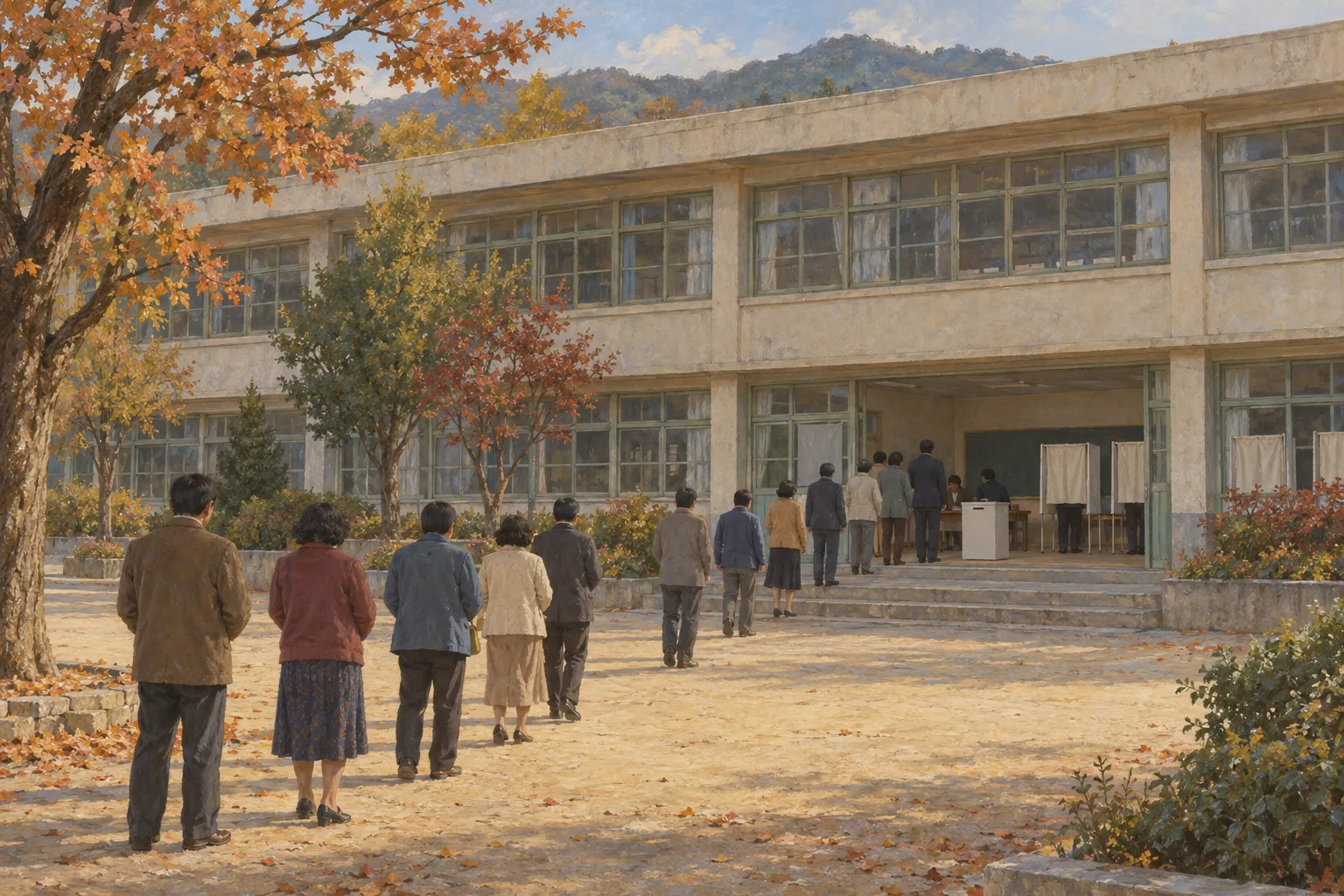
1987 June Democratic Struggle: Direct Election Amendment
The June Democratic Struggle was a nationwide pro-democracy movement in 1987 in which citizens opposed the move to retain the existing constitution and state violence. Growing public participation led to the acceptance of direct presidential elections. The constitutional amendment later went through a referendum and was promulgated.
- The 4·13 measure to retain the existing constitution was intended to maintain indirect presidential elections.
- The exposure of the cover-up in the Park Jong-chul case intensified calls for accountability for state violence.
- The 6·10 National Rally's action guidelines offered ways to take part even outside the rally site.
- The nationwide June uprising led to the 6·29 Declaration's promise of a constitutional amendment to introduce direct presidential elections.
- The constitutional amendment was confirmed in a referendum on October 27, 1987.
The June Democratic Struggle was a nationwide movement for democracy in which citizens opposed the policy of keeping the existing constitution and state violence in 1987. As participation in rallies and everyday acts of protest grew, the movement secured a promise to amend the constitution to allow direct presidential elections. It is remembered as an event in which citizens’ demands changed how the president was elected.
Records from the Korea Democracy Foundation and the National Institute of Korean History were compared in October 2026.
Why people opposed the April 13 measure to keep the existing constitution
The April 13 measure set out a policy of electing the next president under the existing constitution. At the time, the constitution provided for an indirect election in which a presidential electoral college chose the president. Citizens and opposition parties demanding a constitutional amendment for direct elections opposed the policy.
Discussions about amending the constitution had begun before 1987. The ruling party argued for an amendment to introduce a parliamentary system. The opposition’s central demand was that voters elect the president directly. Chun Doo-hwan’s announcement that the existing constitution would be maintained came amid this dispute. National Institute of Korean History Korean History Timeline
| Term | Meaning at the time |
|---|---|
| Keeping the existing constitution | Maintaining the existing constitution |
| Ending the policy of keeping the existing constitution | A demand to withdraw the April 13 measure and pursue a constitutional amendment |
| Indirect election | A system in which a presidential electoral college elects the president |
| Direct election | A system in which voters elect the president directly by ballot |
The Park Jong-chul case helped spread protests against state violence. Park Jong-chul, a Seoul National University student, died from police torture on January 14, 1987. After the case became known, memorial gatherings and a movement to uncover the truth followed.
On May 18 of the same year, the cover-up and downplaying of the case were made public. The Catholic Priests’ Association for Justice disclosed them. Demands to hold those responsible for the torture accountable joined the movement against keeping the existing constitution. Commentary on the “June 10 National Rally Declaration” in Korean History through Sources
Timeline of the 1987 struggle and constitutional amendment
The circumstances behind the struggle developed from January onward, and institutional changes continued after June. June 10 was the day nationwide rallies were held. The amendment introducing direct elections was confirmed by referendum on October 27.
| Date | Event | Confirming record |
|---|---|---|
| January 14, 1987 | Park Jong-chul died from police torture | National Institute of Korean History Korean History Timeline |
| April 13, 1987 | Chun Doo-hwan announced a policy of keeping the existing constitution | National Institute of Korean History Korean History Timeline |
| May 18, 1987 | The cover-up and downplaying of the Park Jong-chul case were made public | Commentary on the declaration in Korean History through Sources |
| May 27, 1987 | National Movement Headquarters for a Democratic Constitution formed | Korea Democracy Foundation Gukbon Collection |
| June 5, 1987 | Gukbon announced guidelines for action at the National Rally | Korea Democracy Foundation Gukbon Collection |
| June 9, 1987 | Lee Han-yeol was critically injured by a tear gas canister fired by police | National Institute of Korean History Korean History Timeline |
| June 10, 1987 | National Rallies held across the country | Commentary on the declaration in Korean History through Sources |
| June 10 to 15, 1987 | Sit-in at Myeongdong Cathedral continued | Commentary on the declaration in Korean History through Sources |
| June 18, 1987 | Rally to Ban Tear Gas held | Korea Democracy Foundation Gukbon Collection |
| June 26, 1987 | National Peace March held | Korea Democracy Foundation Gukbon Collection |
| June 29, 1987 | Roh Tae-woo announced acceptance of a constitutional amendment for direct elections | National Institute of Korean History Korean History Timeline |
| October 27, 1987 | Constitutional amendment confirmed by referendum | Korean History Database Chronology of the Republic of Korea |
| October 29, 1987 | Ninth amended constitution promulgated | National Archives of Korea, “Promulgation of Constitutional Amendment” |
| December 16, 1987 | 13th presidential election held by direct vote | Presidential Archives record of President Roh Tae-woo’s inauguration |
| February 25, 1988 | Amended constitution took effect | National Assembly Archives, Constitution of the Republic of Korea |
The role of the National Movement Headquarters and its guidelines for action
The National Movement Headquarters for a Democratic Constitution was a coalition that organized joint action nationwide. It was known by the shortened name Gukbon. It brought together opposition parties, civic groups, religious communities and other groups.
Gukbon was formed at Hyanglin Church in Seoul on May 27, 1987. It set June 10 as the date for the National Rally. On the same day, the Democratic Justice Party held its presidential nomination convention. Korea Democracy Foundation Gukbon Collection
The “June 10 National Rally Guidelines for Action” gave specific ways to participate. They stated when and where to gather for rallies. They also included ways for people who could not go to a rally site to take part.
| Participation situation | Plan in the guidelines for action |
|---|---|
| Participation by group and religious denomination | Hold National Rallies after 10 a.m. |
| Joint rally in Seoul | Gather at the Anglican Cathedral at 6 p.m. |
| Participation from wherever people were | Sing the national anthem and give three cheers, or observe a moment of silence |
| Participation by vehicles and religious facilities | Sound car horns and ring bells at temples, cathedrals and churches |
| Participation in the evening | Turn off lights for 10 minutes starting at 9 p.m. and refuse to watch broadcast news |
| Encouraging participation in advance | Call people on June 8 and 9 to encourage participation and support one another |
| National Rallies outside Seoul | Set times and places according to local circumstances and form organizing committees |
The original document repeatedly asks for nonviolent participation. It also leaves room to adjust times and places by region. This can be understood as an approach to organizing that combined shared guidelines with local autonomy. Original guidelines for action, Korea Democracy Foundation, registration number 00170898
How participation expanded from June 10 to 26
The June struggle grew as citizens continued to participate after the National Rally. The sit-in at Myeongdong Cathedral showed that the movement was continuing. Office workers joined as well, giving rise to the so-called “necktie brigade.”
Citizens joined marches or gave food and drinks to demonstrators. They also sounded car horns to show support. Participation spread beyond students and the established activist groups. Commentary on the declaration in Korean History through Sources
Lee Han-yeol’s injury from a tear gas canister on June 9 intensified protests. Rallies to ban tear gas were held across the country on June 18. The National Peace March on June 26 brought nationwide resistance together again.
Gukbon proposed dates and demands for joint action. Spontaneous demonstrations also continued in many places. Not every action on the ground can therefore be explained as following Gukbon’s instructions. Korea Democracy Foundation Gukbon Collection
The difference between the June 29 Declaration and the constitutional amendment for direct elections
The June 29 Declaration was a political promise to accept a constitutional amendment for direct elections. It was announced by Roh Tae-woo, the Democratic Justice Party’s presidential candidate. The announcement itself did not change the text of the constitution.
An amendment was then drafted through negotiations between the ruling and opposition parties. The National Assembly passed it on October 12, 1987. On October 27, 1987, the amendment was confirmed by referendum. National Archives of Korea, “Ninth Constitutional Amendment”
The Chronology of the Republic of Korea records a 93.1% vote in favor in the referendum. This percentage is based on those who voted. It does not mean that 93.1% of all eligible voters voted in favor. Korean History Database referendum record
| Stage | Meaning | Date |
|---|---|---|
| Political acceptance | Promise to pursue a constitutional amendment for direct elections | June 29, 1987 |
| Confirmation by referendum | Approval of the amendment by the people | October 27, 1987 |
| Promulgation | Official announcement of the confirmed amended constitution | October 29, 1987 |
| Election held | Voters directly elect the president | December 16, 1987 |
| Constitution took effect | Effective date set by the supplementary provisions arrived | February 25, 1988 |
The amended constitution’s supplementary provisions allowed a presidential election before the constitution took effect. The election date therefore preceded the effective date of the constitution. The difference between the dates follows from those provisions. Constitution of the Republic of Korea, supplementary provisions, Articles 1 and 2
The amendment also changed institutions beyond the method of electing the president. It abolished the president’s power to dissolve the National Assembly. It restored the National Assembly’s power to audit state affairs. It also introduced provisions strengthening the protection of fundamental rights. National Archives of Korea, “Promulgation of Constitutional Amendment”
The date of the guidelines for action and records of their implementation
The date the guidelines for action were announced must be distinguished from the date of creation listed in the archival catalog. The Gukbon Collection says the guidelines were announced on June 5, 1987. The creation date for registration number 00170898 is listed as June 10, 1987.
The catalog does not explain why the dates differ. The announcement date should not be changed based on the catalog date alone. The sequence of events and the catalog information for the individual document must be checked together. Gukbon Collection, Detailed archival record for the guidelines for action
The guidelines for action show what the organizers proposed. They are not evidence that the plan was carried out in every region. Photographs from the sites and records from the day must be compared to assess what participation took place.
Records and interpretation
The dates of events, demands made at the time and historical assessments should be read separately. Documents about the same event contain different information depending on their purpose. Figures for the scale of participation vary by source.
Facts confirmed by the records
The declaration shows that Gukbon demanded an end to the policy of keeping the existing constitution. The guidelines for action describe how participation was organized. Referendum records and records of the constitution’s promulgation confirm the dates of the institutional changes.
Shared assessment in historical accounts
Public historical commentaries describe nationwide citizen participation as a key reason direct elections were accepted. The National Institute of Korean History’s Korean History Timeline focuses on the continuing nationwide demonstrations. The Korea Democracy Foundation addresses both Gukbon’s organizing and the expansion of citizen participation. Korean History Timeline, Gukbon Collection
Where the sources differ
Two commentaries give different numbers of participating areas on June 26. They cannot readily be combined into one definitive figure. The scope and criteria of the counts need further checking.
| Source | Participating areas listed for June 26, 1987 |
|---|---|
| National Institute of Korean History commentary on the declaration in Korean History through Sources | 37 cities and counties |
| Korea Democracy Foundation Gukbon Collection | 33 cities, counties and towns |
This difference alone is not enough to conclude that either record is wrong. The two commentaries also use different units for counting areas. Any figure for the total number of participants should likewise be cited with the counting organization and period identified. Commentary on the declaration, Gukbon Collection
What it means for understanding today’s institutions
The June Democratic Struggle shows how citizens’ demands led to institutional change. Demands made in the streets went through political acceptance and the constitutional amendment process. Direct presidential elections were one result.
Protests against torture and its concealment demanded accountability from state authorities. The amended constitution explicitly required that people be informed of their rights when arrested or detained. It also prohibited licensing and censorship of the press and publications. National Archives of Korea, “Ninth Constitutional Amendment”
Introducing direct elections did not mean that every goal of democratization had been achieved. Demands from different parts of society continued, including the Great Workers’ Struggle. Changes to political institutions and the expansion of social rights need to be explained separately. Korea Democracy Foundation Gukbon Collection
Frequently asked questions
Are the June Democratic Struggle and the June 10 Democratic Struggle different events?
The names generally refer to the same democracy movement. “June 10” emphasizes the date of the nationwide National Rally. The struggle did not end after June 10.
How do the Park Jong-chul and Lee Han-yeol cases differ?
Park Jong-chul died from police torture in January 1987. Lee Han-yeol was struck by a tear gas canister during a demonstration on June 9 of the same year. The two cases spread protests at different times.
Are the guidelines for action and the National Rally declaration the same document?
The guidelines for action and the declaration are documents with different purposes. The guidelines state when and how to participate. The declaration sets out the movement’s demands and position, including its call to end the policy of keeping the existing constitution.
Did direct elections take effect on the day of the June 29 Declaration?
The June 29 Declaration was an announcement promising a constitutional amendment for direct elections. The amendment went through a referendum that October. The presidential election was held on December 16.
Did the introduction of direct elections mean an immediate transfer of power to the opposition?
Introducing direct elections and transferring power to the opposition are different things. In the December 1987 election, the ruling party’s candidate, Roh Tae-woo, won. The change in the method of election must be distinguished from the election result. Presidential Archives record of President Roh Tae-woo’s inauguration
FAQ
What was the June Democratic Struggle?
It was a nationwide pro-democracy movement against efforts to preserve the existing constitution and against state violence in 1987. The citizens' protests led to the acceptance of a constitutional amendment introducing direct presidential elections.
What did the April 13 measure to preserve the existing constitution seek to maintain?
It sought to maintain the indirect presidential election system under the existing constitution. It faced demands from citizens and opposition parties for a constitutional amendment to allow direct presidential elections.
What impact did the exposure of the cover-up of the Park Jong-cheol case have?
The cover-up and downplaying of the case were made public on May 18, 1987. Demands to hold those responsible for state violence accountable joined the movement opposing efforts to preserve the existing constitution.
What was the National Movement Headquarters for a Democratic Constitution?
It was a coalition of pro-democracy groups formed on May 27, 1987. Opposition parties, dissident groups, and religious organizations were among its participants. It organized nationwide public rallies.
What did the guidelines for the June 10 National Rally cover?
They specified the time and place of the rally and ways to participate nonviolently. They also suggested ways to take part from outside the rally sites, such as honking car horns, ringing bells at religious facilities, and turning off lights.
Are the date the guidelines were announced and the date in the archival record listing the same?
The National Movement Headquarters collection gives the announcement date as June 5, 1987. The production date for archival record registration number 00170898 is listed as June 10. The listing does not explain the difference between the two dates.
How many localities took part in the June 26 National Peace March?
The National Institute of Korean History's commentary on the declaration lists 37 cities and counties. The Korea Democracy Foundation's National Movement Headquarters collection records 33 cities, counties, and towns. When citing these figures, the source and the unit of counting should be stated.
How did the June 29 Declaration differ from the constitutional amendment?
The June 29 Declaration was a political promise to accept a constitutional amendment introducing direct presidential elections. The proposed amendment was approved in a referendum on October 27, 1987. The revised constitution was promulgated on October 29.
What does the 93.1% vote in favor in the 1987 constitutional referendum mean?
It is the percentage in favor among those who voted. It does not mean that 93.1% of all eligible voters voted in favor.
Why was the presidential election held before the revised constitution took effect?
Because the supplementary provisions of the revised constitution allowed a presidential election before it took effect. The election was held on December 16, 1987. The constitution took effect on February 25, 1988.
Did the introduction of direct presidential elections immediately bring the opposition to power?
The ruling party's candidate, Roh Tae-woo, won the 1987 presidential election. The introduction of direct presidential elections should be distinguished from a transfer of power to the opposition.
Sources
- Korea Democracy Foundation Open Archive, 6.10 National Rally Guidelines for Action
- Korea Democracy Foundation Open Archive, National Movement Headquarters for the Achievement of a Democratic Constitution
- National Institute of Korean History Korean History Chronology, June 1987 Democratic Struggle
- National Institute of Korean History Korean History Through Historical Sources, Declaration and Commentary on the 6·10 National Rally
- National Institute of Korean History Chronology of the Republic of Korea, October 27, 1987 Constitutional Amendment Referendum
- National Archives of Korea Thematic Explanations by Area of Government Administration, Ninth Constitutional Amendment
- National Archives of Korea Chronology and Records, Promulgation of the Constitutional Amendment
- National Assembly Archives, Constitution of the Republic of Korea, Constitution No. 10
- Presidential Archives, Records of the Inauguration of the 13th President Roh Tae-woo
Images