Meta Muse Glimmer: Key Facts About a 30-Billion-Parameter Local AI Model for Laptops
Muse Glimmer was introduced as a multimodal model quantized to run approximately 30 billion parameters on consumer hardware and designed as a long-running, tool-using local AI agent. However, because the memory, speed, and benchmark figures are Meta's own measurements cited in the provided materials, they need to be verified through the official model card and independent evaluations.
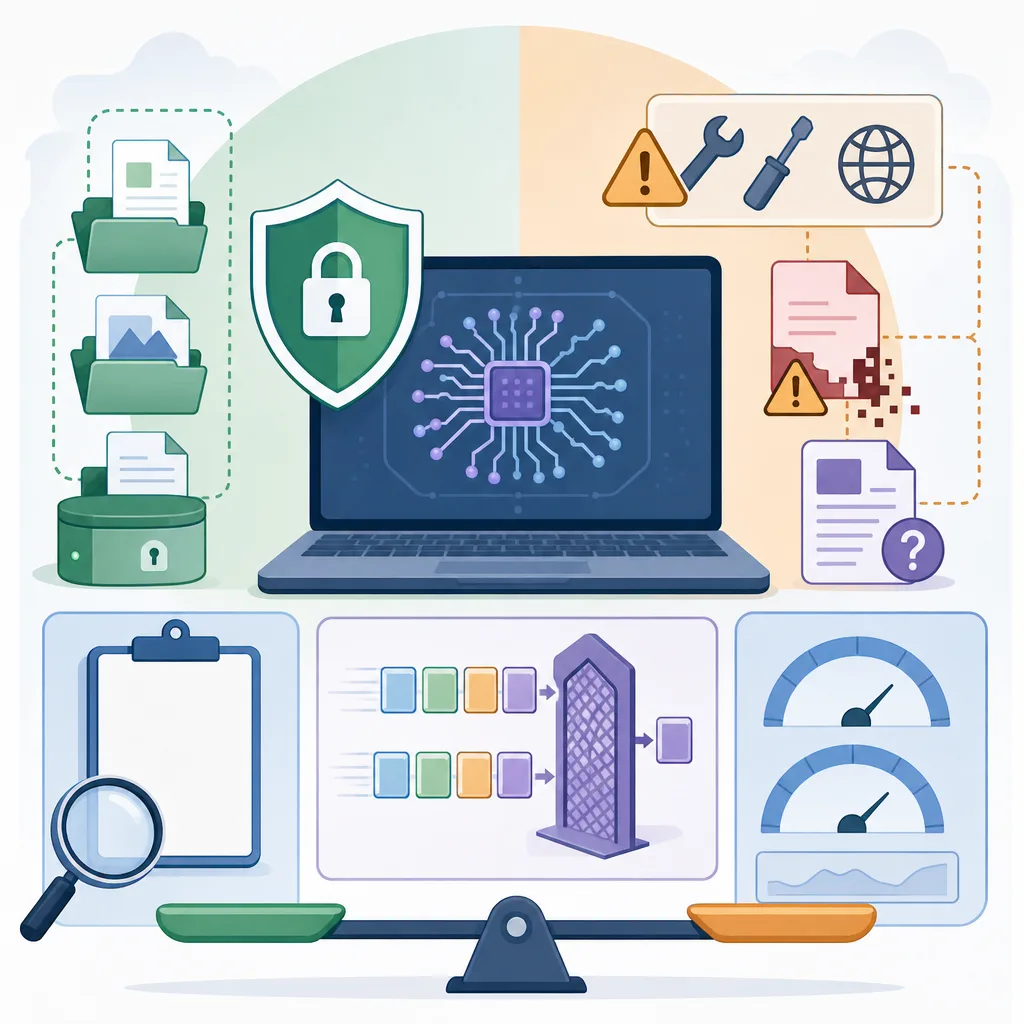
- Muse Glimmer aims to be a long-running AI agent that handles files, screens, and tools, rather than merely a local chatbot.
- According to the provided materials, the 4-bit quantized version was designed to run the entire system in an environment with about 24GB or 32GB of memory.
- Speculative Decoding using a DFlash drafter processes multiple candidate tokens at once, subject to verification by the main model.
- Local processing can reduce external data transmission, but it does not eliminate the risks of prompt injection, excessive system permissions, or file corruption.
- Performance and licensing should be assessed only after reviewing the official repository's model card, the actual license file, and independent hardware-specific measurements.
Meta Muse Glimmer was introduced as a model designed to run a model with approximately 30 billion parameters on a personal PC or high-performance laptop and build long-running local AI agents on top of it. Its core goal is to go beyond text generation by understanding images and screens and using tools such as files, functions, and terminals across multiple steps.
The product specifications and benchmark figures in this article are based on Meta announcements cited in the provided materials. Because direct URLs to the original article and official model card were not provided, the figures should not be interpreted as independently verified results.
Key Specifications of Muse Glimmer
The main specifications described in the provided materials are as follows.
| Item | Introduced details | Points to consider when interpreting |
|---|---|---|
| Model size | Approximately 30 billion parameters | The actual number of active parameters and detailed architecture need to be checked in the model card |
| Input formats | Text and images | Supported image resolution, frame count, and vision token costs need to be checked separately |
| Context | At least up to 131,072 tokens | Accuracy and memory usage at the maximum length may differ from those with short inputs |
| Languages | At least 100 languages | This does not mean quality is identical across languages |
| Low-precision versions | K-Quant-17GB, K-Quant-Dynamic | The capacity included in the name must be distinguished from total runtime memory |
| Primary uses | Coding, desktop automation, function calling, document analysis, evaluation | Actual capabilities depend on the connected runtime and permission policies |
| Acceleration method | Speculative Decoding using the DFlash drafter | The degree of acceleration varies depending on hardware and input length |
| Release formats | BF16, 4-bit quantization, drafter model | Available files and supported runtimes need to be checked in the repository |
| License | Introduced as Apache License 2.0 | The actual LICENSE and any additional terms of use in the model repository need to be checked |
How 30 Billion Parameters Can Run in 24GB
A Simple Calculation of Weight Memory
Considering only the model weights, the required storage can be estimated as follows.
- BF16 or FP16: 30 billion × 2 bytes = approximately 60GB
- 8-bit: 30 billion × 1 byte = approximately 30GB
- 4-bit: 30 billion × 0.5 bytes = approximately 15GB
Quantization scales, metadata, alignment, and runtime overhead are added to 4-bit weights. Therefore, the approximately 17GB weight package mentioned in the provided materials may be larger than the theoretical 15GB.
Memory Required Beyond the Weights
Having a 17GB model file does not mean it can run directly on a device with 17GB of memory. Actual inference additionally uses space for the following components.
- The KV cache that preserves input and output history
- A vision encoder that processes image inputs
- Intermediate activations and runtime workspace
- Auxiliary models such as the DFlash drafter
- Memory used by the operating system, desktop, and other applications
- Buffers and copy space between GPU and system memory
The provided materials describe K-Quant-17GB as a version designed for an approximately 24GB environment and K-Quant-Dynamic as one designed for an approximately 32GB environment. However, actual execution instructions must be checked to determine whether this memory refers to dedicated VRAM, unified memory such as Apple Silicon, or a configuration that also uses part of the system RAM.
The KV cache also grows as the context becomes longer. Therefore, a specification stating support for 131,072 tokens alone does not establish that the maximum length can always be used in a 24GB environment.
Why It Was Designed as a Local AI Agent
The type of agent Muse Glimmer aims to support differs from a chatbot that answers a question once and stops. A typical workflow is as follows.
- Interpret the user's goals and constraints.
- Plan the subtasks required for completion.
- Call file search, function, terminal, or browser tools.
- Read execution results and error messages.
- Revise the plan or code.
- Run testing or verification tools again.
- Repeat the process until the completion criteria are met.
For example, when fixing a project error, source analysis, command execution, log reading, code changes, testing, and further revisions occur in sequence. Because model inference is repeated at each step, not only response speed but also the accuracy of tool calls, failure recovery capabilities, and state retention are important.
Training Methods and Agent Capabilities
According to the provided materials, Muse Glimmer was pretrained using a distillation method that leveraged the outputs of a larger teacher model, Muse Spark. Data for long contexts and agent tasks was subsequently added, and supervised learning, on-policy distillation, and reinforcement learning were reportedly used for post-training.
The general role of each method can be understood as follows.
- Distillation: Trains a smaller model to imitate the outputs or behavior of a larger teacher model.
- Supervised learning: Provides desirable responses, function calls, or task procedures as correct examples.
- On-policy learning: Corrects errors based on behavioral trajectories actually generated by the current model.
- Reinforcement learning: Optimizes rewards such as task success, correct tool use, and compliance with safety rules.
These training procedures do not automatically guarantee an agent's success rate. The scope of the training data, evaluation environment, tool definitions, and execution sandbox have a major impact on the results.
Multimodal Capabilities and Applications
Muse Glimmer was introduced as a multimodal model that understands image inputs in addition to text. Expected inputs and use cases include the following.
| Visual input | Example possible tasks |
|---|---|
| PC screen capture | Interpret error messages or UI status |
| Document image | Extract and summarize the contents of tables, paragraphs, and forms |
| Graphs and charts | Read and explain axes, legends, and trends |
| GUI screen | Identify buttons and input fields to plan the next action |
| Development tool screen | Analyze terminal output or debugger status |
| Multiple files and images | Compare documents and retain records of long-running tasks |
Visual understanding and actual computer operation are separate capabilities. Even if the model interprets a screen, operating a mouse or keyboard requires a separate agent runtime, accessibility interface, or automation tool.
DFlash and Speculative Decoding
Autoregressive language models generally calculate the next token sequentially based on previously generated tokens. Speculative Decoding works by having a smaller drafter model propose multiple candidate tokens first and having the main model verify those candidates at once.
The process can be summarized as follows.
- The DFlash drafter proposes a group of tokens likely to come next.
- The main Muse Glimmer model verifies the proposed tokens.
- Tokens that match the main model's distribution are accepted.
- Generation resumes from the point where they do not match.
When an exact verification procedure is used, generation time can be reduced while preserving the main model's output distribution. However, if the drafter's prediction hit rate is low or memory bandwidth is insufficient, the speedup may fall short of expectations.
Generation Speeds Presented in the Provided Materials
The following figures were introduced as Meta's own measurements using the DFlash drafter with K-Quant-17GB. They are not independent benchmarks, and direct comparisons are limited when hardware settings, prompts, context length, runtime, and power conditions are not provided.
| Hardware | Baseline speed | With DFlash | Reported improvement |
|---|---|---|---|
| NVIDIA GeForce RTX 5090 | 74.9 tokens/second | 233.4 tokens/second | Approximately 3.1× |
| Apple M5 Max | 26.6 tokens/second | 50.2 tokens/second | Approximately 1.8× |
| Apple M4 Max | 23.7 tokens/second | 37.8 tokens/second | Approximately 1.5× |
Because an agent performs inference multiple times and waits for external tools, token generation speed does not equal the total task time. Actual completion time also includes prompt processing speed, file input/output, code execution, network access, and the number of tool retries.
How to Read the Benchmark Results
The provided materials compare Muse Glimmer with Gemma 4 31B and Qwen 3.6 27B and present the following results.
| Benchmark | Muse Glimmer | Gemma 4 31B | Qwen 3.6 27B |
|---|---|---|---|
| MCP Atlas | 75.5 | 54.2 | 62.5 |
| DeepSearch QA | 74.6 | No figure in the materials | No figure in the materials |
At the same time, Qwen 3.6 27B was reported to have achieved higher results than Muse Glimmer on OSWorld Verified, TerminalBench 2.1, and SWE-bench Verified. This means that task-specific evaluations are more important than a single average score.
The following should be checked when reviewing benchmarks.
- Were the same model precision and quantization conditions used?
- Were the number of tool calls and time limits identical?
- Were the agent prompts and orchestration code disclosed?
- Were the image resolution and maximum context the same?
- Were averages and variance across multiple runs provided?
- Was the possibility that evaluation data was included in the training data examined?
- Were failed tasks left without human correction or restarting?
According to the provided materials, across an average of 15 benchmarks, K-Quant-Dynamic showed an approximately 0.2% performance decrease relative to the original, while K-Quant-17GB showed an approximately 1% decrease. These figures were also introduced as values from Meta's own evaluations, and the decline for individual tasks may differ from the average.
Privacy Benefits and Limitations of Local Execution
A fully local configuration can help create a system that does not transmit source code, internal documents, screen captures, or database contents to an external LLM API. It also offers the advantages of operating on an isolated network and avoiding external API usage fees charged per token.
However, the fact that the model file is local does not mean all data flows remain local. The following components may connect to external services.
- Web search or remote browser tools
- Error and usage analytics telemetry
- Extensions and agent plugins
- Cloud-based document repositories
- Package managers and code repositories
- Remote embedding, search, or evaluation services
Organizations handling sensitive information should inspect network logs and running processes and review the data paths of all connected tools, not just the model runtime.
Security Risks and Mitigations for Local Agents
Local AI can reduce transmission risks, but risks arising from system permissions may instead increase. Particular attention should be paid to indirect prompt injection, in which instructions hidden in external documents or web pages alter the agent's original goal.
Recommended defensive measures include the following.
- Run it in a read-only workspace first.
- Allow access only to required folders rather than the entire home directory.
- Require human approval for deletion, overwriting, fund transfers, and deployment.
- Block administrator privileges and access to core operating system folders.
- Do not place secret keys or authentication tokens directly in the model context.
- Apply allowlists and execution time limits to terminal commands.
- Treat text from external documents as untrusted data.
- Create a snapshot or version-control commit before making changes.
- Record all tool calls and file changes in audit logs.
- Test it in a container or virtual machine separated from the actual production environment.
In healthcare, finance, law, defense, and the public sector, local processing alone does not complete regulatory compliance. Access controls, record retention, approval by responsible personnel, data classification, and model validation are also required.
What an Apache 2.0 Release Means
The provided materials state that the Muse Glimmer weights were released under Apache License 2.0. Apache 2.0 is generally a permissive license that allows use, modification, distribution, and commercial use and includes explicit patent provisions. Redistribution must comply with conditions such as retaining a copy of the license, preserving copyright notices, and indicating changes.
However, the following need to be checked separately when actually using the model.
- Whether each model file is truly covered by Apache 2.0
- Whether the model card or repository includes additional usage restrictions
- Whether the included code and tokenizer use the same license
- Whether the vision encoder and drafter model have separate terms
- Whether trademark rights or third-party data rights are included within the scope of the permission
Releasing the weights does not mean that the entire training process is open source. According to the provided materials, the complete training data and complete training code were not released. Therefore, while Muse Glimmer can be called an open-weight model, it should not be characterized as a fully open-source model whose entire training process can be reproduced.
Checklist Before Adoption
When evaluating the product, results reproducing your own tasks are more important than the maximum speed stated in press materials.
- Verify the official distributor and model repository.
- Check the architecture, context, supported languages, and input formats in the model card.
- Have legal personnel review the LICENSE file and any additional terms of use.
- Measure peak memory usage, including the model, KV cache, vision encoder, and drafter.
- Evaluate accuracy, tool success rate, and failure recovery rate using actual documents and code.
- Measure input processing speed and memory growth with long contexts.
- Block network access and verify that all features actually operate locally.
- Conduct attack tests using prompt injection and malicious files.
- Apply human approval and automatic backups to important changes.
- Compare task-specific quality differences between the quantized versions and the original BF16 version.
Overall Assessment
Muse Glimmer's distinguishing feature lies less in a claim that it is a general-purpose model with the highest scores across all benchmarks and more in its design goal of bringing a multimodal model with approximately 30 billion parameters and long-running agent capabilities to consumer hardware. If 4-bit quantization, long context, DFlash acceleration, and a permissive license are provided as stated in the official materials, it could become a meaningful option for local coding, document analysis, and automation on isolated networks.
On the other hand, references to 24GB or 32GB do not guarantee that all model capabilities and the maximum context will operate smoothly on every device. Until the official model card and reproducible benchmarks are available, the speed and quality figures should be distinguished as claims based on Meta's own measurements, and memory, security, and accuracy should be evaluated using actual workloads.
FAQ
How is Muse Glimmer different from typical local LLMs?
Unlike chatbots that only generate text responses, its main goal is to serve as a long-running AI agent that analyzes files and screens, invokes tools such as functions or terminals, checks the results, and revises its plans.
Can a 30-billion-parameter model really run with 24GB of memory?
The provided materials explain that the 4-bit K-Quant-17GB version was optimized for an environment with about 24GB of memory. However, the required memory varies depending on the context length, vision input, KV cache, drafter model, and operating system usage, so 24GB should not be interpreted as a guaranteed minimum requirement under all usage conditions.
Why are the 17GB model size and 24GB runtime memory requirement different?
17GB primarily refers to the quantized weights package. Actual execution additionally requires memory for the KV cache, intermediate activations, vision encoder, runtime workspace, and operating system.
Can the 131,072-token context always be used?
Even if the model supports that length, the actual maximum may be limited by the runtime, memory, KV cache precision, and amount of image input. Whether information retrieval accuracy is maintained at the maximum length must also be evaluated separately.
Does the DFlash drafter reduce the model's response quality?
Speculative Decoding is designed so that the main model verifies the tokens proposed by the drafter, so when implemented correctly, it can preserve the main model's output distribution. However, the results and degree of acceleration may vary depending on the implementation method and sampling settings.
If it runs locally, does that mean data never leaves the device?
No. Even if the model is local, web searches, plugins, remote repositories, telemetry, or cloud embedding tools may transmit data. The network communications of the entire agent setup must be reviewed.
What permissions are safe to grant a local AI agent?
It is advisable to grant minimum permissions only to the necessary work folders and initially run it in read-only mode. Human approval should be required for high-risk tasks such as deleting files, transmitting data externally, installing software, and deploying.
Does Apache 2.0 allow unrestricted commercial use?
Apache 2.0 itself is a permissive license that allows commercial use, modification, and redistribution. However, you must check the LICENSE and model card in the official repository to determine whether that license applies to the actual model files and whether there are additional terms or third-party components.
Is Muse Glimmer a fully open-source model?
According to the provided materials, the weights have been released, but the complete training data and training code have not. Therefore, it can be described as an open-weight model, but a distinction must be made as to whether it is a fully open-source model whose entire training process can be reproduced.
Can Meta's reported speeds and benchmarks be taken at face value?
Internal measurements are useful as initial reference material but are not a substitute for independent verification. Reproduction results using the same quantization, runtime, context length, power settings, and agent tools are needed.
Sources
Images