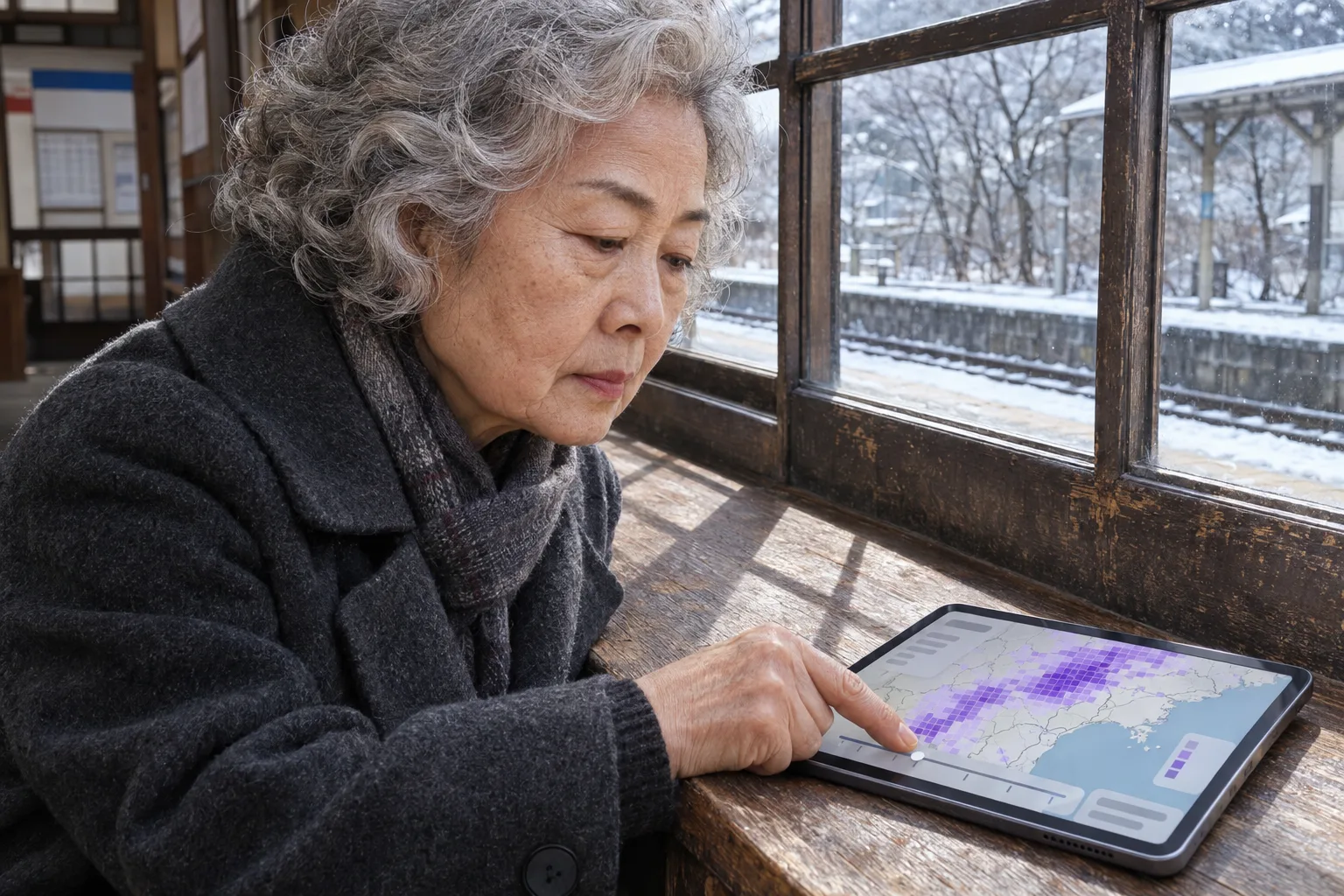
Japan 6-Hour Snowfall Forecast Map and Heavy Snow Warnings
The Japan Meteorological Agency's Korean-language snowfall map shows where snow was on the ground over the past 24 hours and gives the forecast for the next 6 hours. To see whether heavy snow or blizzard warnings have been issued for your destination or stops along the way, check the separate Korean-language "Weather Warnings and Advisories" table.
- On November 12, 2026, the Japan Meteorological Agency added short-term snowfall forecasts to its disaster preparedness pages in 15 languages, including Korean.
- Snow depth is the thickness of the snow on the ground at the selected time. Snowfall is the amount of new snow that accumulates over a given period.
- "6-hour snowfall" is the amount of new snow that accumulated in the 6 hours ending at the selected time. "Up to 6 hours ahead" tells you how far ahead the forecast goes.
- The short-term snowfall forecast updates the averages every hour for areas about 5 km on each side.
- Before traveling, check for heavy snow and blizzard warnings and advisories at your destination and each stop along the way.
The Japan Meteorological Agency’s Korean-language snowfall map shows where snow has been on the ground over the past 24 hours. It also shows where and how much snow is forecast to accumulate over the next 6 hours. Check “Weather Warnings and Advisories” separately for heavy snow and blizzard warnings at your destination and along your route.
The map’s coverage is based on the Japan Meteorological Agency’s November 12, 2026 notice.
How to find the Japan Meteorological Agency’s Korean-language snowfall map
Select Korean on the Japan Meteorological Agency’s multilingual disaster preparedness page to access the snowfall forecast. The Japanese name of the service is Kongo no Yuki (今後の雪). The map was added to pages in 15 languages, including Korean, on November 12, 2026.
- Select “Korean” from the language list on the Japan Meteorological Agency’s multilingual disaster preparedness page.
- On the Korean-language disaster preparedness homepage, open the short-term snowfall forecast.
- Find the area on the map and select either snow depth or snowfall for the period you want to check.
- Select a time within the past 24 hours on the timeline to see analyzed values. Move past the reference time to see forecasts up to 6 hours ahead.
Japan’s Ministry of Land, Infrastructure, Transport and Tourism also links to the same map from its Korean-language disaster preparedness portal. Look for “Upcoming Snow (Short-Term Snowfall Forecast)” under “Weather Conditions.” The portal describes what you can see on the map.
Snow depth, snowfall distribution, and forecast information issued by the Japan Meteorological Agency
“Weather Conditions,” Japan’s Ministry of Land, Infrastructure, Transport and Tourism disaster preparedness portal
The difference between snow depth and cumulative snowfall
Snow depth is the thickness of the snow remaining on the ground at a given time, while snowfall is the amount of new snow that accumulates over a set period. Both are measured in centimeters (cm). Snow depth also reflects any decrease caused by earlier snow melting or compacting.
| Map item | Time basis | What it shows |
|---|---|---|
| Snow depth | Selected time | The thickness of the snow on the ground at that time |
| 6-hour snowfall | The 6 hours ending at the selected time | The amount of new snow that accumulated during that period |
| 3-, 12-, 24-, 48-, and 72-hour snowfall | Each period ending at the selected time | The amount of snow that fell in a short burst or accumulated over several days |
The Japan Meteorological Agency adjusts its calculated snow depths using readings from snow depth gauges. On the analysis map, the increase in snow depth over an hour is counted as snowfall for that hour. If the depth decreases, the analyzed snowfall for that hour is 0 cm.
Example: Reading the 5 p.m. map using the 11 a.m. forecast
To see how much snow is forecast to fall in the 6 hours after 11 a.m., set the display time to 5 p.m. This example comes from the Japan Meteorological Agency’s map guide. Even with the display set to 5 p.m., the value you read depends on which item you select.
| Item selected for 5 p.m. | What the value shows |
|---|---|
| Snow depth | The thickness of the snow expected to remain on the ground at 5 p.m. |
| 3-hour snowfall | The amount of new snow expected to accumulate from 2 p.m. to 5 p.m. |
| 6-hour snowfall | The amount of new snow expected to accumulate from 11 a.m. to 5 p.m. |
In this example, the snow from 2 p.m. to 5 p.m. is already included in the 6-hour snowfall. Adding the two values counts the snow from the last 3 hours twice. For the same reason, the 72 hours in “72-hour snowfall” is the period over which snowfall is totaled. Forecasts are available up to 6 hours after the reference time.
Can the snowfall map show conditions on individual roads?
Each map cell shows average snow conditions for an area about 5 km on each side. The Japan Meteorological Agency issues a new forecast every hour. The analyzed values are also estimates based on observations, so they may differ from actual snow conditions on roads within the same cell.
According to the Japan Meteorological Agency’s guide to short-term snowfall forecasts, forecast snowfall tends to be lower than actual snowfall. The agency advises against taking individual grid values at face value and recommends using them to get a general sense of where snow is distributed. To find out whether a particular road is passable, check the traffic information from the authority responsible for that road.
How to check for heavy snow and blizzard warnings at your destination and along your route
Check “Weather Warnings and Advisories” on the Japan Meteorological Agency’s Korean-language homepage for local warnings and advisories. The colors on the snowfall map show the amount of snow. The warning table shows information issued by the agency based on the risk of a disaster.
- In “Weather Warnings and Advisories,” open the area that includes your destination.
- Find the name of your destination’s city, ward, town, or village in the detailed table. In the table for the Tokyo region of Tokyo Metropolis (東京都), you can view the 23 wards and the Tama (多摩) area separately.
- Check for heavy snow or blizzard warnings and advisories, and note when they were issued.
- Check the areas you’ll pass through in the same way. Outlooks from local weather offices are available on the Japan Meteorological Agency’s heavy snow and blizzard disaster preparedness portal.
| Heavy snow information | When the Japan Meteorological Agency issues it |
|---|---|
| Early advisory information | When snowfall severe enough to warrant a warning is expected within the next 5 days |
| Heavy snow warning | When there is concern about a disaster with major impacts on society, typically 3 to 6 hours before it is expected |
| Urgent weather bulletin on short-term heavy snowfall | When heavy snow falls in a short period, raising the risk of a serious disaster and calling for greater vigilance |
The snowfall outlook for the entire winter and the risks on the day you travel cover different time frames. At a November 18, 2026 press conference, the head of the Japan Meteorological Agency explained that heavy snow can fall if cold air moves in temporarily. He urged people not to drive on summer tires when traveling to areas with heavy snow.
FAQ
Where do I go to view the Japan Meteorological Agency's snowfall map in Korean?
Select ‘Korean’ on the Japan Meteorological Agency's multilingual disaster prevention page, then open the short-term snowfall forecast. On the Ministry of Land, Infrastructure, Transport and Tourism's Korean-language disaster prevention portal, ‘Snow Ahead (Short-Term Snowfall Forecast)’ under ‘Weather Conditions’ links to the map.
What settings show how much snow will fall over the next 6 hours?
Select ‘6-Hour Snowfall’ and set the display time to 6 hours after the forecast reference time. If the reference time is 11 a.m., the 5 p.m. view shows how much snow is expected to fall between those times.
If I select 72-hour snowfall, can I also see the weather three days from now?
The 72 hours are the period over which snowfall is added up, ending at the time selected on the map. The short-term snowfall forecast looks ahead at most 6 hours from the reference time.
Why is there still snow on the ground when the one-hour snowfall is 0 cm?
Snow that fell earlier may still be on the ground. In the Japan Meteorological Agency's analysis, if the snow depth stays the same or decreases during that hour, the snowfall is shown as 0 cm.
Is the snow distribution over the past 24 hours based on direct measurements at every location?
The analysis map uses estimates obtained by calculating snow depth and then adjusting it using readings from snow depth gauges. The map also covers areas without gauges, but the estimates may differ from actual measurements at individual locations.
Can I tell whether a road is passable from the snowfall amounts shown near it?
The snowfall map shows average conditions for areas about 5 km on each side. To find out whether a specific road is passable, check the road authority's traffic information.
Which warnings should I check if I pass through other areas on the way to my destination?
Check the latest bulletins for each city, ward, town, or village along your route, including your destination. The detailed table on the Japan Meteorological Agency's Korean-language ‘Weather Warnings and Advisories’ page lists bulletins about heavy snow and blizzards by area.
Sources
- Japan Meteorological Agency Multilingual Disaster Prevention Information: Language Selection
- Japan Meteorological Agency Korean-Language Disaster Prevention Information Homepage
- Japan Meteorological Agency Notice: Snowfall Map Added to the Multilingual Page, November 12, 2026
- Japan's Ministry of Land, Infrastructure, Transport and Tourism Korean-Language Disaster Prevention Portal: Weather Conditions
- Japan Meteorological Agency Map of Snow Depth and Total Snowfall
- Japan Meteorological Agency: How Snow Depth and Snowfall Analyses and Short-Term Forecasts Are Calculated and What to Keep in Mind When Using Them
- Japan Meteorological Agency: How to Use the Snowfall Map and an Example Forecast as of 11 a.m.
- Japan Meteorological Agency Weather Warnings and Advisories in Korean: Tokyo Metropolis, Tokyo Region
- Japan Meteorological Agency Disaster Prevention Weather Information Portal for Heavy Snow and Blizzards
- Japan Meteorological Agency: When and Under What Conditions Heavy Snow Information Is Issued
- Summary of the Japan Meteorological Agency Director-General's Press Conference, November 18, 2026
Images