Yi Sun-sin's 1597 Navy Rebuild and Battle of Myeongnyang
After the defeat at Chilcheollyang in 1597, Yi Sun-sin gathered the remaining ships and troops and won the Battle of Myeongnyang. This account explains how the navy was rebuilt and the conditions of the battle, distinguishing figures in the records from later interpretations.
- The defeat at Chilcheollyang dealt a major blow to the Joseon navy's ships, personnel, command structure, and supply base.
- Rebuilding the navy required both securing the remaining warships and bringing experienced officers and sailors into its ranks.
- The victory at the Battle of Myeongnyang on the 16th day of the ninth lunar month in 1597 resulted from the combined effects of terrain, currents, ships, weapons, and the responses of officers and sailors.
- Even after the Battle of Myeongnyang, the Joseon navy moved its base while securing personnel and supplies.
- When citing Nanjung Ilgi, the original handwritten draft must be distinguished from later collected editions.
After the defeat at Chilcheollyang in 1597, Yi Sun-sin gathered the scattered naval forces. With the remaining warships and experienced officers and men, he won at Myeongnyang on September 16 of the lunar calendar. The battle is remembered for preserving the foundation that allowed the navy to survive and rebuild its strength.
This article follows 『Nanjung Ilgi』 and explanations by Our History Net. It was checked in October 2026.
What period of Yi Sun-sin’s life was 1597?
1597 was the year Yi Sun-sin lost command of the navy and then regained it. He was born in 1545 and passed the military service examination in 1576. After serving in the northern region, he became the Left Naval Commander of Jeolla in 1591.
During the Imjin War in 1592, he won battles at Okpo and Hansando, among other places. In 1593, he was appointed Commander-in-Chief of the Naval Forces of the Three Provinces. This post commanded the naval forces of Gyeongsang, Jeolla, and Chungcheong. The main events of his life can be found in the Encyclopedia of Korean Culture entry “Yi Sun-sin”.
Timeline from the defeat at Chilcheollyang to Myeongnyang
Rebuilding the navy involved assessing the defeat and gathering the remaining forces. The months and days below are lunar dates from records of the time. They have not been converted to the solar calendar.
| Date | Event | Source |
|---|---|---|
| July 16, 1597 | The navy under Won Gyun suffered a major defeat at Chilcheollyang | Our History Net, “Battle of Myeongnyang” |
| July 18, 1597 | After hearing news of the defeat, Yi began surveying coastal areas | Our History Net, “Battle of Myeongnyang” |
| August 3, 1597 | Yi received the order reappointing him Commander-in-Chief of the Naval Forces of the Three Provinces | Our History Net, “Battle of Myeongnyang” |
| August 19, 1597 | At Hoeryeongpo, Yi took possession of the warships held by Bae Seol | Our History Net, “Battle of Myeongnyang” |
| August 29, 1597 | Yi moved to Byeokpajin | Encyclopedia of Korean Culture, “Battle of Myeongnyang” |
| September 15, 1597 | Yi moved his camp to the Right Naval Headquarters of Jeolla | Encyclopedia of Korean Culture, “Battle of Myeongnyang” |
| September 16, 1597 | Yi repelled the Japanese navy at the Battle of Myeongnyang | Our History Net, “Battle of Myeongnyang” |
| November 19, 1598 | Yi was killed at the Battle of Noryang | Encyclopedia of Korean Culture, “Yi Sun-sin” |
What did the defeat at Chilcheollyang destroy?
The defeat at Chilcheollyang destroyed the Joseon navy’s operational foundation. Many ships were lost, and the officers and men were scattered. Senior commanders were killed, and supplies stored on Hansando were also lost.
Yi Sun-sin had previously been dismissed after a dispute over an order to go into battle. He was then serving under Gwon Yul without an official post. This meant he was assigned military duties despite holding no office.
After the defeat, the court needed a commander to take charge of the navy again. The 『Revised Annals of King Seonjo』 records recommendations by Kim Myeong-won and Yi Hang-bok to reappoint Yi. It also records that King Seonjo accepted them. This is the substance of the article “Reappoint Yi Sun-sin as Commander-in-Chief”.
How were the remaining ships and people brought together?
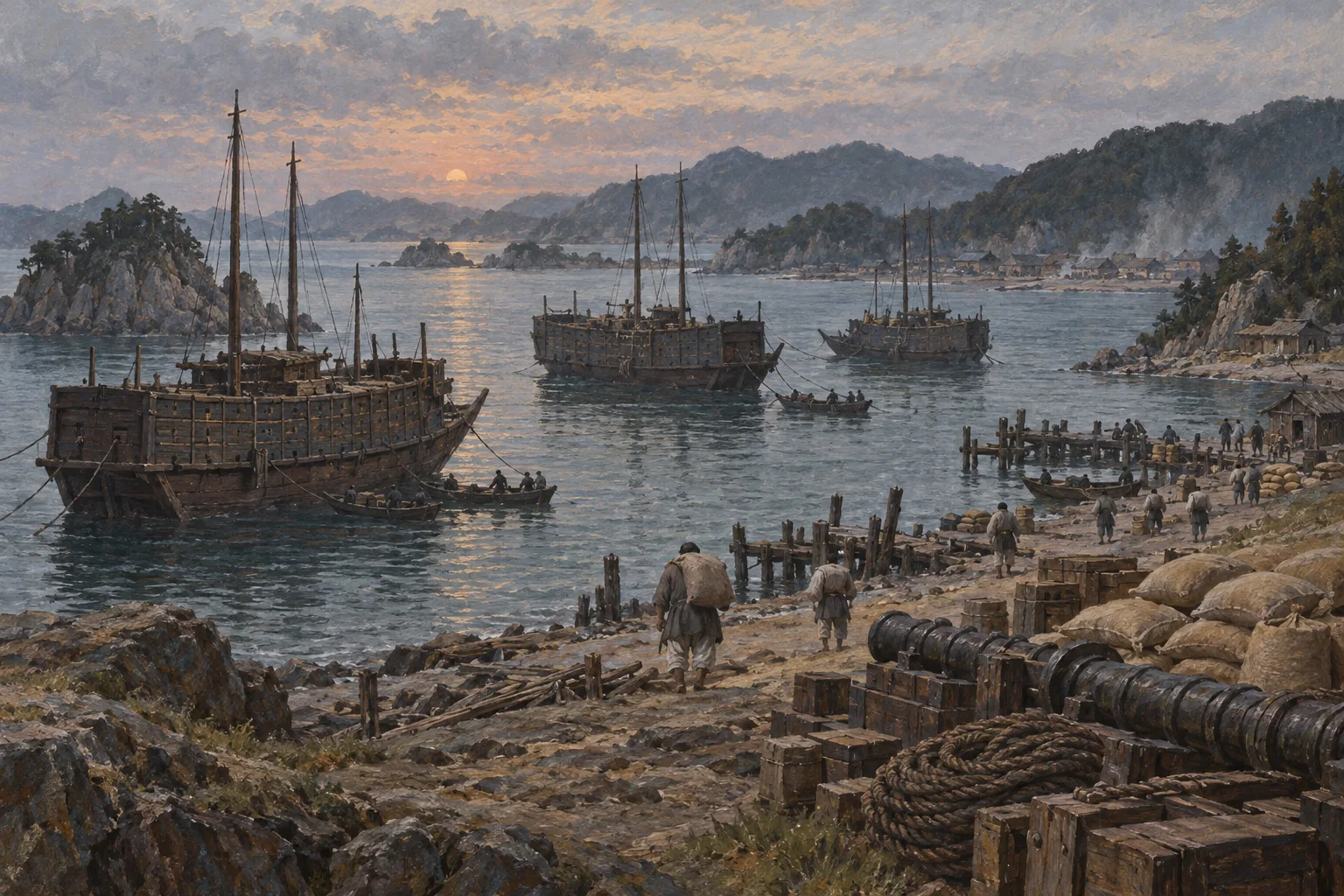
The starting point for rebuilding was the ships and naval personnel that remained. Commanders who had served with Yi, including Bae Heung-rip, Song Hui-rip, and An Wi, joined him. As he traveled through Jeolla Province, he gathered troops and secured weapons.
The court sought to have the weakened navy join the army. Yi argued that the navy had to be maintained to defend the sea routes. As a result of this decision, the remaining fleet continued to serve as a naval force.
The rebuilding process can be broken down into these elements:
- Securing warships: Yi took possession of ships that had escaped from Chilcheollyang.
- Restoring the command structure: He brought commanders and troops back together.
- Preparing for battle: Reconnaissance and watchkeeping helped identify the enemy’s approach.
- Maintaining the force: Food and supplies had to be secured.
These points organize the rebuilding process described by Our History Net, “Battle of Myeongnyang”.
How did the smaller fleet face the enemy at Myeongnyang?
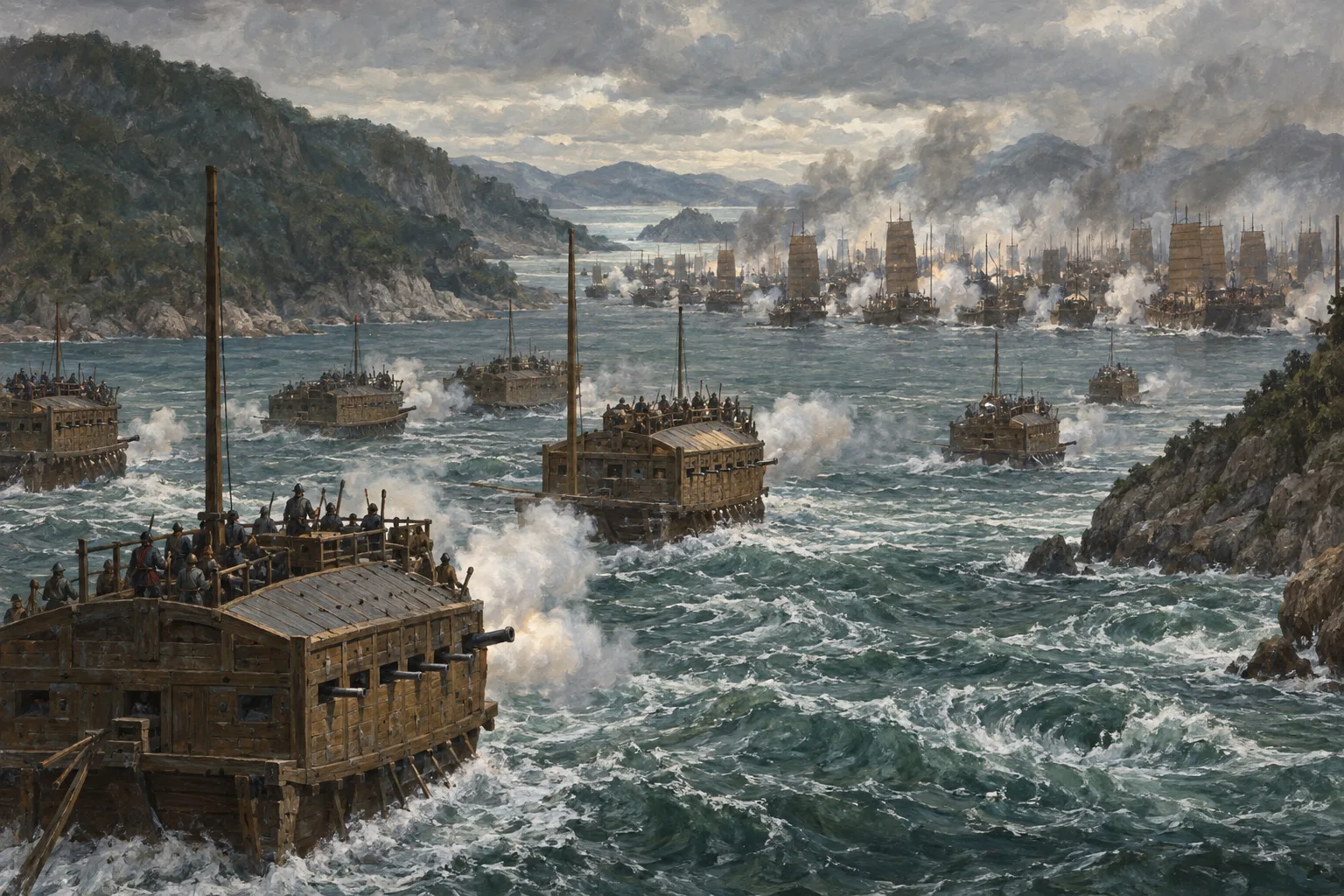
At Myeongnyang, the narrow channel and the fighting capabilities of Joseon’s ships both played a part. The Myeongnyang Strait is Uldolmok, between Jindo and Haenam. The narrow channel and its fast current limited how many ships could maneuver at once.
The Joseon fleet on the day of the battle is generally described as having 13 ships. The figure of 133 Japanese ships is used to describe the scale of the engagement. It should be distinguished from the entire Japanese fleet in the surrounding waters.
| Condition | Significance in the battle | Point to keep in mind |
|---|---|---|
| Narrow channel | Made it difficult for many ships to move at once | The difference in the number of ships did not disappear |
| Fast, changing currents | Affected approaches and the ability to maintain formation | The exact changes in the current over time require separate examination |
| Panokseon and cannons | Supported defense and long-range attacks | The role of the officers and men who operated the ships and weapons must also be considered |
| Command and ships joining the fight | Helped withstand the unfavorable situation early in the battle | Not all ships fought from the same position at the start |
At first, Yi’s flagship fought in front while the other ships lagged behind. Ships commanded by An Wi, Kim Eung-ham, and others later joined the engagement. The Encyclopedia of Korean Culture entry “Battle of Myeongnyang” describes how several commanders joined the fight.
What did the navy regain after the victory?
The victory at Myeongnyang gave the navy room to continue rebuilding. Our History Net and the encyclopedia describe the outcome as the destruction of 31 Japanese warships. This figure should not be read as the destruction of the entire Japanese fleet.
The Joseon navy continued to move its bases after the victory. At Gohado and Gogeumdo, among other places, it expanded its forces and supply base. Cultivating military fields and selling fish and salt also helped provide food for the troops. Military fields were farmland cultivated to provide food needed to run the army.
The war did not end at Myeongnyang. In 1598, the combined Joseon and Ming naval forces fought at Noryang. Yi Sun-sin was killed in that battle. The course of the war’s final stage is summarized in Our History Net, “Yi Sun-sin”.
Records and interpretation
What the records say needs to be distinguished from explanations of why the battle was won. The diary is a historical source containing the participant’s observations. Later accounts connect several sources to explain the battle.
What the records tell us
『Nanjung Ilgi』 also shows how the military operated outside battle. It records the weather, people coming and going, and personal reflections. Its perspective as a record left by a commander must also be considered.
Factors that research identifies as contributing to victory
Alongside leadership, Our History Net’s explanation points to the ships and weapons systems. It also identifies experienced officers and men and the cooperation of local residents as factors in the victory. Taken together, these show that rebuilding was a military effort involving many people.
Details on which accounts differ
Accounts differ on how one additional warship was obtained. Our History Net says Kim Eok-chu brought a warship and joined the fleet. The “Battle of Myeongnyang” entry says local people brought the ship.
Accounts also differ in how they describe the current early in the battle. It is therefore difficult to reconstruct events minute by minute as established fact. Where accounts differ, the details should be identified as the explanation given by the cited source.
Claims that a turtle ship took part or that iron chains were installed across the strait need to be addressed separately. Citing related research, Our History Net rejects both claims. Mixing later traditions with verified facts about the battle leads to misunderstandings about why it was won.
How to read dates, ship counts, and editions together
Historical figures should be read alongside what was counted and when. Works with the same title may also have different editions. These distinctions matter when transferring information into learning materials or data.
| Item to check | Distinction in this case | Possible misreading |
|---|---|---|
| Basis for dates | September 16, 1597, the date of the Battle of Myeongnyang, is a lunar date | Taking it to mean the same month and day on today’s calendar |
| When warships were counted | 12 ships early in the rebuilding process and 13 at the time of the battle | Immediately treating the two numbers as an error |
| Purpose of the boats | Warships, refugee boats, and reconnaissance boats | Counting every boat in the area as a warship |
| Edition of the record | The handwritten original and a later collected edition | Citing different editions as though they were the same text |
Seven volumes of the handwritten original of 『Nanjung Ilgi』 survive today. The collected edition was included in the 1795 『Collected Works of Yi Chungmugong』. The two editions do not have entirely identical contents or publication dates. This difference is noted in the Hyeonchungsa Management Office’s explanation of documentary heritage.
What this means for studying history today
This case encourages readers to connect the battle’s outcome with the preparations behind it. Ship numbers alone cannot explain the roles of troops, supplies, and reconnaissance. Looking at the period before and after the rebuilding reveals the conditions that made victory possible.
The record itself is a resource for research beyond military history. The National Heritage Portal explains the value of its accounts of weather, terrain, and ordinary people’s lives. 『Nanjung Ilgi』 was inscribed on the UNESCO Memory of the World Register in 2013. Related information appears on the National Heritage Portal’s “Nanjung Ilgi” page.
Frequently asked questions
Is the date of the Battle of Myeongnyang on the solar calendar?
September 16, 1597, is a lunar date from records of the time. This article gives the months and days of wartime events according to the lunar calendar.
Were there 12 warships or 13?
The warships remaining early in the rebuilding process must be distinguished from those present at the battle. Accounts commonly give 12 ships initially and 13 at the Battle of Myeongnyang. They differ on how the additional ship was obtained.
Did a turtle ship fight at Myeongnyang?
Our History Net’s explanation rejects the claim that a turtle ship took part. Accounts of the fighting capabilities at Myeongnyang focus on panokseon and cannons.
Does 『Nanjung Ilgi』 record only battles?
It is a diary that also covers military operations and personal life. It includes accounts of the weather and people around Yi.
Did rebuilding the navy end with the victory at Myeongnyang?
Rebuilding continued after Myeongnyang. The navy moved its bases while securing troops and supplies.
FAQ
Why was Yi Sun-sin reinstated after the defeat at Chilcheollyang?
After the Joseon navy suffered heavy losses, the royal court needed a commander to lead its rebuilding. The Revised Annals of King Seonjo records that Kim Myeong-won and Yi Hang-bok recommended his reinstatement.
What was the Commander of the Naval Forces of the Three Provinces?
This commander led the naval forces of Gyeongsang, Jeolla, and Chungcheong. Yi Sun-sin was appointed in 1593 and returned to the post after being dismissed in 1597.
Is September 16, 1597, the date of the Battle of Myeongnyang, a Gregorian calendar date?
It is a lunar calendar date from records of the time. The calendar system should be stated alongside the date to avoid confusion with the Gregorian date.
Did Joseon have 12 or 13 warships at the Battle of Myeongnyang?
The usual explanation distinguishes between 12 ships early in the rebuilding effort and 13 at the time of the battle. Accounts differ on how one additional warship was obtained.
Do the 133 Japanese warships refer to the entire Japanese fleet?
The figure is used to describe the scale of the engagement at Myeongnyang. It should be distinguished from the size of the entire fleet gathered in the surrounding waters.
Were turtle ships and chains central to the victory at Myeongnyang?
The account on Our History Net rejects claims that turtle ships took part at Myeongnyang and that chains were installed. Accounts based on confirmed evidence consider the panokseon warships, artillery, terrain, and the response of the troops together.
Are the handwritten original of Nanjung Ilgi and the version included in Yi Chungmugong Jeonseo the same?
They are versions of the same work passed down through different sources, but their contents and dates of inclusion are not identical. Seven volumes of the handwritten draft survive, and the other version was included in the 1795 Yi Chungmugong Jeonseo.
Was the navy still being rebuilt after the Battle of Myeongnyang?
Rebuilding continued after the victory. Troops and supplies were secured using places including Gohado and Gogeumdo as bases.
How do the Battles of Myeongnyang and Noryang differ?
The Battle of Myeongnyang was a victory won in 1597 by the Joseon navy as it was being rebuilt after the defeat at Chilcheollyang. The Battle of Noryang was fought in 1598, near the end of the war, by the combined Joseon and Ming naval forces. Yi Sun-sin was killed at Noryang.
Sources
- National Institute of Korean History, Our History Net, Chronology of Korean History, “Battle of Myeongnyang”
- Revised Annals of King Seonjo, King Seonjo’s 30th year, July 1, Article 3, “Reappoint Yi Sun-sin as Commander-in-Chief of the Navy”
- National Institute of Korean History, Our History Net, Chronology of Korean History, “Yi Sun-sin”
- The Academy of Korean Studies, Encyclopedia of Korean Culture, “Yi Sun-sin”
- The Academy of Korean Studies, Encyclopedia of Korean Culture, “Great Victory at Myeongnyang”
- Korea’s World Documentary Heritage, Hyeonchungsa Shrine Management Office, “Nanjung Ilgi: General Yi Sun-sin’s Wartime Diary”
- National Heritage Portal, World Documentary Heritage, “Nanjung Ilgi”
Images