Microfiber Comforters: Dryer Use and Care Label Rules
Dryer use for microfiber comforters must comply with both the bedding's care label and the dryer's requirements. A low-heat cycle or bedding fluff function does not override an instruction not to dry the bedding.
- The material name 'microfiber' alone does not tell you whether a comforter can go in a dryer.
- Check whether tumble drying is allowed before reading the temperature requirements.
- Even if the bedding can be tumble-dried, you must follow the dryer manual's restrictions on materials and individual cycles.
- Fitting inside the drum and staying within the selected cycle's load limit are two different requirements.
- The bedding fluff function does not replace a drying cycle for wet bedding.
Microfiber comforters can be machine-dried only when both the care label and the dryer manual allow it. A low-temperature cycle does not override a “do not tumble dry” symbol. Check not only the outer fabric but also the filling and the load limit for each cycle.
The temperatures associated with drying symbols are based on GINETEX’s March 2024 technical booklet.
Can the name “microfiber” alone tell you whether tumble drying is allowed?
The term “microfiber” does not mean that tumble drying is allowed. It refers to fine fibers, while the care requirements for the finished product are a separate matter. Even winter bedding sold under the same name requires checking each product’s care label.
NUBIZIO’s laundry FAQ also distinguishes between products that can and cannot be tumble-dried. It directs users to check the product’s care label and product detail page for the conditions under which drying is allowed. It warns that high-temperature drying can cause fabric shrinkage and deformation.
You need the following information to make a decision.
- Fiber composition and blend percentages of the outer fabric and lining
- Type of filling and whether the cover is removable
- Symbols allowing or prohibiting tumble drying, along with temperature conditions
- Prohibited materials and bedding cycle restrictions for the dryer model
How to read the drying symbols on a care label
First, read the drying symbol to see whether drying is allowed, then check the temperature conditions. Washing and drying symbols describe different processes. Permission to wash an item in water does not mean tumble drying is also allowed.
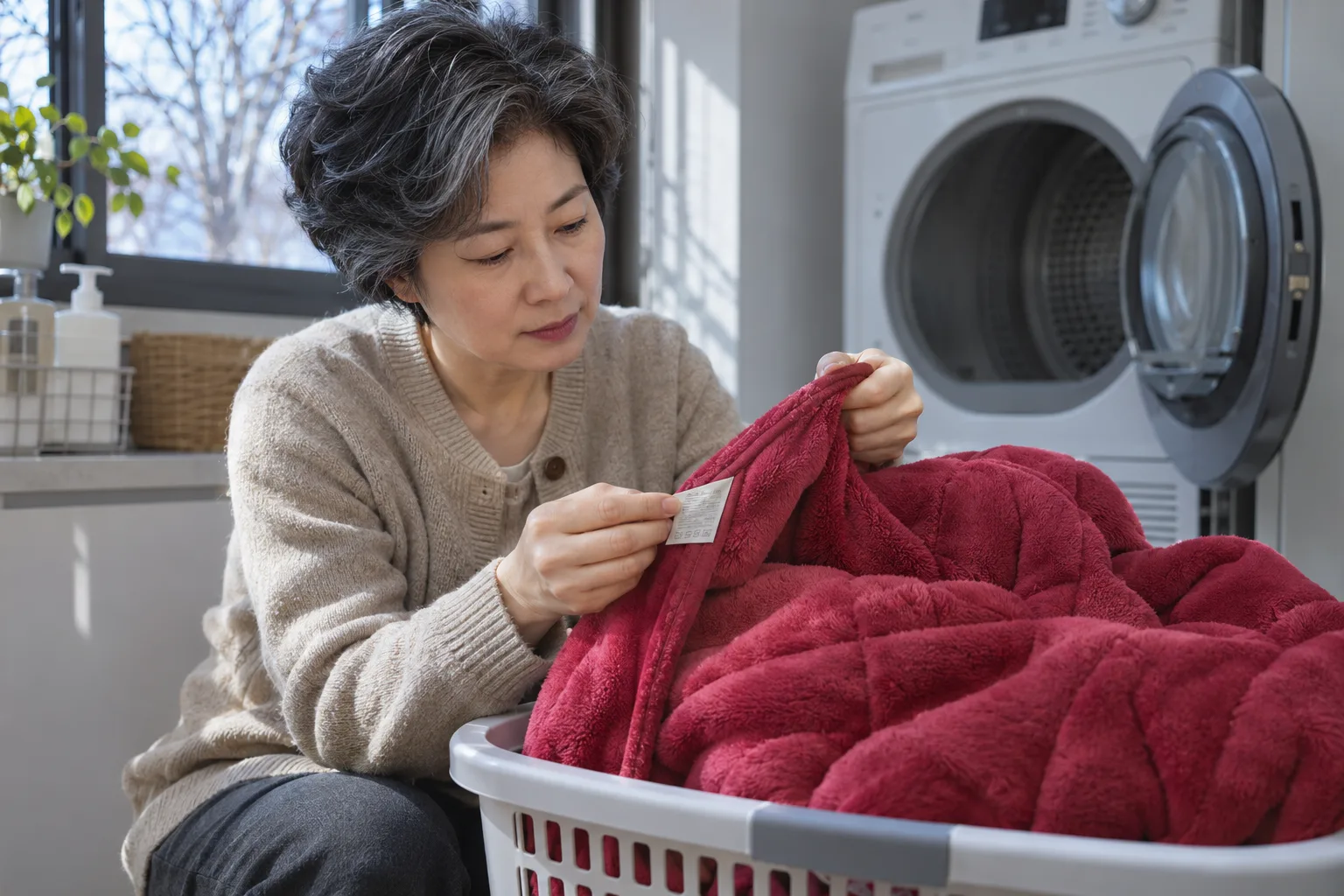
- Find the drying symbols and wording on the label attached to the product.
- Check for a “do not tumble dry” symbol.
- If tumble drying is allowed, read the number of dots and any separate temperature instructions.
- Check the dryer manual for a cycle that meets those conditions.
The following table explains the ISO 3758 system as described by GINETEX. The temperatures are the maximum exhaust air temperatures stated in the March 2024 technical booklet. They are not recommended temperature settings for a particular comforter.
| Symbol appearance | Meaning | Basis for deciding |
|---|---|---|
| One dot in a circle inside a square | Tumble drying allowed at a low temperature | Maximum exhaust air temperature of 60℃ |
| Two dots in a circle inside a square | Tumble drying allowed at a normal temperature | Maximum exhaust air temperature of 80℃ |
| An X over a circle inside a square | Do not tumble dry | A low-temperature setting does not make tumble drying permissible |
| Lines inside a square or other natural-drying symbols | Drying methods such as hanging or laying flat | Dry according to the symbol and product wording |
do not tumble dry
GINETEX, Technical Booklet, Version 10, March 2024
The quotation means that the item must not be tumble-dried. KS K 0021 is also used for care labeling in South Korea. The standard is titled “Symbols for the Care Labeling of Textile Products and Methods of Displaying Them.”
If the labeling system is unclear, do not draw conclusions from the shape of the dots or lines alone. Also check the Korean and English wording on the label. If the symbols have worn off, contact the bedding manufacturer with the product name.
Whether tumble drying is allowed under different conditions
A cycle can be used only when the requirements for both the bedding and the dryer are met. Relying on permission from just one side can lead you to overlook restrictions. The table below provides criteria for applying both documents together.
| Bedding requirements | Dryer requirements | Decision |
|---|---|---|
| Do not tumble dry | A low-temperature cycle is available | Do not machine-dry |
| Low-temperature tumble drying allowed | Supports the material and temperature conditions | Use only after checking the cycle’s load limit |
| Tumble drying allowed | Use with the material is prohibited | Do not dry in that machine |
| A natural-drying method is specified | A bedding cycle is available | Follow the specified natural-drying method |
| Label is missing or cannot be interpreted | It is unclear which cycle can be used | Do not machine-dry until the manufacturer confirms |
Samsung Electronics Service’s guidance dated November 4, 2026, also requires checking the label. It classifies products marked “do not tumble dry” as unsuitable for use in a dryer. It also specifies the risk of damage to products containing sponge, latex, or rubber.
The difference between dryer capacity and comforter size
Simply fitting inside the drum does not mean a comforter meets the drying requirements. Distinguish between the machine’s rated capacity and the load limit for the selected cycle. Separately check any limits on the comforter’s bulk or the number of items loaded.
When looking for the manual, use the exact model number on the machine itself. Do not apply figures from another model, even from the same brand. Check the following in order through the manuals section of the manufacturer’s customer support site.
- Open the user manual that matches the model number.
- Find the section on “items that must not be tumble-dried” or prohibited materials.
- Check which items are suitable for the “Bedding” cycle and its maximum load.
- Read the weight limits and any separate limits on bulk or item count.
Samsung Electronics Service recommends drying tumble-dryable comforters one at a time. This guidance also comes with the initial condition that the bedding must be suitable for tumble drying. Using a larger-capacity machine does not remove material restrictions.
Comparing low-temperature drying and bedding dust removal
Low-temperature drying and bedding dust removal are not the same process. Low temperature refers to the temperature conditions during drying. Bedding dust removal is a separate function that removes dust from bedding.
| Category | Purpose | Restrictions to check |
|---|---|---|
| Low-temperature drying | Removing moisture from items approved for drying | Whether the bedding can be tumble-dried and the machine’s cycle requirements |
| Bedding drying | Removing moisture from bedding approved for drying | Restrictions on materials, filling, and load size |
| Comforter dust removal or bedding dust removal | Removing dust from bedding | Whether items must be dry and which items are excluded from each cycle |
LG Electronics’ guidance dated May 29, 2026, distinguishes bedding dust removal from drying. Bedding or clothing that has just been washed must not be placed in this cycle. The guidance explains that the temperature inside the drum rises to approximately 45℃.
Bedding dust removal should therefore not be considered a heat-free function. LG Electronics prohibits loading items such as electric blankets and rubber mats. It warns that these items or the machine may be damaged.
Using a dust-removal function for bedding marked “do not tumble dry” requires separate confirmation that it is allowed. The cycle’s name alone cannot create an exception to the prohibition. Check the instructions for both the exact model and the bedding.
Why each item in a comforter set must be assessed separately
Check the care requirements for every item in a microfiber comforter set. Being sold as a set does not guarantee identical drying requirements. Permission to tumble-dry the cover must not be applied to the insert or mattress pad.
| Item | What to check | Easily overlooked conditions |
|---|---|---|
| Quilted comforter | The finished product’s label covering the outer fabric, lining, and filling | Do not decide based only on the outer fabric |
| Removable duvet cover | The cover’s own care label | Separate from whether the insert can be tumble-dried |
| Duvet insert | Filling type and specific care instructions | Removing the cover does not remove restrictions on the insert |
| Mattress pad | Backing material and attached layers | Machine restrictions on materials such as rubber or waterproof materials |
| Pillowcase | The cover label and whether the filling can be removed | Do not extend permission to the entire pillow |
For mattress pads in particular, check both the feel of the front surface and the construction of the back. The LG RD22S manual prohibits tumble drying items such as nonslip mats. These prohibited items carry warnings about fire and spontaneous combustion risks.
When comparing products, consider both the included items and their care requirements. If comparing prices, first make sure the sizes and included items match. Matching colors or patterns are no substitute for each product’s label.
Common mistakes in washing and natural drying
A common mistake is to treat washing requirements for microfiber comforters as drying requirements. The washing temperature refers to the temperature of the water. Dryer temperature requirements must be checked separately.
NUBIZIO advises using cold water and a neutral detergent for this material. It also recommends a gentle cycle and washing the item separately. It specifically advises avoiding strong friction and high-temperature drying.
- Using the washing machine’s wool cycle does not mean the dryer’s wool cycle is also allowed.
- Running the dryer briefly does not create an exception to a “do not tumble dry” instruction.
- For natural drying, follow the product’s instructions on hanging, laying flat, and drying in the shade.
- Even if the surface is dry, check that the inside is thoroughly dry as well.
There is no basis for assigning the same drying time to every product. NUBIZIO advises drying the item thoroughly, including the inside, before use. Using or storing it while still damp can cause odor or moisture problems.
Frequently asked questions
If it is unclear whether tumble drying is allowed, checking the product-specific instructions comes first. Other people’s experiences do not establish the permitted conditions for your bedding. When making an inquiry, have a photo of the label and the dryer’s model number ready.
Can I put it in the dryer if it is made of polyester?
The fiber name “polyester” alone is not enough to decide. Check the finished product’s care label first. The material restrictions in the dryer manual also apply.
Can I dry a comforter marked “do not tumble dry” briefly at a low temperature?
If tumble drying is prohibited, neither a low temperature nor a short drying time makes it permissible. Follow the other drying method specified for the product. Any claim that there is an exception must be confirmed with the bedding manufacturer.
Does one dot on the label mean I should select 60℃ on the dryer?
In the GINETEX technical booklet, it means a maximum exhaust air temperature of 60℃. Not all dryers offer the same temperature selection functions. Check the manual for the specific model to find a cycle that meets the conditions.
Does bedding dust removal use only cold air?
The cycle’s name alone does not establish that it uses cold air. LG’s support guidance specifies that the internal temperature rises. For heat-sensitive products, check the restrictions for each cycle.
If only the cover can be tumble-dried, can I put the insert in with it?
Permission to tumble-dry the cover does not mean the insert can also be tumble-dried. Check the insert’s filling and care label separately. Also check whether the machine’s relevant cycle allows the insert.
How should I decide if there is no tumble-drying symbol?
Do not make your own assumptions about whether it is allowed. Samsung Electronics Service also lists products without a symbol permitting tumble drying as items to exclude. Contact the bedding manufacturer with the product name and a photo of the label.
FAQ
Can you tell whether a dryer can be used just from a description saying the material is microfiber?
You cannot tell from the material name alone. You need to check both the bedding's care label and the material and cycle restrictions for the dryer you use.
Can I tumble-dry a comforter labeled 'Do not tumble dry' briefly at a low temperature?
A low temperature or a short drying time is not an exception to 'Do not tumble dry.' Follow the product's other care instructions, such as the specified air-drying method.
What is the difference between one dot and two dots on a drying symbol?
In GINETEX's March 2024 technical guide, one dot indicates a maximum exhaust temperature of 60℃. Two dots indicate a maximum exhaust temperature of 80℃. These figures must not be interpreted as recommended temperature settings for specific bedding.
If an item is machine washable, can it also be machine dried?
Permission to wash an item and permission to tumble-dry it are separate. You need to check the washing and drying symbols individually.
Can I use the bedding shake-out cycle for a wet comforter?
LG Electronics' instructions for that bedding shake-out cycle prohibit loading freshly washed bedding or clothing. The bedding shake-out cycle is not a drying cycle. For wet bedding, follow the drying methods permitted for the product.
Does the bedding shake-out cycle run without heat?
You cannot assume there is no heat based on the function's name alone. LG Electronics' guidance dated May 29, 2026 explains that the internal temperature during that cycle rises to about 45℃. This figure must not be applied directly to other models.
If a comforter fits in the drum, does it meet the capacity requirements?
The size that fits in the drum and the permitted load for the cycle are separate matters. Check the material restrictions and load limits for that model. If there are also limits on volume or the number of items, follow those as well.
Can all the pieces in a bedding set be dried the same way?
You need to check the care label on each piece. Even if the cover can be dried, that does not mean the insert or pad can be dried as well. Also check whether the filling and backing material are subject to the appliance's restrictions.
Where can I check the care instructions if the care label has faded?
Contact the bedding manufacturer with the product name and a photo of what remains of the label. To check which cycles can be used on the appliance, contact the dryer manufacturer with the exact model name.
Can I store an air-dried comforter once only the surface is dry?
You need to check that the product is thoroughly dry all the way through. The NUBIZIO FAQ advises that using or storing it before it is fully dry can cause odor or moisture problems.
Sources
- GINETEX, ISO 3758:2023 care symbol guide
- GINETEX Technical Booklet, Version 10, March 2024, drying symbols and maximum exhaust temperatures
- Korean Standards Information Network, KS K 0021 Care symbols for textile products and methods of displaying them
- NUBIZIO FAQ, dryer suitability and washing and drying care by material
- Samsung Electronics Service, Tell me about laundry that cannot be put in a dryer, November 4, 2026
- LG Electronics, Using the Bedding Dust Removal cycle on an electric heat pump dryer, May 29, 2026
- LG Electronics RD22*S* clothes dryer user manual, items that must not be dried and fire warnings
Images