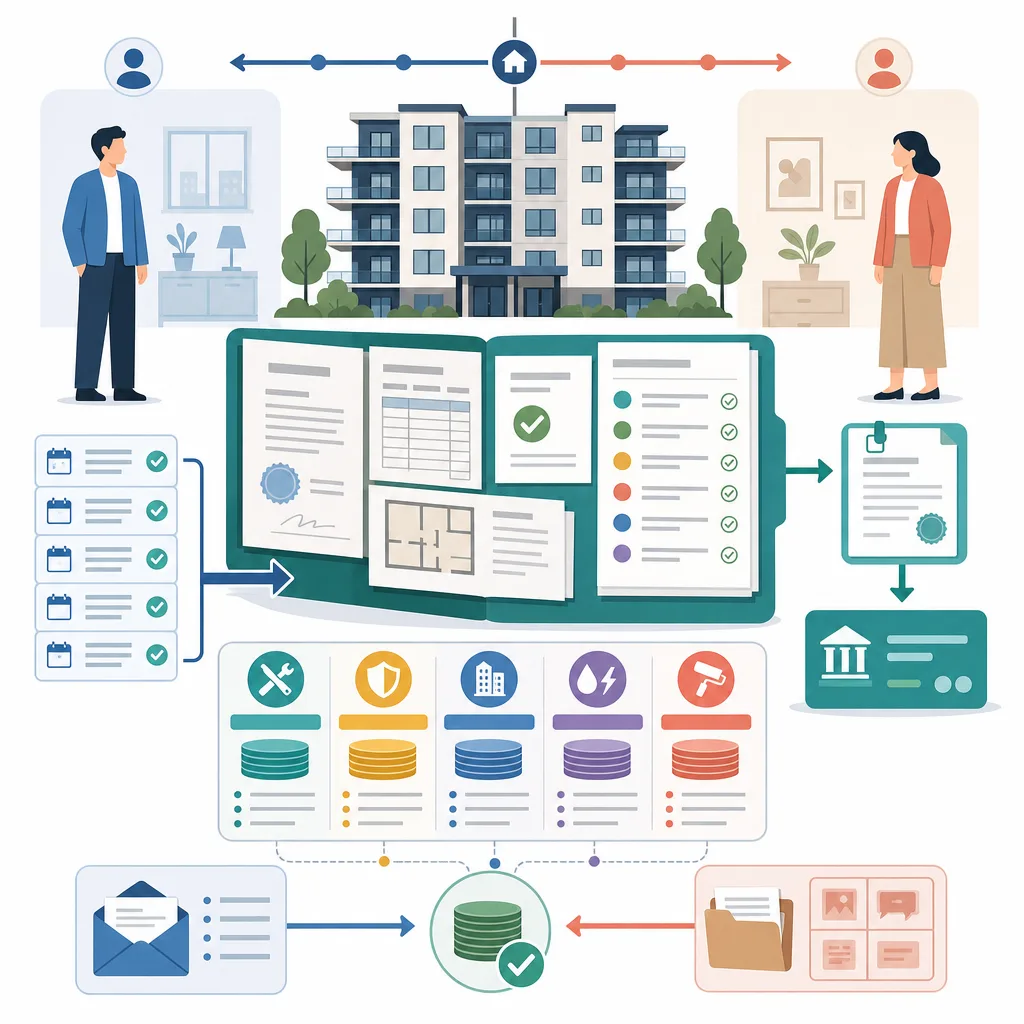
Procedure and Settlement Checklist for Recovering the Long-Term Repair Reserve When Moving Out of a Rental
In principle, the owner must bear the long-term repair reserve that a tenant in multi-family housing paid on the owner's behalf through maintenance fees. However, the settlement may differ if the lease agreement stipulates otherwise. Before moving out, the tenant should obtain a certificate of payment from the management office, review the lease and ownership change history, and then request a refund from the landlord in writing.
- Review the maintenance fee statements and lease agreement to verify whether the long-term repair reserve was paid and whether any special clause assigns the cost separately.
- Ask the management office for a certificate of long-term repair reserve payments made during the tenancy and a monthly breakdown.
- Review the certificate of registered matters and contractual relationships to identify the landlord at the time of move-out and when any ownership change occurred.
- Send the landlord a refund request stating the verified amount paid and account information, and keep a record separate from the security deposit and maintenance fee settlements.
- If the refund is delayed or the responsible party is disputed, preserve the supporting evidence and consider lease dispute mediation or legal advice.
If a tenant has paid apartment management fees and also paid the long-term repair reserve fund on the owner’s behalf, the tenant may request reimbursement from the owner, who is generally responsible for the fund. However, it is also necessary to check whether the lease agreement provides a different allocation of responsibility, whether payment was actually completed, and whether the owner changed during the tenancy.
Documents to prepare include the lease agreement, management fee statements, a certificate of payment of the long-term repair reserve fund, management fee transfer records, a certificate of registered matters, and the account into which the reimbursement should be paid. Because this is not a government-administered lump-sum refund program, there is no separate public refund application deadline or integrated application website. The basic procedure is to verify the payment details with the management office and then request reimbursement directly from the landlord.
1. First Check Whether You Are Eligible for Reimbursement
Check all of the following conditions.
- The
long-term repair reserve fundwas actually charged as part of the apartment management fees. - The tenant paid the relevant management fees with the tenant’s own money.
- The amount has not already been reimbursed by the landlord.
- You have checked whether the lease agreement contains a separate provision requiring the tenant to bear the final cost of the long-term repair reserve fund.
The Multi-Family Housing Management Act and related regulations provide that the long-term repair reserve fund must be collected from apartment owners and accumulated, and that if an occupant pays it on the owner’s behalf, the owner must reimburse that amount. However, if the lease agreement provides otherwise, the terms of the agreement may affect the reimbursement determination.
The long-term repair reserve fund is not imposed on every home. Even for apartments and other multi-family housing, you must check whether the property is subject to the legal requirements to establish a long-term repair plan and accumulate a reserve fund, and whether the relevant item actually appears in the management fees.
2. Distinguish the Long-Term Repair Reserve Fund, Repair and Maintenance Fees, and Management Fee Advance Deposits
Although their names may sound similar, the basis for liability and the party responsible for reimbursement differ.
| Item | Purpose | General liability and reimbursement structure | What to check when moving out |
|---|---|---|---|
| Long-term repair reserve fund | Funds major facility replacements and repairs under a long-term repair plan, such as elevator replacement and exterior wall repairs | Generally borne by the owner. If an occupant pays on the owner’s behalf, the occupant may request reimbursement from the owner | Check monthly payment certificates and special lease provisions |
| Repair and maintenance fees | Management fees used for routine inspections, maintenance, and minor repairs of common facilities | These are expenses related to current management and use and do not have the same statutory reimbursement structure as the long-term repair reserve fund | Separately check the agreement and the basis for imposing the management fees |
| Management fee deposit | A deposit used to secure operating funds needed to manage the apartment complex in advance | Commonly called a management fee advance deposit and generally settled among the seller, buyer, and management entity during a transfer of ownership | If the tenant paid it on the owner’s behalf, check the agreement and circumstances of payment |
The repair and maintenance fees shown on a management fee bill must not be added to the long-term repair reserve fund. Likewise, a management fee advance deposit merely has a similar name and is not automatically included in the reimbursable amount of the long-term repair reserve fund.
3. Obtain a Payment Certificate from the Management Office
Request the following information from the management office or management entity.
- The period during which the long-term repair reserve fund was charged and paid for the relevant unit
- The monthly amounts charged and the amounts actually paid
- Details of any reductions, nonpayment, refunds, or corrections
- The total amount for the tenancy period
- A payment certificate showing the issue date and verification by the management entity
The Enforcement Decree of the Multi-Family Housing Management Act provides that when an occupant requests confirmation of payment of the long-term repair reserve fund, the management entity must issue a certificate. Because management fees, the security deposit, and the handover of keys may all be handled simultaneously on the move-out date, it is safer to request the certificate several days in advance if possible.
The management office does not directly return the money to the landlord. The management office verifies the payment history, while the party from whom reimbursement is generally requested is the owner or the person who succeeded to the landlord’s position.
4. Check the Agreement and Ownership Change History
Look for the following language in the lease agreement.
- The landlord bears the long-term repair reserve fund.
- The tenant bears all management fees.
- The tenant bears the long-term repair reserve fund.
- The landlord settles the long-term repair reserve fund when the tenant moves out.
If the agreement merely states that management fees are borne by the tenant, a dispute may arise over whether this provision means that the tenant must ultimately bear the long-term repair reserve fund as well. The wording of special provisions, explanations provided when the agreement was signed, and the method of paying management fees should all be reviewed together.
If the homeowner changed during the tenancy, check the date of the ownership transfer using a certificate of registered matters. The claim regarding liability may differ depending on whether the buyer of the home succeeded to the landlord’s position and how the former and new owners settled the long-term repair reserve fund during the sale.
If ownership changed, it is advisable to divide the documents by period, as shown in the following table.
| Period to check | Required documents | Party from whom to request confirmation |
|---|---|---|
| Before the ownership transfer | Monthly amounts paid through the transfer date | Confirm the former owner and the landlord-tenant relationship at that time |
| After the ownership transfer | Monthly amounts paid from the day after the transfer | Confirm the current owner and succession to the landlord’s position |
| At the time of moving out | Final management fee and security deposit settlement statement | Confirm the current landlord or person responsible for settlement |
It is difficult for a tenant to know the details of the internal settlement between the seller and buyer. If the responsible party is unclear, it is useful in practice to first provide all documents to the current landlord, notify the former owner as well by specifying the relevant period and basis of the claim, and retain a record of the responses. If there was an auction, public sale, or complex change in rights, the succession relationship may differ from that of an ordinary sale, so an individual legal review is necessary.
5. Calculate the Amount to Request
The safest basis is not an estimated amount but the amount actually paid as verified by the management entity.
Amount requested for reimbursement = Total long-term repair reserve fund actually paid during the tenancy - Amount already reimbursed - Amount recognized under the agreement as ultimately payable by the tenant
For example, simply assuming that the same amount was charged each month and multiplying it by the number of months of occupancy may overlook an increase or reduction during the tenancy, nonpayment, or prorating for the move-in and move-out months. If the totals on the monthly statements and payment certificate differ, first ask the management office which month the discrepancy occurred and why.
Prepare a settlement table that separately lists the security deposit, unpaid rent, ordinary management fees, restoration costs, and the long-term repair reserve fund. If any amounts are to be offset, it is advisable to document which claim is being offset and by how much so that both parties can verify it.
6. Request Reimbursement from the Landlord in Writing
Include the following information in the reimbursement request.
- The address, building number, and unit number of the leased home
- The term of the lease agreement and the actual period of occupancy
- The payment period and total amount of the long-term repair reserve fund
- A statement that the payment certificate is attached
- The account into which reimbursement should be paid
- A reasonable date by which a response or payment is requested
- Contact information
Even if the request is made by text message or messenger, send the payment certificate file and amount calculation table together and retain the transmission records. If a dispute is expected, you may consider a method that allows you to verify the contents sent and whether they were delivered, such as certified-content mail.
The reimbursement request may be worded as follows.
I have attached the certificate of payment for the long-term repair reserve fund that I paid on your behalf through the management fees during the lease term. Based on the total amount actually paid shown on the certificate and the amount previously settled, the amount requested for reimbursement is ○○ won. Please review the attached details and respond by ○ month ○ day.
Do not state that approval or payment is certain. Clearly present the basis for the calculation so that the other party can raise objections based on any special lease provisions or prior settlement.
7. Move-Out Day Settlement Checklist
- I received the final management fee bill or interim settlement statement.
- I checked the start and end dates on the long-term repair reserve fund payment certificate.
- I did not mix repair and maintenance fees or the management fee deposit into the reimbursable amount.
- I rechecked the special provisions concerning the long-term repair reserve fund in the lease agreement.
- I listed the security deposit, rent, utility charges, and restoration costs as separate items.
- I provided the landlord with the requested reimbursement amount and account information in writing.
- If I received cash, I prepared a receipt or settlement confirmation.
- I checked the terms of the agreement to ensure that the handover of keys and move-in registration-related procedures were not completed before receiving the security deposit.
- I retained the payment certificate, settlement table, remittance records, and conversation records.
8. What to Do If You Discover It After Moving Out
Even after moving out, if you can prove that you paid the amount on the owner’s behalf during the tenancy, you may promptly gather the documents and request reimbursement. First, ask the management office at the time or the current management entity whether it can issue a payment certificate by unit and period.
Prepare the following documents.
- Former lease agreement
- Documents verifying the move-in and move-out period
- Monthly management fee bills
- Bank transfer or card payment records
- Long-term repair reserve fund payment certificate
- Certificates of registered matters from the relevant time and the present
- Records of the reimbursement request sent to the landlord and the response
This is not a program with a separate short-term refund application deadline, but monetary claims are subject to a statute of limitations. The limitation period and its starting point for a monetary claim may be determined differently depending on the parties and the nature of the agreement, so they should be confirmed through legal consultation with the Korea Legal Aid Corporation or another legal service. For an old claim, it is safer not to determine the starting point on your own and to seek legal advice promptly.
9. An Easily Overlooked Verification: Distinguishing Amounts Charged from Amounts Paid
The mere fact that a long-term repair reserve fund appears on a management fee bill does not mean the entire amount is eligible for reimbursement. Because reimbursement is based on the amount the tenant actually paid on the owner’s behalf, the following differences must be checked.
- Amounts billed but unpaid
- Amounts paid directly by the landlord in certain months
- Amounts reduced or refunded due to management fee corrections
- Amounts charged for periods before move-in or after move-out
- Amounts already returned in a previous settlement
- Amounts incorrectly associated with the unit’s information
If past records are dispersed because the management entity changed, records for each management period must be obtained separately and linked together. This verification reduces duplicate claims and omissions that can arise from simply multiplying the monthly payment by the number of months of occupancy.
10. If the Landlord Refuses Reimbursement
First, request the reason for the refusal in writing. Organizing documents by issue, such as special lease provisions, a claim that payment was already made, a change of ownership, or a discrepancy in the amount paid, will make it easier to explain the facts during mediation or litigation.
If no agreement can be reached, you may check whether the matter is eligible for mediation by the Housing Lease Dispute Mediation Committee or obtain legal advice from the Korea Legal Aid Corporation or another legal service. Mediation is a dispute resolution process between the parties, and filing an application does not automatically establish entitlement to reimbursement. If the amount is substantial or the matter involves an ownership transfer or auction, the responsible party and statute of limitations must be reviewed individually.
FAQ
Is the long-term repair reserve fund paid by the tenant?
Under the Multi-Family Housing Management Act and its subordinate statutes, the owner of the multi-family housing is, in principle, responsible for the payment. If the tenant paid it on the owner's behalf as part of the maintenance fees, the tenant may request reimbursement from the owner, but should check whether the lease agreement contains a special provision stipulating a different payment arrangement.
Will the management office directly refund the long-term repair reserve fund?
Generally, the management office's role is to verify the amounts assessed and paid during the tenancy and issue a payment certificate. In principle, reimbursement must be requested from the owner or the person who succeeded to the landlord's position.
Can I also get the repair and maintenance fees back from the landlord when I move out?
Repair and maintenance fees are a different type of maintenance fee from the long-term repair reserve fund, so the same statutory reimbursement provisions do not automatically apply. The nature of the expenses, the lease agreement, and the actual basis for the assessment must be reviewed separately.
Are the advance maintenance fee and the long-term repair reserve fund the same?
No. An advance maintenance fee generally refers to a maintenance fee deposit and is intended to secure funds in advance for the operation of multi-family housing, while the long-term repair reserve fund finances the replacement and repair of major facilities under a long-term repair plan.
If the contract says that the tenant is responsible for maintenance fees, does that mean I cannot get reimbursed?
That wording alone does not necessarily mean that the tenant agreed to bear the ultimate responsibility for the long-term repair reserve fund. A determination should be made based on all relevant circumstances, including whether the long-term repair reserve fund was specifically mentioned, what explanation was given when the contract was signed, and how it was paid.
If the landlord changes while I am living there, from whom should I request reimbursement?
You must check the date ownership was transferred, whether the landlord's position was succeeded to, each owner's period of ownership, and the settlement details of the sale. It is advisable to first present the complete payment history to the current landlord and, if responsibility is disputed, also notify the former owner in writing, specifying the relevant period and grounds.
Can I still make a claim if I discover the long-term repair reserve fund after moving out?
Even after moving out, you may consider requesting reimbursement if you can prove that you actually paid it on the owner's behalf during the tenancy. However, disputes may arise over the limitation period for monetary claims and when it begins to run, so you should obtain the payment certificate and lease agreement and make the request promptly.
Is the reimbursement amount calculated by multiplying the monthly assessment by the number of months I lived there?
It is more accurate to use the total amount actually paid as verified by the management office rather than a simple multiplication. Interim increases, reductions, nonpayments, corrections, the handling of the move-in and move-out months, and any amounts already settled must be reflected.
Can the landlord offset the long-term repair reserve fund against the security deposit or repair costs?
To claim an offset, the parties must specifically determine which claims are being settled against each other and in what amounts. It is safer to separate the security deposit, unpaid rent, restoration costs, general maintenance fees, and the long-term repair reserve fund by item and document any disputed amounts in writing.
Is there a government website where I can apply for reimbursement of the long-term repair reserve fund?
There is no integrated reimbursement application website because this is not a program under which the government provides direct refunds. After obtaining a payment certificate from the management office, you should request reimbursement directly from the landlord. If no agreement is reached, you may consider lease dispute mediation or legal counseling.
Sources
- National Law Information Center Multi-Family Housing Management Act
- National Law Information Center Enforcement Decree of the Multi-Family Housing Management Act
- National Law Information Center Civil Act
- Housing and Commercial Building Lease Dispute Mediation Committee
- K-apt Multi-Family Housing Management Information System
- Practical Q&A on the Long-Term Repair Reserve Fund
- Q&A on the Long-Term Repair Reserve Fund and Management Fee Settlement
- Q&A on the Return of the Long-Term Repair Reserve Fund to Tenants
- Q&A on the Settlement of Management Fees and the Long-Term Repair Reserve Fund upon Moving Out
Images