Plus Human: How to Combine Midlife Experience with AI
Plus Human is a practical perspective that combines human purpose, experience, and judgment with AI’s capabilities for searching, organizing, and generating. Middle-aged and older adults can draw on their rich tacit knowledge and awareness of problems as strengths, but they must also take direct responsibility for verification, privacy protection, and human relationships.
- Rather than an officially established academic term, Plus Human is a practical framework for combining human experience with AI’s computational and generative capabilities.
- The field experience and sense of purpose of middle-aged and older adults can be advantageous when using AI, but digital proficiency and verification skills do not automatically follow.
- To remain in control when using AI, humans must retain four roles: setting goals, providing context, verifying results, and assuming final responsibility.
- Hyperpersonalization and vibe coding expand individuals’ ability to create, but they also bring risks involving personal data leaks, errors, security, copyright, and maintenance.
- As AI creates digital outputs more quickly, human relational skills such as empathy, attentive listening, building trust, and resolving conflicts become important differentiators.
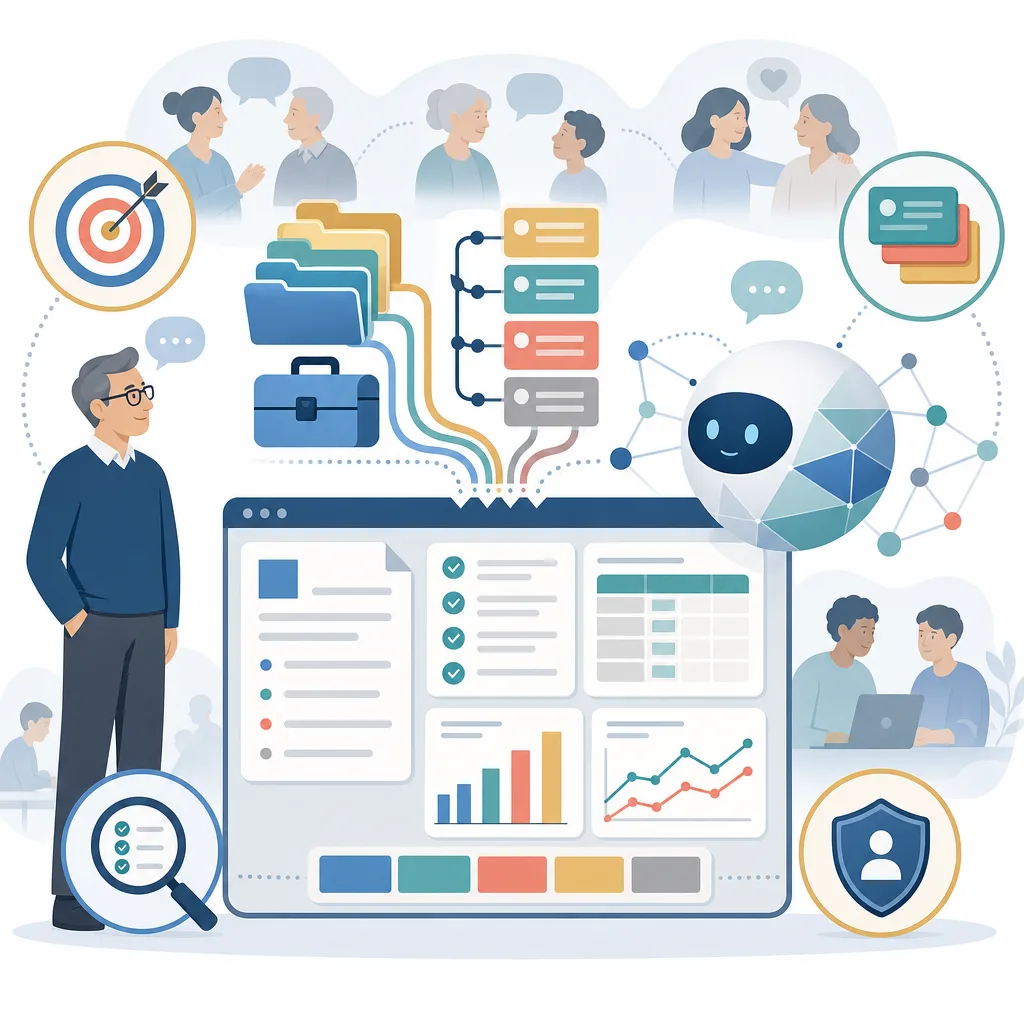
Plus Human is not about replacing humans with AI, but about expanding human capabilities by adding AI’s search, analysis, and generation abilities to human purpose, experience, and relationship-building skills. For middle-aged and older adults in particular, who have accumulated extensive professional experience and dealt with many challenges in life, it can serve as a framework for explaining the potential to use AI as a “second intelligence.”
However, claims that longer lifespans are guaranteed or that AI is like a genius human teammate are not verified facts, but forecasts or metaphors. To use Plus Human as a useful concept, we must consider its possibilities and limitations together with the areas for which humans must remain responsible.
First, a distinction: What is Plus Human?
“Plus Human” is not currently a technical term with a single established definition in academia or international standards. In this article, it is used as a practical concept combining the following three elements.
- Human purpose and judgment: Decide what to solve and assess the meaning of the results.
- Accumulated experience and relationships: Understand exceptions in the field, human emotions, and organizational context.
- AI’s assistive capabilities: Search and summarize materials, create drafts, and quickly compare multiple alternatives.
When searching for the same expression online, companies and organizations with similar names may appear, including those involved in staffing, facility management, ERP, and nonprofit activities. Plus Human in this article does not refer to the name or services of any specific company, product, or association.
The era of 100-year lifespans and redefining one’s 60s
The World Health Organization describes healthy aging not simply as the absence of disease, but as the process of maintaining the functional ability that enables older people to live lives they value. Increased life expectancy and improved health may enable longer periods of activity in some societies, but the reality varies greatly depending on an individual’s health, income, caregiving burden, and working environment.
The following claims must therefore be distinguished.
| Claim | Cautious interpretation |
|---|---|
| Aging is a treatable disease | Although there is a growing movement to study the biology of aging as a therapeutic target, there is no medical consensus that aging as a whole is a single treatable disease. |
| Longer lifespans are a foregone conclusion | A population’s life expectancy differs from an individual’s healthy lifespan, and the extent of future increases cannot be determined with certainty. |
| Everyone in their 60s today is young | Even if more people are active than in the past, differences in health, assets, education, and caregiving circumstances should not be generalized. |
| Retirement will disappear | Opportunities for reemployment, entrepreneurship, and learning may increase, but career options and social security conditions differ from person to person. |
There is no need to define one’s 60s solely as “the age when decline begins.” However, this should not be turned into pressure to keep working unconditionally. The key is having the freedom to redesign the activities one wants, whether work, learning, creative pursuits, caregiving, or community participation.
A structure combining human tacit knowledge with AI’s explicit knowledge
The strength of middle-aged and older adults lies not simply in the amount of information they possess, but in their tacit knowledge. Tacit knowledge is experience-based knowledge that is difficult to acquire simply by reading documents, such as practical intuition, handling exceptions, timing, and relationship judgment. Explicit knowledge is knowledge that can be recorded and conveyed through text, tables, manuals, and data.
Generative AI is useful for quickly producing structured outputs based on public materials and the context provided. However, it cannot automatically know experiences that exist only in a person’s mind. The two types of knowledge can be connected only when people articulate their cases and criteria for judgment in speech or writing.
| Role | What humans do well | Tasks well suited for AI assistance |
|---|---|---|
| Purpose | Determine the problem to solve and the criteria for success | Break down the purpose into action items |
| Context | Explain field practices, relationships, and exceptions | Organize and compare extensive context |
| Production | Make the final choice regarding the message and direction | Generate drafts, tables, code, and image ideas |
| Judgment | Assess factual accuracy, ethics, and real-world suitability | Present lists of counterarguments and alternatives |
| Responsibility | Take responsibility for publication, contracts, and medical, legal, and financial decisions | Assist decision-making rather than act as the responsible party |
The key to this combination is not for AI to replace experience, but to help people turn their experience into explainable knowledge and tangible outputs.
Conditions that enable middle-aged and older adults to use AI effectively
The more specific the question and context, the more likely AI is to produce results aligned with the intended purpose. People who have spent many years working and resolving life’s challenges may possess the following assets.
- The ability to identify problems by knowing which issues recur
- Domain knowledge that allows them to determine whether a result will work in practice
- Relationship context based on understanding what customers and colleagues find difficult
- Unfinished tasks previously abandoned because of cost or technological constraints
- Standards for comparison that allow them to identify errors in outputs
However, age alone does not automatically produce these advantages. There are significant differences in digital accessibility, input skills, knowledge of personal data protection, and confidence in using new tools. There is also insufficient evidence to make a blanket claim that either younger people or middle-aged and older adults are better at using AI.
The most practical approach is not to pit the roles of different generations against one another, but to combine them. For example, an experienced field professional can explain requirements and exceptions, a digitally proficient person can handle tool configuration and automation, and the two can verify the results together.
From user to Wielder: What it means to take the lead with AI
A Wielder originally means a person who handles a tool or power skillfully. In Plus Human discourse, it can be used as a metaphor for an active user who goes beyond being a “user” consuming functions defined by a platform and instead gives AI goals and standards. It is not the name of an official AI position or qualification.
Taking the lead with AI depends less on the ability to write elaborate prompts than on the following four elements.
- Goal-setting: Define the desired output and its intended use in one sentence.
- Providing context: Communicate the target audience, constraints, available materials, and content to avoid.
- Designing verification: Identify where source checks, recalculations, and expert review are required.
- Final responsibility: A human decides which results to adopt and publish.
For example, rather than asking, “Recommend something I can do after retirement,” a request such as, “Compare activities in education, consulting, and content that require no more than 15 hours per week, minimize initial costs, and make use of 25 years of manufacturing quality-control experience,” produces results that are easier to review. Actual demand, qualification requirements, conflicts of interest, and costs must then be checked separately.
Opportunities opened by hyper-personalization and vibe coding
Generative AI can reduce the cost and time required to create documents, learning materials, song ideas, schedules, and simple software prototypes tailored to an individual’s background and purpose. The practice of creating code by describing desired functions in natural language is commonly called “vibe coding.”
This can be viewed as an expansion of digital sovereignty because individuals can try and revise things themselves rather than entrusting the entire process to external creators. Use cases include the following.
- Organizing one’s professional experience into educational materials or a memoir draft
- Creating travel plans or commemorative content tailored to a family’s circumstances
- Building prototypes of small-scale automation tools that streamline repetitive tasks
- Generating questions and explanatory materials suited to a learner’s level
- Creating consultation scripts for different customer types and having a person make the final revisions
However, this does not mean that “anyone can complete safe software simply by describing it.” AI-generated code may contain security vulnerabilities, incorrect dependencies, data-loss risks, and maintenance problems. Personalization in sensitive fields such as healthcare, education, and recruitment also carries risks of bias, privacy violations, and incorrect advice.
Materials used for hyper-personalization should be minimized to what is necessary. It is safer not to enter sensitive information such as resident registration numbers, medical records, original contracts, and company trade secrets until you have checked the storage, training, and deletion policies of the AI service being used, along with your organization’s rules.
Words and relationships that become more important in the AI era
There are no universal statistics showing that human words and relationships automatically become more valuable simply because AI can quickly generate text and images. However, as digital outputs become easier to produce, building trust, showing empathy, providing responsible explanations, and resolving conflicts remain human capabilities that are difficult to differentiate.
The principles that Plus Human should uphold in relationships are as follows.
- Respond: Rather than continually observing a group conversation without participating, express gratitude and interest, even briefly.
- Avoid monopolizing the conversation: “1/N” is not a strict calculation of speaking time, but a principle of giving others an opportunity to speak as well.
- Take on the role of facilitator: Rather than showcasing your own knowledge, ask quieter participants questions and connect the conversation.
- Agree on egalitarian forms of address: Do not impose a relationship style based solely on age or rank; decide together on forms of address that members find comfortable.
- Be transparent about AI use: If AI was used to write a letter, evaluation, or proposal that is important to the other person, explain the use of AI and the review process to the extent necessary.
Even a warm sentence written by AI has meaning when a person sincerely reviews it and revises it to fit the context of the relationship. Ultimately, the party that earns trust is not the tool, but the person responsible for its results.
An easily overlooked task: How to preserve experience as data
One issue frequently omitted from discussions of Plus Human is the transfer of experience. If one person’s 30 years of experience remains only in their head, neither AI nor an organization can readily use it. Conversely, indiscriminately entering every conversation and document into AI can expose personal information and trade secrets.
To preserve experience safely, it is useful to record it using the following categories.
| Record item | What to document |
|---|---|
| Situation | When, where, and what problem occurred |
| Signals | What did the experienced person observe that alerted them to something unusual? |
| Options | Which alternatives were considered, and which were excluded? |
| Criteria for judgment | Which took priority: cost, safety, relationships, or time? |
| Outcome | How did the actual outcome differ from what was expected? |
| Scope of disclosure | Is it for personal use, internal organizational use, or public disclosure? |
Records organized in this way can serve as material for creating manuals, training cases, and checklists with AI. Personal names and customer information should be pseudonymized, and company rules on removing materials and using AI must be checked first. The sustainability of Plus Human does not lie in entering more data, but in structuring necessary experience accurately and safely.
Plus Human practice checklist
Before beginning a new AI task, review the following questions.
- Can I explain the problem I am trying to solve in one sentence?
- Have I distinguished between the experience I will provide to AI and the sensitive information I will withhold?
- Do I have an original source, formula, or expert who can verify whether the result is correct?
- Have I revised the AI-generated result to fit the language and circumstances of the actual intended audience?
- Has someone been designated to take responsibility and stop or correct the process if an error occurs?
- Does using the tool help prepare for better conversations with people rather than reduce those conversations?
The goal of Plus Human is not to create AI that appears human. It is to use AI while keeping purpose, judgment, relationships, and responsibility in human hands. The experience of middle-aged and older adults is not a complete competitive advantage in itself, but becomes an expandable asset when it is explained, verified, and shared with the next generation.
FAQ
Is Plus Human an official academic term?
Currently, Plus Human is closer to a practical framework that combines AI capabilities with human goals, experience, and judgment than to an established academic or technical standard with a single definition. It may also be used as the name of a specific company or product, so the context must be checked.
Are Plus Human and transhumanism the same concept?
No, they are not. Transhumanism includes a philosophical movement that seeks to fundamentally expand the physical and cognitive limits of humans through science and technology. The Plus Human concept in this article focuses on using currently available AI as an assistive tool for thinking and creation rather than on bodily modification.
Can middle-aged and older adults use AI better than younger generations?
No blanket conclusion can be drawn. Middle-aged and older adults may have strengths in practical experience, domain knowledge, and a clear awareness of problems, but digital proficiency and the ability to verify AI outputs vary greatly among individuals. Combining the strengths of different generations is a more realistic approach.
Can AI be called a second intelligence?
It can be used as a metaphor to describe how AI is utilized, but it should not be taken to mean that AI has human-like understanding, intentions, or the capacity to take responsibility. Generative AI can produce plausible but incorrect content, so important decisions require checking original sources and human review.
Where should I start to combine tacit knowledge with AI?
The starting point is to document experience by breaking it down into the situation, observed signals, options considered, decision criteria, and actual results. Provide AI only with the necessary context, and remove customer information, company secrets, and sensitive personal information or handle them in accordance with usage policies.
Can non-developers also build apps through vibe coding?
They can build simple prototypes or personal automation tools, but the quality and safety of a commercial service are not automatically guaranteed. If authentication, payments, personal information, or medical or financial data are involved, security testing and review by a professional developer are necessary.
What information should not be entered into AI when creating personalized content?
You should not carelessly enter resident registration numbers, financial information, medical records, authentication information, original contracts, customer lists, or company trade secrets into publicly accessible AI services. You must first check the service's data storage, training, and deletion policies, as well as your organization's rules on AI use.
Why are interpersonal skills becoming important in the AI era?
AI can generate text and materials, but it cannot take responsibility for the outcomes of relationships or maintain trust on its own. Listening, empathy, conflict resolution, honest explanations, and keeping promises remain areas in which people act and are evaluated.
Sources
Images