Differences Between the KRX New Securities Market, Fractional Investment, and STO
The Korea Exchange plans to open the New Securities Market for trading fractional investment products on November 16, 2026. This article outlines the market’s trading structure and listing requirements, its differences from token securities, how returns are calculated, and the risks investors should review.
- The Korea Exchange’s New Securities Market is scheduled to open as an exchange market where fractional investment securities meeting specific requirements can be traded through securities firms.
- Rather than jointly owning real estate or artwork itself, fractional investors generally hold rights under securities to the income and disposal proceeds from the relevant assets.
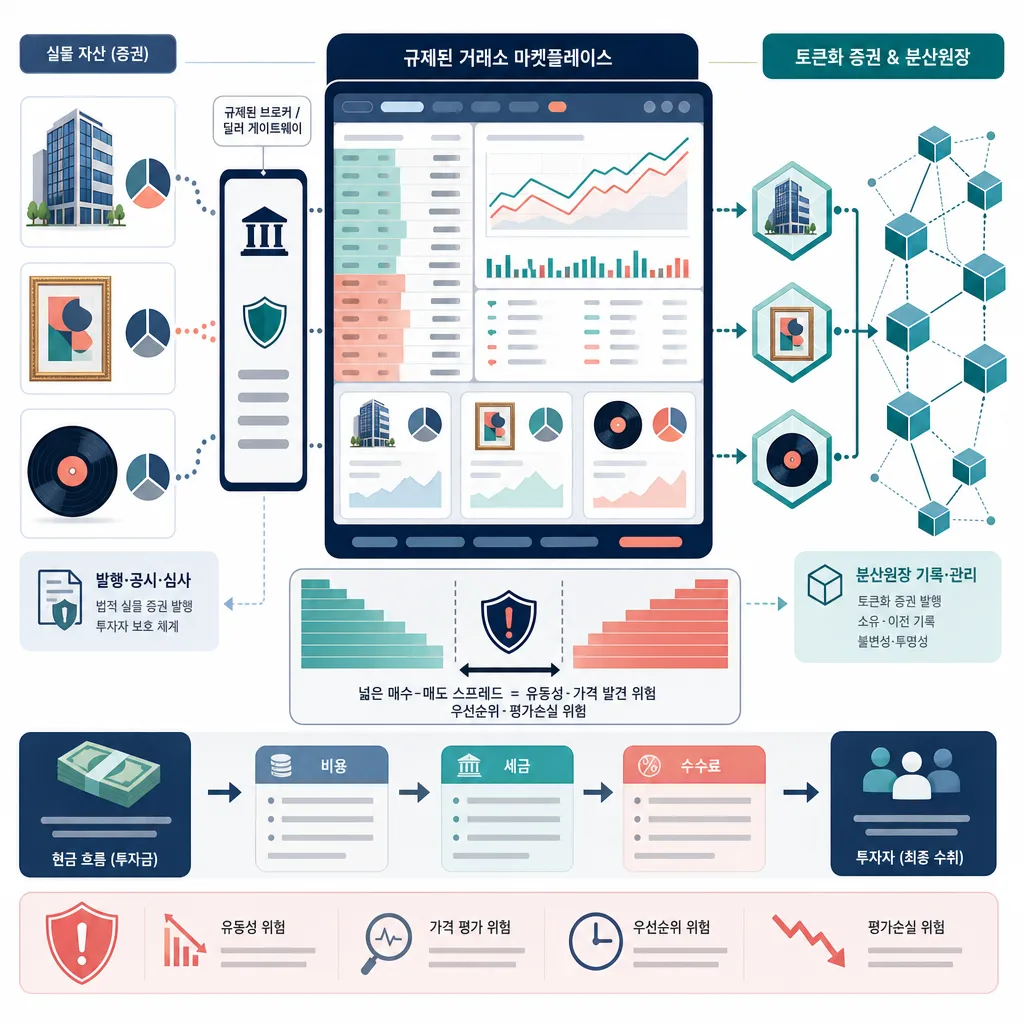
- The New Securities Market and token securities are distinct concepts: the former is a trading venue, while the latter are a method of issuance and management that records securities rights using a distributed ledger.
- Investment returns depend not only on the price of the underlying asset but also on operating costs, taxes, various fees, sale terms, and trading market liquidity.
- Listing or blockchain records do not guarantee the principal, asset value, or the ability to sell at the desired time.
The Korea Exchange plans to open a New Securities Market for fractional investment products on November 16, 2026. This market will allow high-priced assets or assets with complex rights structures, such as artwork, real estate, and music copyrights, to be securitized and traded on an exchange.
However, describing these products as being “traded like stocks” does not mean they carry the same risks as stocks. The underlying assets may be difficult to value and trading volume may be low, while investors often hold rights defined by contracts and securities rather than the assets themselves. The schedule and requirements in this article are based on plans publicly disclosed or provided as of August 20, 2026. Before the market actually opens, investors should review the Korea Exchange’s final rules and securities firms’ notices.
Definitions of Fractional Investment and the New Securities Market
Fractional investment is a general term for structures in which high-priced assets or income rights are divided into small units and offered to multiple investors. It is not a single legally defined product category, and the actual rights may vary according to the product’s legal form, such as investment contract securities or beneficiary certificates.
The New Securities Market is an exchange market where new types of securities that meet specified listing requirements can be bought and sold through the Korea Exchange. Previously, subscriptions and trading often took place within asset-specific fractional investment platforms. Once the market opens, eligible products will be tradable through securities firm accounts and the exchange’s order system.
| Category | Existing Platform-Centered Trading | Planned KRX New Securities Market Structure |
|---|---|---|
| Trading venue | Product-specific platform or separate over-the-counter market | Korea Exchange market |
| Access channel | Platform member account | Account with a participating securities firm |
| Product inclusion | Determined according to each platform’s review process, regulatory exemptions, and other criteria | Exchange listing requirements and review apply |
| Price formation | Platform-specific method | Prices formed through exchange orders |
| Liquidity | Dependent on platform users and trading volume | Market integration effects may be expected, but trading volume is not guaranteed |
| Recording of rights | Current electronic registration and contractual structures, among others | Initially planned to use the existing electronic securities system |
Planned Trading Structure for the November 2026 Market
According to the proposed launch plan, the New Securities Market will open on November 16, 2026, with regular trading hours scheduled to run from 9:00 a.m. to 3:30 p.m., the same as the stock market. Because the market is expected to operate primarily through limit orders, investors will need to specify their desired prices directly.
The announced principal eligibility requirements include the following:
- The product must have an issuance size of at least KRW 3 billion
- The issuer must have equity capital of at least KRW 2 billion
- The issuer must retain a specified portion until maturity, partially aligning its interests with those of investors
- The product must satisfy the exchange’s disclosure, listing, and product-structure requirements
These figures may change or detailed exceptions may be added during preparations for the market opening. When deciding whether to invest, investors should give priority to the Korea Exchange’s final operating rules, listing disclosures, and prospectuses rather than summary figures in press releases.
Listing means that a product has met minimum formal and review requirements. It does not mean that the Korea Exchange guarantees the profitability of the underlying asset or repayment of principal.
What Do Fractional Investors Own?
Purchasing fractional investment securities backed by real estate generally does not mean that the investor’s name is directly entered in the building’s property register. Depending on the product structure, investors hold all or some of the following rights:
- The right to receive distributions of operating income, such as rent or royalties
- The right to receive a distribution from the proceeds of an underlying asset’s sale after deducting expenses and senior debt
- The right to exercise voting rights under specified conditions
- The right to sell the securities in the market before maturity
Therefore, the everyday expression “I bought 0.01% of a building” may differ from the actual legal rights involved. Investors should review the prospectus to identify the registered owner of the asset, whether it is held in trust, the role of the issuer or special-purpose vehicle, and the priority of investors’ claims.
Example of Calculating Returns and Losses
Suppose an issuer issues securities backed by an office building valued at KRW 10 billion, and an investor invests KRW 1 million. The simple ratio is 0.01%, or one ten-thousandth, calculated by dividing KRW 1 million by KRW 10 billion.
If annual rent is KRW 500 million and expenses such as maintenance costs and taxes total KRW 200 million, operating income after expenses is KRW 300 million. Under the simplified assumption that there are no other fees or distribution conditions, the investor’s annual share would be KRW 30,000.
| Item | Calculation | Amount Attributable to Investor |
|---|---|---|
| Investment ratio | KRW 1 million ÷ KRW 10 billion | 0.01% |
| Annual net operating income | KRW 500 million - KRW 200 million | KRW 300 million in total |
| Annual income distribution | KRW 300 million × 0.01% | KRW 30,000 |
| Distributions over 5 years | KRW 30,000 × 5 years | KRW 150,000 |
| Assumed sale for KRW 12 billion after 5 years | KRW 12 billion × 0.01% | KRW 1.2 million |
| Total profit relative to principal | KRW 200,000 capital gain + KRW 150,000 in distributions | KRW 350,000 |
| Total amount recovered | KRW 1.2 million share of sale proceeds + KRW 150,000 in distributions | KRW 1.35 million |
Conversely, if the building is sold for KRW 8 billion, the investor’s share of the sale proceeds would fall to KRW 800,000 under a simple calculation. Even if distributions were received, the final return could be negative because of the loss on sale and fees.
This example is intended to illustrate the calculation method and does not account for vacancies, loan interest, taxes related to acquisition, ownership, or disposal, platform fees, asset management fees, sale fees, or investor taxation.
Differences Between the New Securities Market and Security Tokens
STO(Security Token Offering) refers to the process of issuing and publicly offering securities in token form. In Korean policy, security tokens refer to a format that uses distributed ledger technology to record and manage rights associated with securities.
| Comparison Item | KRX New Securities Market | Security Tokens·STO |
|---|---|---|
| Core concept | A market for trading securities | A method of issuing securities and recording rights |
| Role | Orders, price discovery, trading, and disclosure | Distributed-ledger-based issuance, registration, and rights management |
| Initial method of application | Trading new types of securities through the existing electronic securities system | Use of distributed ledgers that meet legal requirements |
| Whether blockchain is required | Not an essential element | Use of a distributed ledger is a core element |
| Investor protection | Capital market regulations, exchange rules, and disclosure | Requirements related to token issuance and management are added to securities regulations |
In other words, a trading venue for fractional investment securities will first be established in November 2026, while the legal framework for issuing and distributing security tokens is scheduled to take effect in February 2027 under the provided policy timeline. The two systems may be combined, but they are not the same concept.
The fact that a security is tokenized does not increase the value of the underlying asset or eliminate the risk of insolvency. Blockchain may change how records and transfers are handled, but it does not resolve appraisal errors, vacancies, declining copyright income, issuer insolvency, or conflicts of interest.
Priority of Rights and Insolvency Risks Investors May Overlook
Before considering price forecasts, investors should determine who receives cash and in what order. Even if the underlying asset is sold, the amount returned to investors may be less than the asset’s sale price multiplied by their simple investment ratio if loan principal and interest, taxes, maintenance expenses, trust fees, and sale costs are deducted first.
The following factors determine the product’s substantive safety:
- Confirm who holds title to the underlying asset.
- Confirm whether the underlying asset is separated from the property available to general creditors if the issuer becomes insolvent.
- Confirm the amount of secured loans and senior claims, as well as their repayment priority.
- Confirm who has the authority to decide on the asset’s sale and the voting conditions for investors.
- Confirm the appraisal institution, valuation date, and any conflicts of interest.
- Confirm whether insurance or other safeguards cover asset-specific incidents such as fire, damage, or copyright disputes.
These rights structures do not become identical merely because products are listed on an exchange. Even among fractional real estate investments, risks may differ substantially depending on trust arrangements, loans, maturity, and cost structures.
Fees and Liquidity Risks
Fractional investment products may be subject to asset acquisition and structuring fees, issuance fees, trading fees, asset management fees, trust fees, and sale fees. Investors should compare net returns after all costs rather than the underlying asset yield shown in advertisements.
Opening an exchange market increases the available channels for selling, but it does not guarantee liquidity. If there are too few buy orders, the following problems may arise:
- Investors may be unable to sell when they want.
- Investors who need to sell quickly may have to accept a price below the appraised value.
- If there have been no recent trades, the reference price shown on the screen may not reflect the asset’s current value.
- Orders may become concentrated in a small number of products, increasing price volatility.
In a market where only limit orders are available, the spread between bid and ask prices may function as an actual trading cost.
How to Read Market Size Figures
The provided materials estimate the cumulative size of Korea’s fractional investment market at approximately KRW 640 billion, with music copyrights accounting for approximately two-thirds of the total and the secondary market estimated at approximately KRW 14.5 billion. However, market size may vary substantially depending on the reference date and scope of inclusion. When citing these figures, the survey date and definitions used in the original statistics should also be reviewed.
| Statistical Concept | Meaning | Points to Note |
|---|---|---|
| Cumulative amount raised or issued | Total amount raised from investors to date | May differ from the current value of remaining assets |
| Value of assets under management | Appraised value of underlying assets currently under management | Appraised value may differ from the actual sale price |
| Secondary-market trading value | Amount traded between investors over a specified period | Difficult to compare directly with cumulative issuance |
| Overseas market size | Total related market as defined by the research institution | Scope varies depending on whether fractional-share trading is included |
If overseas fractional investment figures include fractional-share trading while Korean figures include only non-standardized assets, the comparison does not use equivalent criteria. When assessing market prospects, it is more accurate to consider the number of products, actual trading value, number of investors, maturity repayment performance, and loss cases together rather than focusing only on monetary amounts.
Significance and Limitations of Opening the New Securities Market
If the exchange market becomes established, it may standardize disclosure and trading procedures for products previously separated across different platforms and create a foundation for investors to compare multiple products through securities firm accounts. For issuers, it broadens the channels for securitizing rights that have been difficult to structure as traditional stocks or bonds, including real estate, artwork, music income rights, and intellectual property rights.
On the other hand, the number of listed products and participating securities firms may initially be small, and trading volume may also be limited. Because over-the-counter fractional investment markets and the exchange market may coexist, investors should verify whether the trading venue is an authorized market and where the same product can be sold.
Integration into the regulated financial system raises the level of disclosure and supervision, but it does not automatically distinguish good assets from bad ones. The key to the final investment decision is not whether the product is described as a token or exchange-listed, but rather the underlying asset’s cash flow, priority of rights, total costs, and actual tradability.
FAQ
When will the Korea Exchange's new types of securities market open?
It is scheduled to open on November 16, 2026. However, the opening schedule, participating securities firms, and eligible securities may change, so you should check the final announcements from the Korea Exchange and your securities firm before the market opens.
Am I buying the artwork or building itself in the new types of securities market?
In most cases, you are buying rights under a security to receive distributions of rent, royalties, or sale proceeds, rather than direct ownership of the underlying asset itself. The exact ownership and distribution rights should be confirmed in the product's prospectus and trust agreement.
Are the new types of securities market and STO the same system?
No. The new types of securities market is a venue for buying and selling securities, while STO refers to the process of issuing token securities using a distributed ledger. Products issued through the existing electronic securities system may also be traded in the new types of securities market.
Is my principal guaranteed if a product is listed on the Korea Exchange?
No. You may lose principal due to a decline in the underlying asset's price, reduced income, issuer insolvency, high costs, or insufficient liquidity, and listing does not guarantee profitability.
Can fractional investment products be sold immediately at any time?
You can place a sell order, but it will not be executed unless there is a matching buy order. Products with low trading volume may remain unsold for an extended period, or you may have to sell them below their appraised value.
How are returns on fractional real estate investments calculated?
Management expenses, interest, taxes, asset management fees, and other fees are deducted from total income, such as rent, and then the investor distribution ratio is applied. At maturity, senior debt and disposal costs must first be deducted from the proceeds of the asset sale.
Are token securities the same as virtual assets?
No. Regardless of their form, token securities are rights that qualify as securities under the Financial Investment Services and Capital Markets Act and are recorded on a distributed ledger. Unlike ordinary virtual assets, they are subject to regulations governing the issuance, disclosure, and sale of securities.
What should I look at first when comparing fractional investment products?
You should first review the underlying asset's cash flow, the investor's legal rights, senior debt, maturity and sale conditions, total fees, and recent trading volume. Comparing only the stated rates of return may overstate actual gains or losses.
Sources
Images