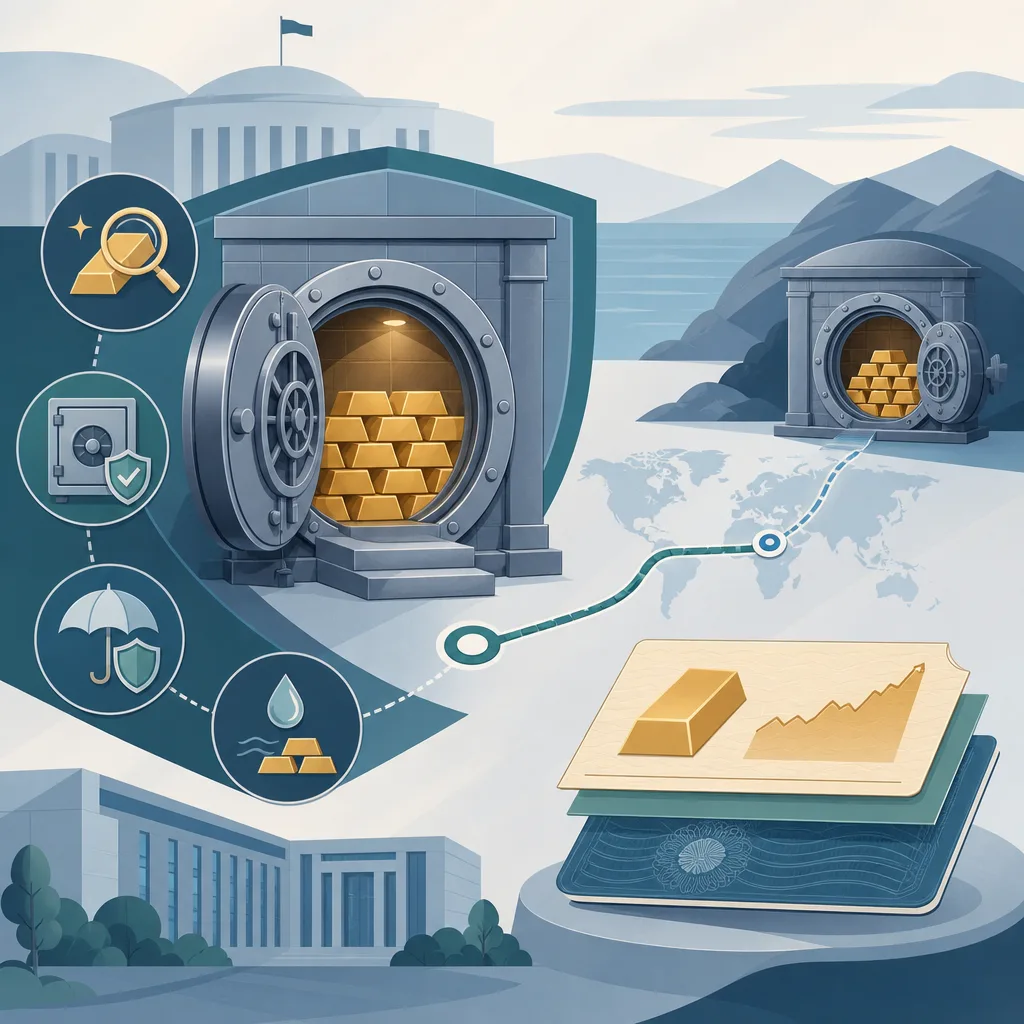
The Bank of Korea's First Physical Gold Purchase Plan in 13 Years and Domestic Procurement Method
The Bank of Korea is establishing a domestic procurement system to resume physical gold purchases, which it suspended after 2013. Purchasing in won, through over-the-counter transactions, gold from domestic refiners that was destined for export could reduce the direct impact on dollar liquidity and exchange-traded gold prices, but the actual purchase volume and timing may vary depending on market conditions.
- The Bank of Korea's gold holdings have remained at 104.4 metric tons since 2013.
- The new procurement plan involves purchasing in won gold produced by domestic refiners that was intended for export.
- Negotiated over-the-counter block trades reduce the extent to which the Bank of Korea's orders appear directly in exchange quotes available to ordinary investors.
- Domestic storage could reduce the risk of concentration in overseas storage locations, but storage, verification, and liquidity management costs must also be considered.
- Purchases of gold ETFs and physical gold differ in terms of price exposure, legal ownership, storage methods, and classification as foreign exchange reserves.
The Bank of Korea is moving to resume purchases of physical gold for the first time in 13 years since 2013. The key difference from the previous method of buying gold with dollars on the international gold market is the creation of a procurement channel through which the Bank can purchase in won gold produced by domestic refiners that was intended for export.
However, “the first purchase in 13 years” should be understood as referring to a policy direction and the establishment of a procurement system. The specific contract size and timing of purchases may be determined based on gold prices, foreign exchange reserve management plans, market liquidity, and consultations with suppliers.
How Much Gold Does the Bank of Korea Hold?
The Bank of Korea purchased a total of 90 tons of additional gold from 2011 to 2013 and has since maintained its holdings at 104.4 tons. Since country rankings by gold holdings and gold’s share of foreign exchange reserves vary depending on the reference date, gold prices, and calculation method, a particular ranking or percentage should not be interpreted as a fixed figure.
In particular, the following two figures must be distinguished.
- Holdings by weight: The physical weight of the gold held by the Bank of Korea. The figure of 104.4 tons falls into this category.
- Share by value: The percentage of the total market value of foreign exchange reserves accounted for by gold. If international gold prices and exchange rates rise, this share may increase even without additional purchases.
The book value and market value of gold, as well as the calculation standards used by international comparison organizations, may also differ. Therefore, any answer to the question “What percentage does gold account for?” must specify both the calculation date and the valuation standard.
Why the Bank of Korea Wants to Increase Its Gold Holdings Again
Diversification of Foreign Exchange Reserve Assets
Foreign exchange reserves are managed with consideration for liquidity, safety, and profitability rather than being concentrated solely in a particular currency or bonds. Because gold does not directly depend on a particular country’s promise to pay, it can complement a portfolio centered on currencies and government bonds.
Responding to Geopolitical and Sanctions Risks
In the event of conflicts between countries, financial sanctions, or disruptions to payment networks, the transfer or disposal of assets held by overseas financial institutions may be restricted. Gold that a central bank directly owns and controls is one means of preparing for such extreme circumstances.
However, accessibility and legal risks also vary depending on where and in what form gold is stored. Diversifying some gold held overseas into domestic infrastructure does not eliminate every risk, but it can reduce concentration in particular overseas storage facilities.
Rising Gold Demand from Central Banks Worldwide
In recent years, several central banks have been net purchasers of gold to diversify their foreign exchange reserves and manage geopolitical risks. However, purchases by other central banks do not automatically determine the appropriate level of holdings for the Bank of Korea. The Bank must consider the won exchange rate, foreign currency liquidity, the ability to sell assets, and gold price levels together.
A Structure for Buying Gold Domestically in Won
The proposed procurement plan involves the Bank of Korea, domestic nonferrous metal refiners, the Korea Exchange, and the Korea Securities Depository, among others. Refiners such as LS MnM and Korea Zinc recover gold as a byproduct while refining nonferrous metals such as copper and zinc.
The term “domestically produced gold” here does not necessarily mean gold mined in Korea. It may also include gold produced by refining imported ore or concentrate at domestic facilities, so it is more accurate to understand it as gold refined and produced domestically.
According to the materials presented, domestic refiners produce approximately 40–45 tons of gold annually, of which approximately 4–5 tons that are not consumed domestically and are scheduled for export are the initial subject of discussions. This does not mean that the Bank of Korea will purchase the entire annual output.
| Category | Existing International Procurement | Proposed Domestic Procurement |
|---|---|---|
| Main counterparty | Overseas gold markets or international financial institutions | Domestic refiners and others |
| Settlement currency | Mainly U.S. dollars | Won |
| Target volume | Gold traded on international markets | Volumes scheduled for export by domestic refiners |
| Transaction method | International market trading | Pre-negotiated over-the-counter block trades |
| Possible storage location | Mainly overseas storage infrastructure | Domestic storage and depository infrastructure may be used |
| Main advantage | Large market and high liquidity | Reduced foreign exchange market burden and concentration risk in overseas storage |
| Main constraint | Use of dollar liquidity | Constraints involving domestic supply, quality certification, and storage systems |
How Won-Denominated Purchases Reduce the Burden on the Foreign Exchange Market
When the Bank of Korea purchases gold on international markets, it generally must pay in a foreign currency such as the dollar. If the purchase is large or the foreign exchange market is unstable, this may create a burden for foreign currency liquidity management.
By contrast, paying domestic producers in won allows the Bank to acquire gold assets without immediately disposing of existing dollar assets. In particular, acquiring domestically volumes that were scheduled for export reduces the need to separately obtain dollars for gold purchases in the on-exchange won-dollar market.
However, won-denominated purchases do not eliminate the economic cost. Producers forgo the foreign currency they could have received by exporting the gold and instead receive won, while the Bank of Korea must pay a price reflecting international gold prices and exchange rates. From the perspective of the country as a whole, there is also an opportunity cost because the export revenue from the gold is not generated.
How Do Negotiated Over-the-Counter Block Trades Work?
If the Bank of Korea places a large purchase order in the same on-exchange order book used by ordinary investors, asking prices may rise rapidly and trigger follow-on buying. To reduce this effect, the Bank may negotiate the price, quantity, and settlement date with producers in advance and then conduct the transaction over the counter.
The general procedure can be described as follows.
- A domestic producer presents the volume scheduled for export and its preferred transaction timing.
- The Bank of Korea reviews its foreign exchange reserve management plan and domestic and international gold prices.
- The two sides negotiate the quantity, pricing formula, quality standards, and settlement terms.
- The transaction is completed after eligibility inspections and title transfer procedures.
- The gold is allocated to designated domestic storage and depository infrastructure.
Over-the-counter transactions reduce the direct exposure of orders to on-exchange quotes, but they do not completely prevent domestic gold prices from rising. Once increased central bank demand becomes known, market expectations may change, and even volumes originally intended for export may affect the outlook for the future supply structure.
Why Volumes Scheduled for Export Are Purchased First
If the Bank of Korea absorbs large quantities of the domestically distributed gold used by ordinary investors or precious metal businesses, supply shortages and price distortions may occur. By contrast, acquiring volumes that were originally intended for export has a relatively limited direct effect on the existing supply in the domestic retail market.
This principle has three purposes.
- Protect the volume circulating in the domestic spot gold market.
- Limit the direct impact of the Bank of Korea’s purchase orders on on-exchange prices.
- Provide domestic refiners with a stable counterparty for large-volume transactions.
However, the criteria for determining whether gold is “scheduled for export,” the fairness of purchase prices, and the actual impact on domestic supply must be examined once the transaction system is specified in detail.
Advantages and Management Requirements of Domestic Storage
A substantial portion of the physical gold held by the Bank of Korea is known to have been stored through overseas infrastructure. Increasing the share stored domestically can help prepare for risks such as operational shutdowns at overseas storage facilities, restrictions on asset transfers, or sanctions between countries.
Domestic storage, however, requires the following conditions.
- Verification of purity and specifications recognized in international markets
- Recordkeeping for each gold bar, including serial numbers and weight
- Independent physical inspections and regular audits
- Security and insurance systems against theft, fire, and disasters
- Transportation and recertification procedures required for future sales on international markets
The mere fact that gold is located domestically does not guarantee liquidity. To use it promptly as collateral during a crisis or sell it on international markets, the gold bars must meet international standards and have clear ownership records.
Physical Gold and Gold ETFs Are Not the Same Asset
Reports that the Bank of Korea purchased a small amount of gold ETFs must be distinguished from the procurement of physical gold. Both assets are affected by gold prices, but their legal and accounting characteristics differ.
| Item | Physical Gold | Gold ETF |
|---|---|---|
| Asset held | Gold bars or direct rights to gold in an account | Fund shares or securities |
| Counterparty risk | Exists depending on the custodian and settlement structure | Exists depending on the asset manager, trustee, and market structure |
| Storage | Requires vaults and physical asset management | Investors do not directly store gold bars |
| Ease of trading | May require transportation, inspection, and settlement | Can be traded relatively quickly in the market |
| Costs | Storage, insurance, and inspection costs | Management fees and trading costs |
| Foreign exchange reserve classification | May be classified as monetary gold if requirements are met | Generally not treated the same as physical monetary gold |
Under the International Monetary Fund’s balance of payments standards, “monetary gold” means gold owned by monetary authorities and held as a reserve asset. Shares in an ETF that tracks the price of gold provide price exposure but are not the same asset as physical monetary gold.
Key Indicators to Monitor Going Forward
To assess the Bank of Korea’s policy of expanding its gold holdings, actual operating data rather than announcement headlines must be examined.
- Annual physical gold purchases and cumulative holdings
- Average purchase price and price-setting criteria
- Changes in the amounts stored domestically and overseas
- Gold’s share of the total market value of foreign exchange reserves
- Differences between on-exchange and off-exchange gold prices and changes in domestic circulation volumes
- Quality certification, storage fees, and insurance costs
- Conditions for suspending or postponing purchases
The significance of this plan does not lie simply in buying more gold. The key is that it creates a new foreign exchange reserve management channel through which the Bank can acquire domestically produced gold in won without immediately disposing of dollar assets while diversifying storage locations and asset types. However, because over-the-counter purchases do not completely eliminate price and supply effects, transparent ex post disclosure of transaction volumes and pricing formulas is important.
FAQ
How much gold does the Bank of Korea currently hold?
The Bank of Korea is known to hold 104.4 tonnes of physical gold. Of this, 90 tonnes were purchased additionally between 2011 and 2013, and its holdings remained unchanged for a long period thereafter.
Does the first gold purchase in 13 years mean that a contract has already been finalized?
Not necessarily. The establishment of a procurement framework and the presentation of a medium- to long-term purchasing strategy should be distinguished from the execution of individual transactions. The actual volume and timing may vary depending on gold prices, the foreign exchange reserve management plan, and the outcome of consultations with companies.
Why does the Bank of Korea want to buy gold with won rather than dollars?
Paying domestic producers in won reduces the need to separately procure dollars for gold purchases on the international market or immediately sell existing dollar-denominated assets. This could help ease foreign currency liquidity pressures when the foreign exchange market is unstable.
Is all the gold produced by domestic refiners mined in Korea?
No. Domestic refiners can also recover gold as a by-product while refining imported ore or concentrates. Therefore, “gold refined and produced in Korea” is a more accurate description than “Korean gold.”
How much domestically produced gold can the Bank of Korea purchase annually?
The materials provided explain that domestic refiners produce approximately 40–45 tonnes annually and identify approximately 4–5 tonnes of that amount, which is not consumed domestically and is scheduled for export, as the initial subject of consultations. The actual purchase volume may be lower and may vary from year to year.
What is an off-exchange negotiated block trade?
It is a method of executing large transactions in which the buyer and seller agree in advance on terms such as price, quantity, and settlement date, separately from regular on-exchange orders. This can reduce the direct visibility of the Bank of Korea’s orders in public bid and ask quotes.
Wouldn’t off-exchange transactions drive up domestic gold prices?
They can reduce the direct impact on on-exchange quotes, but they cannot eliminate the price impact entirely. If new demand from the central bank changes market expectations or affects the outlook for future supply, off-exchange transactions can also have an indirect price effect.
Is buying a gold ETF the same as buying physical gold?
No. A gold ETF is a security or fund interest that tracks the price of gold, while physical gold represents a direct right to gold bars or a gold account. They differ in terms of custody arrangements, counterparty risk, costs, and classification as foreign exchange reserves.
Does storing gold domestically eliminate the risk of overseas asset freezes?
It reduces concentration risk involving overseas custodians, but it does not eliminate all risks. The security of domestic storage facilities, quality verification, disaster response, insurance, the ability to sell on international markets, and ownership records must also be managed.
Why does the share of gold holdings vary across different sources?
This is because gold prices, exchange rates, the total amount of foreign exchange reserves, reference dates, and valuation methods differ. Even if holdings by weight remain unchanged, a rise in gold prices can increase their share based on market value.
Sources
Images