How to Determine Whether Cooling or Dehumidifying Uses Less Electricity
Because both cooling and standard dehumidifying use a refrigerant compressor, you cannot determine which uses less electricity based on the mode name alone. For an accurate comparison, check the product manual, match the starting conditions and operating time, and repeatedly measure electricity consumption in kWh.
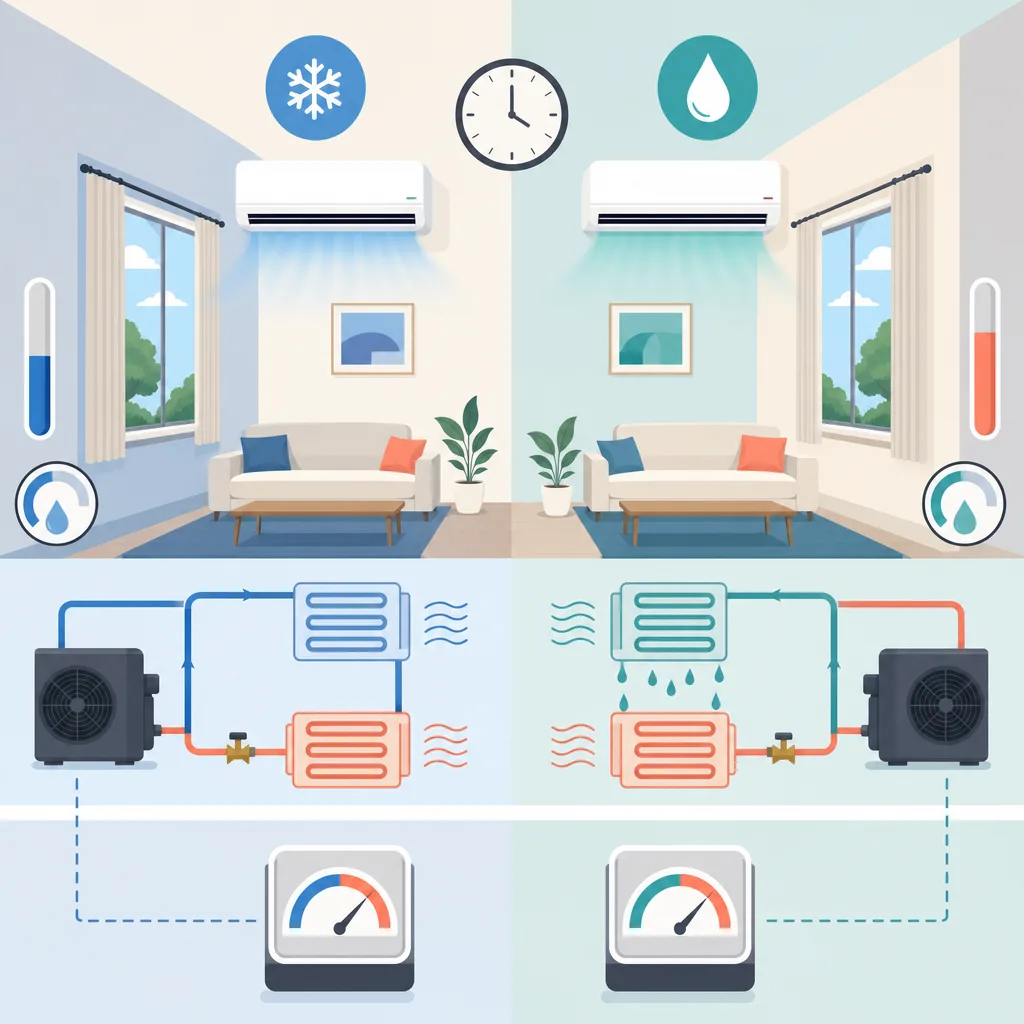
- Cooling and standard dehumidifying generally use the same refrigeration cycle but differ in how operation is controlled.
- Even if instantaneous power consumption is low, a longer operating time can result in higher total electricity consumption.
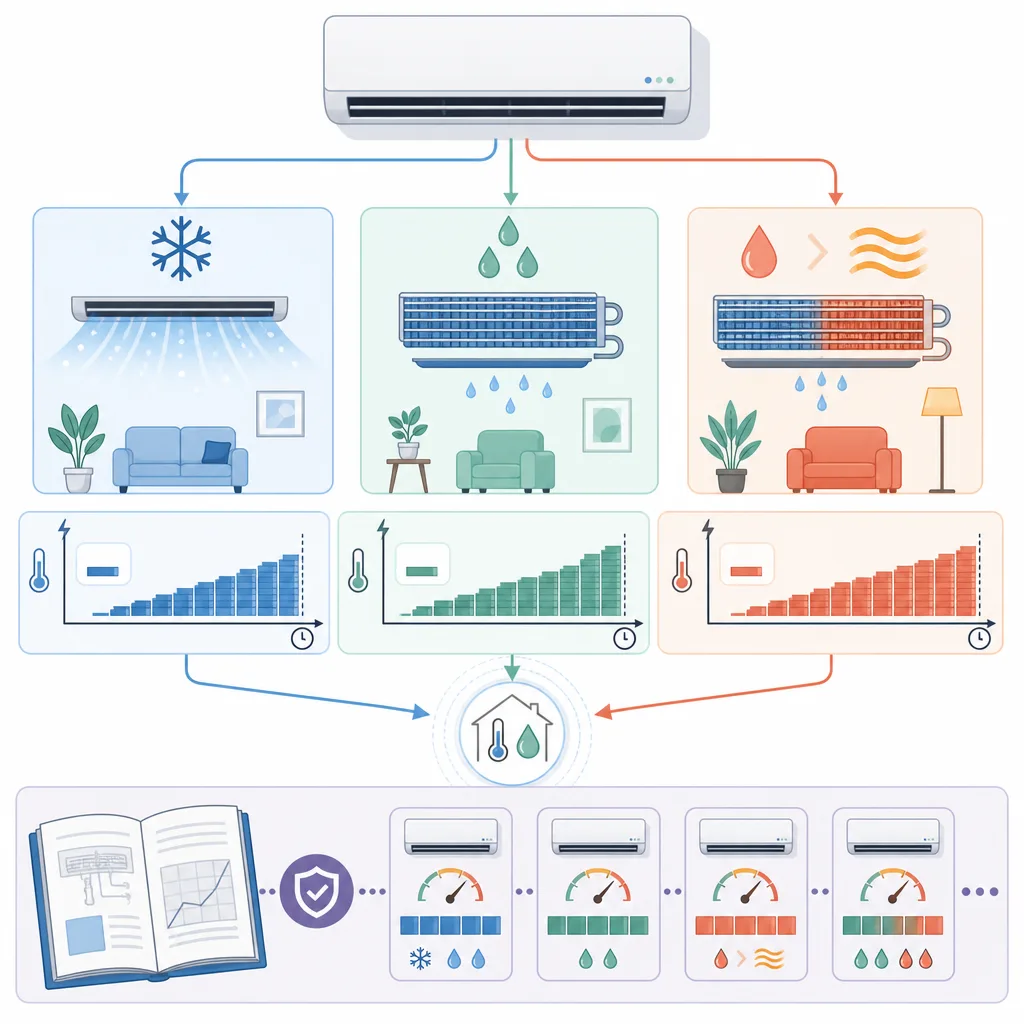
- Standard, reheating, and energy-saving dehumidifying differ in structure and control method, so they should not be compared as if they were the same mode.
- A fair comparison requires the same space, similar indoor and outdoor conditions, and either the same measurement period or the same stopping criterion.
- Electricity costs should be estimated by applying the actual marginal rate and additional adjustment items to the measured kWh.
Explanations that an air conditioner’s dehumidification mode uses less electricity than cooling and explanations that there is almost no difference can both be correct under certain conditions. This is because cooling and standard dehumidification generally use the same refrigerant compressor, but the methods used to control compressor and indoor fan speeds, operating time, and target temperature and humidity vary by product.
The reason related questions repeatedly arose from 2024 to 2026 is also that electricity costs are difficult to determine from mode names alone. An accurate answer requires checking the air conditioner’s specific operating specifications, the usage environment, and the amount of electricity measured over a certain period.
Operating Principles to Understand First
Cooling Also Removes Moisture From the Air
During cooling operation, indoor air passes over a cold evaporator coil. If the coil’s surface temperature is below the air’s dew point, water vapor condenses into water and drains through the drainpipe. Therefore, cooling does not merely lower the temperature; depending on the conditions, it also provides dehumidification.
Standard Dehumidification Also Uses the Compressor in Most Cases
Standard air-conditioner dehumidification uses the same refrigeration cycle as cooling rather than a separate low-power moisture-absorbing device. It cools the air to condense moisture and may combine the following controls.
- Run the indoor fan at a low speed.
- Turn the compressor on and off intermittently.
- Reduce or vary the speed of an inverter compressor.
- Adjust output according to temperature or humidity sensors and the manufacturer’s algorithm.
Reducing the fan speed can make the air passing over the coil colder, which may help moisture condense. However, if the compressor continues operating or takes longer to reach the target conditions, total electricity consumption does not necessarily decrease.
Why Electricity Consumption Cannot Be Determined From the Mode Name Alone
Electricity consumption is determined by the combination of instantaneous power consumption and operating time.
Electricity consumption (kWh) = Average power consumption (kW) × Operating time (h)
For example, even if dehumidification mode has lower average power consumption than cooling, its total electricity consumption may be greater if it operates for much longer. Conversely, on days when humidity is high but the sensible heat load is not large, dehumidification controls may reduce compressor output and use less electricity.
The main variables that affect the results are as follows.
| Variable | Effect on electricity consumption |
|---|---|
| Starting indoor temperature | The higher it is, the more heat may need to be removed. |
| Starting indoor humidity | The higher it is, the more moisture must be condensed and removed. |
| Outdoor temperature and humidity | They change the conditions under which the outdoor unit releases heat and the load entering the room. |
| Set temperature and humidity | The lower the targets, the longer the compressor may operate. |
| Room size and insulation | They determine the cooling load and the time required to reach the target conditions. |
| Open doors and number of occupants | They may distort comparison results by adding heat and moisture. |
| Compressor type | Fixed-speed and inverter models have different part-load operating characteristics. |
| Condition of filters and heat exchangers | This affects airflow and heat-exchange performance. |
In particular, inverter air conditioners continuously adjust compressor output instead of simply turning the compressor on and off. A W reading at a single point during measurement does not represent the entire operation, so cumulative kWh must be checked.
Differences Among Standard, Reheat, and Energy-Saving Dehumidification
First check the product manual to identify the type of dehumidification function. Even when the names are similar, the actual operation may differ.
| Function type | Typical operating characteristics | Points to note when comparing electricity consumption |
|---|---|---|
| Standard dehumidification or dry | Cools the air to condense moisture and adjusts fan or compressor output. | Because it uses the same compressor as cooling, it cannot always be regarded as low-power. |
| Reheat dehumidification | Cools and dehumidifies the air, then warms it again to reduce excessive drops in indoor temperature. | Depending on the reheating method and additional operation, it may use more electricity than standard dehumidification. |
| Energy-saving or comfort dehumidification | Controls temperature, humidity, fan, and compressor using the manufacturer’s proprietary algorithm. | The savings rate cannot be determined from the name alone; information and measurements for the relevant model are required. |
| Cooling dehumidification | Reduces humidity through condensation generated during cooling. | On hot days, it may reach the target temperature and humidity faster than a separate dehumidification mode. |
Reheat dehumidification warms the cold air produced after dehumidification, making it useful for lowering humidity without making the room excessively cold. However, because its design varies, such as whether it uses an electric heater or heat from the refrigeration cycle, the direction of its effect on power consumption cannot be stated uniformly.
Check Product Specifications Before Measuring
Before making a comparison, find the official user manual using the air conditioner’s model number and check the following items.
- Check whether the temperature or humidity can be set directly in dehumidification mode.
- Check whether it uses standard or reheat dehumidification and whether it has a separate energy-saving function.
- Check how the compressor and indoor fan are controlled during dehumidification.
- Check the measurement range and units for energy consumption shown by the app or the unit itself.
- Check whether additional functions such as automatic drying, air purification, and ventilation can be turned off individually.
Models that do not allow temperature selection in dehumidification mode cannot be set to the same setting as cooling. In this case, it is better to conduct separate fixed-time comparisons and target temperature-and-humidity comparisons.
Procedure for Comparing Electricity Consumption Between Cooling and Dehumidification
1. Select an Appropriate Measurement Method
The recommended order is as follows.
- The air conditioner’s own cumulative energy monitor or the manufacturer’s app
- Smart meter usage data provided by the electric utility
- A circuit measurement device for the distribution panel
- A plug-in electricity meter that adequately supports the rated voltage, current, and power
If a wall-mounted or floor-standing air conditioner uses a dedicated circuit or high-voltage power supply, do not arbitrarily connect a standard household plug-in meter. Measurements of hardwired equipment should be left to a qualified professional. When using a smart meter to view total household consumption, avoid using other high-power appliances such as electric ranges, dryers, and electric water heaters.
2. Record the Starting Conditions
Immediately before each test, record the following data.
- Indoor temperature and relative humidity
- Outdoor temperature and, if possible, relative humidity
- Whether windows and doors are open or closed
- Number of occupants and whether heat-generating appliances are in use
- Set temperature, fan speed, and additional functions
- Starting cumulative electricity reading
Do not directly compare the results if the indoor and outdoor conditions differ significantly between the two tests. If cooling at midday is compared with dehumidification on a rainy night, differences in weather may dominate the results more than differences between the modes.
3. Distinguish Between Two Testing Methods
Fixed-Time Test
Operate cooling and dehumidification for the same amount of time and compare the kWh consumed. This makes it easier to observe differences in electricity consumption caused by the control methods themselves, but the temperature and humidity at the end may differ.
Same-Target Test
Run both modes under similar starting conditions and compare the kWh and time required to reach a predetermined target temperature and humidity. For example, a specific temperature and relative humidity may be selected as the experimental stopping criteria. However, these figures should not be universal recommendations but identical endpoints for comparison.
If one mode cannot reach the target humidity or temperature, that fact is also an important result. If it uses less electricity but fails to create the required comfortable conditions, it is difficult to regard it as more efficient in actual use.
4. Measure Repeatedly, Not Just Once
Alternate the testing order for cooling and dehumidification, and measure each mode at least several times. Group together results from similar weather conditions, and separately mark trials during which a door was left open for an unusually long time or another large appliance was used.
It is useful to record the following values together in the comparison table.
| Item | Cooling | Dehumidification |
|---|---|---|
| Starting temperature and humidity | ||
| Ending temperature and humidity | ||
| Operating time | ||
| Cumulative electricity consumption (kWh) | ||
| Electricity consumption per hour (kWh/h) | ||
| Whether the target was reached | ||
| Outdoor conditions |
For repeated results, check not only the average but also the median and range. Drawing a conclusion from a single trial may allow the result to be affected by the compressor’s initial high-output operation or changes in outdoor temperature.
5. Convert the Results Into Electricity Costs
The cost difference between the two modes can first be estimated as follows.
Estimated cost difference = Difference in electricity consumption between the two modes (kWh) × Applicable rate for the relevant usage tier
However, the actual bill may reflect progressive rate tiers, time-of-use rates, fuel cost adjustments, taxes, or additional charges. Using the marginal rate applied to the increase in electricity consumed by the air conditioner is more suitable for interpreting the added cost than using the average rate applied to total consumption.
Criteria for Interpreting Measurement Results
The following three factors must be considered together.
- Energy: How many kWh were used to reach the target?
- Time: How long did it take to reach the target conditions?
- Result: Were the temperature and humidity at the end actually comfortable?
Even if dehumidification mode uses fewer kWh, it cannot be considered a replacement for cooling if the room remains hot or the target humidity is not reached. Conversely, on days when the temperature is not high but humidity alone is high, cooling may make the room colder than necessary, so dehumidification or reheat dehumidification may better suit the purpose.
The key to comparison is not to determine which mode is universally superior, but to find the operating method that achieves the desired temperature and humidity with less energy for the specific air conditioner and actual residential environment.
Common Measurement Errors
- Comparing only the instantaneous W readings shown on the remote control or app.
- Comparing results from days with different starting temperatures and humidity levels.
- Using different stopping criteria by measuring cooling based on the set temperature and dehumidification for a fixed time.
- Comparing only the modes while leaving reheat enabled during dehumidification or powerful operation enabled during cooling.
- Using other high-power appliances during smart meter measurements.
- Simply dividing the total electricity bill by the operating time and treating the result as the air conditioner’s cost.
- Applying the result of a single measurement to all seasons and weather conditions.
Selection Principles by Situation
- When it is hot and humid indoors: First using cooling to lower both temperature and humidity may be effective.
- When it is humid but not hot: Standard or reheat dehumidification may be suitable for reducing excessive temperature drops.
- When electricity consumption is the highest priority: Follow the results of a direct comparison of cumulative kWh under the same conditions.
- When humidity remains consistently high: Also check sources of moisture infiltration, such as gaps around doors, ventilation, cooking, drying laundry, and leaks.
- When the air conditioner’s capacity does not match the space: Oversized equipment may run in short repeated cycles and fail to dehumidify sufficiently, while undersized equipment may operate at high output for long periods.
In conclusion, there is no single mode that always uses less electricity between cooling and dehumidification. The most reliable way to determine this is to check the functions of the exact model and measure both cumulative kWh and final temperature and humidity under similar environmental conditions.
FAQ
Does air conditioner's dehumidification mode always use less electricity than cooling mode?
No. Both modes generally use the refrigerant compressor, and total energy consumption varies depending on compressor output, fan speed, operating time, and settings. The specific model must be measured under the same conditions to determine this.
Why does the outdoor unit run even in dehumidification mode?
To condense moisture in the air into water, the indoor heat exchanger must be cooled below the dew point, which requires the refrigeration cycle and compressor to operate. Dehumidification is generally not simply a fan-only function.
Does lower instantaneous power consumption necessarily mean a lower electricity bill?
No. The energy consumption on which electricity bills are based is the product of power consumption and operating time. Running longer at a lower output can actually result in higher total kWh.
What conditions should be kept the same to fairly compare cooling and dehumidification?
The tests should be conducted in the same space with similar initial indoor temperature and humidity, outdoor weather, door opening and closing, number of occupants, and auxiliary features. It is advisable to distinguish between tests conducted for the same length of time and tests targeting the same temperature and humidity, and to repeat each test.
Can I use the energy consumption shown in the air conditioner app to calculate my electricity bill?
It may be useful for relative comparisons between modes, but you should not assume that the displayed value is exactly the same as that of the utility company's billing meter. Check the app's units and aggregation period, and compare it with smart meter data if possible.
Does reheat dehumidification use more electricity than regular dehumidification?
It can, but it depends on the product's design. Reheat dehumidification requires an additional process because it cools the air to remove moisture and then reheats it, but power consumption varies depending on whether it uses an electric heater or recovered heat.
Can I save electricity while dehumidifying by using fan mode?
Fan mode generally consumes less electricity because it does not run the compressor, but it does not actively dehumidify because it does not cool the air below the dew point. If water remaining on the heat exchanger evaporates again, the humidity may temporarily increase.
Is it safe to measure an air conditioner's electricity use with a plug-in energy meter?
It should be used only when the meter's rated voltage, current, and power are sufficient for the air conditioner's load and the air conditioner is designed for a standard plug connection. Do not arbitrarily connect adapters to air conditioners with dedicated circuits, high voltage, or fixed wiring; use professional measurement methods instead.
How do I convert the difference in energy consumption into the actual electricity cost?
You can make a rough calculation by multiplying the kWh difference between the two modes by the applicable rate for that usage tier. The actual bill may vary depending on the contract and regional rate structure, including progressive rates, time-of-use rates, adjustment charges, and taxes.
Sources
- U.S. Department of Energy Energy Saver: Air Conditioning
- Aha Question 1 About Air Conditioner Cooling, Dehumidification, and Electricity Costs
- Aha Question 2 About Air Conditioner Cooling, Dehumidification, and Electricity Costs
- Aha Question 3 About Air Conditioner Cooling, Dehumidification, and Electricity Costs
- Aha Question 4 About Air Conditioner Cooling, Dehumidification, and Electricity Costs
Images