Battle of Salsu 612: Eulji Mundeok's Strategy
The Battle of Salsu was a 612 battle in which Goguryeo defeated the Sui forces advancing on Pyongyang. It centered on Eulji Mundeok's reconnaissance and lure tactics and an attack during a river crossing as the enemy retreated. Troop figures and the flood theory must be read with attention to the scope of each historical record.
- The Battle of Salsu was a battle in the seventh lunar month of 612 in which Goguryeo decisively defeated the Sui forces at the Salsu River.
- Eulji Mundeok inspected the enemy camp under the guise of surrender, then lured the Sui forces onward.
- Goguryeo attacked the Sui rear guard when the retreating forces were halfway across the Salsu River.
- The figures of 305,000 and 2,700 in the Samguk Sagi refer respectively to the initial strength of the nine armies and the number who returned to Liaodong Fortress.
- The Battle of Salsu thwarted the 612 campaign, but it did not end the Sui dynasty's later invasions.
The Battle of Salsu was a battle in 612 in which Goguryeo repelled an invasion by the Sui dynasty. Eulji Mundeok lured the enemy deep into Goguryeo territory, then attacked as it crossed the Salsu River during its retreat. It is remembered as a victory that thwarted a large expeditionary force's assault on Pyongyang.
This article follows the Samguk Sagi in the Korean History Database and was checked in September 2026.
When and where did the Battle of Salsu take place?
The Battle of Salsu took place in the seventh lunar month of 612, the 23rd year of King Yeongyang's reign. The Salsu River is generally identified as today's Chongchon River. The Goguryeo commander was Eulji Mundeok. His opponents were the Sui forces advancing toward Pyongyang under Yu Zhongwen, Yuwen Shu, and others.
This battle was one part of the war between Goguryeo and Sui. The entire Sui army did not gather and fight at a single location on the Salsu River. The troops attacking Liaodong Fortress must be distinguished from those heading toward Pyongyang. Basic information about the battle is available in the Encyclopedia of Korean Culture entry on the Battle of Salsu.
Background to the Sui invasion
The war arose from a conflict between the two states over the East Asian order. Sui unified China in 589. It then sought to expand its influence over neighboring states. Goguryeo sought to preserve its existing independent sphere of influence.
In 598, Goguryeo attacked Liaoxi first. Emperor Wen of Sui responded by sending an army, but the campaign failed. His successor, Emperor Yang of Sui, personally launched a campaign against Goguryeo in 612. This sequence is outlined in Our History Net's explanation of the Goguryeo-Sui War.
Goguryeo faced multiple attacks that extended as far as its capital. The main Sui forces put pressure on the fortresses of Liaodong. Nine armies under Yu Zhongwen, Yuwen Shu, and others advanced toward Pyongyang. The Sui navy commanded by Lai Hu'er also approached by sea.
Timeline from the invasion to the retreat
The Battle of Salsu progressed from reconnaissance of the enemy camp to luring the enemy in and attacking it during its retreat. The months below follow the lunar calendar used in the historical sources. They have not been converted to Gregorian dates.
| Period | Event | Source |
|---|---|---|
| 589 | Sui unifies China | Our History Net, “Goguryeo-Sui War” |
| 598 | Goguryeo attacks Liaoxi and Emperor Wen of Sui's campaign fails | Our History Net, “Goguryeo-Sui War” |
| 612 | Emperor Yang of Sui launches a large-scale invasion of Goguryeo | Our History Net, “Battle of Salsu” |
| Sixth lunar month of 612 | Eulji Mundeok conducts reconnaissance of the Sui camp | Samguk Sagi, “Biography of Eulji Mundeok” |
| Seventh lunar month of 612 | Goguryeo attacks the retreating Sui forces at the Salsu River | Samguk Sagi, “Biography of Eulji Mundeok” |
| 613 | Sui invades again but withdraws after Yang Xuangan's rebellion | Our History Net, “Goguryeo-Sui War” |
| 614 | After another Sui invasion, the war ends with Goguryeo's request for peace | Our History Net, “Goguryeo-Sui War” |
Eulji Mundeok's reconnaissance and luring strategy
What did he learn through a false surrender?
The Samguk Sagi explains that Eulji Mundeok visited the enemy camp to conduct reconnaissance. Under royal orders, he entered the Sui camp under the pretense of surrendering. His actual purpose was to examine the opposing army's strengths and weaknesses. This is stated in the reconnaissance account in the “Biography of Eulji Mundeok”.
The Sui commanders tried to capture Eulji Mundeok. However, Liu Shilong opposed this, and they let him return. Eulji Mundeok did not respond when they asked him to come back. The record states that he then crossed the Yalu River and returned.
Why did they starve despite receiving so many provisions?
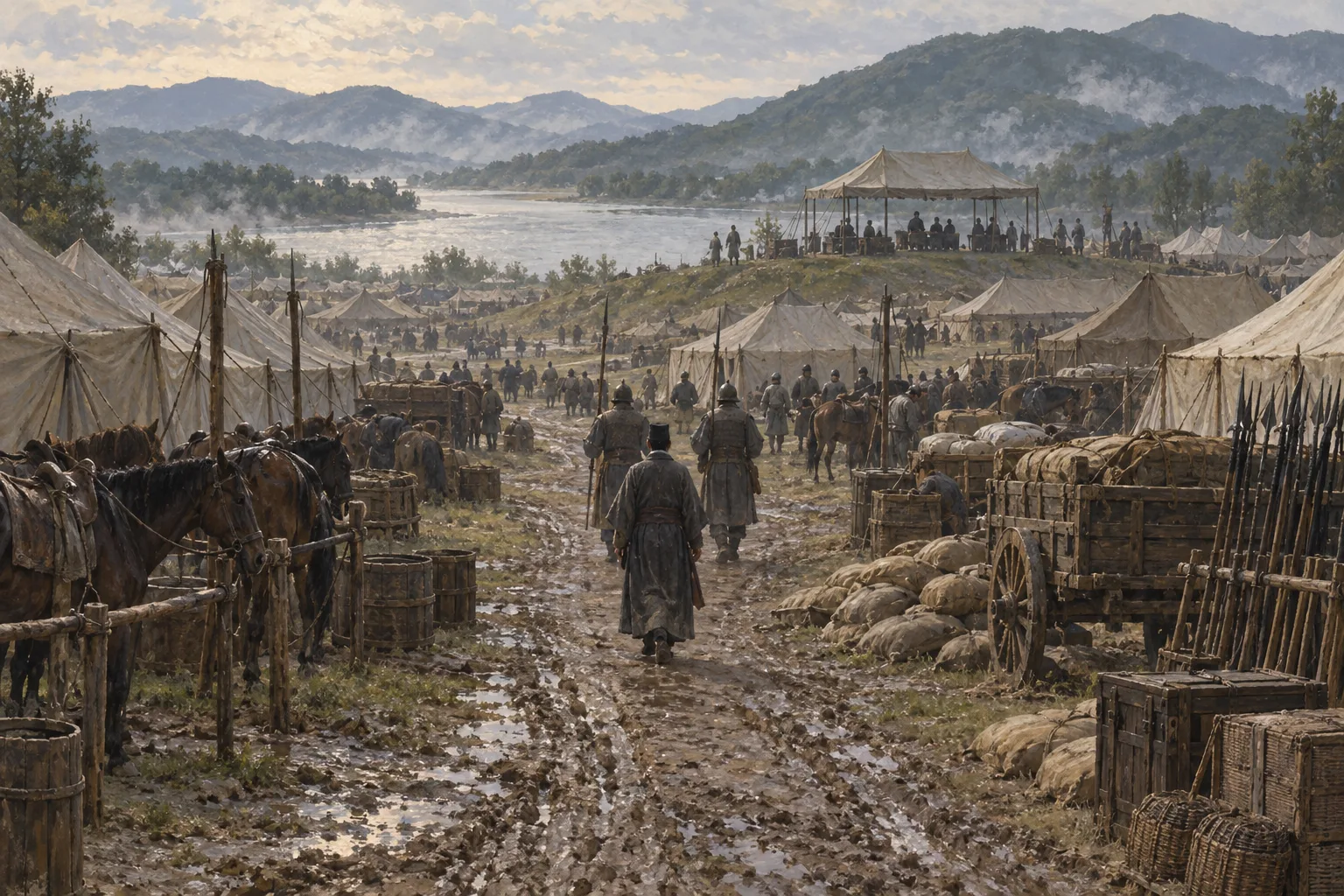
The supply problem arose from the gap between the amount of food issued and the troops' actual ability to carry it. The nine armies reportedly received 100 days' worth of food when they departed. The soldiers also had to carry weapons and other military supplies. There are records of soldiers burying food because they could not bear the heavy loads.
The mere fact that food was issued therefore does not mean the supply effort succeeded. Enough food had to remain for the advance to Pyongyang. As the campaign continued, this condition broke down. The Encyclopedia of Korean Culture describes this as an operational constraint on the nine armies.
Why did they pretend to lose and retreat?
Eulji Mundeok's retreat was a luring operation intended to draw the enemy deeper into Goguryeo territory. Our History Net describes the seven battles fought in one day as deliberate defeats. The Sui forces exhausted themselves even as they won the battles. The troops that eventually advanced to the vicinity of Pyongyang faced supply shortages and fatigue.
Eulji Mundeok sent Yu Zhongwen a poem calling for an end to the war. However, the poem alone cannot be seen as the reason for the decision to retreat. The shortage of provisions and the difficulty of taking Pyongyang Fortress must also be considered. A related explanation appears in Our History Net's account of the Battle of Salsu.
The turning point was the retreat and river-crossing attack
The decisive turning point came when the Goguryeo forces continued to pressure the retreating enemy. Eulji Mundeok sent an envoy to propose surrender once again. He offered to arrange an audience between the Goguryeo king and the emperor if the Sui forces withdrew. The exhausted Sui commanders used this as a justification to retreat.
The Samguk Sagi's “Biography of Eulji Mundeok” describes the ensuing attack as follows.
Eulji Mundeok sent out his troops, surrounded the enemy on all sides, and attacked.
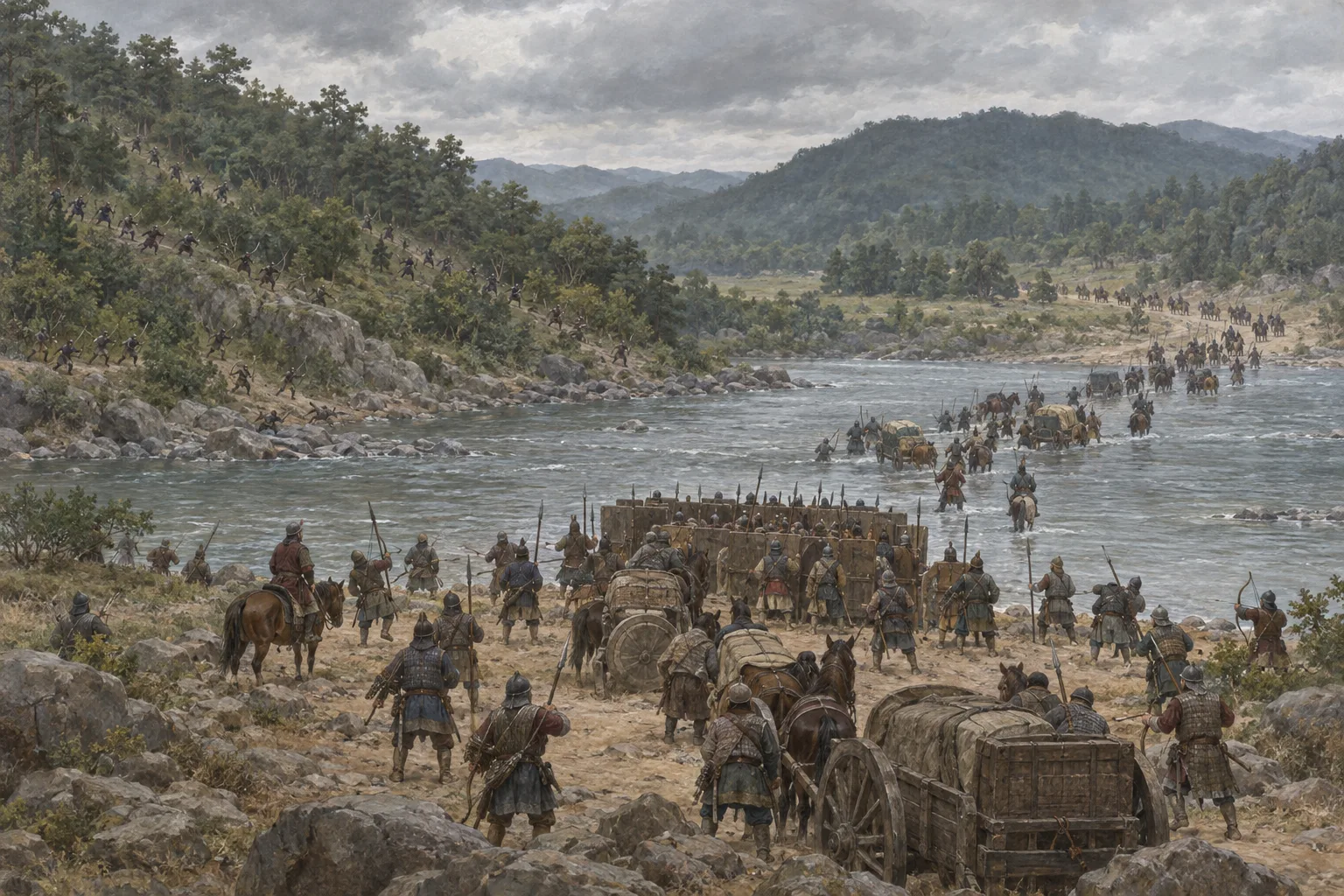
The Sui forces moved while fighting in a square formation. A square formation was designed to defend against attacks from multiple directions. When about half of the troops had crossed the Salsu River, the Goguryeo forces attacked the rear guard. The record states that the collapse of the rear units spread to other units.
From a tactical perspective, units can easily become divided while crossing a river. This interpretation explains their vulnerability during the crossing. The historical source directly identifies the rear guard as the target of the attack. The evidence comes from the account of the Battle of Salsu in the “Biography of Eulji Mundeok”.
Troop figures and the outcome of the battle
The figures in the Samguk Sagi show the major defeat suffered by the nine armies that advanced toward Pyongyang. However, the difference between the number of departing troops and returning troops is not necessarily the number killed. The locations and counting scopes represented by the two figures must be distinguished.
| Recorded figure | Period and scope | Points to note when interpreting |
|---|---|---|
| 1 million | Figure reported as the number mobilized for the Sui campaign in 612 | Not the number of troops gathered at the Salsu battlefield |
| 305,000 | Strength of the nine armies when they first crossed the Liao River in 612 | Starting size of the force advancing toward Pyongyang |
| 2,700 | Number who returned to Liaodong Fortress after the defeat in 612 | Cannot be treated as the total number of survivors from the entire expeditionary force |
The first figure is given in Our History Net's account of the Battle of Salsu. (verified figure: 1,133,800 soldiers and twice that number of provisions carriers · source: contents.history.go.kr · checked 2026-09-23) The latter two figures come from the Samguk Sagi's “Biography of Eulji Mundeok.” (verified figures: 305,000 troops in the nine armies that first crossed the Liao River, 2,700 who returned to Liaodong Fortress · source: db.history.go.kr · checked 2026-09-23) These records do not reveal the exact strength or losses of the Goguryeo forces.
The Battle of Salsu sealed the failure of Sui's 612 campaign. Emperor Yang of Sui ultimately withdrew his army. However, Sui attacked Goguryeo again in 613 and 614. This victory therefore cannot be regarded as the immediate end of the entire war between the two states.
Sui's fall is also difficult to explain through a single battle. Repeated campaigns increased the burden on the state. Large-scale civil engineering projects and internal rebellions also played a role. This background is described in Our History Net's explanation of the Goguryeo-Sui War.
Records and interpretations
What the historical source directly states
The Samguk Sagi recounts the reconnaissance, luring operation, and attack during the retreat. However, it is not a report written at the scene in 612. It is a historical work compiled in Goryeo by Kim Busik and others in 1145. Its date of compilation is given in Our History Net's explanation of the Samguk Sagi.
The commonly accepted explanation
Public history resources identify the luring operation and supply difficulties as key factors in the outcome. This explanation is shared by Our History Net and the Encyclopedia of Korean Culture. The ability of Liaodong's fortresses to hold out must also be considered. Eulji Mundeok's strategy can be understood within the broader conditions of the war.
Is the flood attack theory a confirmed fact?
The claim that Goguryeo broke an embankment and swept away the enemy is difficult to regard as established fact. The relevant passage of the Samguk Sagi does not mention the destruction of an embankment. A note in the Korean History Database examines the later tradition on which the flood attack theory is based. It questions both when the tradition arose and the feasibility of constructing such an embankment.
A battle using the river must therefore be distinguished from a flood attack carried out by breaking an embankment. The former is confirmed by the record of an attack during the river crossing. The latter is an interpretation that requires separate evidence.
Why do the same numbers appear in several historical works?
Even when the same figure appears in multiple historical works, it cannot necessarily be treated as independent testimony. Later historical works may have quoted earlier books. A note in the Korean History Database explains the relationship between passages in the Samguk Sagi and the Zizhi Tongjian. It states that some content was omitted or quoted with changes in wording.
The accuracy of a number should therefore not be judged simply by counting the historical works in which it appears. The source from which the same figure was transmitted must also be examined. This makes it possible to assess the battle's outcome separately from the accuracy of its troop statistics.
What the Battle of Salsu means today
The Battle of Salsu shows that troop strength alone cannot explain the outcome of a war. When supplies are cut off, even a large force has difficulty continuing operations. Command decisions and fortress defenses also change the conditions of battle. The final attack during the river crossing was connected to the events that preceded it.
In studying history, the following points should be distinguished.
- War and battle: the entire Goguryeo-Sui War and the 612 Battle of Salsu
- Whole and part: the Sui expeditionary force and the nine armies advancing toward Pyongyang
- Record and reconstruction: the attack described in historical sources and the later story of a flood attack
- Event and compilation: the battle in 612 and a historical work compiled during the Goryeo period
Frequently asked questions
Where is the Salsu River today?
The Salsu River is generally identified as today's Chongchon River. Our History Net and the Encyclopedia of Korean Culture give this explanation. However, identifying the river does not establish the exact location of the crossing at the time.
Are Eulji Mundeok's birth and life known?
Eulji Mundeok's birth and death dates are unknown. The Samguk Sagi also states that his family background is unknown. Accounts of his birthplace in later books are of uncertain accuracy. Related information is summarized in the Encyclopedia of Korean Culture entry on Eulji Mundeok.
Do “Sui forces” and “navy” mean the same thing?
In this article, “Sui forces” means the military forces of the Sui dynasty. Depending on the context, “navy” refers to forces that fight aboard ships. Lai Hu'er's navy must be distinguished from the land forces of Yu Zhongwen and Yuwen Shu.
Can the date of the Battle of Salsu be used as a Gregorian calendar anniversary?
A lunar-calendar record should not simply be used as a Gregorian calendar anniversary. The Korean History Database dates the battle to the seventh lunar month of 612. This article does not convert it to a Gregorian date.
FAQ
When did the Battle of Salsu take place?
The Battle of Salsu took place in the seventh lunar month of 612, the 23rd year of the reign of King Yeongyang of Goguryeo. This date must not be converted to and written as July in the solar calendar.
Where did the Battle of Salsu take place?
Salsu is generally considered to be the present-day Cheongcheon River. The location of the river must be distinguished from the exact crossing point at the time.
Why did Eulji Mundeok feign surrender?
The Samguk sagi explains that the purpose of his visit to the enemy camp was to assess the strengths and weaknesses of the Sui army. His subsequent offer to surrender through an envoy is linked to the Sui army's decision to withdraw.
How did Eulji Mundeok's strategy of luring the enemy work?
The Goguryeo army pretended to be defeated and retreated, luring the Sui army deep into its territory. The advancing troops faced food shortages and exhaustion. During their withdrawal, they were pursued by the Goguryeo army.
Was the Battle of Salsu a flood attack carried out by breaching an embankment?
The claim that an embankment was breached is difficult to regard as an established fact. The Samguk sagi records that the rear guard was attacked when the Sui army was halfway across the river.
What does the record that only 2,700 out of 305,000 returned mean?
In the Samguk sagi, the 305,000 were the troops of the nine armies that crossed the Liao River. The 2,700 were those who returned to Liaodong Fortress after the defeat. The entire difference between the two figures cannot be counted as soldiers killed in action.
Did the Battle of Salsu end the war between Goguryeo and Sui?
Although the 612 campaign failed, Sui invaded again in 613 and 614. The Battle of Salsu must be distinguished from the end of the entire war between the two states.
Have Eulji Mundeok's year of birth and place of origin been confirmed?
The years of Eulji Mundeok's birth and death are unknown. The Samguk sagi states that his lineage is unknown. Accounts of his place of origin in later records are also difficult to regard as established fact.
Sources
- National Institute of Korean History, Korean History Database, Samguk Sagi, Eulji Mundeok Spies on the Strengths and Weaknesses of the Sui Camp
- National Institute of Korean History, Korean History Database, Samguk Sagi, Eulji Mundeok Wins a Great Victory at Salsu and Notes
- National Institute of Korean History, Our History Net, Chronology of Korean History, Battle of Salsu
- National Institute of Korean History, Our History Net, Chronology of Korean History, Goguryeo-Sui War
- National Institute of Korean History, Our History Net, Chronology of Korean History, Samguk Sagi
- Academy of Korean Studies, Encyclopedia of Korean Culture, Battle of Salsu
- Academy of Korean Studies, Encyclopedia of Korean Culture, Eulji Mundeok
Images